

Bringing Nature Back into Bhutan’s Urban Future
Bhutan’s experience with eco-regenerative parks opens new perspectives for municipal Nature-based Solutions
How can growing municipalities make space for development while not only protecting nature, but actively restoring it? This question was at the centre of the Connective Cities Insight Session “Bringing Nature Back into Bhutan’s Urban Future”, organised in cooperation with the Bhutan Ecological Society (BES) on 22 October 2026.
Around 50 participants joined the virtual exchange, which formed part of the Urban October programme and brought Bhutan’s experience into the wider Connective Cities community.
Bhutan provides a particularly interesting setting for this discussion. Environmental conservation is deeply embedded in the country’s development model: its Constitution requires that at least 60 per cent of the country’s total land area remain under forest cover for all time. Yet Bhutan’s growing towns and municipalities are also confronted with increasingly complex urban pressures, including flooding and landslide risks, changing land use, pressure on ecosystems and biodiversity, and the need to provide liveable spaces for growing populations.
For Connective Cities, these challenges are also highly relevant beyond Bhutan. Municipalities around the world are exploring how Nature-based Solutions (NbS) can contribute to climate resilience while improving biodiversity, public space and quality of life. The Insight Session therefore provided an opportunity not only to present emerging approaches from Bhutan, but also to consider which experiences and lessons could be useful for municipalities elsewhere.
From conserving nature to regenerating it
Dr. Nawang Norbu, Executive Director of the Bhutan Ecological Society, opened the session by placing the discussion within Bhutan’s wider environmental and development context.
His contribution highlighted the close relationship between conservation, climate resilience, human wellbeing and development in Bhutan. It also raised an important question for the country’s urban future: how can Bhutan’s long-standing commitment to protecting its natural environment be reflected more strongly in the way its municipalities grow and develop?
Building on this perspective, Namgay Dendup, Nature-based Solutions Specialist at BES, introduced the concept of Eco-Regenerative Parks.
The approach seeks to go beyond simply reducing environmental impacts or restoring damaged ecosystems. Instead, the ambition is to actively improve ecological conditions while creating benefits for people and communities..
Nature-based Solutions form an important part of this approach. They can combine ecosystem protection and restoration with responses to practical urban challenges, while creating benefits for biodiversity, climate resilience and human wellbeing.
The presentation also highlighted the potential of combining green and grey infrastructure. Forests, vegetation, soils and other natural systems do not necessarily have to be treated separately from roads, buildings, water infrastructure and recreational facilities. Together, they can form hybrid solutions adapted to the needs of growing municipalities.
Kharbandi: testing an eco-regenerative approach in practice
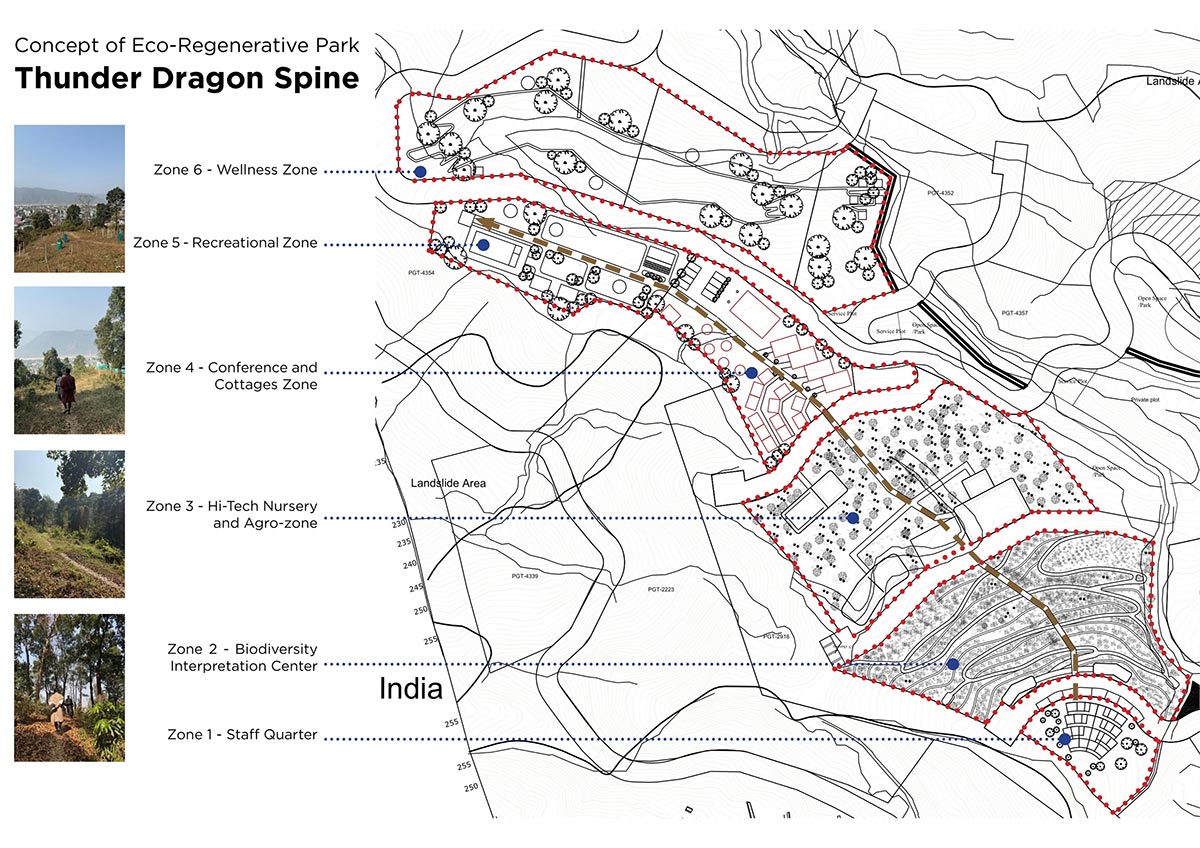
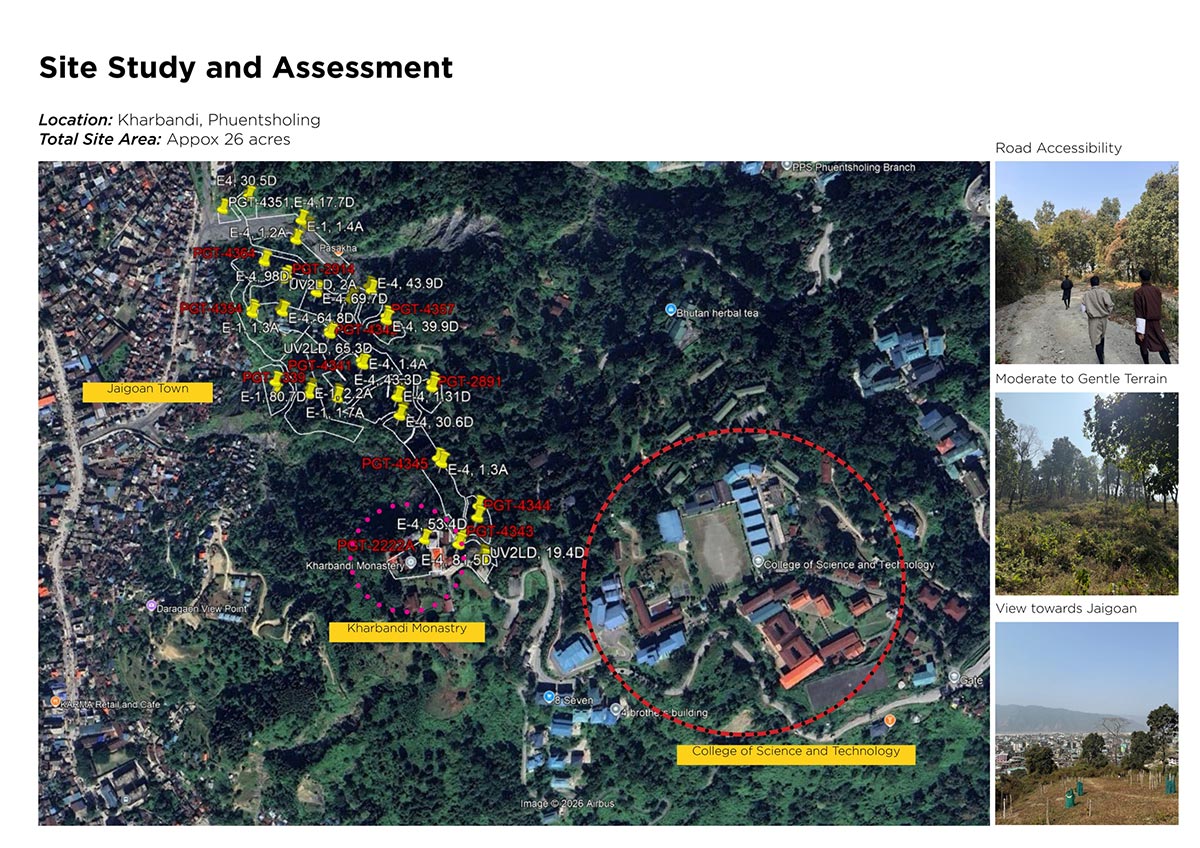
A central example was the planned Kharbandi/Rinchending Eco-Regenerative Park in Phuntsholing.
The approximately 26-acre (10.5 hectare) site is envisioned as much more than a conventional urban park. The concept brings together biodiversity conservation, recreation, environmental education, climate-smart agriculture, wellness and low-impact tourism, while also aiming to create employment, revenue and benefits for surrounding communities.
Its location makes the initiative particularly relevant from a municipal resilience perspective.
Phuntsholing lies directly on Bhutan’s southern border with India, adjoining the densely populated town of Jaigaon. The wider area is also exposed to both flooding and landslide risks. The Eco-Regenerative Park therefore responds to a context in which urban development, environmental pressures, climate risks and the need for accessible green spaces come together within a relatively constrained area.
The ambition is consequently not simply to create another green space, but to demonstrate how nature can become an active component of urban resilience, recreation, local economic development and quality of life.
At the same time, the model raises important practical questions. How can ecological restoration and commercial viability reinforce rather than undermine one another? How should benefits for nature and communities be measured? And how can local communities become active participants in the long-term development and management of such spaces?
From one park to wider municipal learning
BES is also exploring an Eco-Regenerative Park approach in Samdrup Jongkhar, opening a wider discussion about whether the concept could be adapted by other municipalities in Bhutan.
This became an important focus of the exchange.
Scaling up does not necessarily mean reproducing the same park in every municipality. Different places have different ecosystems, climate risks, communities, land-use pressures and development priorities. Instead, the experiences emerging from Phuntsholing and Samdrup Jongkhar could provide a set of transferable lessons and principles that other municipalities can adapt to their own circumstances.
Which elements can be replicated? What needs to remain locally specific? What technical capacities, partnerships and financing models are needed? And how can the experiences of early projects be documented so that other municipalities do not have to start from zero?
These are precisely the kinds of questions at the heart of the Connective Cities approach to municipal peer learning.
As an international community of practice for sustainable municipal development, Connective Cities brings together municipal practitioners, experts and partners to exchange concrete experiences, identify transferable approaches and jointly work on locally adapted solutions. Insight Sessions provide a flexible format for bringing emerging practices into this wider network and creating connections between practitioners working on similar challenges in different contexts.
The Bhutan session also built on Connective Cities’ wider exchange around Nature-based Solutions and municipal resilience. Through learning processes, Insight Sessions and peer-to-peer exchange, municipalities and practitioners from different regions have been sharing practical experiences on issues such as urban flooding, biodiversity, green-blue infrastructure, governance and the integration of NbS into municipal planning.
Connecting Bhutan with an international community of practice
The exchange therefore also looked beyond the individual projects presented.
Participants discussed where Bhutanese municipalities could benefit from international experience — for example in the areas of urban biodiversity planning, park governance, community participation, financing, green-blue infrastructure and long-term maintenance.
At the same time, the exchange highlighted that learning does not move in only one direction.
Bhutan’s experience of integrating environmental protection into its broader development philosophy, combined with emerging approaches such as Eco-Regenerative Parks, can offer valuable perspectives to municipalities elsewhere that are trying to rethink the relationship between urbanisation and nature.
One central message emerged from the session: urban development and environmental protection do not necessarily have to be opposing objectives.
As municipalities grow, nature can become part of their infrastructure, resilience and identity. The challenge is to move from individual green interventions towards approaches that combine ecological restoration with the social and economic needs of the people who live there.
For Connective Cities, the exchange with the Bhutan Ecological Society provides a starting point for further dialogue. As the Eco-Regenerative Park initiatives progress, the experiences and lessons emerging from their implementation could be shared with other municipalities in Bhutan and with practitioners across the wider Connective Cities network.
In this way, an emerging project in Phuntsholing can contribute to a much broader conversation: how municipalities can grow with nature rather than at its expense.

© © Rui T Guedes, iStock