

From Challenge to Practice: How Municipalities Turn Local Plans into Public Services
Connective Cities Lab at the UCLG World Congress 2026
Connective Cities participated in the United Cities and Local Governments (UCLG) World Congress 2026, held from 22–25 June in Tangier, Morocco. Under the overarching theme “A New Generation of Universal Local Public Services,” the Congress brought together more than 3,000 local and regional leaders, municipal practitioners, city networks and development partners from around the world.
As part of the Local4Action Track, Connective Cities, together with the Association of German Cities, organised the 90-minute Lab “From Challenge to Practice: How Municipalities Turn Local Plans into Public Services.”
From Planning to Implementation
The Lab addressed a challenge shared by municipalities worldwide: while local strategies and development plans are often well designed, translating them into effective, inclusive and sustainable public services remains a complex task. Rather than focusing solely on success stories, the session encouraged municipalities to share real implementation experiences, discuss practical challenges and learn from one another.
Gabi Schock from the City of Krefeld (Germany) opened the session with insights into strategic municipal waste management, demonstrating how citizen participation can become a key success factor in planning and implementing public services. Using Krefeld’s waste management strategy as an example, she illustrated how local government, political representatives, businesses and citizens were involved at an early stage of the planning process. The presentation showed that participation not only increases public acceptance of new measures but also helps integrate local knowledge into decision-making, identify potential conflicts early on and develop sustainable long-term solutions. Krefeld’s experience highlighted that successful municipal service delivery is built on transparent governance, continuous dialogue and trust-based cooperation with citizens.
The second case was presented by H.E. Governor Issa Timamy of Lamu County (Kenya), who introduced the Kiunga Solar-Powered Desalination Initiative. The project addresses the challenge of providing reliable access to clean drinking water in a remote border region. By using solar-powered desalination technology, Lamu County has not only improved water supply but also reduced dependence on fossil fuels and strengthened resilience to climate change. Governor Timamy emphasised that the initiative’s success was made possible through close cooperation between the County Government, local communities and development partners. The project demonstrates how integrated municipal planning can simultaneously contribute to improved public services, better health outcomes, social cohesion and local economic development. In recognition of these achievements, Lamu County received the UCLG Peace Prize, accompanied by prize money of €20,000.
The two presentations highlighted a common message: effective public service delivery is achieved where technical solutions are combined with good governance, active citizen participation and strong local partnerships.
Peer-to-Peer Consultation: Developing Solutions Together
The second half of the Lab shifted from presentations to collaborative problem-solving.
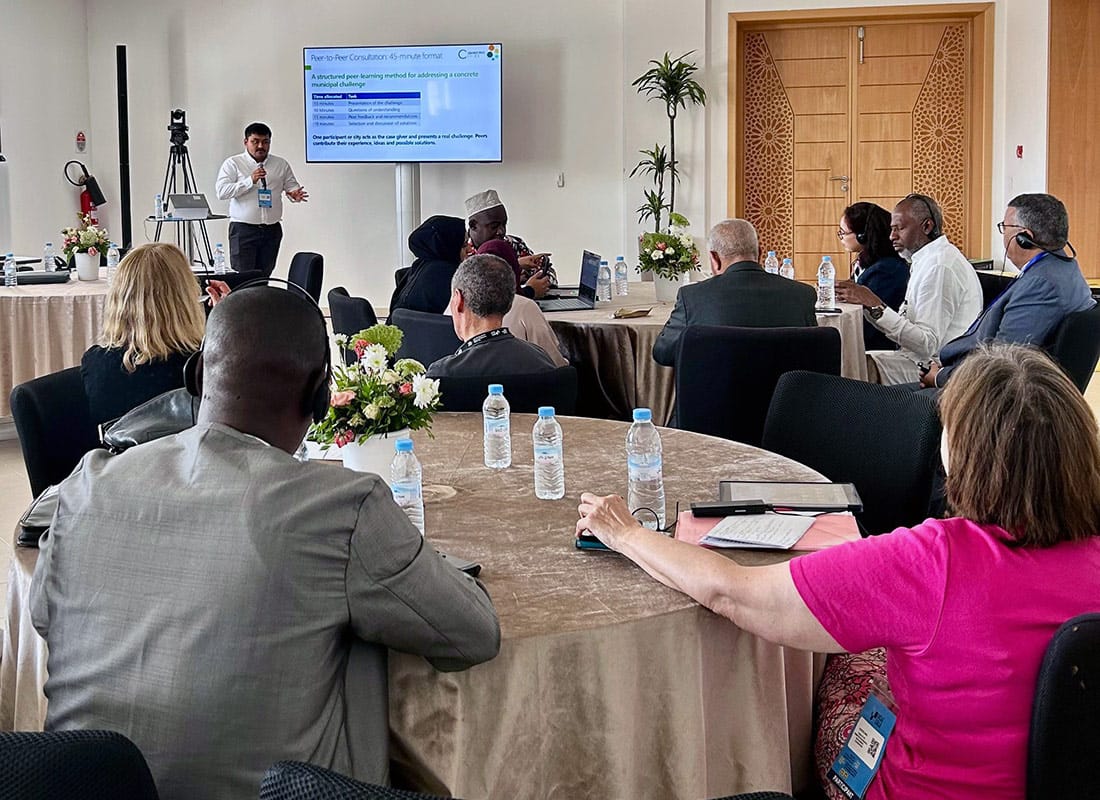
A representative of the Municipality of Pékine (Senegal) presented a real implementation challenge: complex procurement procedures, lengthy administrative processes and staff turnover were delaying infrastructure projects and slowing down municipal service delivery.
Participants jointly analysed the challenge during a facilitated Peer-to-Peer Consultation and developed a range of practical recommendations. Proposed solutions included:
- strengthening knowledge management to preserve institutional memory;
- developing clearer procurement roadmaps and process guidelines;
- improving coordination across municipal departments;
- establishing clear responsibilities and accountability mechanisms;
- promoting knowledge exchange with neighbouring municipalities;
- investing in continuous capacity development for municipal staff;
- creating databases of qualified service providers;
- introducing minimum quality standards for contractors and service providers; and
- assessing the political and institutional context at an early stage to identify opportunities for implementation.
The discussion demonstrated that municipalities across different regions often face remarkably similar implementation challenges. This is precisely where the Connective Cities approach creates value: structured municipal exchange enables practitioners to jointly develop practical solutions that can be adapted to their respective local contexts.
The Lab also illustrated how international municipal exchange can move beyond traditional good practice presentations. By openly discussing implementation challenges and working together to identify solutions, peer learning becomes a practical instrument for strengthening local public service delivery.
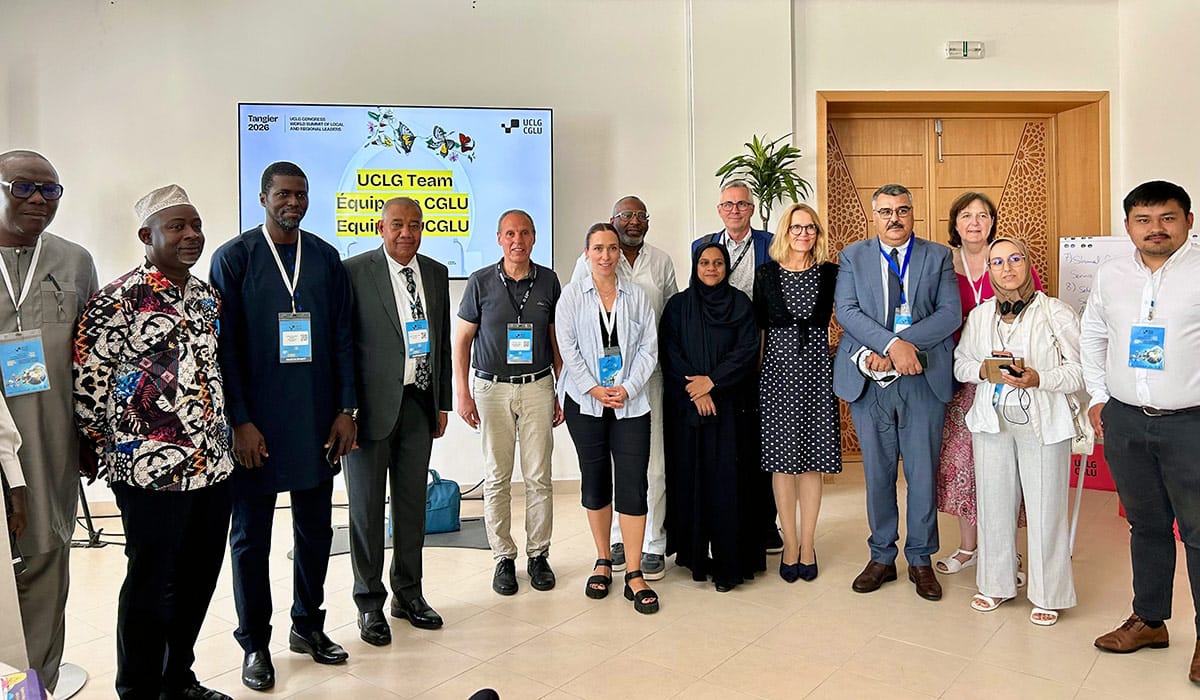
The Connective Cities team and participants in the Lab | Photo: Connective Cities
See also: Highlights of the UCLG World Congress

© Connective Cities | H.E. Governor Issa Timamy aus Lamu County (Kenia) die Kiunga Solar-Powered Desalination Initiative vor.