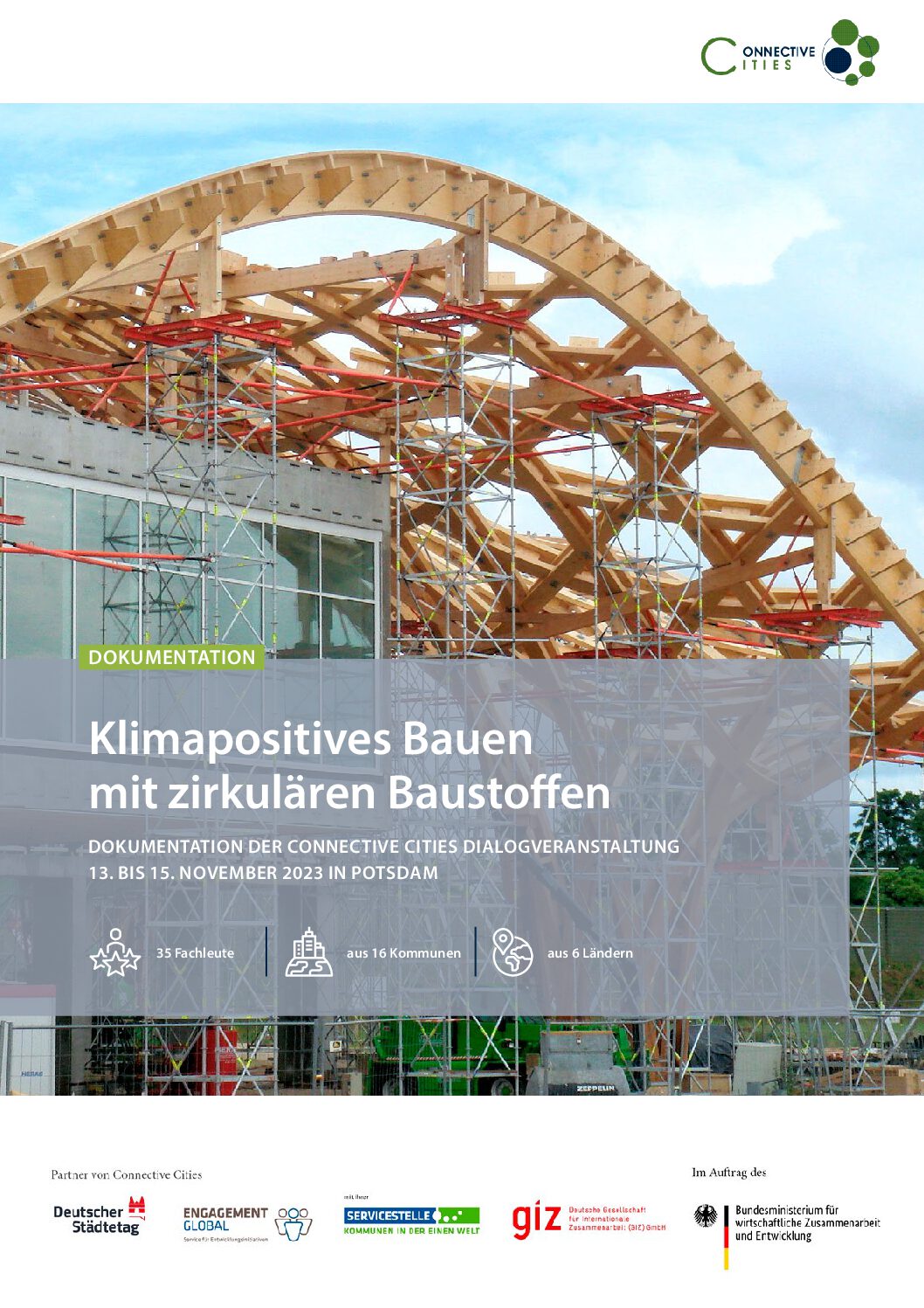
Climate-positive construction with circular materials

Demand for living space is growing around the world, particularly within cities, which makes the construction industry a major sector in every economy. However, producing and processing raw materials for construction are significant contributors to environmental damage and carbon emissions. The construction sector also uses a lot of energy (sometimes known as “grey energy”) not only when producing construction materials and during the building phase itself, but also while the building is operated for heating, cooling and electricity use. Organic materials such as wood and bamboo could play a vital role in decarbonising the construction industry.

More than 30 representatives of municipalities, academia, business and civil society gathered at the Potsdam Institute for Climate Impact Research from 13 to 15 November 2023 for an event hosted by Connective Cities and the city of Potsdam to share ideas and experiences about the transformation to climate-friendly construction. They presented their experiences from Bhutan, Germany, Indonesia, Nepal, South Africa and Tanzania, and developed ideas for specific local projects. While in Potsdam they visited examples of good practice, such as a wood-built nursery school and the construction site of a pavilion which is being built with organic and recycled materials.

This documentation provides insights into the conference content and results.

Further impressions can also be found on the conference website “Climate-friendly construction with organic and recycled materials

Eredvi Municipality (Georgia) grants renewable energy solutions for IDP settlements

Eredvi Municipality, located just five kilometers from Tskhinvali, has been navigating the challenges stemming from the 2008 Russian-Georgian War, remaining under the de facto control of the breakaway Republic of South Ossetia. Despite these challenges, the local government, operating from Tbilisi, has dedicated efforts to aid internally displaced families dispersed throughout Georgia.

The Eredvi Municipality’s Good Practices center on implementing sustainable solar power projects in internally displaced persons (IDP) settlements in eastern Georgia. Through a collaborative initiative with Lithuanian companies and financing, the municipality aims to address energy needs, providing free electricity to 692 families and municipal facilities while drawing inspiration from Lithuania’s successful experience in renewable energy solutions.

Banepa preserves traditional construction methods using bio-based materials

The historic town centre of Banepa in Nepal extends along a road for a distance of around 1.2 kilometres. Many of the houses have been in poor condition, making the town less attractive.

This good practice describes how the town of Banepa is restoring its historic centre and a retirement home using traditional construction methods. Bio-based building materials such as wood, bamboo, brick and clay are significantly more sustainable and earthquake-resistant than cement or concrete.

In order to allay the concerns of the local population, the municipality is first refurbishing one building to provide an example of the methods that will be applied to the others. It is working together with the Nepalese RP Foundation, which has over 25 years of experience in the renovation of historical buildings.

This good practice was presented at the Connective Cities dialogue event on climate-friendly construction with organic and recycled materials in Potsdam.

Involvement of civil society actors on both sides is crucial

Yarinacocha is located in the Ucayali region of the Peruvian Amazon. The city of around 100,000 inhabitants is close to the regional capital Pucallpa. 26% of Yarinacocha’s population live in poverty, 3.6% in extreme poverty. A large proportion of the urban population has no access to clean drinking water. All the district’s wastewater is discharged into the Ucayali River and the Yarinacocha Lagoon untreated. This has a negative impact on the environment, health, tourism, and economic development in the region.

To meet the increasing challenges of climate protection and climate change adaptation, the Yarinacocha district administration has developed an action program in collaboration with their German Partner City Cologne. This program includes the planning and implementation of improvement measures in areas such as the provision of municipal, climate and environmentally relevant basic services, the use of renewable energies, the preservation of biodiversity and local economic development through value chains. The district administration is working on building appropriate planning and project management capacities in the administration and establishing mechanisms to increase the participation of relevant interest groups from civil society, in particular indigenous actors, and universities, in local planning and decision-making processes. To support these objectives, an expert is supporting the district administration and the climate partnership between Yarinacocha and Cologne in the framework of the program “Experts fund for Municipal Partnerships Wordwide”, which is implemented by GIZ and SKEW.

In this good practice partnership-based cooperation with indigenous communities and their organizations as well as the commitment of political decision-makers are important success factors, e.g. to set up a center for indigenous medicine in Yarinacocha or to implement projects benefitting the indigenous population in the areas of local governance, biodiversity, and autonomous indigenous energy supply.

Developing a climate change strategy in-house

External consultants often develop climate protection strategies for municipalities, which then end up in the shelf because their implementation does not match the capabilities of the municipality, the measures are too costly or there is little ownership in the departments of the municipality. Kouga municipality was able to successfully conduct the in-house development of a climate strategy. They followed a cross-sectoral and multi-stakeholder approach, including various departments of the municipal administration. This was supported by a development advisor funded by the “Experts fund for Municipal Partnerships worldwide” between 2021 and 2023. It was a challenge to bring together and activate all these players and at the same time gain political support, but eventually this approach enabled an integrated and therefore feasible strategy.

The climate change strategy consists of three implementation lines. The first line focuses on mainstreaming climate change into the municipal management, the second line talks to responses to main climate change vulnerabilities and the third line lists short-term measures that were identified through the process. Several of these are already being implemented now such as tree planting and dune rehabilitation.

The Development of Covid-19 recovery solutions at municipal level in the area of digitalisation and crisis management in the Southeast European region (SEE)

This report summarizes the activities developed under the project “The Development of COVID-19 Recovery Solutions at Municipal Level in the Areas of Digitalization and Crisis Management.” The project covered Southeast Europe and was conducted from September 2021 until December 2021.

The Report describes in detail the capacity-building processes conducted to support municipal resilience within the working groups of digitalization and crisis management over the course of several months, while also highlighting good practices that were identified and small urban initiatives that were developed together during the collaboration with urban practitioners from across the SEE region.

Additionally, the report covers processes and steps undertaken to support the expansion of the Connective Cities Network through encouraging more active and practical involvement of its current and new members.

For presentations and explanatory videos please refer also to

Development of Covid-19 recovery solutions at municipal level in the area of digitalisation 

Development of Covid-19 recovery solutions at municipal level in the areas of Crisis Management

Toolbox citizen engagement for sustainable mobility planning and implementation

The success of sustainable mobility plans and projects often depends on the commitment and acceptance by citizens. Therefore, citizen engagement in planning and implementation of sustainable mobility in municipalities turns out to be a key success factor not only for impactful implementation of new concepts, but also for co-creating smart sustainable mobility measures. This happens when solutions are developed together with stakeholders.

Due to the consequences of the pandemic citizen engagement is limited or impossible. This can endanger the success and/or slowing down necessary sustainable mobility projects. For this reason, the Connective Cities working group «Sustainable Mobility after COVID-19» created a prototype for «Toolbox citizen engagement for sustainable mobility planning and implementation».

The toolbox covers different levels and degrees of participation. It is a collection of successful tools and roadmaps that can be used in different phases of sustainable mobility planning and implementation in and after the pandemic.

Municipal Response to the Covid-19 Pandemic – MENA region

In the wake of the Pandemic, municipalities in the MENA region in both urban and rural areas need to rethink their modes of operation and accelerate their shift towards building resilience during the recovery process. In an effort to support municipalities that are members of the Connective Cities network in the MENA region, four thematic working groups were established as part of Connective Cities program ‘Municipal Recovery from the Pandemic.’ Objectives of this working group include promoting practice–oriented knowledge exchange between municipal and urban practitioners, facilitating peer learning on sustainable and innovative approaches to build resilience in cities through biodiversity and environmental protection, digitalisation of municipal services, and promoting social entrepreneurship for circularity. The program has resulted in the development of concrete urban solutions. Another outcome was the creation of partnerships between municipalities as well as with private sector actors to articulate the proposed solutions and scale up the impact. This report summarizes the main achievements until February 2022.

Urban Gardening Guidebook

From July to December 2020, an initial intensive global programme on ‘municipal response to the pandemic’ was conducted by Connective Cities that has been augmented with the programme ‘municipal recovery from the pandemic’ starting August 2021. The working group “Biodiversity and Environmental Protection” was the first group to be established as part of this programme.

This Guidebook is one result of an extensive exhange. It explains,  why Urban Gardening Matters? and guides the reader through all steps of an urban gardening project – from the first situational analysis, over the preparatory and implementation phase up to a final monitoring and evaluation.

Unturning the Stones – Exploring Climate Finance for Asian Cities

In the event 25 urban practitioners and experts from 6 countries exchanged on innovative and efficient financing approaches to build climate resilient and low-carbon cities. They were united by the fact that all of them are working at the forefront of climate change mitigation and adaptation measures in their cities. The event was jointly organised by Connective Cities, TURBOCLIC (Transformation – Urban Opportunities – Climate Change), an initiative from GIZ’s sector networks TUEWAS (Transport Environment Energy and Water in Asia) and SNGA (Governance Asia).

Further information, presentations and impressions