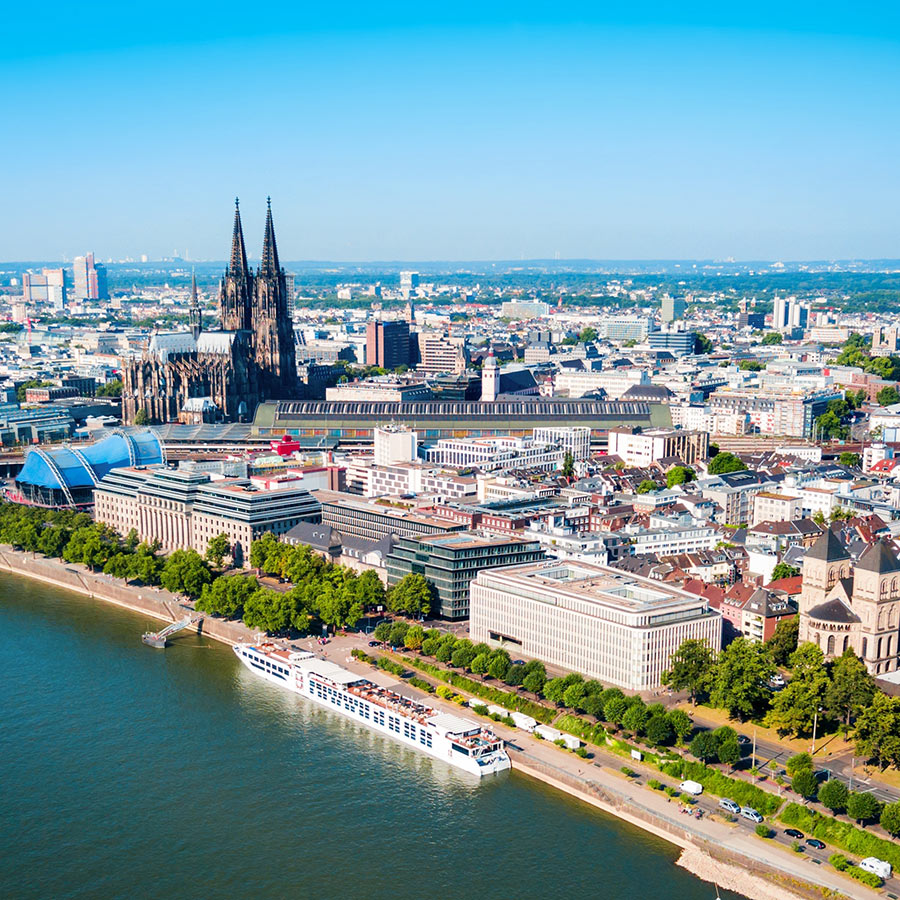
From 14 to 16 September 2026, the 19th Federal Congress on National Urban Development Policy will take place in Cologne. The theme is “Act together, act faster, think further: shaping cities for everyone”. This event will bring together stakeholders from local governments, politics, public administration, academia and civil society to discuss innovative approaches to sustainable, resilient and forward-looking urban development.
For the first time this year, Connective Cities will have a stand at the event run by the Service Agency Communities in One World (SKEW). The congress offers an excellent opportunity to raise the profile of the international city network and its services for facilitating professional exchanges between local authorities. We will be focusing on discussions with local authority experts from the fields of urban development, mobility, climate adaptation and sustainable transformation.
At the SKEW stand, we particularly want to show experts what Connective Cities has to offer and discuss potential opportunities for participation and cooperation. We will also present selected examples of good practice from the relevant specialist areas, as well as the Connective Cities Media Centre as a knowledge platform. We warmly invite network members attending the Federal Congress to take this opportunity to speak to the team at the stand. We look forward to exchanging ideas, making new contacts, and generating new impetus for municipal development cooperation.
Connective Cities participated in the United Cities and Local Governments (UCLG) World Congress 2026, held from 22–25 June in Tangier, Morocco. Under the overarching theme “A New Generation of Universal Local Public Services,” the Congress brought together more than 3,000 local and regional leaders, municipal practitioners, city networks and development partners from around the world.
As part of the Local4Action Track, Connective Cities, together with the Association of German Cities, organised the 90-minute Lab “From Challenge to Practice: How Municipalities Turn Local Plans into Public Services.”
From Planning to Implementation
The Lab addressed a challenge shared by municipalities worldwide: while local strategies and development plans are often well designed, translating them into effective, inclusive and sustainable public services remains a complex task. Rather than focusing solely on success stories, the session encouraged municipalities to share real implementation experiences, discuss practical challenges and learn from one another.
Gabi Schock from the City of Krefeld (Germany) opened the session with insights into strategic municipal waste management, demonstrating how citizen participation can become a key success factor in planning and implementing public services. Using Krefeld’s waste management strategy as an example, she illustrated how local government, political representatives, businesses and citizens were involved at an early stage of the planning process. The presentation showed that participation not only increases public acceptance of new measures but also helps integrate local knowledge into decision-making, identify potential conflicts early on and develop sustainable long-term solutions. Krefeld’s experience highlighted that successful municipal service delivery is built on transparent governance, continuous dialogue and trust-based cooperation with citizens.
The second case was presented by H.E. Governor Issa Timamy of Lamu County (Kenya), who introduced the Kiunga Solar-Powered Desalination Initiative. The project addresses the challenge of providing reliable access to clean drinking water in a remote border region. By using solar-powered desalination technology, Lamu County has not only improved water supply but also reduced dependence on fossil fuels and strengthened resilience to climate change. Governor Timamy emphasised that the initiative’s success was made possible through close cooperation between the County Government, local communities and development partners. The project demonstrates how integrated municipal planning can simultaneously contribute to improved public services, better health outcomes, social cohesion and local economic development. In recognition of these achievements, Lamu County received the UCLG Peace Prize, accompanied by prize money of €20,000.
The two presentations highlighted a common message: effective public service delivery is achieved where technical solutions are combined with good governance, active citizen participation and strong local partnerships.
Peer-to-Peer Consultation: Developing Solutions Together
The second half of the Lab shifted from presentations to collaborative problem-solving.
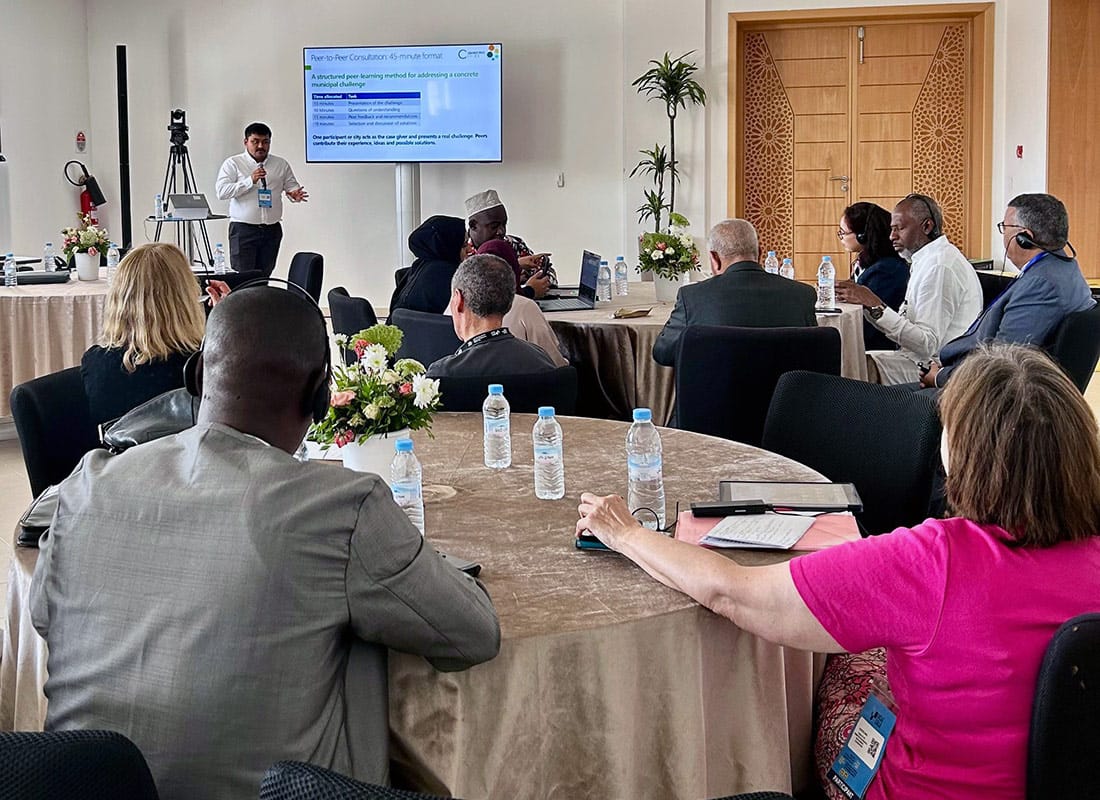
An Introduction to the Peer-to-Peer Consultation Methodology | Photo: Connective Cities
A representative of the Municipality of Pékine (Senegal) presented a real implementation challenge: complex procurement procedures, lengthy administrative processes and staff turnover were delaying infrastructure projects and slowing down municipal service delivery.
Participants jointly analysed the challenge during a facilitated Peer-to-Peer Consultation and developed a range of practical recommendations. Proposed solutions included:
strengthening knowledge management to preserve institutional memory;
developing clearer procurement roadmaps and process guidelines;
improving coordination across municipal departments;
establishing clear responsibilities and accountability mechanisms;
promoting knowledge exchange with neighbouring municipalities;
investing in continuous capacity development for municipal staff;
creating databases of qualified service providers;
introducing minimum quality standards for contractors and service providers; and
assessing the political and institutional context at an early stage to identify opportunities for implementation.
The discussion demonstrated that municipalities across different regions often face remarkably similar implementation challenges. This is precisely where the Connective Cities approach creates value: structured municipal exchange enables practitioners to jointly develop practical solutions that can be adapted to their respective local contexts.
The Lab also illustrated how international municipal exchange can move beyond traditional good practice presentations. By openly discussing implementation challenges and working together to identify solutions, peer learning becomes a practical instrument for strengthening local public service delivery.
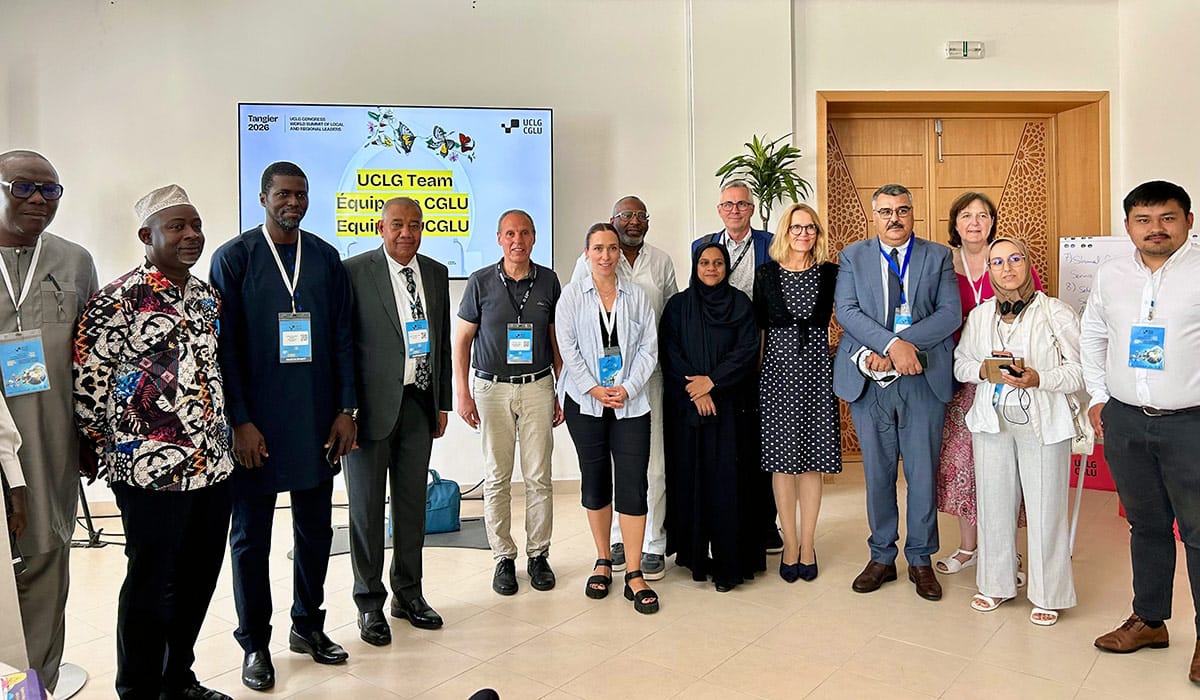
The Connective Cities team and participants in the Lab | Photo: Connective Cities
How can municipalities translate strategies and local development plans into effective public services? This question lies at the heart of the Connective Cities Lab “From Challenge to Practice: How Municipalities Turn Local Plans into Public Services”, organised in cooperation with the Association of German Cities.
Municipalities around the world face similar challenges when implementing local development plans. In this Lab, municipal representatives from different regions will share practical experiences: What obstacles had to be overcome? Which approaches proved successful? And what lessons can be adapted to other local contexts?
Following a series of short case presentations, participants will engage in a moderated peer-to-peer exchange to discuss challenges and jointly explore practical solutions for effective local public service delivery.
Objectives of the Lab
Exchange experiences on challenges related to local public service delivery
Share practical and transferable implementation approaches
Promote international networking and peer learning
We look forward to welcoming municipal practitioners, experts, and partner organisations from around the world.
Participation: The Lab will take place exclusively in person as part of the UCLG World Congress 2026. All participants and speakers must register through the official Congress registration system: https://registration.uclgcongresstangier2026.com/
How can AI-generated images help municipalities discuss affordable housing and informal settlement upgrading – without losing sight of implementation challenges?
At the World Urban Forum 13 (WUF13) in Baku, Connective Cities will contribute to the official WUF Academy programme with an interactive event on AI-based visualisation for affordable housing and informal settlement upgrading. The event will take place on 21 May 2026, from 09:30 to 11:30 Baku time (UTC+4).
Organised by the German Association of Cities in cooperation with Connective Cities and the participating municipalities, the event brings together urban practitioners from different regions to work with real urban cases and explore how digital visualisation can support dialogue, participation and peer learning.
About the event
The format builds on the recent Connective Cities working group exchange on affordable housing, including an AI-based visualisation exercise under the umbrella of the New European Bauhaus.
At its core is a practical city exchange: participating municipalities and institutions provide images of selected housing areas, informal settlements and urban transformation sites. WUF participants will work in groups with these prepared cases and use AI-generated visual scenarios as analytical and dialogue-oriented tools — not as final planning products or implementation promises.
The focus is not on the technology itself, but on the urban development questions that the images make visible. How are housing needs, affordability, density, land use, public space, infrastructure and social inclusion negotiated in different contexts? How can visual scenarios support communication between city administrations, communities, technical experts and decision-makers?
The event will also address the limits and risks of AI-supported visualisation. In the context of affordable housing and informal settlement upgrading, attractive images alone are not enough. They need to be linked to questions of financing, operation, maintenance, climate resilience, land ownership, social safeguards and clear implementation responsibilities.
The format was developed and coordinated by Jelena Karamatijevic, Connective Cities, as part of the Connective Cities peer-learning approach.
The event will be moderated by Prof. Hilmar von Lojewski, Association of German Cities. The practical AI exercise will be facilitated by Damiano Cerrone, co-founder of CoPlan AI.
In addition, the GIZ Sustainable Urban Development Programme in Santa Cruz, Bolivia, represented by Ruvi Suárez, will contribute a short methodological reflection on AI-supported scenario thinking and impact assessment.
City exercise examples
Selected examples from the city exercises show how real urban situations can be translated into AI-supported visual scenarios for discussion, reflection and peer learning.
The Academy event will include practical city examples from:
Nairobi City County / Kenya – Godfrey Ngugi, Director of Urban Renewal
Huye District / Rwanda – Richard Ndicunguye, Senior Advisor / Adaptation and Green Cities
Mariental Municipality / Namibia – Sunday Haimbodi, Building Inspector
Urban Development Fund, Egypt / Cairo – Dr. Marwa Ahmed, General Manager, International Cooperation and Community Participation Department
Hebron Municipality / Palestine – Husam Shweiki, Head of the Architecture Department
Berlin Senate Department for Urban Development, Building and Housing / Germany – Lars Loebner
In times of multiple crises, cities must become increasingly resilient. They are increasingly under pressure due to war, the climate crisis, and economic uncertainties. At the seventh German-Ukrainian Municipal Partnership Conference on 18 June 2025, Connective Cities will host an expert forum on the topic of ‘Resilient cities in times of multiple crises – strategies for resilient municipalities’.
The expert forum will examine and classify aspects of resilient urban development in Ukrainian and German municipalities. Christian Rauch from the Federal Institute for Research on Building, Urban Affairs and Spatial Development (BBSR) will present the concept of urban resilienceand report on the ‘city stress test’ with German municipalities. How does urban resilience manifest itself in practice? Invited panelists from German and Ukrainian municipalities will use visual material to present their strategies for sustainable urban development on a wide range of aspects of urban resilience. Led by the moderator, the audience will also be involved in the subsequent panel discussion.
The seventh German-Ukrainian municipal partnership conference will take place in Münster from 16 to 18 June 2025. It is directed at local government representatives and other committed individuals from the German-Ukrainian municipal partnership network and offers space for professional and personal exchange, insights into support services, as well as expert forums and panel discussions on pressing current issues. More information on the partnership conference can be found here.
Since the Russian aggression in Ukraine, relations between Germany and Ukraine have intensified. On 18 November 2024, the state of North Rhine-Westphalia organised a conference on cooperation with Ukraine in cooperation with the city of Cologne. The aim of the conference was to network North Rhine-Westphalian and Ukrainian stakeholders from state and local government, business, civil society and academia. The focus was on the question of how horizontal cooperation can contribute to strengthening Ukraine’s resilience, reconstruction and EU integration. The regional partnership between North Rhine-Westphalia and the Dnipropetrovsk Oblast was a particular focus.
With 300 German and 100 Ukrainian guests, the conference was a success. It was officially opened by the Minister President of North Rhine-Westphalia, Hendrik Wüst, and the Mayor of Cologne, Henriette Reker.
Under the notion ‘initiate change from home: locally, together, and now’, WUF12 was convened in Cairo- Egypt on 4 – 8 November 2024. Connective Cities and its network members have organized and participated in several activities with various thematic focus areas.
As a thriving knowledge-sharing network, Connective Cities was showcased during an intellectual panel that included representatives of the Guangzhou Institute for Urban Innovation, VNG International, the Arab Urban Development Institute, and Metropolis. The discussion delved into examples of utilizing digital tools and innovative approaches for growth and collaborative knowledge-sharing to advance inclusive and resilient urban development on a global scale.
Tbilisi, June 7th – Connective Cities Southeast Europe convened a parallel session during the Local Economic Development (LED) Forum in Tbilisi, focusing on “Renewable Energy Options at the Municipal Level.” This session provided a platform for mayors from Georgian municipalities, including Senaki, Eredvi, and Khoni, to exchange insights, challenges, and innovative approaches in advancing renewable energy initiatives within their jurisdictions. Furthermore, Dr. Irakli Samkharadze, Energy Advisor of Omnia, provided insights into the European Green Deal and its implications for municipalities, enriching the discussion with a broader perspective on sustainable energy transitions.
The Mayor of Senaki Municipality shared notable advancements, including the integration of renewable energy sources into municipal buildings and the installation of solar panels across various locations to raise awareness and support action plans aligned with the Covenant of Mayors.
On 13 February 2024 the GIZ projects “Connective Cities” and “International Smart Cities Network (ISCN)” held a side event titled “Smart Connected Cities: Harnessing Ecosystem Potential for Digitalization”. It took place alongside the main event of “Data-Driven Cities: Conference for the Urban Common Good” held in Nairobi and online 12 & 13 February 2024. The side event brought together 21 representatives from cities represented at the main conference, among them the Kenyan cities Nairobi, Kisumu, Mombasa and Wote Municipality, Munich, Berlin, and Enzkreis from Germany, as well as Cape Town, Johannesburg, and Ekurhuleni from South Africa.
Cities were able to exchange in a more intimate surrounding on their digitalization journey. Following initial presentations from Berlin on their Smart City strategy Gemeinsam Digital: Berlin (Together Digital: Berlin) and from Munich on its’ urban planning challenges undergirding Smart City efforts, a vivid discussion emerged on common challenges but also differing perspectives.
Together with the Connective Cities, the Association of German Cities organized a side event in the German Pavilion at the COP28 World Climate Conference in Dubai on the question of “What solutions are there for sustainable and decentralized energy generation and supply at local level”. On 6 December at 2 p.m. local time, representatives from German and African cities (Cologne, Bonn, eThekwini and Abuja) discussed their local innovations for climate-friendly energy solutions.
In her keynote speech, Katja Dörner, Vice-President of the German Association of Cities, Mayor of Bonn, and ICLEI Co-Chair for Climate Action, emphasized the importance of a socially just and participatory approach to a climate and energy transition. She emphasized that the voice of cities in climate negotiations is essential to achieve global goals.
She showed how the city of Bonn can achieve climate neutrality by 2035 and called on the federal level to make swift changes to support the local level. The EU and the German federal level must create the framework for a climate-friendly energy transition. She again emphasized the importance of making climate protection and adaptation a mandatory task for local authorities.