Startups and entrepreneurship offer young people opportunities to secure their livelihoods and advance their careers, while also serving as crucial factors for the well-being of local communities and for local economic development.
Municipalities play a central role: They engage in networking with stakeholders, provide advice and support to founders, provide infrastructure and resources, and facilitate access to funding or contacts with investors. In short, they create a founder-friendly climate and ecosystem at the local level.
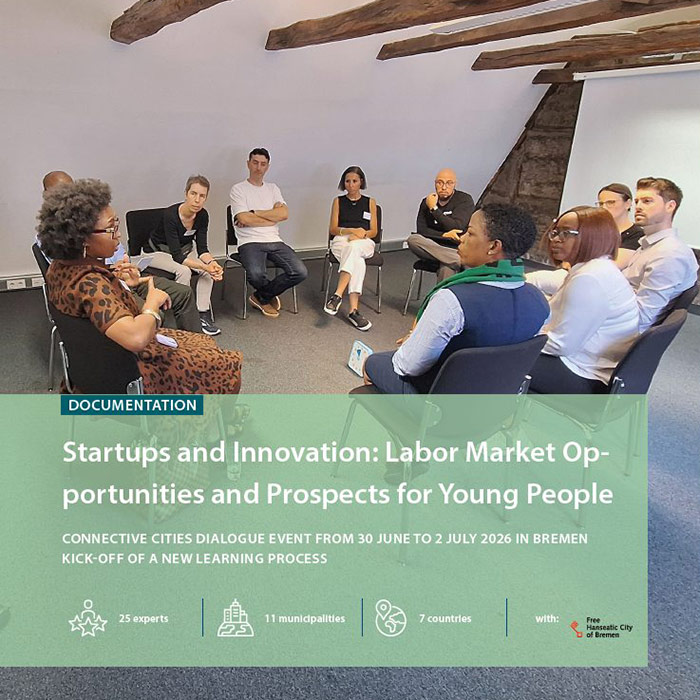
From 30 June to 2 July 2026, around 25 experts from 11 local authorities and seven countries gathered in Bremen to exchange experiences, learn from one another, and develop new approaches together. The focus was on the opportunities that start-ups and entrepreneurship offer for employment, economic development, and the social inclusion of young people. Despite their different circumstances, many municipalities worldwide face similar challenges, such as a lack of role models and networking opportunities, bureaucratic hurdles, and inadequate infrastructure. However, 13 examples of good practice also demonstrated how these challenges can be overcome. The event marked the launch of a new Connective Cities learning process. Take a look at our comprehensive documentation!
When electricity fails, water pumps stop working. When communication networks are disrupted, emergency response slows down. Critical infrastructure is interconnected—and so are the risks municipalities face.
Across South Eastern Europe and the South Caucasus, municipalities are increasingly confronted with complex and interconnected risks. Climate change, ageing infrastructure, cyber threats and geopolitical instability are placing growing pressure on the systems that provide essential public services.
To support municipalities in addressing these challenges, Connective Cities launched the regional learning process Planning for Municipal Resilience: Safeguarding Critical Infrastructure through Risk-Informed Development.
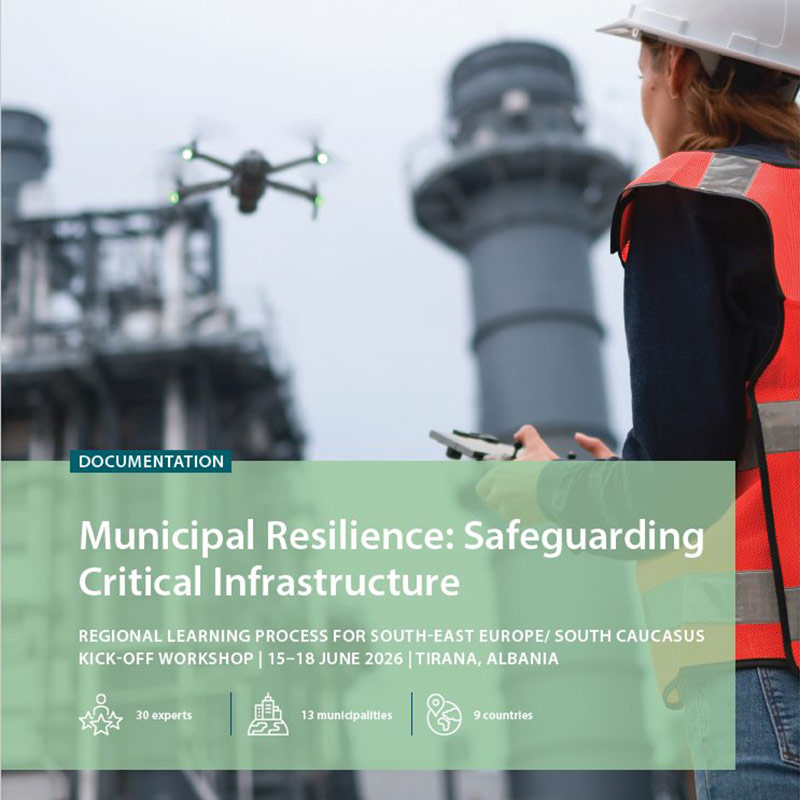
At the kick-off of the regional Connective Cities Learning Process in Tirana, 30 experts from 13 municipalities and nine countries worked together to identify local vulnerabilities and develop practical solutions. The result: eleven municipal action plans – ranging from backup power and digital infrastructure monitoring to flood prevention, crisis communication and new approaches to municipal coordination.
What challenges do municipalities share, what solutions are they developing – and what can other local governments learn from them? Read more in this full documentation.
On July 8th, 2026, Connective Cities hold an online Insight Session to explore ways, by which urban forests can be cultivated under difficult climate conditions. Attempts to do so are notoriously difficult in dry regions with high temperatures and low precipitation, where the usage of scarce water resources has to be distributed between (urban) populations, local businesses, agriculture and industry. Planting and watering urban trees is regularly considered secondary under such circumstances, leading to unsuccessful attempts of urban afforestation due to a lack of financial support and maintenance work. The Insight Session was joined by 34 participants from 13 countries, representing a broad range of municipalities from Africa and the Middle East.
Over the past decades, the Miyawaki-method of planting tiny forests has become an outstanding success story around the globe. In this technique developed by Japanese botanist Akira Miyawaki, a small dense forest is made from native trees and plants. The specifically dense way of planting a miscellany of indigenous plants accelerate the growth of flora and fauna, so that after around five years, micro forests may already be entirely self-sustaining. The forests improve air quality, reduce heat and bring back lost biodiversity, thereby stabilizing ecosystems and countering the environmental degradation as a result of the climate crisis. A videographic overview of the Miyawaki-Method can be found here.
Stefan Scharfe, speaking on behalf of Miya-Forest, a forest-planting/educating/researching NGO based in Eberswalde, Germany explained the success of the Miyawaki method through the instance, that planting trees is usually broadly accepted among a range of actors such as urban populations, housing providers and local administrations. However, the participatory approach of planting urban micro forests must be facilitated through a small group of core actors who take ownership of the project. Especially a thorough soil study can significantly increase the chances of the micro forests to become self-sustainable after an initial, intense phase of watering and caring.
Coming from the highly urbanized and biodiversically degraded context of Amman, Jordan’s Capital, Deema Assaf from the ecological research studio TAYYŪN joined the Insight Session as a second speaker, providing the participants with valuable hands-on insights from the MENA region. Mrs. Assaf elaborated on the tedious work with paleobotanists to collect evidence of indigenous species from the region, proven evolutionary resilient towards the local climate conditions. The seeds of these plants known to the soil form the base for a multi-layered ecosystem featuring canopy, sub-canopy, shrubs and ground cover tiers. Over the course of its growth, the micro forest attracts insects, mushrooms and birds. Also edible plants may be included, turning micro forests into sites of (urban) gardening.
In result, the Insight Session provided the participants with new inspiration for their own project development within the scope of the currently running Connective Cities learning processes on ‘Nature at the Heart of Municipal Resilience’ and ‘Green Corridors in the City and its Surroundings’. The potential of the Miyawaki Method to produce fast and self-reinforcing benefits through various ecosystem services and according to the local circumstances makes urban micro forests a tangible and fitting intervention in the current situation of intensifying climate crisis. However, forestry-related preparation – i.e. soil data and seedlings –, as well as institutional backing, secured funding and maintenance of the planting project are key elements for micro forests to thrive.
Connective Cities provides the network for future engagement on the topic and looks forward to share expertise among urban practitioners
Kisumu, a port city on the shores of Lake Victoria and one of Kenya’s largest cities, is becoming increasingly important for the movement of goods and trade between Kenya and its neighbouring countries, Tanzania and Uganda. With an annual population growth rate of just under 4 per cent, the population has more than doubled in 15 years, rising from around 205,000 in 2001 to at least 422,000 in 2025. This has led to a series of major infrastructure projects, which, however, have primarily focused on motorised transport, even though 53 per cent of residents’ daily journeys are made on foot.
One project under the ‘Kisumu Sustainable Mobility Plan’ is the ‘Walkable Triangle’: the pedestrian-friendly redesign of the three main streets—Oginga Odinga, Ang’awa Ave and Jomo Kenyatta Ave—in a commercial district in the city centre. These streets form a triangle around a sports and park area and are used by over 2,200 pedestrians every day. The aim is to promote non-motorised transport along the 1.5-kilometre stretch, making it safer, more pleasant and accessible, whilst preserving and integrating the existing tree population.
In addition, the city is promoting e-mobility in public transport through a battery-swapping system for motorcycle taxis, known as ‘boda-bodas’, and three-wheeled taxis, known as ‘tuk-tuks’.
The documentation describes the approach as well as the outcomes achieved by this good practice.
Migration policy may be a national matter – however, its success or failure is also determined at the local level. Convinced by this, around 50 local government professionals came together for a virtual Insight Session organised by Connective Cities. The focus was on the question of what role municipalities can play in the immigration of skilled workers and in supporting migrant entrepreneurship.
In addition to a study by the German Institute for Employment Research IAB, practical examples from the German Pinneberg District, Mersin (Türkiye) and Oberhausen (Germany), Munich (Germany) and Gharb Irbid (Jordan) formed the basis of in-depth working group discussions. These clearly demonstrated that local governments can play a crucial role in realising the economic potential of migration at the local level.
For over a year, more than 30 experts from six countries worked as part of Connective Cities‘ learning process ‘2nd Hands on Public Buildings. Repurposing Modernist Public Buildings from the 1960s and 1970s ’ on solutions for aging public buildings from the 1960s and 1970s. How can they be sustainably reused or repurposed instead of being demolished? At four events and two working meetings between September 2024 and September 2025, they learned about current trends in this area, deepened their knowledge, heard details about possible solutions from external experts, and inspired each other with their respective experiences, approaches, and ideas.
But the participants didn‘t just exchange ideas, they also took action. They further developed the project ideas they presented at the dialogue event in Berlin in September 2024 or, in some cases, implemented them directly, taking up suggestions from the other participants. The innovative and very diverse projects impressively demonstrate the potential of the paradigm shift away from rapid demolition toward well-thought-out reuse and conversion.
The documentation provides insights into the key findings.
The Final Event of the Connective Cities Learning Process in Southeast Europe brought together municipalities, donors, and technical experts in Podgorica to accelerate the region’s transition toward sustainable, renewable energy solutions. Over three dynamic days, participants exchanged practical insights, pitched municipal project concepts, engaged directly with financing institutions, and visited a completed energy-efficiency project in Cetinje. The workshop marked the culmination of nearly two years of collaboration, equipping cities with clearer financing pathways, stronger partnerships, and concrete next steps for turning their renewable energy ambitions into implementable, fundable projects.
On a voluntary basis, more and more municipalities are reporting on the implementation status of the 2030 Agenda‘s Sustainable Development Goals (SDGs) at the local level in so-called Voluntary Local Reviews (VLR) or Voluntary Sub-National Reviews (VSR) at the regional level. These serve as a supplement to the national reports (VNRs) of governments and are presented each year at the United Nations High-Level Political Forum (HLPF) in New York. This leads to greater visibility for the local level regarding the international level and highlights its central role in implementing the SDGs. However, in many countries, there is more talk about local governments at the national level than with them when it comes to developing national sustainability strategies. Yet it is at the local level that over 65% of the SDGs are implemented (or not).
At the beginning of December 2024, Connective Cities therefore launched a learning process on sustainable reporting at the local and regional level. The aim was to improve the preparation of VLRs and VSRs through an international exchange of experiences, accelerate the implementation of the SDGs, and ultimately promote dialogue between the local, regional, and national levels. For the first time, representatives of municipal associations consulted with their colleagues from city administrations in a dialogue event organized by Connective Cities. Regional diversity, with perspectives and practical examples from South America, sub-Saharan Africa, Germany, Southeast Europe, and Asia, vividly fuelled the discussion and contributed to the success of the process.
Local governance plays a critical role in advancing climate action across the MENA region, where cities and municipalities are increasingly at the frontline of responding to climate-related challenges such as water scarcity, extreme heat, and urban vulnerability. Despite national climate strategies, local authorities often face limited financial and technical capacities to implement sustainable solutions. However, there is growing recognition of the need to decentralize climate governance by empowering municipalities with the tools, knowledge, and resources to plan and implement locally tailored climate initiatives. Collaborative efforts—such as regional networks, peer-learning platforms, and partnerships with civil society and the private sector—are helping to strengthen local capacities and foster more inclusive, participatory approaches to climate resilience in urban and rural settings alike. Against this background, Connective Cities has organized on the 13th October 2025 an insight session to showcase good practices and achievements from municipalities in the MENA region in this field.
Planning framework for municipal heat adaptation in Aswan| Photo: Connective Cities
Dr. Marwa Ahmed (General Manager of International Cooperation and Community Participation at the Urban Development Fund in Egypt), presented the good practice ‘Integrated Heat Action Framework Development in Aswan, Egypt’, where the Urban Development Fund partnered up with Aswan governorate to channel its institutional knowledge while putting together fragmented parts that will form the base for an Integrated Heat Action Framework in Aswan. The aim was to 1) establish a core working group with the most relevant departments to be involved in the process of developing a heat action plan, and 2) develop the general framework and select a zone for piloting. International experiences showcased and discussed as part of the deep dive were adapted to serve in the local context. Capitalizing on the local native knowledge in Aswan on climate-responsive design and construction methods, the local building codes will be reviewed and modified. The general framework includes measures for 1) adaptation planning and implementation, 2) preparedness, communication, and workers’ safety, 3) built environment, infrastructure, and managed spaces, and 4) ecosystem-based adaptation.
Voting for area prioritization and selection was conducted and resulted in choosing “Elsail Elgadida” as a pilot area. Initial needs assessment meetings with local residents revealed a myriad of urban challenges, among which is the lack of safe public spaces. Accordingly, it was suggested to designate one of the districts numerous wide streets to this purpose by converting it into a pedestrian-only area and rehabilitating it with tree planting, shading elements and urban furniture. Local residents expressed their willingness to collaborate by watering the planted trees.
Assessment of pedestrian-friendliness in Constantine | Photo: Connective Cities
Mr. Al-Hani Maghzi (representative of Constantine municipality-Algeria) presented the initial results and roadmap for improving walkability and transitioning into transit-oriented development in Constantine. He showcased the multi-stage roadmap that incorporates a wide range of procedures that are categorized as structural (e.g. review of mobility plan), comprehensive (e.g. reducing car use, widening sidewalks, reorganizing parking spaces) and priority actions (transforming the city center into a pedestrian-friendly area). He concluded his presentation with the statement that green and liveable cities prioritize pedestrians over vehicles.
In conclusion, the examples showcased how decentralized cooperation supports knowledge exchange, strengthens global partnerships, and drives innovation in local climate adaptation and climate protection efforts. Through the resulting lively discussion, the participants were provided with actionable insights and tools for municipalities to integrate climate resilience into local planning, infrastructure, and service delivery while ensuring social equity and long-term environmental sustainability.
Cities play a dual role in climate change—they are both major contributors to it and highly vulnerable to its impacts. This dynamic creates a feedback loop that exacerbates urban challenges, where urban contributions to climate change worsen the very risks that urban centers face. As cities worldwide experience the impacts of climate change including rising temperatures and more frequent heatwaves, the need for proactive, risk-informed planning has never been more urgent.
Cities Leading by Example: A Guidebook on Risk-Informed Planning and Heat Mitigation serves as a practical guide for municipal actors, urban planners, policymakers, and community leaders seeking to adopt risk-informed approach and to integrate heat adaptation into their planning processes. Drawing on practice-oriented examples, this guidebook delves into city experiences in devising policies and strategies, optimizing the institutional set-up and steering structures, pursuing effective communication and public engagement as well as utilising evidence-based planning using climate data.