Rising energy costs, changing supply chains, climate impacts and new technologies are reshaping local economies worldwide. At the same time, new markets, innovative technologies and new forms of cooperation offer municipalities significant opportunities to strengthen their economic base, attract investment and create new prospects for businesses and employment.
Connective Cities invites municipalities and other local economic development actors to join the new international Deep Dive “Strengthening Local Economies – Globally Competitive, Profitable and Fit for the Future.”
Over approximately 1.5 years, participating municipalities will exchange experiences internationally, analyse their local economic structures, challenges and opportunities, and develop concrete strategies, partnerships and local projects for more resilient, innovative and future-oriented local economies.
Depending on the priorities of participating municipalities, the Deep Dive may address topics such as:
local competitiveness and structural change
business- and investment-friendly municipalities
innovation ecosystems and future technologies, including AI and sustainable energy
cooperation between municipalities, businesses, universities and other local actors
financing growth and turning ideas into implementable projects
The programme combines in-person workshops, digital exchanges, expert input and peer learning, with opportunities for short expert missions and peer visits.
Key information
Virtual kick-off: End of November 2026
First in-person workshop: Early February 2027 (3 days)
Duration: Approx. 1.5 years
Target group: Municipal and regional administrations, economic development agencies, municipal enterprises and other relevant institutions
Regions: Germany, Southeast Europe and the South Caucasus, Sub-Saharan Africa, and MENA
Working language: English
Submit your Expression of Interest by 31 October 2026
Interested in participating?
Find further information on the objectives, thematic focus, participation conditions and application process in the full Call for Participation [PDF].
International Community of Practice for Sustainable Municipal Development
NEWSLETTER – ISSUE NO. 98, September 2026
Dear Readers,
“It’s the economy, stupid!” is a somewhat blunt and much-quoted statement by James Carville, which he himself now regrets having made in such a simplified form. This statement can be expanded to cover many aspects of sustainability, for example: “It’s nature and the economy, stupid!”.
Climate-resilient and liveable communities attract investment, and a thriving economy creates the financial scope for climate adaptation measures. In this issue of our newsletter, we explore the interplay between the local economy and nature through concrete examples and discussions with experts.
We take a look at how the Bukamoso Business Centre in Windhoek, Namibia, has evolved from a business incubator into a local hub for young people to start their own businesses.
We also demonstrate how local authorities are developing and implementing innovative solutions to strengthen their climate resilience as part of the ‘Nature at the Heart of Municipal Resilience’ learning process.
Also, we would like to cordially invite you to our upcoming “Deep Dive”, where for the next one and a half years, we will be looking at how the economies of municipalities can be strengthened to be globally competitive. Through this extended learning process, municipalities around the world will be put together to pilot concrete project ideas.
We will keep you updated on how our colleagues in the MENA region, particularly in Egypt, are making their local communities more resilient and liveable by creating green corridors. We would also like to invite you to take part in our Inside Session, ‘Bringing Nature Back into Bhutan’s Urban Future’, which explores Bhutan’s innovative approach to combining biodiversity conservation, climate resilience, well-being, and sustainable tourism.
If you are able to attend the German-Ukrainian Municipal Partnership Conference, we would be delighted to welcome you to our panel discussion, ‘When Facts Come Under Pressure: Strengthening Municipalities Against Disinformation’.
We wish you an inspiring read.
Your Connective Cities Team
INSIGHTS
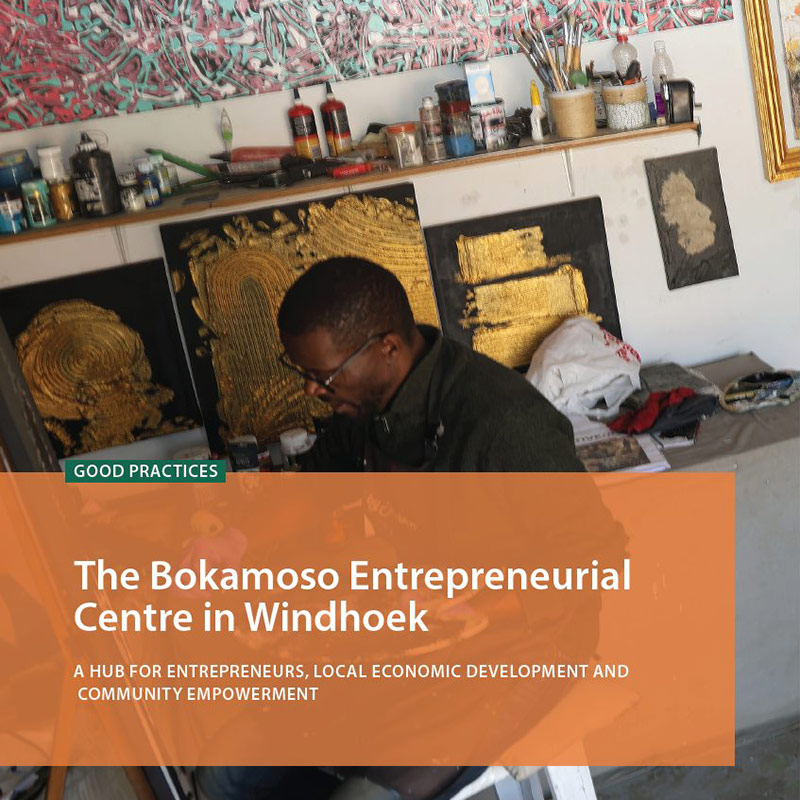
The Bokamoso Entrepreneurial Centre in Windhoek
A Hub for Entrepreuners, Local Economic Development and Community Empowerment
The Bokamoso Entrepreneurial Centre supports small and medium-sized enterprises, particularly start-ups founded by young people. Over the past 16 years, it has supported an estimated 1,200 young people aged 18–35 in their entrepreneurial activities. Originally functioning as a business incubator, it provided SMEs with basic infrastructure. It then added training, business development support and other capacity-building measures to promote sustainable business growth. The centre is currently exploring its future strategic direction and undergoing an organisational development process, which is being supported by its twin city in Germany, Bremen.
Nature at the Heart of Municipal Resilience: Paving the Way Forward
From urban parks and street trees to mangrove restoration and nature-based enterprises
The Connective Cities learning process “Nature at the Heart of Municipal Resilience” continues to bring municipalities from across Sub-Saharan Africa together to exchange experiences and develop locally adapted solutions. Following previous exchanges, participating municipalities are now refining their reform measures through online sessions and expert support, preparing them for the next stage of the learning process. The next milestone will bring participants together in Kigali, where municipalities will share their progress and further develop their measures towards implementation.
Call for Participation: Strengthening Local Economies – Globally Competitive, Profitable and Fit for the Future
How can municipalities strengthen their local economies in times of global uncertainty, structural change and rapid technological transformation?
Rising energy costs, changing supply chains, climate impacts and new technologies are reshaping local economies worldwide. At the same time, new markets, innovative technologies and new forms of cooperation offer municipalities significant opportunities to strengthen their economic base, attract investment and create new prospects for businesses and employment. Connective Cities invites municipalities and other local economic development actors to join the new international Deep Dive. Over approximately 1.5 years, participating municipalities will exchange experiences internationally, analyse their local economic structures, challenges and opportunities, and develop concrete strategies, partnerships and local projects for more resilient, innovative and future-oriented local economies. Join in!
The deadline for submitting expressions of interest is 31 October 2026.
Green Corridors Learning Process: From Exchange to Implementation
How can municipalities translate the concept of green corridors into practical and locally adapted solutions?
Green corridors can help to mitigate heat, improve the urban climate and biodiversity, and optimise rainwater management. Furthermore, they can reduce traffic and noise pollution. At the same time, they create attractive walking and cycling routes between neighbourhoods, public spaces and key everyday destinations. In this way, they promote sustainable mobility, accessibility and quality of life. In this way, green corridors combine climate resilience and environmental sustainability with healthier, better-connected and more liveable communities. On 28 and 29 September, the focus will be on local authorities in Egypt, who will meet in person in Cairo, while their peers and experts from the region will participate online.
When Facts Come Under Pressure: Strengthening Municipalities Against Disinformation
How can municipalities effectively counter disinformation, build trust and communicate reliably, even in times of crisis?
Disinformation and polarising narratives are posing increasing challenges for municipalities. False information can undermine trust in local institutions, intensify social tensions and spread rapidly, particularly in times of crisis. It is therefore all the more important for municipalities to be prepared and able to communicate quickly, credibly and effectively.
These questions will be the focus of the Connective Cities expert forum on 8 October 2026, from 2.00 to 4.30 pm in Berlin, as part of the 8th German-Ukrainian Municipal Partnership Conference. Come and join the discussion!
Insight Session: Bringing Nature Back into Bhutan’s Urban Future
How can municipalities grow while not only protecting nature, but actively helping to regenerate it?
In this virtual Insight Session, the Bhutan Ecological Society (BES) will demonstrate how nature-based solutions and eco-regenerative development can create greener, healthier, more climate-resilient urban spaces. The event will showcase concrete, innovative approaches from Bhutan and demonstrate how biodiversity conservation, ecological restoration, green-blue infrastructure, recreation and local development can be integrated into urban planning. Particular focus will be placed on the planned Eco-Regenerative Park in Rinchending, Phuentsholing. The park aims to combine biodiversity conservation, green spaces, nature education, sustainable recreational activities, wellness, regenerative tourism, and benefits for the local population. The event will take place on 22 October 2026 from 10:00 to 11:00 (CEST). Be inspired!
Engagement Global gGmbH
Service Agency Communities in One World
Friedrich-Ebert-Allee 40, 53113 Bonn | Deutschland
Contact: Sibylle Loyeau
Email: sibylle.loyeau@engagement-global.de
Deutsche Gesellschaft für Internationale Zusammenarbeit (GIZ) GmbH
Friedrich-Ebert-Allee 32 + 36, 53113 Bonn | Deutschland
Contact: Ricarda Meissner
Email: ricarda.meissner@giz.de
Windhoek, capital and economic centre of Namibia as well as home to around 500,000 inhabitants, draws young people from all corners of the country seeking higher education and training, employment in government and corporate sector jobs, and entrepreneurial opportunities. Around 40 percent of the population of the capital region Khomas is aged between 15 and 34.
The regional and local authorities thus have made start-ups and entrepreneurship a strategic priority, significantly improving the political and regulatory framework for business creation. The Bokamoso Entrepreneurial Centre supports small and medium-sized enterprises, particularly start-ups run by young people. Over the past 16 years, the centre has reached out to and supported an estimated 1,200 young people aged between 18 and 35 in their entrepreneurial activities.
Initially, it operated primarily as a business incubator, providing basic infrastructure for SMEs. When, over time, it became clear that physical space alone was insufficient to enable businesses to operate beyond their day-to-day activities, the Centre introduced training, business development support and other capacity-building activities to foster sustainable business growth. Currently, the Centre is exploring its future strategic focus, undergoing an organisational development process supported through its sister city Bremen.
International Community of Practice for Sustainable Municipal Development
NEWSLETTER – ISSUE NO. 97, August 2026
Dear Readers,
“Nothing in life is to be feared; it is only to be understood,” French physicist Marie Curie once wrote. With this in mind, this issue takes a focused look at how municipalities can better protect their residents from extreme heat, make critical infrastructure more resilient, and create new opportunities for young people.
Safeguarding critical infrastructure together is at the heart of our new Learning Process in South-Eastern Europe and the South Caucasus. Eleven municipalities are working on their action plans and will further develop them into concrete pilot measures to better prepare for power outages, extreme weather events and cyberattacks.
Promoting start-ups, entrepreneurship and young people’s participation in society is the focus of the Learning Process “Start-ups, Innovation and Opportunities for Young People”. Thirteen good practices provide the starting point for deeper peer-to-peer exchange and collaboration among municipal practitioners.
With 17 expert forums, six arenas and several symposia, the 19th Federal Congress on National Urban Development Policy offers a wide range of opportunities for exchange. It will take place from 14 to 16 September 2026 at the Palladium in Cologne. Connective Cities will also be there – come and meet us!
We wish you an inspiring read.
Your Connective Cities Team
INSIGHTS
Start-ups and Innovation: Labour Market Opportunities and Prospects for Young People
International Municipalities Exchange Ideas in Bremen, Germany
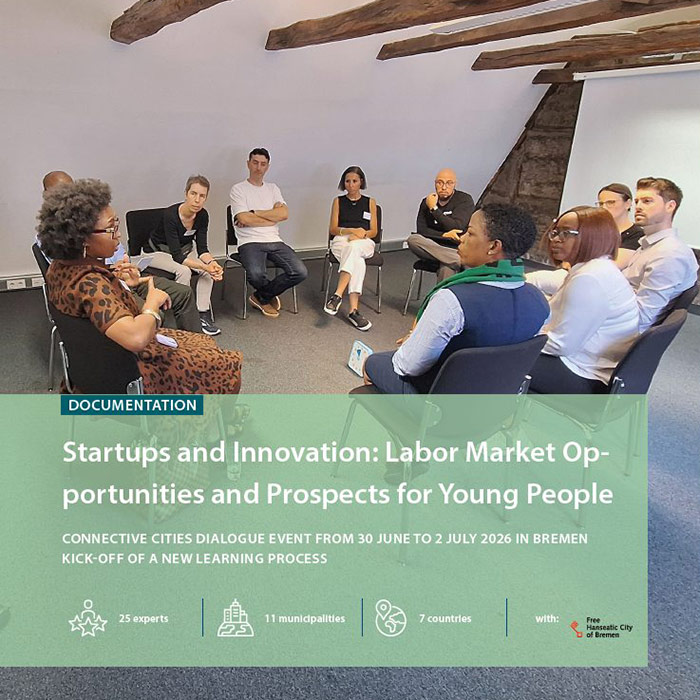
From 30 June to 2 July 2026, around 25 experts from 11 local authorities and seven countries gathered in Bremen to exchange experiences, learn from one another, and develop new approaches together. The focus was on the opportunities that start-ups and entrepreneurship offer for employment, economic development, and the social inclusion of young people. Despite their different circumstances, many municipalities worldwide face similar challenges, such as a lack of role models and networking opportunities, bureaucratic hurdles, and inadequate infrastructure. However, 13 examples of good practice also demonstrated how these challenges can be overcome. The event marked the launch of a new Connective Cities learning process. Take a look at our comprehensive documentation!
Good Practices, a Guidebook and Recommended Reading
Heat affects us all. It is one of the world’s fastest-growing and deadliest climate risks.
However, we are not powerless against it. Municipalities around the world are developing and sharing comprehensive strategies and ideas – including through Connective Cities. We have compiled a selection of good practices from this context, as well as additional resources, ranging from heat protection plans and green and blue infrastructure planning to smart rainwater management, AI use and digital twin creation for risk-informed crisis management.
Municipal Resilience: Safeguarding Critical Infrastructure Together
From local vulnerabilities to concrete action
What happens when a power outage also disrupts water, communication or other essential services? Critical infrastructure systems are closely interconnected – and these dependencies can amplify the impacts of crises. At the kick-off of the regional Connective Cities Learning Process in Tirana, 30 experts from 13 municipalities and nine countries worked together to identify local vulnerabilities and develop practical solutions. The result: eleven municipal action plans – ranging from backup power and digital infrastructure monitoring to flood prevention, crisis communication and new approaches to municipal coordination. What challenges do municipalities share, what solutions are they developing – and what can other local governments learn from them?
Connective Cities at the 19th Federal Congress on
German National Urban Development Policy
“Act together, act faster, think further: shaping cities for everyone”
The 19th Federal Congress on National Urban Development Policy will take place in Cologne from 14 to 16 September 2026. The congress brings together stakeholders from local authorities, politics, public administration, academia and civil society to discuss innovative approaches to sustainable, resilient and forward-looking urban development. This year, for the first time, Connective Cities will have a stand at the event organised by the Service Agency for Communities in One World (SKEW). The focus will be on discussions with local government experts in the fields of urban development, mobility, climate adaptation and sustainable transformation.
Engagement Global gGmbH
Service Agency Communities in One World
Friedrich-Ebert-Allee 40, 53113 Bonn | Deutschland
Contact: Sibylle Loyeau
Email: sibylle.loyeau@engagement-global.de
Deutsche Gesellschaft für Internationale Zusammenarbeit (GIZ) GmbH
Friedrich-Ebert-Allee 32 + 36, 53113 Bonn | Deutschland
Contact: Ricarda Meissner
Email: ricarda.meissner@giz.de
Startups and entrepreneurship offer young people opportunities to secure their livelihoods and advance their careers, while also serving as crucial factors for the well-being of local communities and for local economic development.
Municipalities play a central role: They engage in networking with stakeholders, provide advice and support to founders, provide infrastructure and resources, and facilitate access to funding or contacts with investors. In short, they create a founder-friendly climate and ecosystem at the local level.
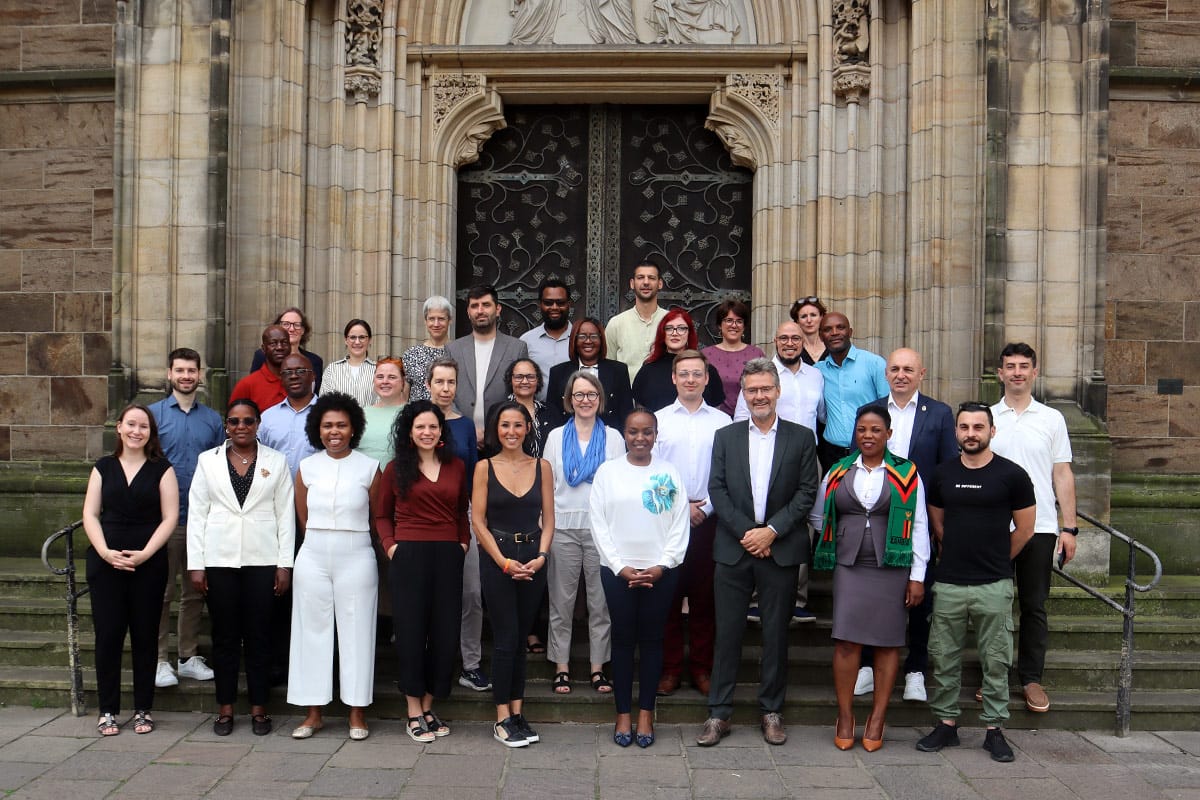
From 30 June to 2 July 2026, around 25 experts from 11 local authorities and seven countries gathered in Bremen to exchange experiences, learn from one another, and develop new approaches together. The focus was on the opportunities that start-ups and entrepreneurship offer for employment, economic development, and the social inclusion of young people. Despite their different circumstances, many municipalities worldwide face similar challenges, such as a lack of role models and networking opportunities, bureaucratic hurdles, and inadequate infrastructure. However, 13 examples of good practice also demonstrated how these challenges can be overcome. The event marked the launch of a new Connective Cities learning process. Take a look at our comprehensive documentation!
How can municipalities help young people successfully start businesses while also driving local development? This question was at the heart of the international Connective Cities dialogue event “Start-ups and Innovation: Labour Market Opportunities and Prospects for Young People”, held in Bremen from 30 June to 2 July 2026. Around 35 experts from 11 municipalities and seven countries came together to exchange experiences, learn from one another, and jointly develop new solutions.
The event focused on the opportunities that start-ups and entrepreneurship create for employment, economic development, and social participation among young people. A key finding was that, despite differing local conditions, municipalities around the world face many similar challenges. Young entrepreneurs need access to advisory services, networks, financing, suitable infrastructure, and practical education. Municipalities play a crucial role as facilitators, supporters, and enablers of thriving local entrepreneurial ecosystems.
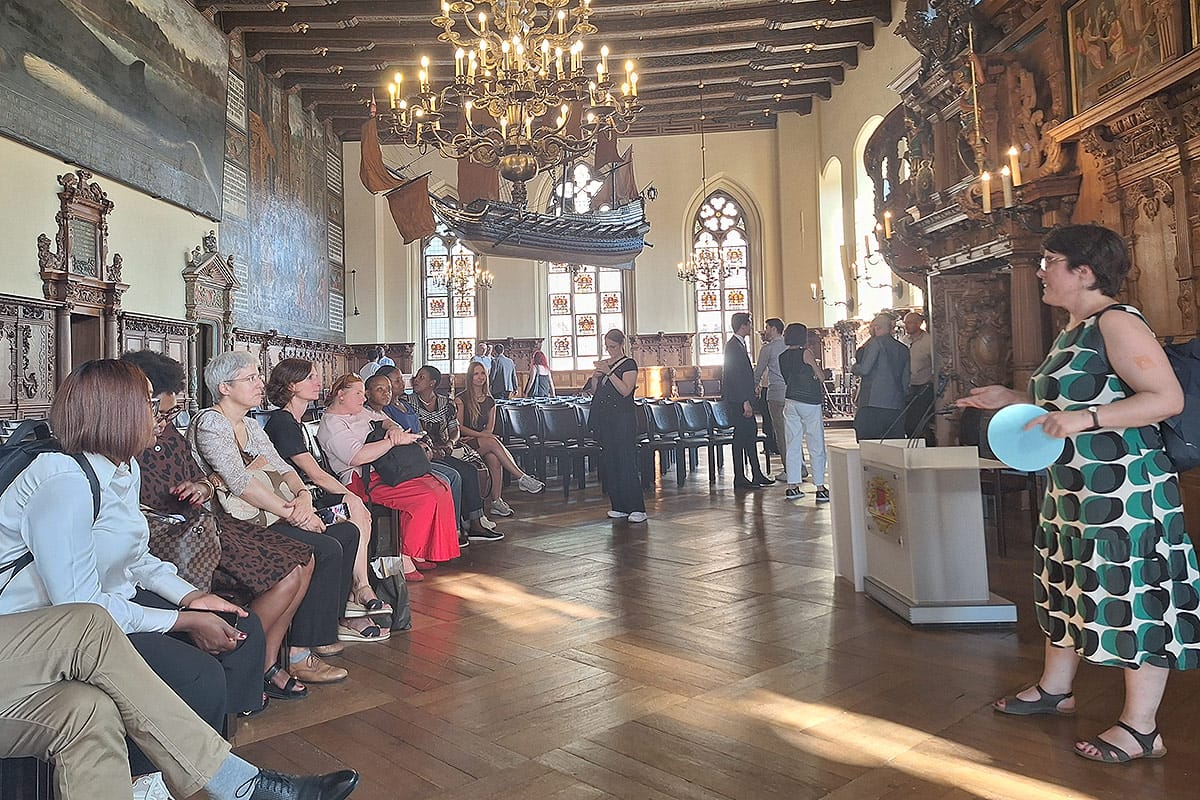
Reception for participants at Bremen City Hall | Photo: Connective Cities
Participants gained insights into successful municipal approaches from Germany, Namibia, North Macedonia, Rwanda, Serbia, South Africa, and Zambia. Examples included business incubators, one-stop shops for advisory services, digital platforms, mentoring programmes, and initiatives supporting women, migrants, and young people in rural areas. Particularly impressive was the diversity of solutions tailored to local challenges.
“We use storytelling and share the stories of start-ups so that others can see: this could be my story as well.” Oliver Götz, Gründungswerft e.V., Germany
One example from the Global South came from Windhoek, Namibia. The Bokamoso Entrepreneurial Centre supports young businesses with affordable infrastructure and training opportunities to help them enter national and international markets. The centre has successfully assisted companies in sectors such as crafts, the creative industries, and food production. It also specifically promotes business concepts focused on resource efficiency and recycling, thereby strengthening the circular economy in Windhoek.
From Germany, Bremen presented its closely connected start-up ecosystem, which brings together stakeholders from business, academia, and public administration. Through Starthaus Bremen & Bremerhaven, the city offers a central point of contact supporting aspiring entrepreneurs with advice, networking, financing, and funding opportunities. Bremen also promotes entrepreneurship awareness among young people through partnerships with schools and universities.
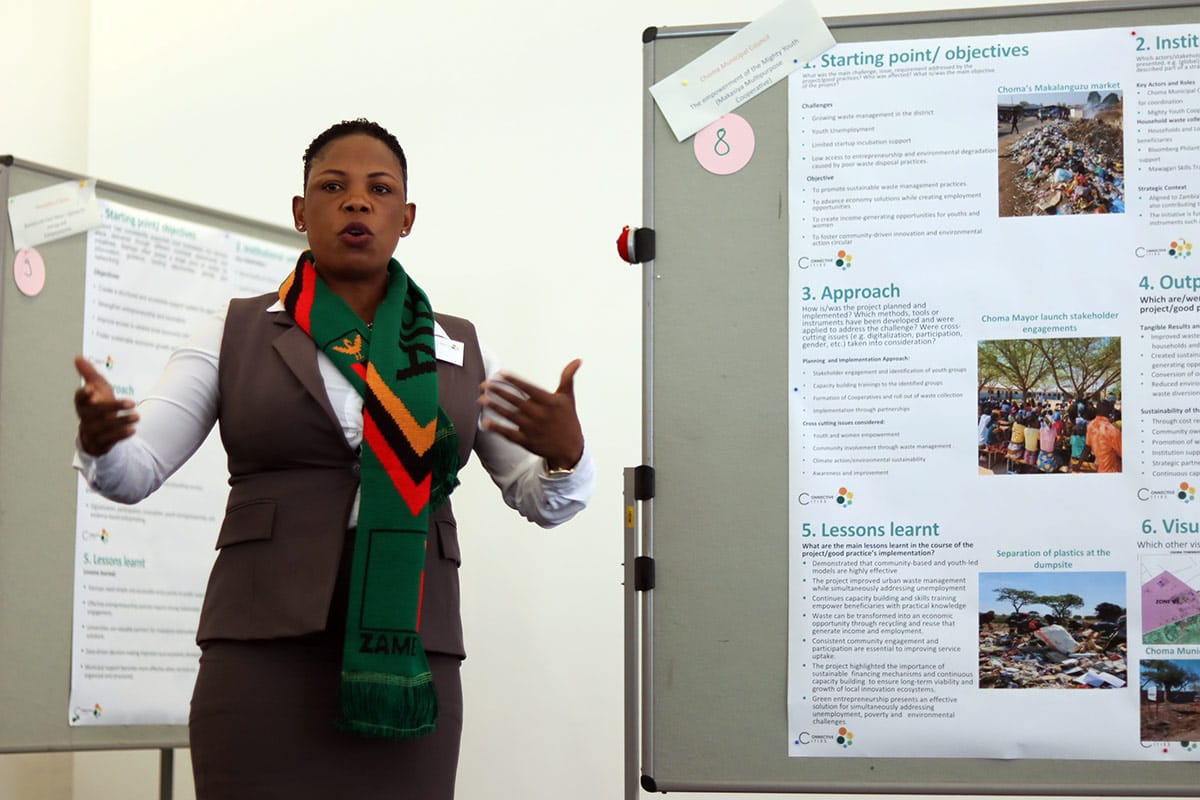
Project presentation from Choma, Zambia | Photo: Connective Cities
The connection between education and entrepreneurship was a central theme throughout the event. Professor Dr. Jörg Freiling of the University of Bremen emphasized that young people today need skills such as creativity, initiative, problem-solving abilities, and entrepreneurial thinking to succeed in an increasingly complex world. Universities, schools, and companies must therefore work more closely together and expose young people to real-world challenges and innovation processes at an early stage.
“I often tell my students: you are the innovators in our society.” Professor Dr. Jörg Freiling, University of Bremen
During the working groups and peer-to-peer consultations, participants developed numerous practical solutions. Topics included strengthening the links between education and business, creating new training and mentoring formats, introducing mobile advisory services for remote regions, and reducing bureaucratic barriers for entrepreneurs.
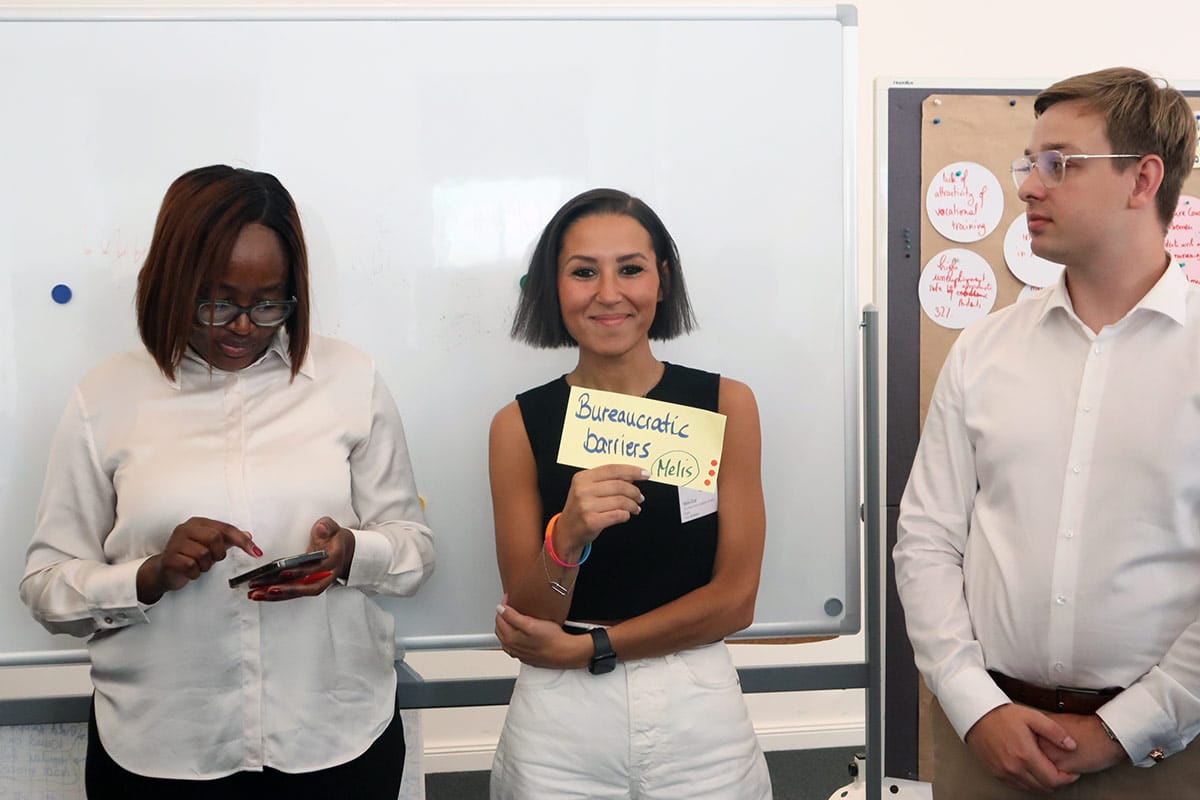
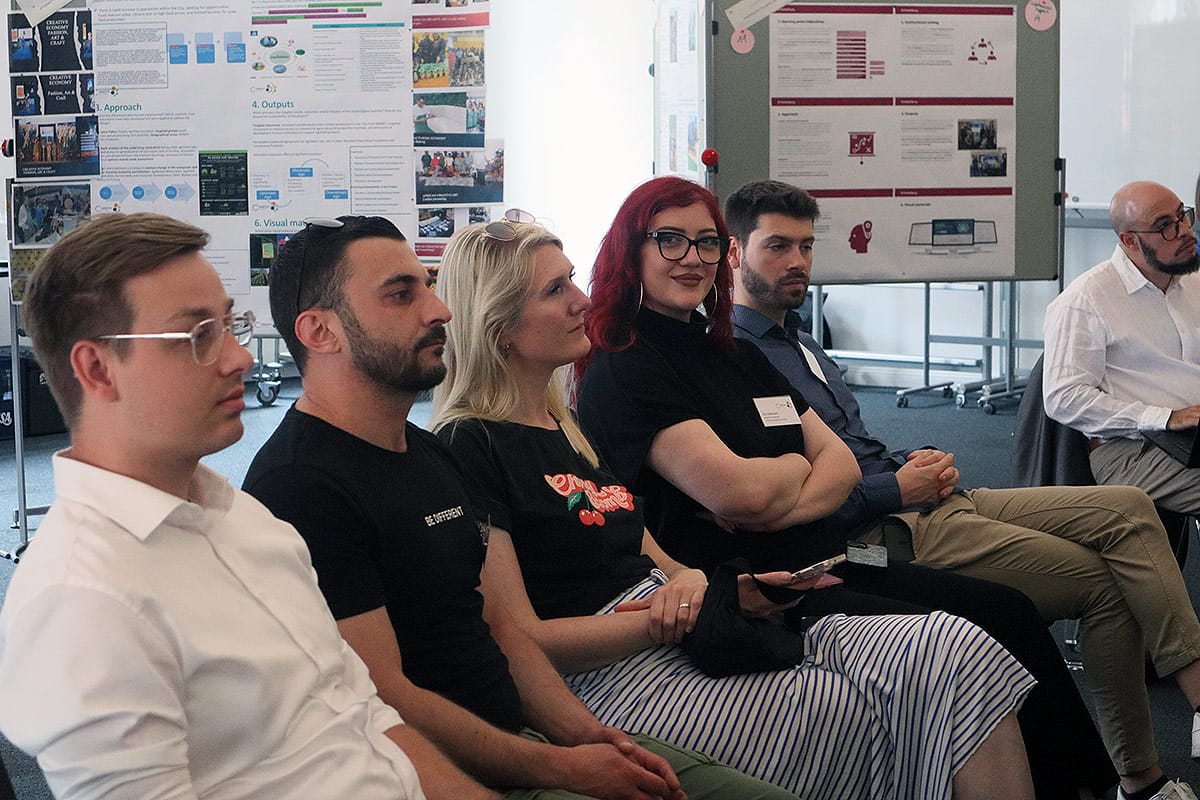
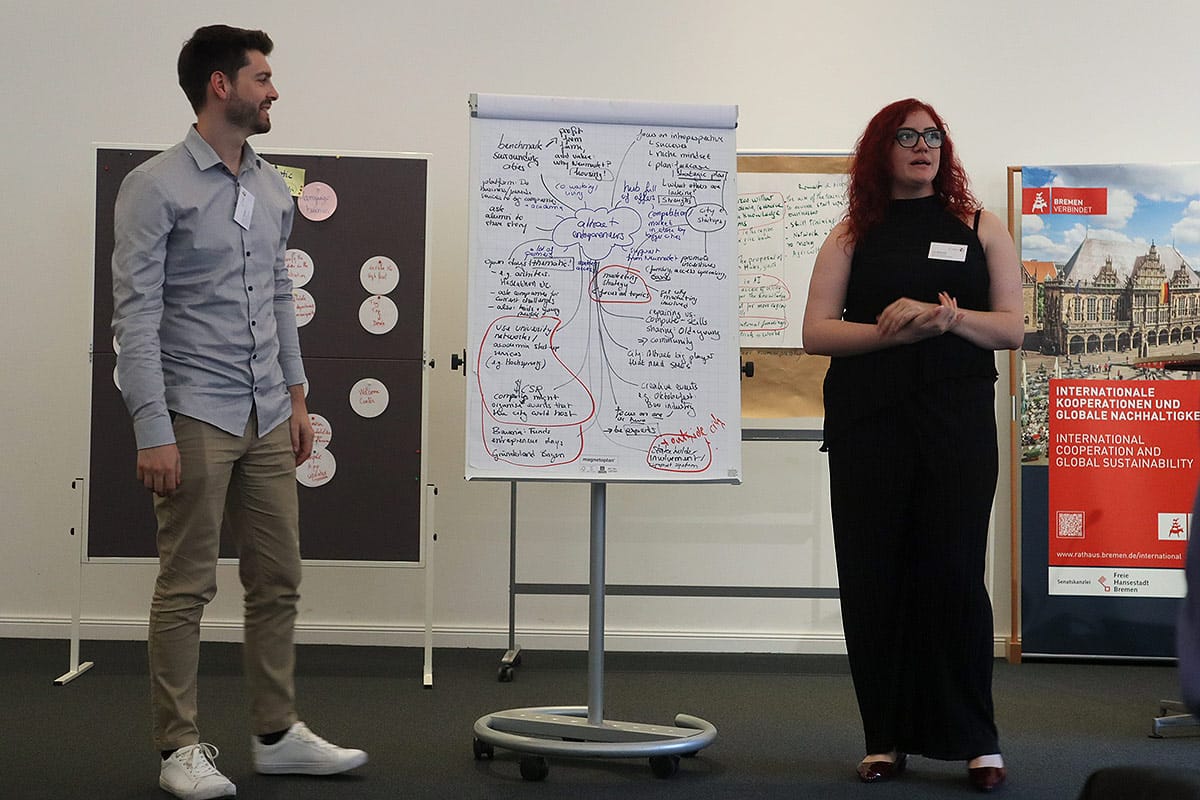
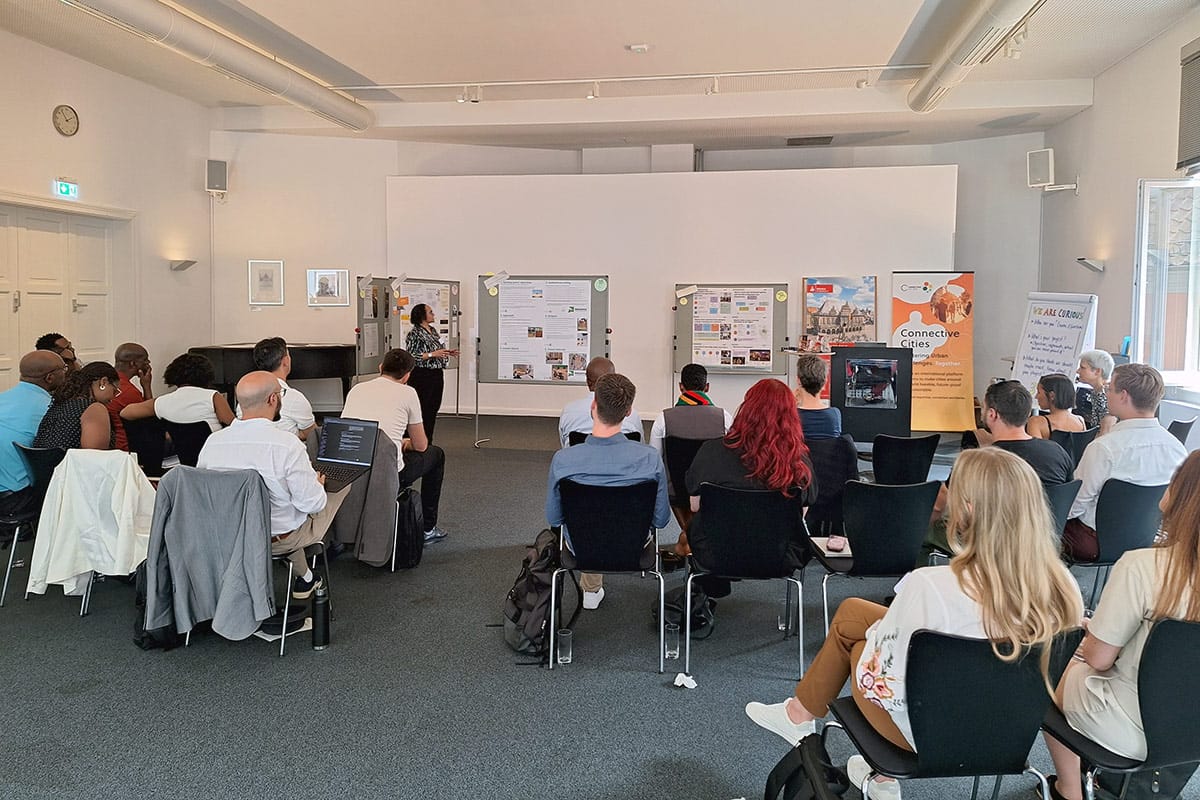
Presentation of the group work | Photo: Connective Cities
Representatives from Munich contributed ideas on how to better support entrepreneurs with migration backgrounds. Proposed measures included multilingual information services, mentoring programmes to help navigate administrative procedures, and closer cooperation with Welcome Centres and other advisory institutions.
Another widely discussed solution came from eThekwini, South Africa, addressing the challenges faced by remote and rural communities. Participants explored the concept of mobile hubs—vehicles that regularly deliver advisory services, training, digital infrastructure, and information on funding opportunities directly to hard-to-reach communities. This approach would allow young people outside major urban centres to access essential support services.
We need to encourage young people to not just work for self-sustenance, but to create jobs to the local communities as well.“
Dumisani Nhlengethwa, eThekwini Municipality, South Africa
The dialogue programme was complemented by study visits to Bremen and Bremerhaven’s start-up ecosystem. Visits to Starthaus Bremen & Bremerhaven, the hoi startup factory, and other local initiatives demonstrated how a well-connected innovation ecosystem can support entrepreneurs throughout their journey.
The event marked the beginning of a new Connective Cities learning process. Additional online formats, expert exchange visits, and a closing online event will continue the collaboration among municipalities in the coming months. The strong interest and vibrant discussions highlighted that supporting youth entrepreneurship is increasingly seen worldwide as a key driver of sustainable economic and social development.
“This event gave me a bird’s-eye view. It is often difficult to see what is truly important when you are deeply involved in projects.”
Era Bektashi, Neumarkt in der Oberpfalz, Germany
Connective Cities invites two experts from your municipality to participate in the international exchange of expertise in Bremen and the subsequent learning process
Do you support the startup scene in your municipality? What opportunities do you offer young people in the job market? What challenges do you face in your work? The City of Bremen is already well-connected on this topic—including internationally. Now, in cooperation with Connective Cities, the city invites you to join five other German and six international municipalities in Bremen to exchange expertise on startup initiatives and incubators, as well as municipal incentives and support programs for startups and new businesses.
Opening new perspectives and promoting skills development are equally important for young people in Germany and the Global South; the opportunity to enter the labour market is essential. In Bremen and Bremerhaven, the number of startups is high by national standards. The startup scene is vibrant, innovative, and well-connected. The Bremen Senate Chancellery also already has valuable international contacts: its partner cities Windhoek (Namibia) and Durban (South Africa) contribute experience with their own startup centres and instruments for startup support.
The goals of this dialogue event are to learn together by sharing good practices at the local level, to discuss challenges through peer consultations, to develop solutions to the challenges identified, and to foster networking among participants.
We look forward to the participation of two experts from your municipality, particularly from the fields of economic development, labour and social affairs, or youth work.
International Community of Practice for Sustainable Municipal Development
NEWSLETTER – ISSUE NO. 90, December 2025
Dear readers,
‘Only nature can teach us creation, can teach us creativity. Our true illiteracy is the inability to be creative,’ wrote artist, painter and architect Friedensreich Hundertwasser in 1983 in his manuscript ‘Concrete Utopias for the Green City’.
Inspired by this quote, in this issue we look back at a dialogue event in Bonn, where creative minds came together to innovatively combine various forms of CO₂-free mobility. It also marks the start of a new learning process on the topic, which we will continue in 2026.
We provide insights into how cities in Germany and sub-Saharan Africa are converting and expanding their infrastructure for green hydrogen, thereby boosting the local economy.
Taking nature as our model, we invite your municipality to participate in our two-year learning process, exploring the most creative options for protection against drought and heavy rainfall. We would also like to cordially invite you to join our learning process on ‘Green Corridors in Germany and the MENA Region’.
Connective Cities is also starting the new year with three additional strong partners. We will briefly introduce them and outline the topics that we would like to explore in greater depth together with you.
We wish you happy holidays and a good start to the new year.
Sincerely Your Connective Cities Team
REVIEW
Combination of future-proof mobility forms
Kick-Off of the New Learning Process on Sustainable Mobility in Bonn
From 25 to 27 November, Connective Cities hosted a dialogue event in Bonn. 38 experts from 20 municipalities in 11 countries followed the invitation to share their innovative project approaches with colleagues and collaborate on new implementation ideas. Small municipalities such as Schlangen in the Teutoburg Forest, with a population of around 9,000, were represented, as well as metropolises with millions of inhabitants, such as Rio de Janeiro and Munich. The innovative approaches were equally diverse.
Unlocking the potential of new technologies at the local level
Green hydrogen is rapidly gaining global prominence as a crucial energy carrier for the future. For many African countries, abundant solar and wind resources give cities a unique advantage, positioning them not only as innovation hubs but also as centers for technology transfer, workforce training, and industrial diversification. By integrating sustainable use of green hydrogen into urban planning, municipalities can enhance energy security, attract long-term investment, and build more resilient, climate-friendly local economies—ultimately becoming key drivers in the global clean-energy transition.
Water resilience – Municipalities strengthen themselves against drought and heavy rainfall events
Call for participants: Connective Cities Deep Dive – a two-year learning process with a kick-off event in Germany in March 2026
Local authorities are facing challenges due to climate change and soil sealing, with more frequent droughts, heavy rainfall and flooding. In Germany and the Global South, innovative solutions are currently being promoted and rapidly tested. Connective Cities is therefore offering an in-depth learning process on this topical and highly relevant issue, and we warmly invite interested local authorities to participate.
Invitation to the Kickoff Workshop, 7–9 April 2026 (TBC), Egypt
Green corridors improve urban microclimates, enhance public spaces, and support municipalities in adapting to climate change. In the new one-year Connective Cities Learning Process MENA, professionals from Germany and the MENA region will jointly develop practical, co-creative and actionable solutions for green corridors in their local contexts. We warmly invite you to join the kickoff workshop and contribute your project idea or challenge to the learning process.
Stronger Together: The New Partners of Connective Cities
The German County Association, the German Association of Towns and Municipalities and the Association of Public Utilities are now part of the Steering Committee
More municipal voices, more exchange, more joint creative power – Connective Cities is entering the next phase with an expanded group of partners. We introduce our partners and outline the thematic priorities for the coming year. Take a look!
Engagement Global gGmbH
Service Agency Communities in One World
Friedrich-Ebert-Allee 40, 53113 Bonn | Deutschland
Kontakt: Sibylle Loyeau
Email: sibylle.loyeau@engagement-global.de
Deutsche Gesellschaft für Internationale Zusammenarbeit (GIZ) GmbH
Friedrich-Ebert-Allee 32 + 36, 53113 Bonn | Deutschland
Kontakt: Ricarda Meissner
Email: ricarda.meissner@giz.de
Green hydrogen is rapidly gaining global prominence as a crucial energy carrier for the future. Although much of today’s discussion focuses on hydrogen production and its export potential, domestic consumption of green hydrogen offers equally significant opportunities for local economic development—strengthening municipal infrastructure, creating skilled jobs, and stimulating new economic activities along various value chains. For many African countries, abundant solar and wind resources give cities a unique advantage, positioning them not only as innovation hubs but also as centers for technology transfer, workforce training, and industrial diversification. By integrating sustainable use of green hydrogen into urban planning, municipalities can enhance energy security, attract long-term investment, and build more resilient, climate-friendly local economies—ultimately becoming key drivers in the global clean-energy transition.
To advance the exchange of best practices and accelerate strategy development between African and German cities, Connective Cities hosted its second workshop on “Exploring the Potential of the Green Transition for Local Economic Development” held on 25–27 November 2025 in Mombasa. Representatives from Mauritania, Kenya, South Africa, and Germany participated. This edition focused on improving technological readiness for green hydrogen production, addressing local implementation challenges andstrengthening regional competitiveness among other readiness issues. The discussions further emphasized the importance of involving , and integrating universities, research institutions and start-ups as key drivers of job creation and innovation.
The City of Nakuru, Kenya presented its benchmark strategy to position itself as a model green city and a leading hub for green fertiliser production within is floriculture sector, reducing import dependency and supporting the emergence of new green industries. With its proximity to the rift valley geothermal vents, Nakuru is well positioned for cost- competitive green hydrogen production. The city aims to attract pilot projects, applied research initiatives, and local and international start-ups working along the green hydrogen value chain., reinforcing its long-term vision as a regional clean-energy and innovation hub.
Field visit to the port of Mombasa | Photo: Connective Cities
Kenya has adopted a national Green Hydrogen Strategy and participates in regional African hydrogen initiatives. Mombasa, as a major port city, holds strategic significance for export logistics and coastal project siting. While early national activities have focused on potential assessments and pilot sites, coastal locations like Mombasa are increasingly viewed as gateways for logistics, export-oriented hydrogen production, and coastal renewable-energy projects. The city now seeks to leverage its strategic location to establish itself as a global player in hydrogen-powered logistics and to develop the port into a logistics cluster that attracts innovative local and international investment supported by a skilled workforce.
In South Africa, the Waterberg region in Limpopo forms part of the national “Hydrogen Valley,” stretching across Limpopo, Gauteng, and KwaZulu-Natal. Mining and industrial operations in the Waterberg–Mokopane corridor are being integrated into hydrogen and platinum-group-metal value chains. Recent feasibility studies and national green hydrogen planning have made the region increasingly attractive to investors. The local development vision is to integrate renewable energy generation with mining operations and downstream green hydrogen and green ammonia applications. This approach aims to link industrial decarbonisation and new export opportunities with local job creation and investment. Waterberg is also seeking to strengthen collaboration with universities by fostering local and international research partnerships to spur pilot projects and nurture green start-ups across emerging value chains.
Mauritania has become a high-potential green hydrogen country due to its exceptional wind and solar resources and favourable export position toward Europe. Several large-scale, export-oriented hydrogen and ammonia projects have been announced or are under development. While the national strategy prioritises export-driven green hydrogen production, it also emphasises renewable energy use to support domestic power grids and industry. However, as national projects advance, municipalities within Nouakchott—particularly Sebkha and Ksar, – continue to face high electricity costs, pollution, limited infrastructure, and the absence of clear municipal hydrogen strategies. These communes are not seeking merely to host hydrogen developments, they aim to participate meaningfully in shaping equitable, community-centered value creation within Mauritania’s emerging green hydrogen economy. The City of Nouakchott through its private sector and international partnerships, now seeks to position itself as an active player in his transition with a focus on modernizing urban services , strengthening governance, and building local private-sector capacity ultimately becoming a regional hub for green urban development, logistics, and industrial enterprises linked to the green hydrogen value chain.
The participating German cities also shared key insights and updates on their latest initiatives. Karlsruhe highlighted its hydrogen hub around the Rhine ports (H2iPortKA) and its strong research ecosystem in collaboration with the Karlsruhe Institute of Technology and the Fraunhofer Institutes. Particularly noteworthy is the dynamic start-up and spin-off environment, which demonstrates how the green transition can generate new jobs and investment for an entire region.
Heilbronn, well known as a centre for technology and hydrogen innovation within Germany’s automotive and engineering clusters, aims to use green hydrogen to diversify its industrial base, upgrade workforce skills, and anchor research-driven companies in the region. Heilbronn University and nearby Fraunhofer initiatives are expanding applied research and innovation centers—including those focused on hydrogen technologies—leveraging strong industry links for piloting and skills development.
Field visit to the port of Mombasa | Photo: Connective Cities
The workshop underscored the vast opportunities emerging around green hydrogen production across regions endowed with abundant renewable energy resources.. However, cities and regions hosting these new green industries are often overlooked in national strategies that prioritize high-profile investments and export ambitions. Many localities remain uncertain of how they and their populations can directly participate in these developments. Significant technological and institutional gaps persist, and synergies between international high-tech initiatives and local realities are not automatic. As a result, municipalities are increasingly seeking models, international experiences, expertise, and partnerships to strengthen their capacity and create a level playing field:- one that enables prosperous, innovative and equitable local economies in which nations, investors, and communities all benefit alongside advancing technologies
African and German Cities Power a Shared Vision for a Just, Climate-Smart Hydrogen Future
Cities across Africa and Europe are accelerating their role as frontline actors in the global green transition, driving innovation, investment, and climate resilience from the ground up. Following the successful launch of the Hydrogen Cities Working Group earlier this year in Naivasha, Kenya, Connective Cities will convene the second peer-learning workshop on 24–27 November 2025 in Mombasa, Kenya.
This flagship event will bring together city leaders, practitioners, industry innovators, researchers, and development partners to scale up municipal hydrogen strategies and unlock new pathways for green industrialization, inclusive growth, and just transition at the local level.
From Naivasha to Mombasa: Turning Ideas into Impact
The inaugural workshop in Naivasha brought together over 30 municipal representatives and technical experts to explore how cities can anchor the emerging green hydrogen economy in local value creation and job generation. It underscored hydrogen’s role not only as a clean-energy vector but as a catalyst for climate-neutral industrial ecosystems, skills development, and innovation-driven urban transformation.
Case studies showcased how municipalities are positioning themselves along the hydrogen value chain — from production and storage to end-use applications in mobility, manufacturing, and port logistics. Examples ranged from Namibia’s evolving hydrogen hubs to Germany’s Heilbronn and Karlsruhe regions, where local governments are building innovation clusters, R&D partnerships, and market linkages for hydrogen deployment.
Specialist presentation during the meeting in Naivasha | Photo: Connective Cities
Participants also highlighted the importance of integrated urban governance — combining spatial planning, transparent land management, and strong stakeholder engagement — to ensure hydrogen projects deliver tangible community benefits.
Key takeaways from Naivasha included:
Municipal leadership as a driving force for innovation, investment, and policy alignment.
Local value creation through SME participation, skills training, and green entrepreneurship.
Institutional capacity and human capital as preconditions for hydrogen readiness.
Peer-to-peer collaboration as a catalyst for scaling solutions and knowledge transfer.
Since Naivasha, cities have been actively refining their project concepts, forging cross-regional partnerships, and identifying bankable entry points to accelerate their green transition agendas.
Green Hydrogen: Powering Sustainable, Inclusive Urban Futures
Africa’s vast solar and wind potential places its cities at the heart of the global clean-energy transformation. Green hydrogen — and its derivatives such as green ammonia and e-methanol — offers a once-in-a-generation opportunity for low-carbon industrialisation, climate resilience, and circular economy development.
For municipalities, this transition means:
Developing innovation clusters and hydrogen corridors that attract private investment.
Expanding renewable energy infrastructure and smart urban grids.
Enhancing water security and resource-efficient technologies such as desalination and wastewater reuse.
Creating green jobs across engineering, construction, logistics, and research sectors.
Catalysing start-ups, incubators, and technology partnerships.
Building skills pipelines aligned with future hydrogen markets.
Yet, challenges persist — from infrastructure gaps and regulatory complexity to financing bottlenecks and local ownership. The Hydrogen Cities Working Group provides a collaborative platform where cities can co-create solutions, de-risk investment, and ensure the green transition remains inclusive, equitable, and locally anchored.
What to Expect in Mombasa: Scaling Up and Going Deeper
The upcoming workshop in Mombasa will mark a critical shift from strategic visioning to operationalisation and project implementation. Over three days, participants will:
Present project updates and refine concepts through structured peer-review and coaching.
Engage in interactive sessions on land use, water-energy nexus, and industrial cluster design.
Explore innovative financing instruments, including blended finance and PPP models.
Participate in hands-on peer-coaching clinics to advance project maturity.
Exchange with international experts on policy frameworks, investment pipelines, and market integration.
Join a site visit to the Mombasa Port and Special Economic Zone to identify real-world opportunities for green hydrogen applications.
The event will feature keynotes from government and private-sector leaders, expert panels, and networking sessions to strengthen partnerships between African and German municipalities.
Confirmed participants include cities such as Mombasa, Naivasha, Lüderitz, Arandis, Nouakchott, Waterberg District, Hamburg, Karlsruhe, Heilbronn, and Freudenstadt — forming a growing alliance of municipalities championing decentralized, climate-smart hydrogen ecosystems.
Looking Ahead: Cities as Catalysts of a Just Green Economy
As the global energy landscape transforms, cities that act decisively today will become the engines of tomorrow’s green prosperity. The Mombasa workshop represents another milestone in empowering municipalities to lead the hydrogen-powered urban transformation — advancing climate action, economic resilience, and social inclusion in equal measure.
Through the Hydrogen Cities Working Group, Connective Cities continues to bridge continents, connect expertise, and translate ambition into action — ensuring that the hydrogen revolution drives sustainable, locally embedded, and future-ready urban economies.
From Naivasha to Mombasa, cities are demonstrating that the green transition starts locally — and scales globally.