


Heat affects us all. It is one of the world’s fastest-growing and deadliest climate risks.
However, we are not powerless against it. Municipalities around the world are developing and sharing comprehensive strategies. These range from heat action plans and green and blue infrastructure planning to smart rainwater management, the use of AI, and the creation of digital twins for risk-informed crisis management.
Naturally, municipalities have also been tackling this crucial topic within the Connective Cities framework. We’ve put together a selection of examples from the Connective Cities context along with additional resources for you.
 Heat in the City – The Connective Cities Deep Dive Learning Process
From 2023-2025, six municipalities joined forces to analyse the impact of heatwaves and heat islands, and developed solutions tailored to local conditions.
Detailed interim report: https://www.connective-cities.net/en/media-center/heat-in-the-city-2/
Cities Leading by Example
This guidebook on risk-informed planning and heat mitigation, developed by the Connective Cities’ Deep Dive, serves as a practical guide for municipal actors, urban planners, policymakers and community leaders who wish to adopt a risk-informed approach and integrate heat adaptation into their planning processes.
https://www.connective-cities.net/wp-content/uploads/2025/10/cities-leading_guidebook.pdf
 The „Walkable Triangle“ in Kisumu, Kenya
The pedestrian-friendly redeveloped commercial district is now a lovely place to linger with its mature trees keeping it pleasantly cool and the air fresh
https://www.connective-cities.net/media-center/das-walkable-triangle-in-kisumu-kenia/
Greater climate protection and quality of life: Green corridors in the MENA region lower ambient temperatures in cities and their surroundings
An AI-based visualisation exercise focusing on green corridors and green neighbourhoods, designed to bring together different perspectives on urban planning from the fields of administration, politics and academia. https://www.connective-cities.net/en/media-center/greater-climate-protection-and-quality-of-life-green-corridors-in-the-mena-region/
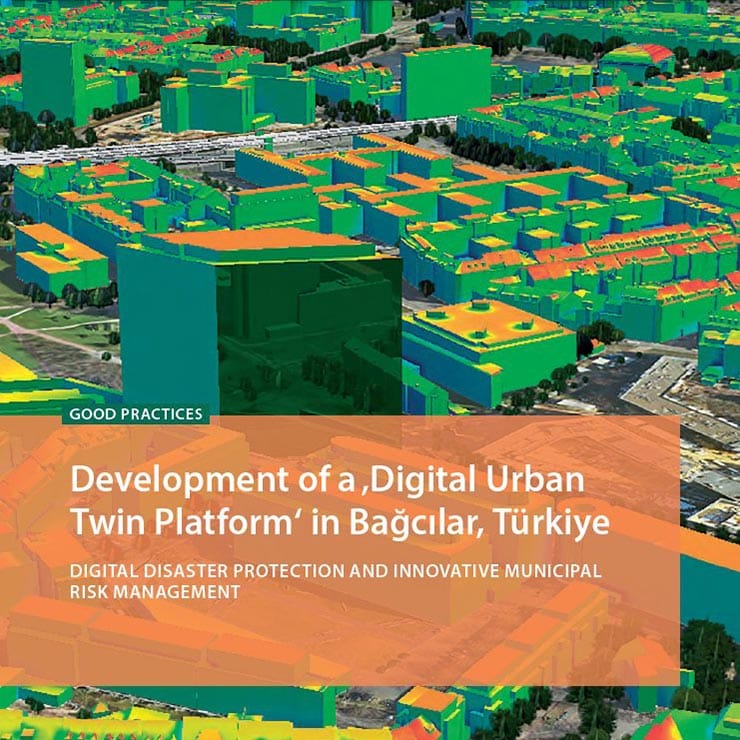 The Digital Twin Platform of Bağcilar, Türkiye
Read about how a municipality in Istanbul combines citizen services with data-driven urban risk management also in terms of heat assessments.
https://www.connective-cities.net/en/media-center/the-digital-twin-platform-of-bagcilar-turkiye/
Recommended Papers:
Ibero-American Urban Climate Atlas
This project covers 11 cities in Spain and South America. The research aims to analyse the local context of each city with regard to the impact of heat islands. The objective is to assess changes in temperature patterns and their territorial effects within cities.
Union of Ibero-American Capital Cities (UCCI) and ICLEI South America
https://e-library.iclei.org/uploads/IBER_ATLAS_EN_2.pdf
 Financing heat resilience
How governments can finance heat resilience through risk-informed investments, innovative financing mechanisms, and resilient infrastructure.
United Nations Office for Disaster Risk Reduction (UNDRR), Centre for Disaster Protection, National Disaster Management Authority (India)
https://www.undrr.org/publication/documents-and-publications/financing-heat-resilience
Heat Action Plans in Local Government Practice (in German)
Implementation of the recommendations for drawing up heat action plans in local government practice (Plan°C)
German Institute for Urban Studies (Difu)
https://repository.difu.de/items/c805c6fb-c3c1-4288-b1c9-eff356fb04bd
 Smart Sponge Cities and Modern Heavy Rainfall Management (in German)
Ideas on how cities can further strengthen their climate and risk resilience and protect themselves against both heavy rainfall events and droughts
German Association of Cities
https://www.staedtetag.de/positionen/positionspapiere/2026/diskussionspapier-smarte-schwammstadt-modernes-starkregenmanagement


