From 22 to 25 June 2026, the World Organisation of Local Authorities (UCLG) held its World Congress in Tangier, Morocco. With the theme of ‘A New Generation of Universal Local Public Services’, over 3,000 delegates from around the world gathered.
The organisation brings together national associations of local authorities, as well as over 1,000 local authorities from seven regions of the world: Africa, the Asia-Pacific region, Europe, Eurasia, the Middle East and West Asia, and Latin America and North America. The UCLG therefore represents around five billion people, accounting for 70 per cent of the world’s population.
The UCLG World Congress is held every three years. Alongside the technical discussions held in numerous Barcamps and side events, and the many networking opportunities, the Congress marked the start of a new governance cycle for the international local government movement. The Presidium, which consists of a President and six Co-Presidents representing different regions, was re-elected. The delegates elected Uğur İbrahim Altay, Mayor of Konya, Turkey, as the new UCLG President for the 2026–2029 term.
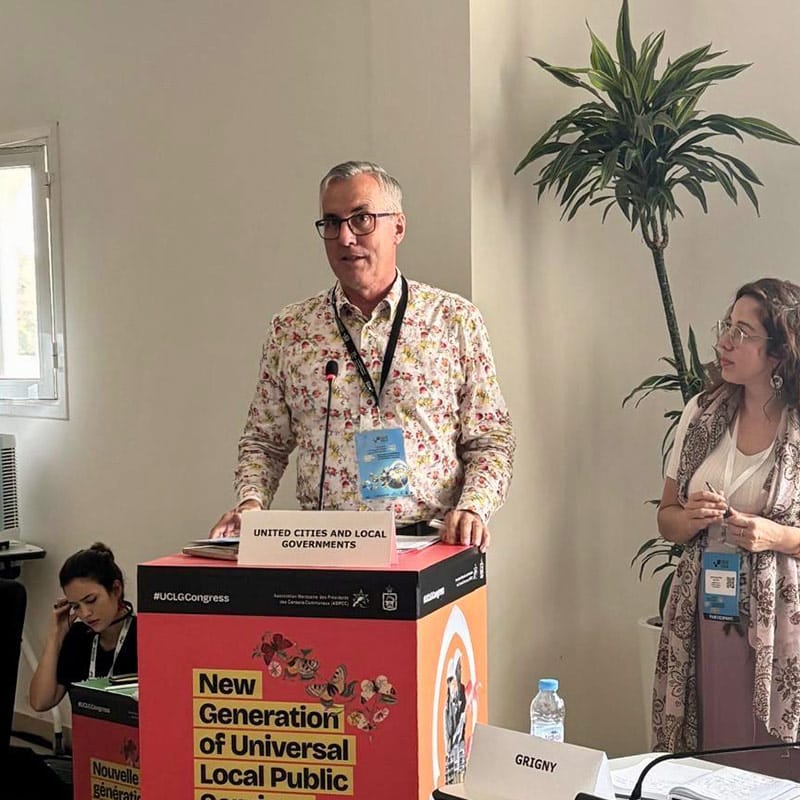
Andreas Wolter, a Cologne city councillor, represents the German side on human rights issues | Photo: Connective Cities
The Congress also renewed UCLG’s governing bodies, including the World Council and the Executive Bureau. Representing Germany on the new World Council are Dr Ursula Sautter (Mayor of Bonn), Jörk Cardeneo (City Councillor, Düsseldorf) and Andreas Wolter (City Councillor, Cologne). The election process reflects UCLG’s commitment to balanced regional representation and shared political leadership within the global municipal movement.
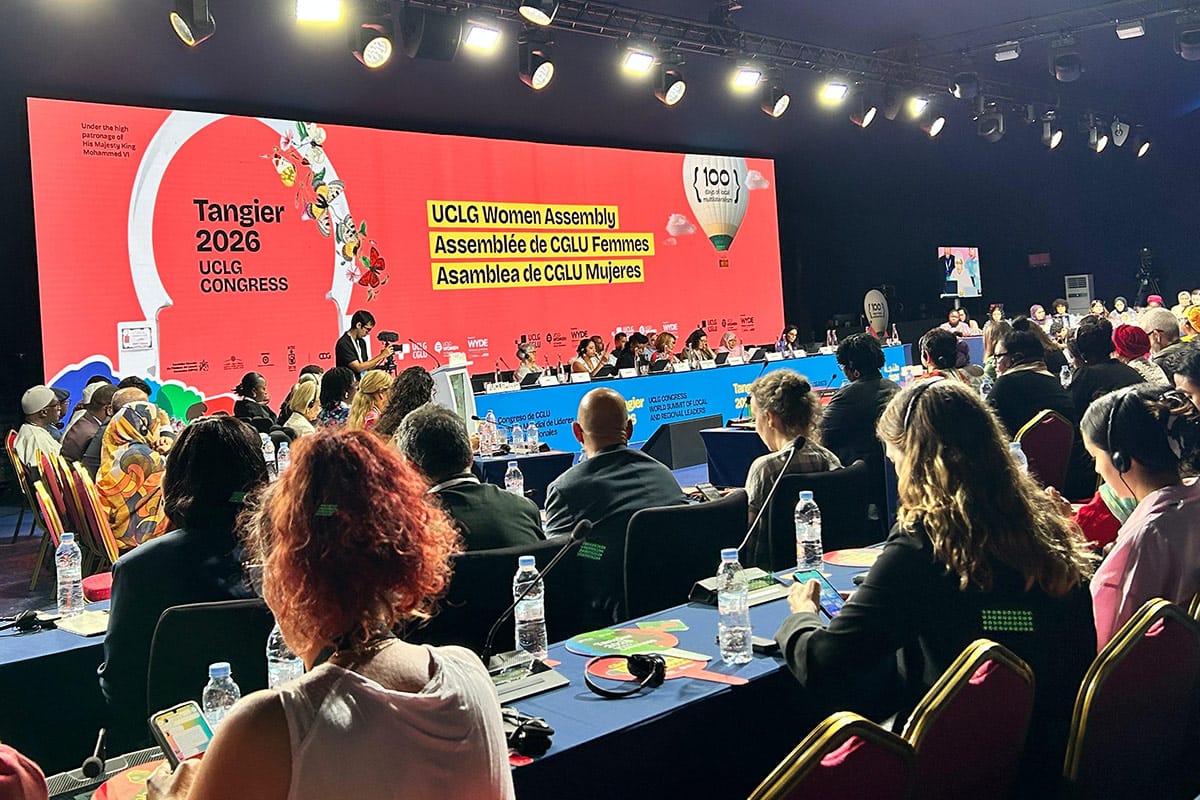
Another milestone was the first-ever UCLG Women’s Assembly, which brought together women mayors, governors and local leaders from around the world. Discussions focused on advancing gender equality in local governance, strengthening women’s political leadership and further developing the Feminist Municipal Movement within UCLG. The Assembly reaffirmed that gender equality is a fundamental component of resilient, inclusive and future-oriented local governance. During the Assembly, Mayor Dr Ursula Sautter also proposed introducing a gender-balanced co-presidency model for the next UCLG mandate.
UCLG Women Assembly | Photo: Connective Cities
In the ‘Tangier Outcome Document – A New Generation of Universal Local Public Services’, the delegates also reaffirmed the central role of local and regional governments in providing inclusive, accessible and resilient public services. The focus was on issues such as affordable housing, climate resilience, digital transformation, social inclusion and international municipal cooperation.
The Connective Cities learning process on “Nature at the Heart of Urban Resilience” was officially launched through a three-day kick-off workshop held in Naivasha, Kenya from 21 to 23 April 2026, bringing together 20 municipalities and cities from across Sub-Saharan Africa and Germany, alongside over 40 urban practitioners, technical experts, and institutional partners.
The workshop marked the starting point of a longer-term engagement aimed at supporting local governments in translating their urban challenges into concrete, implementable solutions through structured peer exchange and technical support.
Cities at the Frontline: Climate Pressures and the Need for Nature-Based Solutions
Urban areas are increasingly where the impacts of climate change are most visible—and most intensely felt. Across Sub-Saharan Africa, cities and municipalities are facing a convergence of pressures: rapid urbanisation, environmental degradation, and growing exposure to climate risks such as flooding, drought, and heat stress. These pressures are not isolated; they interact in complex ways, amplifying vulnerabilities and placing strain on already limited infrastructure and institutional capacities.
At the same time, local governments are not passive actors. As highlighted in the opening of the workshop, they are at the forefront of both experiencing and addressing climate challenges.
Andreas Wolter, President of Climate Alliance and City Councilor of Cologne, emphasized the critical importance of ensuring that cities are actively represented in the global climate discourse, as municipalities are where climate impacts are most immediate and where solutions must ultimately be implemented.
Complementing this perspective, Dr. Nelson Maara, representing Nakuru County, highlighted the importance of preserving ecosystem services as a foundation for resilience, drawing on local experience to illustrate how the degradation of natural systems directly translates into increased urban vulnerability for climate-related risks.
Together, these perspectives reinforce a growing recognition that municipalities must play a stronger role in shaping climate action, as they are responsible for translating high-level commitments into practical, locally grounded solutions. In this context, Nature-Based Solutions (NbS) offer a critical pathway—enabling cities to address environmental, social, and economic challenges simultaneously through the restoration and sustainable management of ecosystems. However, while the relevance of NbS is increasingly acknowledged, the ability to move from concept to implementation remains a complex issue. This is where the Connective Cities learning process plays a critical role, equipping municipal practitioners with the technical capacities and knowledge required through structured exchange formats.
From Exchange to Implementation: The Role of the Learning Process
The learning process is built on the principle that cities and municipalities learn most effectively when they engage directly with one another on real, shared challenges. Rather than focusing on abstract knowledge transfer, it creates a structured space for practitioners to jointly analyse their challenges, exchange experiences, and progressively develop reform measures—concrete actions or project concepts that can be taken forward within their local contexts.
Additionally, another key component of the Learning Process methodology is to strengthen the capacities of urban practitioners to design, plan, and advance these measures within their institutional environments. The peer-to-peer approach is particularly important given the diversity of participating municipalities, bringing together different governance structures, capacities, and experiences while highlighting that many of the underlying challenges are fundamentally shared.
The learning process is therefore not about transferring solutions from one context to another, but about enabling cities to adapt and refine ideas through dialogue, ensuring that they are both context relevant and practically implementable.
From Framing to Practice: Expert Inputs and Panel Insights
Building on the broader objectives and structure of the learning process, the kick-off workshop in Naivasha marked the first step in translating this approach for peer learning into practice. Over the course of three days, participating cities and municipalities engaged in a structured exchange that combined expert inputs, panel discussions, and peer learning sessions, allowing them to ground NbS in their own urban realities.
The expert inputs provided the theoretical basis for the participants to better understand the importance of NbS for sustainable municipal development:
Prof. Johanes Belle introduced NbS through the lens of ecosystem services, highlighting how natural systems provide essential functions such as flood regulation, water purification, and climate moderation.
In addition to their core infrastructural functions, Nature-Based Solutions also generate co-benefits, including improvements in psychological well-being of local residents, increased soil quality, and opportunities for job creation. By framing NbS in terms of these services, Dr. Belle underscored that ecosystems should be understood as functional infrastructure, central to urban resilience rather than peripheral environmental assets.
For example, wetlands and urban green spaces can absorb excess stormwater, reducing flood risk while simultaneously improving water quality in rapidly growing urban areas. This perspective was particularly relevant for participating cities, many of which are experiencing the direct consequences of ecosystem degradation in the form of increased flood risk, declining water quality, and heightened climate vulnerability.
The input from Deputy Mayor William Wolfgramm, from the City of Cologne’s Climate Department demonstrated how such concepts of NbS can be translated into practice within a structured comprehensive planning framework by presenting the City of Cologne’s ‘urban green space masterplan’. Drawing on concrete examples, the presentation showed how NbS are embedded within long-term planning instruments and supported through institutional coordination, data-driven analysis, and dedicated funding mechanisms.
Measures such as de-sealing urban surfaces, expanding green corridors, and promoting green roofs and rainwater retention systems illustrated how NbS can be systematically implemented at scale when anchored in governance structures, through long-term planning processes and through taking a ‘whole-of-society’ approach.
The panel discussion further reinforced this shift from concept to application. Drawing on experiences from cities that had previously engaged in similar processes, panelists demonstrated through experiences from previous Connective Cities learning processes how initial ideas developed through peer exchange can evolve into tangible outputs—whether through feasibility studies, planning instruments, or pilot interventions. The discussion highlighted various concrete lessons:
eThekwini (South Africa): Emphasised the importance of adopting an all-of-society approach to disaster risk management, bringing together local government departments, technical experts, and communities. Particular attention was given to strengthening communication channels with local populations and ensuring that NbS are embedded within long-term, city-wide programmes and institutional frameworks.
Abelkuma, Accra (Ghana): Highlighted the importance of breaking down institutional ‘silos’ and ensuring coordination across departments in the development of foundational instruments such as urban greening guidelines and implementation plans. The intervention further underscored the need to strengthen technical detailing, local ownership, and financing pathways in order to move from concept to implementation.
Berlin (Germany): Emphasised the importance of clearly scoping technical challenges, anchoring them within appropriate institutional frameworks, and establishing clear lines of accountability. They further highlighted how inclusive, participatory processes—bringing together multiple stakeholders, including local communities—can strengthen implementation, supported by robust control mechanisms such as data systems, continuous monitoring, and regulatory frameworks.
Lusaka (Zambia): Emphasised the critical role of data collection and feasibility studies in advancing projects from concept to implementation. They highlighted the importance of partnerships in mobilising financing and noted the value of city networks in providing technical support and facilitating access to funding opportunities.
Commonly shared among the panelists was the insight, that while ideas often originate through exchange, their success depends on strong ownership —both in terms of institutional anchoring and the involvement of all relevant stakeholders— alongside the ability to translate concepts into structured an financeable interventions.
Cities in Dialogue: From Individual Challenges to Shared Patterns
With these insights in mind, the workshop moved into the peer learning phase, where participating cities and municipalities began to unpack their own challenges in greater detail. To facilitate focused exchange, participants were organised into five moderated working groups:
Group 1: Babadjou (Cameroon), Méagui (Côte d’Ivoire), Natitingou (Benin), Commune de Nanga-Eboko (Cameroon)
Group 3: Tanga City (Tanzania), Köln (Germany), Mazabuka (Zambia), Ilemela (Tanzania)
Group 4: Embu (Kenya), Nakuru (Kenya), Mwanza (Tanzania), Tarkwa-Nsuaem (Ghana)
Group 5: Bosaso (Somalia), Sinda Town Council (Zambia), Kimberley (South Africa), Berlin (Germany)
Within these groups, municipalities presented their challenges, received peer feedback, and began refining possible directions for action. While the discussions initially reflected diverse local contexts, a clear pattern of shared challenges quickly emerged.
Across the groups, municipalities repeatedly highlighted issues related to ecosystem degradation, water management, waste systems, and rapid urbanisation. These challenges were often closely interconnected. For instance, inadequate waste management was identified as a key contributor to flooding, as blocked drainage systems exacerbate water accumulation during heavy rainfall. Similarly, unplanned urban expansion into wetlands and riverbanks was found to increase exposure to climate risks.This reinforced the understanding that urban challenges are not isolated, but rather systemic in nature, requiring integrated responses that address environmental, institutional, and social dimensions simultaneously.
As discussions progressed, cities began to move beyond describing their challenges and toward identifying more structured pathways forward.
From Challenges to Action: Peer Recommendations and Emerging Directions
Through structured peer exchange, participants worked to refine and prioritize potential solutions. Rather than introducing entirely new ideas, this process helped cities to clarify the thoughts broad to the workshop and translate broad concepts into more concrete directions.
Key recommendations emerging from the discussions included the need to strengthen the evidence base for planning, through baseline studies, risk assessments, and feasibility analyses. Cities were also encouraged to integrate NbS within urban planning and governance frameworks, ensuring that interventions are embedded within long-term strategies rather than implemented as isolated projects.
Another strong theme was the importance of community engagement and behavioral change, particularly in areas such as waste management and environmental protection. Many cities recognised that technical solutions alone would not be sufficient without local ownership and awareness building measures.
Finally, there was a clear emphasis on the need to move toward structured project development, including cost-benefit analysis, clearer project definition, and preparation for financing.
From Ideas to Implementation: What Comes Next
While the initial phases of the workshop focused on understanding challenges and identifying potential solutions, time was also dedicated to looking ahead within the year-long learning process. The emphasis shifted towards how these ideas can be further developed into implementable and financeable interventions.
To support this, inputs were provided by the City Climate Finance Gap Fund and the Covenant of Mayors in Sub-Saharan Africa (CoM SSA). Both initiatives outlined their approaches to supporting cities in developing climate projects, including their selection criteria, support mechanisms, and application processes. Emphasis was placed on the importance of strong technical preparation, clear project scope, and alignment with climate and development priorities.
These inputs directly responded to the needs expressed by cities, particularly in relation to moving beyond early-stage ideas and accessing financing. Building on this, the workshop concluded with a forward-looking exercise in which cities presented initial concepts for reform measures, beginning to articulate more concrete project ideas and potential pathways for implementation.
What the workshop demonstrated is that cities are not lacking solutions. Across contexts, there is already a strong foundation of ideas, experiences, and emerging practices. The key challenge lies in structuring these ideas, strengthening the enabling environment, and advancing them toward implementation.
The Connective Cities learning process provides a platform to do exactly that—turning exchange into collaboration, and collaboration into tangible action.
From 12 to 14 September 2025, the Urban 20 (U20) Mayor Summit took place in Johannesburg as part of South Africa’s G20 presidency. The mayors of the C40 cities came together to strengthen the voice of cities at the global level. The U20 is a diplomatic initiative jointly supported by C40 Cities and United Cities and Local Governments (UCLG). This year, the cities of Johannesburg and Tshwane took the chair.
Connective Cities and the City of Bonn participated in the panel discussion organised by SALGA (South African Local Government Association) on the topic ‘From Goals to Impact: Advancing Urban Sustainability and Resilience through the SDGs’. The discussion highlighted the central role of local governments in implementing the Sustainable Development Goals (SDGs): more than 65% of the SDG targets are directly linked to municipal and regional responsibilities, as SALGA Vice-President Flora Mabea-Baltman emphasised.
The panel participants provided a wide range of insights. Aaron Maluleka from the City of Tshwane presented energy programmes and partnerships in the field of sustainable energy. Dr Angela from São Paulo discussed the importance of philanthropic initiatives in achieving the SDG goals. Verena Schwarte from the City of Bonn emphasised the importance of data and international cooperation, and Sibylle Loyeau from Connective Cities stressed the significance of partnerships, professional exchanges, and peer learning.
The communiqué, the summit’s joint outcome document, recognises the importance of the local perspective in the G20 agenda. Four priority areas for action were defined: economic opportunities and financing; climate protection and urban resilience; social inclusion and justice; and digital transformation and innovation.
The Urban 20 Summit 2025 confirmed impressively that cities are at the forefront of solving global challenges locally, working towards a sustainable, inclusive and resilient future.
The OECD report “Reshaping Decentralised Development Co-operation in Germany” was presented at the “6th OECD Roundtable on Cities and Regions for the SDGs” in Brussels on 20 April 2023. It assesses decentralised development cooperation (DDC) policies, strategies, programmes and financing in Germany, as well as the challenges they face, and provides concrete recommendations on how to increase the effectiveness and impact of DDC policies and programmes.
It is the result of an 18-month policy dialogue with more than 100 stakeholders from all levels of government in Germany. The OECD conducted two surveys: one with the federal states and one with the municipalities. The OECD survey of the federal states, conducted between November 2021 and January 2022, was targeted to the development cooperation focal points in the 16 German federal states. The survey was answered by the departments responsible for development cooperation in the state ministries of 14 of the 16 federal states, as well as by representatives of the Federal Government (BMZ) and the implementing organisations. A similar survey was extended to the German municipalities and addressed to the respective persons responsible for development cooperation on the ground. This second survey was conducted between April and June 2022.
Since the 1950s, the DDC has become increasingly important within German development cooperation. Compared to other members of the OECD’s Development Assistance Committee, German municipalities and regions provide by far the highest Official Development Assistance (ODA) in absolute terms, totalling approximately €1538 million in 2020 followed by Spain with €369 million. Most federal states and municipalities focus their development cooperation on technical cooperation, advisory services and peer-to-peer learning as well as networking, especially in the policy areas of education, environment and health.
Results at the municipal level
At the municipal level, building and promoting networks and peer-to-peer learning are the two most used types of technical assistance for municipal DDC activities. About 75% of municipalities responding to the OECD survey engaged in building and promoting networks in 2018, 2020, or both. Peer-to-peer learning is the second most important type of technical assistance for municipalities’ DDC projects. About two-thirds of municipalities used collegial advice in their DDC programs. Roundtables and platforms that bring together actors from different sectors are tools used by municipalities that can improve communication and knowledge sharing, especially during crises and emergencies.
In this context, the cooperation of the Service Agency Communities in One World (SKEW) of Engagement Global and the Deutsche Gesellschaft für Internationale Zusammenarbeit (GIZ) was explicitly mentioned: “There are several forms of collaboration between Engagement Global and GIZ when it comes to international development co-operation. This encompasses SKEW projects with GIZ offices in certain partner countries such as in the Maghreb region, Ukraine and in the West Bank and Gaza Strip, as well as projects such as the Connective Cities programme that promotes the global exchange of municipal expertise and supports learning and peer-to-peer exchange between German and international urban practitioners geared toward the needs of municipalities.”
Technology and know-how transfer plays a similarly important role as peer-to-peer learning: around 60% of municipalities used it as part of their DDC activities in 2018 and/or 2020. Other relevant types of technical assistance that are important for municipalities’ DDC activities include, in particular, vocational training, advisory services, organisational development and change management.
Other important policy areas for German municipalities are governance and democracy. Nearly 30 % have been active in the areas of local governance, democracy and decentralisation in the last five years. Around 27 % have focused on social inclusion in their development cooperation activities in both 2018 and 2020. Other relevant areas of municipalities participating in the survey include urban development (20%), health, especially since the outbreak of the COVID 19 pandemic (22% active municipalities under SDC), and economic development, water, gender and culture. In general, it is important to find a common understanding of the objective of an DDC project in order to avoid a mismatch in priorities.
Criticism and recommendations
However, the report also sees weaknesses in the German DDC system: most of the states would coordinate their policies with the federal government through the federal-state programme. However, there is hardly any policy coordination between the states and the municipalities. This could lead to scattered small projects, unused synergy potential in the partner countries and duplication of work. In addition, the DDC still has room for improvement, especially at the country level.
Furthermore, there is no uniform definition of decentralised development cooperation and insufficient data for impact monitoring. Appropriate evidence of impact could increase the overall attractiveness of DDC. Another point of criticism was the bureaucratic hurdles associated with financial support, which is often limited to one financial year.
The resulting policy recommendations are therefore in brief:
Strengthening cooperation between federal states and municipalities on DDC.
Strengthen DDC at the state level by promoting more direct cooperation with local and regional governments in partner countries.
Clarify the definition and boundaries of DDC in Germany to promote action and strengthen existing DDC guidelines.
Enhance policy dialogue on the results and mutual benefits of cross-border DDC projects for federal states, municipalities and implementing organisations.
Establish a more flexible framework to expand co-financing of DDC projects and address the challenge of one-year funding agreements.
Simplify the bureaucratic and application procedures for funding programmes and strengthen the capacity of staff to manage development assistance at the municipal level.
Develop a harmonised approach to monitoring and evaluating DDC results in all countries and municipalities.
Despite all the criticism in detail, however, the effectiveness of DDC is not called into question; on the contrary, its potential for implementing the 2030 Agenda is highlighted and further expansion is recommended.
The Euroregion Pomerania has existed for 25 years and has given rise to many cross-border friendships and cooperations. The region includes the German districts from Rügen on the Baltic Sea to the district of Barnim near Berlin, and on the Polish side the entire West Pomeranian Voivodeship. When the borders were closed during the Corona pandemic, it was a shock for both sides. But necessity is the mother of invention – through a series of innovative measures such as the “special call”, the region grew even closer together. For its outstanding achievements and peaceful, people-uniting cooperation, the partnership was awarded the municipal science prize of the Carl and Anneliese Goerdeler Foundation. See here how both cities went through the crisis together and benefit from their experiences! German, Polish and English subtitles available.
Dobra praktyka: Euroregion Pomerania – pokonywanie granic poprzez współpracę Euroregion Pomerania istnieje od 25 lat i w jego ramach powstało wiele międzynarodowych przyjaźni i kooperacji. Region obejmuje niemieckie powiaty od Rugii nad Bałtykiem do dzielnicy Barnim pod Berlinem, a po stronie polskiej całe województwo zachodniopomorskie. Kiedy podczas pandemii Corony zamknięto granice, był to szok dla obu stron. Ale konieczność jest motorem wynalazku – dzięki serii innowacyjnych działań, takich jak “specjalne wezwanie”, region jeszcze bardziej zbliżył się do siebie. Za wybitne osiągnięcia i pokojową, jednoczącą ludzi współpracę partnerstwo otrzymało miejską nagrodę naukową Fundacji Carla i Anneliese Goerdeler. Zobacz tutaj, jak oba miasta wspólnie przeszły przez kryzys i skorzystaj z ich doświadczeń! Dostępne napisy niemieckie, polskie i angielskie.
The virtual dialogue event “Unturning the stones – Exploring Climate Finance for Asian Cities” was held on the Connective Cities platform from the 28th to the 30th of September 2021. It was jointly hosted by Connective Cities and TURBOCLIC (Transformation – Urban Opportunities – Climate Change), an initiative from GIZ’s sector networks TUEWAS (Transport Environment Energy and Water in Asia) and SNGA (Governance Asia).
The active participants consisted of 25 urban practitioners and experts from 6 countries (Nepal, Indonesia, India, Bangladesh, Philippines and Germany) working in the sectors financing, public works / infrastructure, greening and planning departments. They were united by the fact that all of them are working at the forefront of climate change mitigation and adaptation measures in their cities. In order to implement green and sustainable solutions that leapfrog current unsustainable patterns, it is essential to develop innovative and efficient financing approaches to build climate resilient and low-carbon cities.
The event series “Insight Sessions: Post-COVID Urban Futures” is part of this year’s Connective Cities Corona programme and facilitates a regular, open exchange on relevant topics of the post-COVID-19 era for municipal practitioners and relevant experts worldwide. Different topics of sustainable urban development during and after the COVID-19 pandemic will be discussed and innovative approaches in this regard will be shared in brief and concise virtual exchange formats. The aim of these events is to provide impulses that encourage participants to reflect on their progress so far and think about innovative solutions. The open discussion rounds will take place on Wednesdays once every three weeks.
We are pleased to invite you to the fifth event in the series on „Crisis Management – Cross Border Solidarity in time of crisis“ on Wednesday, September 29st, 2021 from 10:00 – 11:30 CEST.
The Covid-19 pandemic challenge international cooperation. Namely, border closure at the beginning of the pandemic, different national regulations and the lack of adequate communication tools made collaboration difficult. Moreover, not only the pandemic but also conflicts and political dynamics challenge cooperation between cities, countries, and neighbour regions. Cities cooperation can play and certainly played an essential role during the pandemic. Cooperation between cities can strenghen multilaterlism as municipalities have, in comparison to national governance, often a closer partnership with other cities and can react faster to crises. At the beginning of the Covid-outbreak, cities worldwide supported each other, e.g., by admission of patients in hospitals and donations.
The session will focus on international cross-border solidarity among cities in times of crisis and beyond. Challenges and opportunities from cities cooperation will be discussed, and best practices and lessons learned will be presented from different world regions.
A detailed agenda will be provided shortly. The event will take place virtually in the Connective Cities Community.
Date: Wednesday, September 29th
Time: 10:00-11:30 CEST (tba)
Event language: English, German
If you have any further questions, please do not hesitate to contact us.
We are now living through a period during which we are both struggling to find adequate ways to characterize the dominant urban challenges and to respond adequately to those challenges. It is indicative of this complexity that we live in a period that is simultaneously being criticized as ‘the Anthropocene’ and, more optimistically, called ‘the Urban Age’. This is the era in which humans have had a profound impact upon the earth’s ecological systems. It is also the period during which the planet has become overwhelmingly urbanized. Likewise, social relations are ever more global, and thus, at one level, diffuse. To address local challenges, global targets have been set up to inspire and guide common efforts in sustainable development.
Arguably, responding well to the current challenges is best achieved by a set of integrated principles that firstly link highlevel aspirations to on-the-ground practical guidelines. Secondly, it is best realized through recognizing global and generalizing patterns while being sensitive to local particularities and priorities. Thirdly, it requires simple and aspirational principles at the top level but, at the same time, a grounding in more complex detail as the process goes deeper.
Principles for Better Cities is a collective response to that set of tensions. The document attempts to meet those contradictory needs by outlining a set of layered principles (Part I) while providing a method for translating between other existing charters, frameworks and sets of principles such as the Sustainable Development Goals (Part II).
Cities have emerged as major players on the international scene in recent years. Yet, their ambition to project themselves internationally and to influence global agendas is not a new phenomenon. Cities have operated through organised networks for decades. The first international organisation of cities was the International Union of Local Authorities, created in 1913. Towards the end of the past century, the regional integration processes of the 1990s engendered a proliferation of city networks, especially in Europe but also in Latin America, Africa and Asia. In 2004, the founding of United Cities and Local Governments as a platform for international municipalism marked a turning point.
Today city networks play a growing role in defining and implementing some of the main global agendas. Their involvement in the United Nations Conference on Climate Change, their success in adding a territorial dimension to the UN 2030 Agenda, and their participation in the Steering Committee of the Global Partnership for Effective Development Co-operation, are good examples of how city networks are making their voice heard. But the increasing importance attributed to urbanisation processes on international development agendas has also caused a reconfiguration of the ecosystem of city networks that brings with it both risks and opportunities.
This volume seeks to analyse the changing dynamics of the ecosystem of city networks, focusing on how the main platforms operate, what influence they have on global agendas, what services they provide and how they coordinate their efforts. By zooming in on the strategies networks have been developing to enhance their influence and make their operations more effective, the volume examines the added value they provide.