Projects for the expansion of renewable energies

Version française

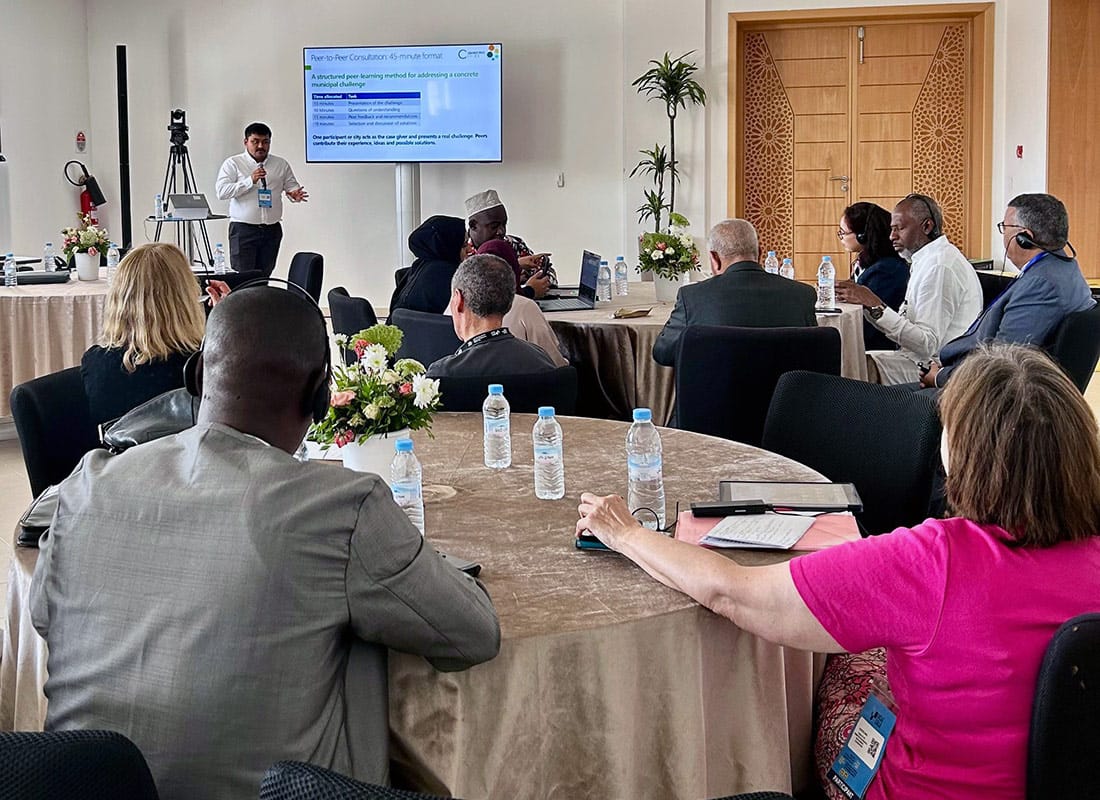
The Regional Renewable Energy for Cities Workshop, held from October 23-25, 2024, in Tunis, Tunisia, was organized by Connective Cities, RoAid, the Global Covenant of Mayors (GCoM), and the City Climate Finance Gap Fund (Gap Fund). The event was part of the Renforcement de la Gouvernance Locale et Modernisation des Service Locaux (REMO) project by GIZ Tunisia due to its close collaboration with Tunisian municipalities, key partners in the project, as well as its partnership with the Ministry of the Interior.

The regional conference aimed to strengthen renewable energy initiatives in urban areas, provide technical expertise, and promote peer-to-peer learning among cities in North and West Africa.

Tunisian cities participating in the workshop demonstrate a strong commitment to improving citizens’ quality of life, enhancing safety, and reducing energy costs through investments in green energy solutions. Their priorities include public lighting using photovoltaic panels and sustainable energy operations for public buildings (e.g., health, education, recreation).

The goal of these cities, regardless of their size or character, is to become more attractive for residents, investors, and tourists by fostering sustainable development and creating a healthy environment.

Tunisian cities face several challenges in their transition to green energy systems. Key obstacles include:

  • limited access to non-reimbursable funding,
  • modest technical and financial preparation,
  • political-administrative constraints, and
  • a shortage of technical expertise in the environmental sector.

Despite these hurdles, opportunities exist for cities to access support through initiatives like The Gap Fund, which provides assistance for feasibility studies, cost-benefit analyses, and securing international financing. International development banks prioritize projects that emphasize environmental health, community well-being, and the adoption of green technologies, adding significant value to local populations.

With immense solar potential and a favorable modernization context, Tunisian cities must focus on collaboration with other municipalities or regions to secure larger-scale funding. Leveraging the expertise of institutions such as GIZ, the European Investment Bank (EIB), and other development banks is essential. Additionally, adopting proven, cost-effective solutions from successful global projects can help tailor efforts to their specific needs. By aligning their initiatives with international standards, Tunisian cities can accelerate their transition to sustainable green energy systems and ensure a healthier, more attractive environment for citizens, investors, and tourists alike.

Day 1: Focus on project preparation, financing, and expert presentations

The workshop began with a welcome address by Madame Samira Abidi, President of the Instance Générale de Prospective et d’Appui à la Décentralisation, Ministry of Interior, Tunisia. She emphasized the importance of supporting cities in their renewable energy efforts, highlighting that the Ministry has available funds to support projects. Madame Abidi stressed the need for combined funding opportunities to maximize impact and welcomed all participants to collaborate towards sustainable solutions.

Jelena Karamatijević (Connective Cities) introduced the objectives of the workshop, stressing the organization’s commitment to peer learning and knowledge exchange among cities. She also introduced Connective Cities as a global network facilitating collaboration and capacity-building to tackle sustainability challenges through urban innovation and energy efficiency projects.

Romanian city expertise and good practices

The technical sessions began with a presentation by RoAid, focusing on the experiences of Romanian cities and how they have overcome challenges similar to those faced by cities in Tunisia and other African countries. Romanian experts discussed specific examples of solar energy integration, smart grid technologies, and energy-efficient infrastructure. These insights were particularly relevant, as Romania’s urban energy projects closely align with those of the participating cities. Romanian cities demonstrated innovative urban solutions in solar street lighting, community-driven energy models, and energy-efficient public infrastructure.

Kragujevac – renewable energy in district heating

‘ENERGETIKA’ Kragujevac, a state-owned company specialising in steam generation and air conditioning, has taken an important step towards environmental protection. In 2021, the old coal-fired boilers were replaced by modern gas-fired boilers, which have been in operation since the 2022/2023 heating season. This conversion has significantly reduced the plant’s environmental impact.

In a further project for the next three years, it is now planned to use the waste heat from a data centre located near the ‘Aerodrom’ boiler house heating plant and feed it into the district heating network using a heat pump. The data centre is planned for two expansion stages and the first has been in operation for less than two years. The currently installed cooling capacity of the 2 modules is 4.4 MW. The expansion of the data centre to 4 modules is expected to double the cooling capacity, which is planned for the coming years. The cooling system is designed for redundant operation.

By using the waste heat from the data centre in Kragujevac and other measures to increase energy efficiency in the hot water system, a significant reduction in greenhouse gas emissions will be achieved.

The initiative highlights the importance of continuous improvement through the exchange of expertise and experiences, ensuring medium to long-term success.

Showcasing the Amman Urban Observatory

The insight session on “Showcasing the Amman Urban Observatory” was held on 24 April 2024, delivered by Mr. Akram Khreisat from the Greater Amman Municipality. The session was organized by Connective Cities and presented to the global community of urban practitioners, as part of the Connective Cities network. Among the participants were urban practitioners, local and national government actors, academic researchers, non-governmental organizations, and local community members.

Mr. Akram Khreisat, director of the Amman Urban Observatory, introduced the participants into the working mechanisms and the fields of action of the Amman Urban Observatory and its role in tackling planning challenges in the capital city of Jordan.

The Amman Urban Observatory generates ‘urban indicators’ to monitor various aspects of the city that are important for urban development. Based on real-time monitoring of these urban indicators, planning processes in urban development are improved, as planners and developers are empowered to make informed decisions. In doing so, the observatory works together with ministries, government departments, national organizations, NGOs and companies from the private sector. The observatory works together with over 40 partners and stakeholders. Such urban indicators include vital characteristics for measuring sustainable urban development such as unemployment rate, land cover or the percentage of people living in poverty.

The Amman Urban Observatory has proved itself to be an effective tool for strategic and urban planning. Mr. Akram Khreisat described the observatory as not being a tool, but as a “process to achieve the Sustainable Development Goals”. In the case of the Amman Urban Observatory, the indicators created focus on the thematic areas of the following SDGs: Good Health and Well-Being (3); Affordable and Clean Energy (7); Industry, Innovation and Infrastructure (9); Sustainable Cities and Communities (11); Climate Action (13) and Partnerships for the Goals (17).  

After the presentation by Dr. Akram Khreisat, the attendees asked questions about the Amman Urban Observatory. When asked about the challenges and difficulties the observatory faces, he elaborated on the large influx of refugees that Amman receives and the associated challenges for the measurement of urban indicators. As the city recently receives many refugees, indicators need a certain flexibility to account for the inconstant change of inhabitant numbers. Furthermore, Mr. Khreisat was asked whether the observatory uses the gathered data for spatial analysis or 3D cadaster purposes. In answering this, he elaborates that they work together with the city’s GIS Department in order to deliver scenario plans for spatial growth.

The Connective Cities Network intends to create a working group to identify different best practices for the observation of urban parameters. Furthermore, interested cities are intended to be assisted through the development of templates that can be used to implement in a similar process to the one in Amman. Any city representatives interested in joining the working group are very welcome to contact Dr. Muna Shalan (muna.shalan@giz.de) and Mr. Jimmy Yoedsel (jimmy.yoedsel@giz.de) for further information and the possibility to take part.

Connective Cities would like to thank Dr. Akram Khreisat and all the participants for the presentation of the Amman Urban Observatory and for the fruitful exchange and discussion.

Resilience in Times of War – Municipal Exchange between Ukraine and Germany

Discover innovative strategies for rebuilding infrastructure and fostering resilience in Ukrainian municipalities amidst the aftermath of Russian aggression. Join us in exploring the outcomes of the Connective Cities’ Project Planning Workshop, ‘Resilience in Times of War – Municipal Exchange between Ukraine and Germany.’ Held from November 28 to 29, 2023, in Munich, Germany, this workshop brought together over 35 participants, including representatives from 12 Ukrainian municipalities. Through dialogue and experience sharing, attendees delved into key focus areas such as sustainable energy development, local and regional economic growth, and strategic/urban planning. Learn from the insights of esteemed guest speakers and delegates from Kosovo municipalities, as they offer perspectives on German and international municipal experiences, paving the way for collaborative efforts in rebuilding and fortifying Ukrainian communities. 

All presentations can be found here: https://community.connective-cities.net/en/group/215/topics

Renewable Energy Options on the Municipal Level

Discover the highlights of the Connective Cities Dialogue Event held from 10 – 12 October 2023, focusing on ‘Renewable Energy Options at the Municipal Level.’ In this insightful gathering in Tbilisi, Georgia, 35 urban practitioners from 19 municipalities across 8 countries convened to exchange experiences. Representatives from Albania, Bosnia and Herzegovina, Georgia, Germany, Moldova, Montenegro, Serbia, and Ukraine collaborated, sharing valuable insights and collectively crafting innovative solutions for sustainable energy practices at the municipal level. Dive into the dynamic discussions and collaborative efforts that unfolded during this event, driving positive change in the realm of renewable energy within diverse urban settings.

Watch video at YouTube:

https://youtu.be/uc1SMXGdHvs

Renewable Energy for Local Economic Development in Africa

The main objective of the workshop is to develop renewable energy projects in African cities.

The workshop was attended by 30 practitioners* from city governments, associations and the private sector representing 7 countries and 20 cities from Africa, as well as high-level guests including the Country Director of GIZ, the Kenyan Ministry of Energy, the head of the Romanian Development Agency (RoAid), the City of Gersthofen from Germany, and officials from the European Investment Bank (EIB) and the African Development Bank (AfDB). Representatives from various cities in Ghana, Kenya, Malawi, Nigeria, Senegal, Tanzania, and Tunisia also contributed to the success of the conference with their presentations of the framework conditions and project examples.

Connective Cities with side event @COP27

Join us on November 12th, 6:30 – 8:00 pm UTC+2, virtually or at the German Pavilion at COP27 – and discuss challenges and solutions to energy supply and energy efficiency in cities.

Cities worldwide face dependence on energy imports and energy supply as well as high prices and price fluctuation due to wars, conflicts, and insecure situations worldwide. The expansion of renewable energies and energy efficiency in urban development are therefore currently gaining further momentum.

How can cities work towards energy autarky? What role can cities play in eliminating energy imports? To what extent can cities and municipalities produce their own energy?

The side-event is organized by Connective Cities and the German Association of Cities (Deutscher Städtetag) and addresses challenges and good practices examples in the fields of:

  • Energy supply and energy consumption of different sectors in cities
  • Good Practices in reducing energy consumption (e.g., nearly zero energy buildings; renewable energy; clean energy)

Keynote: Mrs. Lea Ranalder, UN-Habitat

Panel discussion:      

  • Mr. Andreas Wolter, Mayor, City of Cologne, Germany
  • Mrs. Melanie Grabowy, Mayor, City of Bonn, Germany
  • Mr. Houcine Jrad, Mayor, Municipality Houmt Souk, Tunisia
  • Dr. Georges Youssef, Municipality Menjez, Lebanon
  • Mme Gladys Wanga, Governor County Government of Homa Bay, Kenia

Moderation: Sabine Drees, German Association of Cities

Virtual participation is possible via:  Side Event | Responding Russia´s war: Towards Energy Autarky on a local level (german-climate-pavilion.de)

Sustainable Urban Energy Planning in Southeast Europe (SEE)

Video about Connective Cities’ learning process II conducted in May 2021 – June 2022 to support municipalities in fine-tuning their project ideas in the fields of energy efficiency and renewable energy and developing them further towards bankable project proposals.

Watch video at YouTube:

https://youtu.be/TET3myNbj2I

More information on the dialogue event in November 2021:

Development of bankable project proposals for sustainable urban energy planning in Southeast Europe

TUMI Transport Outlook 1.5˚C

The Paris Climate Agreement as adopted in December 2015 set out to reduce global greenhouse emissions at a rate that would limit global temperature increase this century to a level 2.0˚C above pre-industrial levels. It went even further, laying out steps that might be taken to pursue an increase limited to 1.5˚C.

for exactly how we can achieve the goal of limiting greenhouse emissions. The transport sector accounts for nearly one-quarter of global energy-related carbon emissions. Climate action in transport is urgently needed because energy-related carbon dioxide (CO2) emissions are the main driver of climate change (Teske et. al 2019). Yet a clear-cut path to transformation, one which is backed up with ‘hard’ numbers for policymakers around the world, remains missing. To close this gap, TUMI and the University of Technology Sydney developed a robust scenario study.

This study considers the conditions necessary to achieve these goals under three scenarios: A reference baseline study, in which no changes are implemented in terms of transport, along with a look at those changes that need to take place in order to limit warming to 1.5˚C or 2.0˚C.

For an executive summary and animated charts visit:

https://outlook.transformative-mobility.org/

TUMI Transport Outlook 1.5˚C

The Paris Climate Agreement as adopted in December 2015 set out to reduce global greenhouse emissions at a rate that would limit global temperature increase this century to a level 2.0˚C above pre-industrial levels. It went even further, laying out steps that might be taken to pursue an increase limited to 1.5˚C.

for exactly how we can achieve the goal of limiting greenhouse emissions. The transport sector accounts for nearly one-quarter of global energy-related carbon emissions. Climate action in transport is urgently needed because energy-related carbon dioxide (CO2) emissions are the main driver of climate change (Teske et. al 2019). Yet a clear-cut path to transformation, one which is backed up with ‘hard’ numbers for policymakers around the world, remains missing. To close this gap, TUMI and the University of Technology Sydney developed a robust scenario study.

This study considers the conditions necessary to achieve these goals under three scenarios: A reference baseline study, in which no changes are implemented in terms of transport, along with a look at those changes that need to take place in order to limit warming to 1.5˚C or 2.0˚C.

For an executive summary and animated charts visit:

https://outlook.transformative-mobility.org/