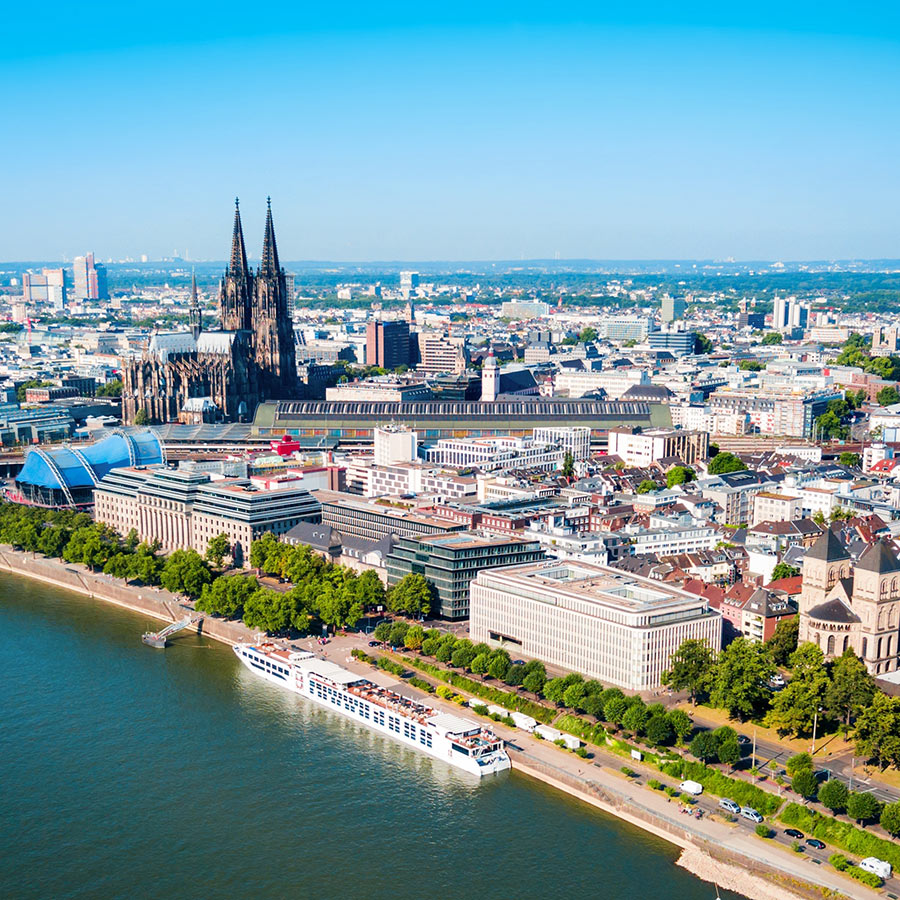
From 14 to 16 September 2026, the 19th Federal Congress on National Urban Development Policy will take place in Cologne. The theme is “Act together, act faster, think further: shaping cities for everyone”. This event will bring together stakeholders from local governments, politics, public administration, academia and civil society to discuss innovative approaches to sustainable, resilient and forward-looking urban development.
For the first time this year, Connective Cities will have a stand at the event run by the Service Agency Communities in One World (SKEW). The congress offers an excellent opportunity to raise the profile of the international city network and its services for facilitating professional exchanges between local authorities. We will be focusing on discussions with local authority experts from the fields of urban development, mobility, climate adaptation and sustainable transformation.
At the SKEW stand, we particularly want to show experts what Connective Cities has to offer and discuss potential opportunities for participation and cooperation. We will also present selected examples of good practice from the relevant specialist areas, as well as the Connective Cities Media Centre as a knowledge platform. We warmly invite network members attending the Federal Congress to take this opportunity to speak to the team at the stand. We look forward to exchanging ideas, making new contacts, and generating new impetus for municipal development cooperation.
Kisumu, a port city on the shores of Lake Victoria and one of Kenya’s largest cities, is becoming increasingly important for the movement of goods and trade between Kenya and its neighbouring countries, Tanzania and Uganda. With an annual population growth rate of just under 4 per cent, the population has more than doubled in 15 years, rising from around 205,000 in 2001 to at least 422,000 in 2025. This has led to a series of major infrastructure projects, which, however, have primarily focused on motorised transport, even though 53 per cent of residents’ daily journeys are made on foot.
One project under the ‘Kisumu Sustainable Mobility Plan’ is the ‘Walkable Triangle’: the pedestrian-friendly redesign of the three main streets—Oginga Odinga, Ang’awa Ave and Jomo Kenyatta Ave—in a commercial district in the city centre. These streets form a triangle around a sports and park area and are used by over 2,200 pedestrians every day. The aim is to promote non-motorised transport along the 1.5-kilometre stretch, making it safer, more pleasant and accessible, whilst preserving and integrating the existing tree population.
In addition, the city is promoting e-mobility in public transport through a battery-swapping system for motorcycle taxis, known as ‘boda-bodas’, and three-wheeled taxis, known as ‘tuk-tuks’.
The documentation describes the approach as well as the outcomes achieved by this good practice.
Publisher: German Institute for Urban Studies (Difu)
Women and gender minorities make up more than half the world’s population, yet transportation systems have historically been planned around a default male user. Research indicates that women and gender minorities navigate mobility networks differently, yet their travel patterns and needs remain underserved by conventional planning models. By prioritizing the needs of women and gender minorities, planners can design safer and more accessible transportation systems that enhance the experience for every user. This toolkit offers practical resources and guidance for designers, planners, and policymakers looking to integrate gender-inclusive practices into mobility and transportation planning. Mirroring the key phases of the urban planning process, the toolkit features chapters on topics such as data collection and public participation, each illustrated by a case study from local government projects. The toolkit also includes a Practitioner’s Guide that highlights key points and recommendations, allowing readers to quickly grasp and apply key guidance without reading the entire toolkit. While the toolkit is not comprehensive, it offers a starting point for re-examining and improving transportation and mobility systems at the local level.
What does it take to make mobility in our municipalities more sustainable? New technologies? More funding? The will of the citizens? One answer: We need reliable information to make informed decisions that can bring about targeted changes. At the dialogue event “Sustainable mobility—Combination of future-proof mobility forms” last November, 38 participants from 11 different countries identified data management and use as a central aspect of the transportation transition. On 23 March 2026, around 20 participants in the Connective Cities learning process came together again for an online follow-up session to engage in an in-depth discussion on the topic of ‘mobility data management’. During the two-and-a-half-hour exchange, a total of 5 municipalities presented aspects of their mobility data management as a basis for transportation planning decisions.
“Data (or the absence) can be a reason to unnecessarily delay important decisions. Also make sure you apply the correct data for the correct application.”
Participant as part of a survey conducted during the online event
Those with the capacity and financial resources can undertake the process of developing a Sustainable Urban Mobility Plan (SUMP). This multi-year, partly participatory data collection and analysis process includes a catalog of Sustainable Urban Mobility Indicators (SUMI) and concrete recommendations for action. Dr. Metin Mutlu Aydin, Associate Professor at Ondokuz Mayıs University, who provided academic guidance during the three-year development of the SUMP in Trabzon, Turkey’s easternmost major port city on the Black Sea, presented the process and the recently published results to the participants in his keynote speech:
SUMPs are strategic plans used to formulate concrete, participatory responses to the mobility needs of people and businesses. To this end, the team of experts responsible draws on primary and secondary data and bases its recommendations for action on a large-scale participatory process. The city of Trabzon utilized existing statistics but also invested in a variety of digital measurement methods that enable automated, real-time data collection and ensure the monitoring of set goals. The most comprehensive data was collected through participatory means, including institutional meetings, exchanges with professional and civil society organizations, and public engagement via online surveys and social media. In Trabzon’s case, a total of 95 institutions were consulted. Integrated scenario analyses highlight the need for action: in this coastal city with hilly topography, for example, day trips by car already result in high traffic volumes today. By 2040, this number is expected to nearly double. Therefore, the city must provide alternatives, particularly along the identified main corridors.
In Munich, data is continuously collected and analyzed using a multimodal traffic model (“M3”); the City of Munich places a high priority on its data strategy. Attila Lüttmerding, Head of the Fundamentals and Data Division in the City of Munich’s Mobility Department, emphasizes that data should not be collected for its own sake, but rather that efforts must be goal-oriented. In addition to climate neutrality and traffic safety, Munich aims to significantly improve the use of public transport, walking, cycling, and electric vehicles. The data clearly demonstrates this success: The “traffic jam capital” has been showing a clear trend toward becoming a “pedestrian-friendly city” for several years now; the use of sustainable modes of transportation is increasing despite rising car ownership. Especially in the city center, these options are now an alternative for many. To determine this, the city uses a variety of technologies and—pragmatically—continues to use manual counting methods. The robust data set enables Munich to provide accurate information, including regarding the EU’s mobility indicators, which are intended to ensure greater international comparability in the coming years.
Viktor Goebel, project manager in the City of Munich’s Mobility Department, highlighted how sharing services can become more user-friendly if they are tailored to user behavior and closely monitored. Operators must adhere to the rules imposed on them by the city: E-scooters may not be parked in certain areas, and there are also limits on, for example, the number of scooters per zone, so that pedestrian and bicycle traffic is not disrupted by the additional mobility option. Data analysis is used here to determine the needs of individual areas and identify which sustainable forms of mobility can be effectively implemented. The significant level of interest shown by Munich’s residents thus justifies municipal subsidies.
Bremen, Windhoek (Namibia), and La Paz (Bolivia) provided brief insights into how data is managed in other municipalities. While data in Bolivia is managed as open data and public portals facilitate its use, the digital ticketing system in Windhoek serves as a new source of important data, enabling, among other things, the identification of areas where fare evasion poses a financial risk to operators.
In subsequent breakout sessions, participants engaged in in-depth discussions and gained further insights:
“Companies are always asking for money, so you need to do your own research to be able to evaluate their offers”
Voice as part of a survey conducted during the online event
However, the group discussions also highlighted how varied the availability and resources for data analysis are, and that it is important to consider many suggestions within their respective individual contexts.
On 26 February 2026 from 11:00 to 12:30 CET, the Heilbronn Region Economic Development Corporation will present an Insight Session on the Heilbronn Green Hydrogen Model, highlighting how the Heilbronn-Franken region is advancing the green hydrogen transition through a coordinated regional ecosystem.
Aligned with the EU Hydrogen Strategy and Germany’s National Hydrogen Strategy, the initiative supports climate neutrality by expanding electrolysis capacity, developing hydrogen infrastructure, and connecting to the national hydrogen core network.
Under the regional transformation programme ANTRIEB HNF, the strategies RegioStrat and H2 Transform HNF guide long-term planning for energy, mobility, industry, and infrastructure until 2040. Implementation is driven by H2-Impuls, which brings together over 100 stakeholders from 60 institutions, initiates concrete subprojects, and strengthens regional coordination through structured networking and communication.
Join us to gain practical insights into regional hydrogen development and to exchange with experts on building effective hydrogen ecosystems.
The approximately 9,300 inhabitants of Borgholzhausen in Germany are spread over an area of 56 km². One third of the population lives in the town centre, while the other two thirds live in eleven settlements, each with a few hundred inhabitants. From the station in Borgholzhausen, the NordWest-Bahn railway connects to the neighbouring cities of Osnabrück in the north-west and Bielefeld in the south-east. However, there is no local public transport connecting the settlements to the station.
Against this backdrop, Borgholzhausen has developed a new type of electric car sharing service that enables residents of the municipality to book the last mile from the train station to their home conveniently and at no extra cost, included in the price of their train ticket. The neighbouring municipality of Halle-Künsebeck is participating in this innovative mobility concept.
Anyone with a valid public transport ticket can now book an electric vehicle free of charge for a maximum of half an hour on specified routes between certain stops. It is also now possible to rent a vehicle at a moderate cost through the classic car-sharing scheme. The income from this reduces operating costs.
This good practice describes how this model, which is unique in Germany to date, was developed, how it is being implemented, what advantages it offers and what lessons have been learned so far.
From 25 to 27 November, Connective Cities hosted a dialogue event in Bonn. 38 experts from 20 municipalities in 11 countries followed the invitation to share their innovative project approaches with colleagues and collaborate on new implementation ideas.
Stefan Wagner, Head of the City of Bonn’s Office for International Affairs and Global Sustainability, warmly welcomed the guests, especially his colleagues from La Paz, Bonn’s twin city. The two cities are already collaborating on numerous sustainability projects. Bonn itself has set itself the goal of becoming climate neutral by 2035, with the aim of achieving 75% CO₂-free mobility by then.
ighlighted the complexity of regional mobility planning in Germany. | Photo: Aschoffotografie, Engagement Global
In his opening speech, Jan Strehmann, Head of Mobility at the German Association of Towns and Municipalities (DStGB), highlighted the complexity of regional mobility planning in Germany. Various levels of government — federal, state, district and individual municipalities — are often involved, either as financiers or planning units. Additionally, municipal and private transport providers frequently collaborate to establish transport associations responsible for providing public inter-urban local transport services. In this context, it is not competition, but rather tailor-made cooperation, that plays a decisive role in ensuring smooth passenger transport.
In her presentation, Melanie Schade, project manager at the Federal Institute for Research on Building, Urban Affairs and Spatial Development (BBSR), introduced Mobilikon. This online encyclopaedia compiles information on mobility in rural areas, helping local authorities to prepare and implement mobility measures more easily. The database contains 104 measures, 110 instruments for their implementation and 79 implementation aids for areas such as external communication and data collection. It also contains 206 practical examples. Various filters, e.g. for spatial structure, costs and implementation duration, facilitate the search for suitable measures.
In his welcoming speech, Jürgen Kretz, the new head of the Countries and Municipalities Division at the Federal Ministry for Economic Cooperation and Development, expressed his delight that Connective Cities had entered a new phase in October 2025 and was now more broadly positioned within Germany with three additional partners: the DStGB, the German County Association (DLT), and the Association of Municipal Enterprises (VKU).
The Connective Cities team led to the technical part of the event and the project presentation.
The participants in front of the old town hall in Bonn | Photo: Aschoffotografie, Engagement Global
Small municipalities such as Schlangen in the Teutoburg Forest in Germany, with a population of around 9,000, were represented, as well as metropolises with millions of inhabitants, such as Rio de Janeiro and Munich. The innovative approaches were equally diverse. The free electric line-car-sharing service in Borgholzhausen, unique in Germany, connects rural communities with the nearest train stations. Meanwhile, Kisumu in Kenya has developed a battery exchange model for electric motorcycle taxis; La Paz, the capital of Bolivia, plans to integrate its 36-station cable car network — the largest in the world — more closely with the bus network; and Rio de Janeiro is developing a multimodal network comprising express buses, buses, cycle paths, bicycle parking facilities, and e-bike rentals. Despite or because of the war, Vinnytsia in Ukraine is gradually converting its public infrastructure to make it barrier-free. Monheim is focusing on autonomous shuttle buses and Windhoek in Namibia is providing students with electric bikes on loan. Poti in Georgia and Strumica in North Macedonia are expanding their cycle path networks, while Dortmund is systematically expanding its charging infrastructure for cars and e-bikes. Munich is pursuing a comprehensive strategy to link the various CO₂-free forms of mobility as closely as possible, including through an app and mobility hubs. These are just a few examples of the projects underway.
Despite all the structural, geographical and cultural differences, it quickly became clear during the various experience-sharing sessions that the challenges faced were largely similar. These include:
complex institutional frameworks;
conflicts over the use of limited public space;
lack of standards in data collection and processing;
infrastructure damage due to vandalism and theft;
changing political guidelines and/or unclear legal frameworks;
different and high expectations of stakeholders;
changing the usual behaviour patterns of citizens in terms of mobility;
insufficient financial resources for project implementation;
and finally: obtaining know-how about similar projects.
The last point was largely resolved during the conference. Implementation challenges in Bergholzhauen, Kisumu, La Paz, Munich, Poti, Trabzon (Turkey), Strumica and Windhoek were discussed in depth during peer consultations.
Further project ideas were considered in the action planning stage:
‘Pedestrian Angles’: public relations work to promote walking in Kisumu
Integrated mobility planning with political backing in Windhoek.
Improved data management in Vinnytsia.
Development of safe cycling infrastructure in Poti.
The dialogue event concluded with an excursion to a bus depot operated by Stadtwerke Bonn (SWB), which has charging infrastructure for electric buses. The group also visited the bicycle station (‘Radstation’) at Bonn Central Station and mobility stations offering services such as cargo bicycle rental, secure bicycle parking boxes, car-sharing parking spaces, and municipal charging facilities for electric vehicles in Bonn’s Südstadt district.
Marcella Sobisch, the project coordinator, will continue to supervise the learning process in the coming year and is the contact person for the group and other interested parties: marcella.sobisch@engagement-global.de .
To build cities of the future, which provide good quality of life, improved economic robustness, and harmony with nature, India needs unique solutions that are not only efficient but also offer services and benefits to all segments of society. It has chosen to leverage data in creating these solutions by facilitating the real-time sharing of data among stakeholders through an open, neutral, and secure platform, the India Urban Data Exchange (IUDX). IUDX is all about the use of data for public good and enabling data providers to create innovative services and generate value.
With Corona, there was also a crisis in public transport in the German capital Berlin: passenger numbers fell by 70% – the BVG met the communication challenge with humour. Passengers and employees were to be convinced that safe bus and train travel was possible under consideration of the Corona rules.
As cycling is becoming increasingly popular for leisure and as an alternative to using the car, municipalities have to adapt their cycling infrastructure. However, they should not forget to involve their citizens in the planning process.