Municipal Observatory for Gender Mainstreaming

“What gets measured, gets managed.” This adage underscores the importance of tracking progress to achieve meaningful change. For municipalities committed to gender mainstreaming, this means developing structured data systems, enriching the knowledge base, and ensuring precise monitoring—essential steps toward truly inclusive, gender-sensitive local governance.

Building on the model pioneered by the National Federation of Tunisian municipalities (FNCT) and its partners,1 this guide provides a unified, practical framework for advancing gender equality by integrating a gender perspective across all municipal services. Beyond policies and projects, it aims to catalyze a cultural shift—one where gender mainstreaming is no longer an add-on, but a fundamental pillar of equitable and effective local governance. Establishing a municipal observatory for Gender Mainstreaming enables municipalities to integrate the gender perspective into all aspects of municipal services, and to foster a shift in mindset where gender mainstreaming is recognized as a core element of fair and inclusive local governance. Employing the guide’s evidence-based approach, municipalities can stimulate dialogue, propose concrete solutions, and develop measurable gender related indicators that municipalities can apply and track.

Municipal Observatory for Gender Mainstreaming

English version [pdf, 11 pp.]

Arabic version [pdf, 11 pp.]

Empowering Communities: The Ripple Effect of Women’s Leadership

The initiative “Making My School More Beautiful,” led by five women elected for the municipal council of Yarmouk al-Jadida municipality in Jordan, showcases a successful model for promoting democracy and empowering girls through school parliaments. By collaborating closely with local communities, schools, and mothers, the project not only enhanced school environments but also fostered civic awareness and active participation among young women. Its structured approach offers a replicable framework for similar initiatives in other communities.

Connective Cities at WUF12
Under the notion ‘initiate change from home: locally, together, and now’, WUF12 was convened in Cairo- Egypt on 4  – 8  November 2024. Connective Cities and its network members have organized and participated in several activities with various thematic focus areas.
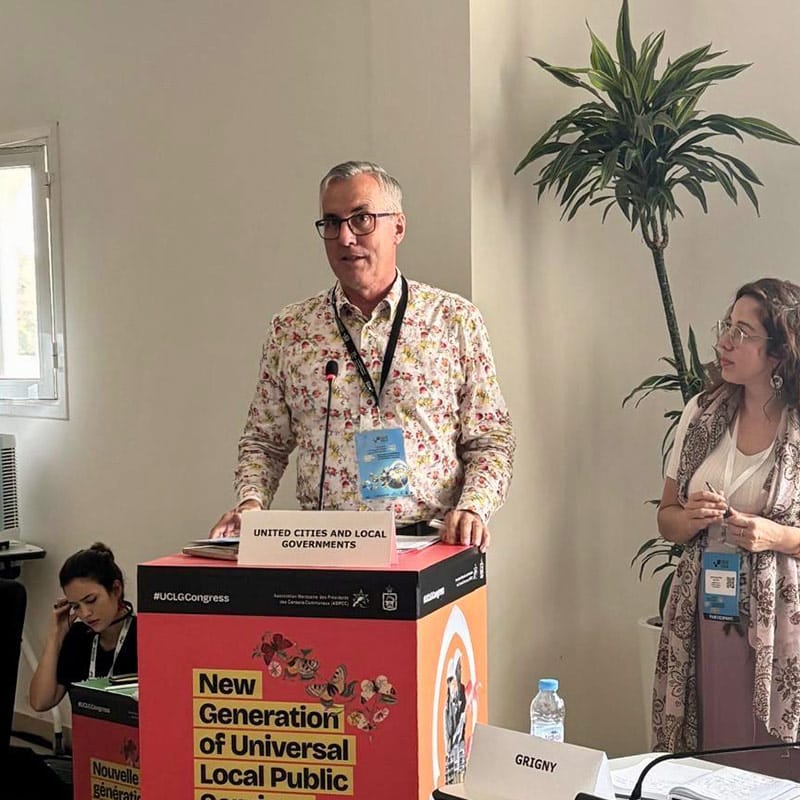
As a thriving knowledge-sharing network, Connective Cities was showcased during an intellectual panel that included representatives of the Guangzhou Institute for Urban Innovation, VNG International, the Arab Urban Development Institute, and Metropolis. The discussion delved into examples of utilizing digital tools and innovative approaches for growth and collaborative knowledge-sharing to advance inclusive and resilient urban development on a global scale.
Strategies and tools for successful municipal election campaigns

Planning a successful municipal election campaign involves several key elements that include understanding the political landscape, developing a campaign strategy, building a strong campaign team, creating a compelling message, fundraising, outreach and engagement, as well as utilizing media and technology. To delve into these topics, a workshop was held on the 29th July 2024 as part of the working groups’ activities. The workshop introduced the necessary strategies, tools, and practical steps to build successful election campaigns that bring women into leadership positions in municipalities. By showcasing experience from Germany and Lebanon, the participants have also discussed the challenges and obstacles that female candidates may face and ways to overcome them.

Women’s leadership in municipalities

The disparity in confidence and trust placed in female leaders in municipalities compared to their male counterparts presents a significant impediment towards promoting women’s leadership in municipalities. This gap is manifested in various ways, including biased perceptions, limited support from the voters, and unequal treatment in professional settings that hinders their efforts to create positive change.

The working group ‘Women’s leadership in municipalities’ has identified this topic among three thematic focus topics that also include election campaigning and lobbying strategies, as well as legislative reforms of municipal election laws. The workshop held on the 25th June aimed at 1) proposing practical ideas and mechanisms to enhance women’s self-confidence to fully achieve their leadership potential, 2) investigating ways to strengthen trust between women and society with regards to assuming decision-making roles and implementing reform programs.

Related publication:

Municipal Observatory for Gender Mainstreaming
A guide for municipalities in the MENA region

Working group Kickoff: Women’s leadership in municipalities

With this statement, participants of the working group ‘Women’s leadership in municipalities’ have begun their activities. The virtual kickoff took place on the 16th May 2024 and included an input from the former deputy mayor of Bonn (Ms. Melanie Grabowy), and the showcasing of the GIZ manual ‘Duos for Empowerment’ on a Mentoring Programme for Women in the Middle East and North Africa focusing on practical experience from Palestine, Jordan and Lebanon (presented by Hiba Tijani, WOMENA-GIZ).

The participants who represent 14 municipalities and civil society from Jordan, Palestine, Lebanon, Tunisia, Morocco and Germany have expressed their enthusiasm and team spirit to engage with their peers on this topic and to exchange experience in order to design localised solutions.

Related publication:

Municipal Observatory for Gender Mainstreaming
A guide for municipalities in the MENA region

Women’s leadership in municipalities

As a follow-up to the webinar on ‘Women in Municipal Leadership’, which took place in February 2024, Connective Cities recently organised another insight session for the network in the MENA region. This event focussed on the experiences from Tunisia and Morocco.
Historically, Tunisia has been a forerunner and an example of equitable representation of women in municipal councils in the MENA region and around the globe. In 2018 seven years after the 2011 revolution and four years after the adoption of the constitution, women made up 47 per cent of the local council positions in Tunisia. The dramatic increase in women members is the result of a 2016 electoral law that includes the principles of parity and alternation between men and women on candidate lists for all elections. Nonetheless, presidential decrees announced in March 2023  dismantled the country’s democratically-elected municipal councils.

In Morocco, the international commitments and affirmation of equal rights for women and men political rights in addition to legal and institutional measures have prompted women’s political participation.

The speakers representing the National Federation of Tunisian Municipalities (FNCT), the National Democratic Institute in Tunisia (NDI), and the municipality of Fes in Morocco have delved into the status quo of legal barriers and their impact on women election and roles assessing the advantages and disadvantages of the gender quota in election. In addition, they discussed opportunities and challenges for the full participation of women in politics and public affairs.

Against this background, Connective Cities is launching a working group to spread awareness and advocate for creating a supportive environment where women can play an active, productive and leading role in municipal and local governance. Empowering women includes strengthening their knowledge and boosting their skills to give them more opportunities and capacities in communicating and building fruitful partnerships and fulfill a decisive role in achieving sustainable development.
For further details about this working group, please refer to the concept note.

Recording of the insight session

Please do not hesitate to contact us, if you have any questions: muna.shalan@giz.de

Related publication:

Municipal Observatory for Gender Mainstreaming
A guide for municipalities in the MENA region

Women’s leadership in municipalities

As part of the network activities in the MENA region, an insight session was held on 5 February 2024 to delve into the opportunities and challenges influencing women’s leadership and representation in municipalities.

Gender equality and the inclusion of women in decision-making processes has been catapulted to the forefront of the political debate in the last few decades in the MENA region. Efforts to promote women’s leadership in municipalities are promising, with some states implementing policies aimed at increasing women’s representation. Despite this progress, persistent challenges such as limited access to education and institutional barriers, hinder women’s progress towards leadership positions.

In this insight session, participants have engaged in discussions about the importance of women’s leadership in municipalities and the related challenges, while acknowledging the progress that has been achieved. Dr. Manal Al-Abdallat, the director of the women’s regional network at the Greater Amman municipality, has presented an overview of the tools that increased women’s representation in municipalities including the establishment of women’s empowerment units. Nonetheless, she highlighted that women’s limited access to funds for lobbying limits their chances of success in election campaigns. An additional challenge is the phenomenon of nominating a single candidate for tribal representation, which puts women at a disadvantage compared to male candidates.

Related publication:

Municipal Observatory for Gender Mainstreaming
A guide for municipalities in the MENA region

Gender mainstreaming and inclusive governance in municipalities

Gender equality has emerged as a critical driver of social progress and inclusive governance, in which municipalities play a crucial planning and implementation role. To strengthen the municipal role in gender mainstreaming and inclusive governance, Connective Cities has co-organised a workshop on 8-10 August 2023 in Amman-Jordan for municipal actors and experts to showcase good practices in this field as well as to support the participating municipalities in developing measures to achieve sustainable, inclusive and gender-equitable development in their respective contexts. Get inspired by short video!
Watch video at YouTube: https://youtu.be/JHvDIx2e40k

Further information: https://www.connective-cities.net/en/news/gender-mainstreaming-and-inclusive-governance-in-municipalities

Gender mainstreaming and inclusive governance in municipalities

Gender equality has emerged as a critical driver of social progress and inclusive governance, in which municipalities play a crucial planning and implementation role. To strengthen the municipal role in gender mainstreaming and inclusive governance, Connective Cities has co-organised a workshop on 8-10 August 2023 in Amman-Jordan for municipal actors and experts to showcase good practices in this field as well as to support the participating municipalities in developing measures to achieve sustainable, inclusive and gender-equitable development in their respective contexts. The collaboration included other programmes: WoMENA, the Municipal Know-how for Host Communities in the Middle East Programme (IKKN) (German-Jordanian-Lebanese) and PAL (German-Palestinian).
Watch video about the workshop at YouTube: https://youtu.be/JHvDIx2e40k