Local authorities face challenges due to climate change and soil sealing, with frequent droughts, floods, and heavy rainfall. Ensuring water supply, preserving green spaces, and preventing damage can be addressed through nature-based and structural measures. Approaches like the sponge city principle, unsealing urban areas, and installing retention basins are becoming central to climate adaptation strategies. In Germany and the Global South, innovative solutions are emerging. Connective Cities therefore offers an in-depth learning process on this topical and highly relevant subject.
Connective Cities is launching an international call for applications for its new Deep Dive. It will begin in early 2026 and will run until 2027, depending on the funding allocated. The Deep Dive is a recent format from connective cities, the platform for sustainable urban development that brings together up to five municipalities from the Global South and three German municipalities, which are invited to work together to develop a locally adapted solution that responds to a current challenge.
To participate in this Deep Dive, please send us your completed expression of interest before 5 January 2026.
The use of artificial intelligence (AI) is becoming increasingly important for local governments. From more efficient administrative processes to data-driven decisions in urban development, resource use, or citizen participation, AI opens up new possibilities for action. At the same time, questions arise about ethical standards, transparency, and social inclusion.
The expert event brings together municipalities from Germany and the Global South to share international experiences, opportunities, and challenges in dealing with AI in municipal practice.
The aim is to:
highlight specific best practices from different contexts,
promote interregional knowledge exchange, and
provide impulses for the development of individual approaches.
Firstly, the Bonn-based AI company Petanux will present its AI tools and how they collaborate with German municipalities. Secondly, the City of Jakarta will showcase the AI tool employed to support its urban development strategy. The event will conclude with a presentation from the City of Hamburg, sharing its experiences with a Large Language Models (LLMs)-based analysis tool used to monitor the implementation of the SDGs in Hamburg.
The global transition towards sustainable transportation is essential for a sustainable future. Experts agree: there is no one-size-fits-all solution for sustainable mobility. Instead, we must create public transport services that include a range of mobility solutions and combine them in the best possible way – in a smart, accessible, and time- and resource-efficient manner. In addition, measures must be tailored very individually to the needs of citizens in individual regions, cities, counties, or municipalities. For strategic planning, German municipalities often develop concepts across regions in collaboration with transport and special-purpose associations. Innovative solutions and considerations for connecting transport are particularly reflected in concepts for mobility, tourism, or strategic regional development. In the Global South, municipalities are often challenged by urbanization and increasing traffic volumes to formulate solutions for developing their communities, and are increasingly relying on digital solutions and private providers.
The dialogue event marks the start of a one-year learning process in which participating municipalities are also invited to take part in further optional activities.
Objectives of the event
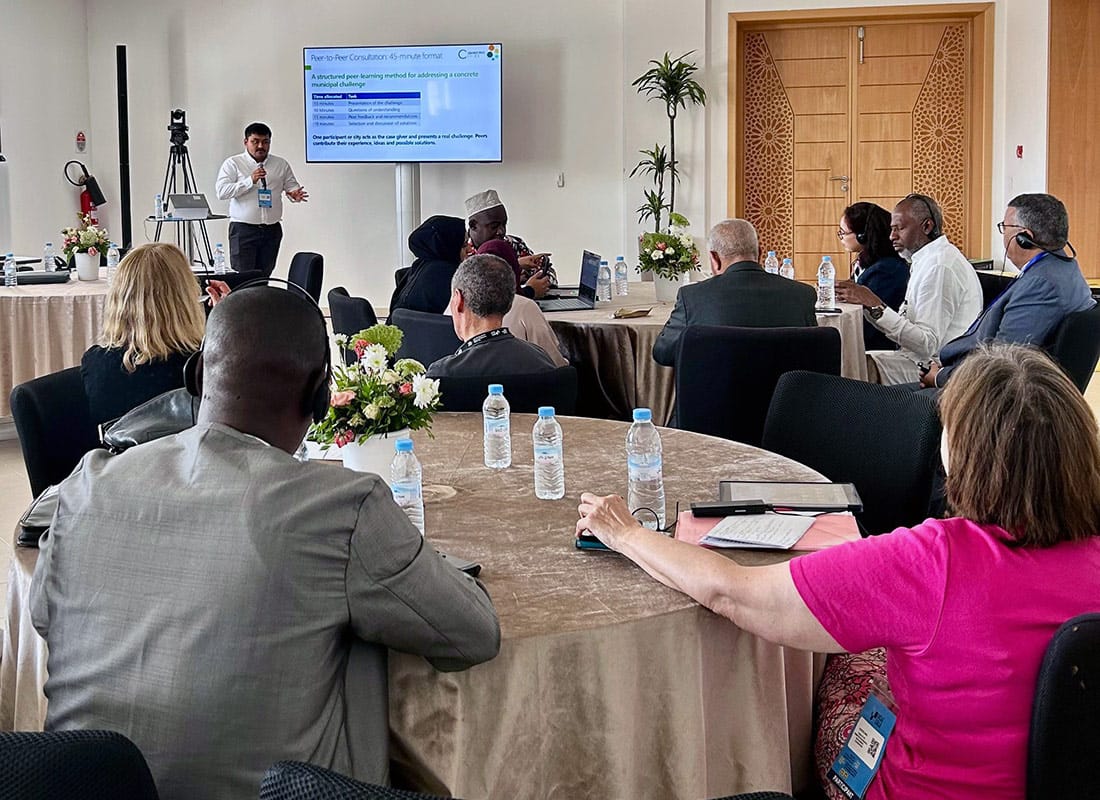
The event brings together experts from cities, counties, and municipalities and supports international expert exchange on the interaction of sustainable forms of mobility.
Goals for participants
Learn about innovative mobility solutions and how to combine them in a smart way
Compare strategic approaches and instruments for sustainable mobility in cities and surrounding areas
Acquire skills to solve challenges in the implementation of planned measures, drawing on an extended network and the method of peer consultation
In addition: getting to know each other as a basis for expanded peer exchange, e.g., through professional exchange trips
Participation and contact
If you would like to participate in the learning process, please send us an email by 15 October 2025, with details about your municipality or organization, your role, and a brief description of the project or challenge you would like to present to the other participants.For further information, please download the Call for particpation [pdf, 2 pages].
If you have any questions about the Connective Cities learning process, the event and your participation, please feel free to contact us:
African and German Cities Power a Shared Vision for a Just, Climate-Smart Hydrogen Future
Cities across Africa and Europe are accelerating their role as frontline actors in the global green transition, driving innovation, investment, and climate resilience from the ground up. Following the successful launch of the Hydrogen Cities Working Group earlier this year in Naivasha, Kenya, Connective Cities will convene the second peer-learning workshop on 24–27 November 2025 in Mombasa, Kenya.
This flagship event will bring together city leaders, practitioners, industry innovators, researchers, and development partners to scale up municipal hydrogen strategies and unlock new pathways for green industrialization, inclusive growth, and just transition at the local level.
From Naivasha to Mombasa: Turning Ideas into Impact
The inaugural workshop in Naivasha brought together over 30 municipal representatives and technical experts to explore how cities can anchor the emerging green hydrogen economy in local value creation and job generation. It underscored hydrogen’s role not only as a clean-energy vector but as a catalyst for climate-neutral industrial ecosystems, skills development, and innovation-driven urban transformation.
Case studies showcased how municipalities are positioning themselves along the hydrogen value chain — from production and storage to end-use applications in mobility, manufacturing, and port logistics. Examples ranged from Namibia’s evolving hydrogen hubs to Germany’s Heilbronn and Karlsruhe regions, where local governments are building innovation clusters, R&D partnerships, and market linkages for hydrogen deployment.
Specialist presentation during the meeting in Naivasha | Photo: Connective Cities
Participants also highlighted the importance of integrated urban governance — combining spatial planning, transparent land management, and strong stakeholder engagement — to ensure hydrogen projects deliver tangible community benefits.
Key takeaways from Naivasha included:
Municipal leadership as a driving force for innovation, investment, and policy alignment.
Local value creation through SME participation, skills training, and green entrepreneurship.
Institutional capacity and human capital as preconditions for hydrogen readiness.
Peer-to-peer collaboration as a catalyst for scaling solutions and knowledge transfer.
Since Naivasha, cities have been actively refining their project concepts, forging cross-regional partnerships, and identifying bankable entry points to accelerate their green transition agendas.
Green Hydrogen: Powering Sustainable, Inclusive Urban Futures
Africa’s vast solar and wind potential places its cities at the heart of the global clean-energy transformation. Green hydrogen — and its derivatives such as green ammonia and e-methanol — offers a once-in-a-generation opportunity for low-carbon industrialisation, climate resilience, and circular economy development.
For municipalities, this transition means:
Developing innovation clusters and hydrogen corridors that attract private investment.
Expanding renewable energy infrastructure and smart urban grids.
Enhancing water security and resource-efficient technologies such as desalination and wastewater reuse.
Creating green jobs across engineering, construction, logistics, and research sectors.
Catalysing start-ups, incubators, and technology partnerships.
Building skills pipelines aligned with future hydrogen markets.
Yet, challenges persist — from infrastructure gaps and regulatory complexity to financing bottlenecks and local ownership. The Hydrogen Cities Working Group provides a collaborative platform where cities can co-create solutions, de-risk investment, and ensure the green transition remains inclusive, equitable, and locally anchored.
What to Expect in Mombasa: Scaling Up and Going Deeper
The upcoming workshop in Mombasa will mark a critical shift from strategic visioning to operationalisation and project implementation. Over three days, participants will:
Present project updates and refine concepts through structured peer-review and coaching.
Engage in interactive sessions on land use, water-energy nexus, and industrial cluster design.
Explore innovative financing instruments, including blended finance and PPP models.
Participate in hands-on peer-coaching clinics to advance project maturity.
Exchange with international experts on policy frameworks, investment pipelines, and market integration.
Join a site visit to the Mombasa Port and Special Economic Zone to identify real-world opportunities for green hydrogen applications.
The event will feature keynotes from government and private-sector leaders, expert panels, and networking sessions to strengthen partnerships between African and German municipalities.
Confirmed participants include cities such as Mombasa, Naivasha, Lüderitz, Arandis, Nouakchott, Waterberg District, Hamburg, Karlsruhe, Heilbronn, and Freudenstadt — forming a growing alliance of municipalities championing decentralized, climate-smart hydrogen ecosystems.
Looking Ahead: Cities as Catalysts of a Just Green Economy
As the global energy landscape transforms, cities that act decisively today will become the engines of tomorrow’s green prosperity. The Mombasa workshop represents another milestone in empowering municipalities to lead the hydrogen-powered urban transformation — advancing climate action, economic resilience, and social inclusion in equal measure.
Through the Hydrogen Cities Working Group, Connective Cities continues to bridge continents, connect expertise, and translate ambition into action — ensuring that the hydrogen revolution drives sustainable, locally embedded, and future-ready urban economies.
From Naivasha to Mombasa, cities are demonstrating that the green transition starts locally — and scales globally.
The Final Event of the Connective Cities Learning Process in Southeast Europe brought together municipalities, donors, and technical experts in Podgorica to accelerate the region’s transition toward sustainable, renewable energy solutions. Over three dynamic days, participants exchanged practical insights, pitched municipal project concepts, engaged directly with financing institutions, and visited a completed energy-efficiency project in Cetinje. The workshop marked the culmination of nearly two years of collaboration, equipping cities with clearer financing pathways, stronger partnerships, and concrete next steps for turning their renewable energy ambitions into implementable, fundable projects.
On a voluntary basis, more and more municipalities are reporting on the implementation status of the 2030 Agenda‘s Sustainable Development Goals (SDGs) at the local level in so-called Voluntary Local Reviews (VLR) or Voluntary Sub-National Reviews (VSR) at the regional level. These serve as a supplement to the national reports (VNRs) of governments and are presented each year at the United Nations High-Level Political Forum (HLPF) in New York. This leads to greater visibility for the local level regarding the international level and highlights its central role in implementing the SDGs. However, in many countries, there is more talk about local governments at the national level than with them when it comes to developing national sustainability strategies. Yet it is at the local level that over 65% of the SDGs are implemented (or not).
At the beginning of December 2024, Connective Cities therefore launched a learning process on sustainable reporting at the local and regional level. The aim was to improve the preparation of VLRs and VSRs through an international exchange of experiences, accelerate the implementation of the SDGs, and ultimately promote dialogue between the local, regional, and national levels. For the first time, representatives of municipal associations consulted with their colleagues from city administrations in a dialogue event organized by Connective Cities. Regional diversity, with perspectives and practical examples from South America, sub-Saharan Africa, Germany, Southeast Europe, and Asia, vividly fuelled the discussion and contributed to the success of the process.
Local governance plays a critical role in advancing climate action across the MENA region, where cities and municipalities are increasingly at the frontline of responding to climate-related challenges such as water scarcity, extreme heat, and urban vulnerability. Despite national climate strategies, local authorities often face limited financial and technical capacities to implement sustainable solutions. However, there is growing recognition of the need to decentralize climate governance by empowering municipalities with the tools, knowledge, and resources to plan and implement locally tailored climate initiatives. Collaborative efforts—such as regional networks, peer-learning platforms, and partnerships with civil society and the private sector—are helping to strengthen local capacities and foster more inclusive, participatory approaches to climate resilience in urban and rural settings alike. Against this background, Connective Cities has organized on the 13th October 2025 an insight session to showcase good practices and achievements from municipalities in the MENA region in this field.
Planning framework for municipal heat adaptation in Aswan| Photo: Connective Cities
Dr. Marwa Ahmed (General Manager of International Cooperation and Community Participation at the Urban Development Fund in Egypt), presented the good practice ‘Integrated Heat Action Framework Development in Aswan, Egypt’, where the Urban Development Fund partnered up with Aswan governorate to channel its institutional knowledge while putting together fragmented parts that will form the base for an Integrated Heat Action Framework in Aswan. The aim was to 1) establish a core working group with the most relevant departments to be involved in the process of developing a heat action plan, and 2) develop the general framework and select a zone for piloting. International experiences showcased and discussed as part of the deep dive were adapted to serve in the local context. Capitalizing on the local native knowledge in Aswan on climate-responsive design and construction methods, the local building codes will be reviewed and modified. The general framework includes measures for 1) adaptation planning and implementation, 2) preparedness, communication, and workers’ safety, 3) built environment, infrastructure, and managed spaces, and 4) ecosystem-based adaptation.
Voting for area prioritization and selection was conducted and resulted in choosing “Elsail Elgadida” as a pilot area. Initial needs assessment meetings with local residents revealed a myriad of urban challenges, among which is the lack of safe public spaces. Accordingly, it was suggested to designate one of the districts numerous wide streets to this purpose by converting it into a pedestrian-only area and rehabilitating it with tree planting, shading elements and urban furniture. Local residents expressed their willingness to collaborate by watering the planted trees.
Assessment of pedestrian-friendliness in Constantine | Photo: Connective Cities
Mr. Al-Hani Maghzi (representative of Constantine municipality-Algeria) presented the initial results and roadmap for improving walkability and transitioning into transit-oriented development in Constantine. He showcased the multi-stage roadmap that incorporates a wide range of procedures that are categorized as structural (e.g. review of mobility plan), comprehensive (e.g. reducing car use, widening sidewalks, reorganizing parking spaces) and priority actions (transforming the city center into a pedestrian-friendly area). He concluded his presentation with the statement that green and liveable cities prioritize pedestrians over vehicles.
In conclusion, the examples showcased how decentralized cooperation supports knowledge exchange, strengthens global partnerships, and drives innovation in local climate adaptation and climate protection efforts. Through the resulting lively discussion, the participants were provided with actionable insights and tools for municipalities to integrate climate resilience into local planning, infrastructure, and service delivery while ensuring social equity and long-term environmental sustainability.
Cities play a dual role in climate change—they are both major contributors to it and highly vulnerable to its impacts. This dynamic creates a feedback loop that exacerbates urban challenges, where urban contributions to climate change worsen the very risks that urban centers face. As cities worldwide experience the impacts of climate change including rising temperatures and more frequent heatwaves, the need for proactive, risk-informed planning has never been more urgent.
Cities Leading by Example: A Guidebook on Risk-Informed Planning and Heat Mitigation serves as a practical guide for municipal actors, urban planners, policymakers, and community leaders seeking to adopt risk-informed approach and to integrate heat adaptation into their planning processes. Drawing on practice-oriented examples, this guidebook delves into city experiences in devising policies and strategies, optimizing the institutional set-up and steering structures, pursuing effective communication and public engagement as well as utilising evidence-based planning using climate data.
From 12 to 14 September 2025, the Urban 20 (U20) Mayor Summit took place in Johannesburg as part of South Africa’s G20 presidency. The mayors of the C40 cities came together to strengthen the voice of cities at the global level. The U20 is a diplomatic initiative jointly supported by C40 Cities and United Cities and Local Governments (UCLG). This year, the cities of Johannesburg and Tshwane took the chair.
Connective Cities and the City of Bonn participated in the panel discussion organised by SALGA (South African Local Government Association) on the topic ‘From Goals to Impact: Advancing Urban Sustainability and Resilience through the SDGs’. The discussion highlighted the central role of local governments in implementing the Sustainable Development Goals (SDGs): more than 65% of the SDG targets are directly linked to municipal and regional responsibilities, as SALGA Vice-President Flora Mabea-Baltman emphasised.
The panel participants provided a wide range of insights. Aaron Maluleka from the City of Tshwane presented energy programmes and partnerships in the field of sustainable energy. Dr Angela from São Paulo discussed the importance of philanthropic initiatives in achieving the SDG goals. Verena Schwarte from the City of Bonn emphasised the importance of data and international cooperation, and Sibylle Loyeau from Connective Cities stressed the significance of partnerships, professional exchanges, and peer learning.
The communiqué, the summit’s joint outcome document, recognises the importance of the local perspective in the G20 agenda. Four priority areas for action were defined: economic opportunities and financing; climate protection and urban resilience; social inclusion and justice; and digital transformation and innovation.
The Urban 20 Summit 2025 confirmed impressively that cities are at the forefront of solving global challenges locally, working towards a sustainable, inclusive and resilient future.
“What gets measured, gets managed.” This adage underscores the importance of tracking progress to achieve meaningful change. For municipalities committed to gender mainstreaming, this means developing structured data systems, enriching the knowledge base, and ensuring precise monitoring—essential steps toward truly inclusive, gender-sensitive local governance.
Building on the model pioneered by the National Federation of Tunisian municipalities (FNCT) and its partners,1 this guide provides a unified, practical framework for advancing gender equality by integrating a gender perspective across all municipal services. Beyond policies and projects, it aims to catalyze a cultural shift—one where gender mainstreaming is no longer an add-on, but a fundamental pillar of equitable and effective local governance. Establishing a municipal observatory for Gender Mainstreaming enables municipalities to integrate the gender perspective into all aspects of municipal services, and to foster a shift in mindset where gender mainstreaming is recognized as a core element of fair and inclusive local governance. Employing the guide’s evidence-based approach, municipalities can stimulate dialogue, propose concrete solutions, and develop measurable gender related indicators that municipalities can apply and track.