Deep Dive: Heat in the City

The Deep Dive celebrated another milestone in the two year long process, with the latest workshop being held in Aswan – Egypt from 21st to 23rd January 2025. The workshop marked the transition from the phase of piloting of solutions towards optimization and upscaling. Participants representing the cities of Nairobi, Aswan, Mombasa, Lüdenscheid, Heidelberg and Lviv (virtually) discussed the results of implementing their pilots. Additionally, participants had the opportunity to learn about projects and initiatives implemented in Aswan governorate that are relevant to sustainable urban development and urban climate action.

Program

The workshop activities were carried out over three days, and included peer advisory activities, presentations and a technical input from Prof. Jürgen Kropp from the  Potsdam Institute for Climate Impact Research (PIK) in addition to an excursion in Aswan. A series of peer-to-peer exchanges between the participants who are working in different local conditions was facilitated.  During the first day, the participants discussed their key learnings from the implementation of their pilots and elaborated on the measures taken to ensure co-creation with relevant stakeholders and the sustainability of the pilots’ results. Furthermore, a keynote from the deputy governor of Aswan, Mr. Amr Lashin, shed light on efforts to transition towards human-centric urban development in the governorate. The introduction also included a presentation from UDF’s general manager for international cooperation and community participation, Dr. Marwa Soliman, which delved into the role of the Urban Development Fund (UDF) and its numerous projects on integrated urban development and urban climate action.

This was followed on the second day by a series of exercises that guided the participants into identifying areas for optimization in their pilots and methods for upscaling including 1) standardization of design and replication, 2)planning  incremental upscaling, 3) financial and human resources allocation,  4) redefining the anticipated risks given the wider scale of implementation, and 5) monitoring of progress including the definition of key performance indicators.

The final day incorporated a session on reflections from the participants on their experiences throughout the implemented stages of the Deep Dive in addition to a hybrid session with Prof. Kropp, who addressed their questions on various technical topics including 1) using artificial intelligence in climate research and devising of solutions, 2) channeling climate finance to implement measures for mitigation of urban heat, 3) existing affordable solutions that are of high impact, 4) cities and local governments position in international climate talks such as the COP29, and 5) building climate-resilient health systems. These topics will be the focus of a series of virtual sessions that will be held in the upcoming months with Prof. Kropp and PIK.

2nd Hands on Public Buildings

Author: Dr. Susanne Reiff

Publisher: Connective Cities

Documentation of the Connective Cities dialogue event from 24 to 26 September 2024 in Berlin.

Public buildings from the 1960s and 70s are a common feature of many cityscapes around the world. Today, they rarely meet the 21st century’s technical, energy and aesthetic requirements, and are frequently demolished and replaced with new buildings. However, they have great potential for reducing emissions in the construction sector, thereby contributing to climate change mitigation.

At the dialogue event, almost 25 municipal experts from Germany, Kenya, Montenegro, the Palestinian territories, Zambia and Ukraine exchanged views on solutions and challenges for the sustainable reuse of public buildings from the 1960s and 1970s and worked together to develop project ideas. New concepts often include multifunctional use for residential, social, educational, cultural, retail and office space.

Short summary and a photo gallery on our microsite ‘More sustainable than demolition

9 pages

Year of publishing: 2024

Towards a more sustainable building sector

The building sector must become more sustainable: It is responsible for up to 40 per cent of all CO2 emissions worldwide. The construction industry also consumes many resources, as valuable building materials are rarely recycled. Moreover, it’s not just about the construction phase: the way a building is constructed plays a decisive role in how much energy is used for heating or cooling throughout the entire life cycle of the building.

In order to fight climate change and protect the environment, the construction sector urgently needs to be decarbonized. There are many innovative ways to do this, for example with bio-based materials such as wood, clay and bricks or by recycling used materials.

Local authorities play a key role in making the construction sector more sustainable: as innovation drivers in their own buildings and in the design of building regulations.

As part of a yearlong learning process organized by Connective Cities, representatives from local authorities and research institutions as well as planners and architects shared their experiences and knowledge of climate-friendly constructions and inspired each other’s work.

Dialogue event: What must be done and what can we do?

The learning process began with a dialogue event in Potsdam from 13 to 15 November 2023, at which participants from Bhutan, Indonesia, Nepal, South Africa, Berlin, Heidelberg, Lörrach, Munich, Stuttgart and Potsdam reported on how they are shaping the green transformation in the building sector. In Heidelberg and Munich, the aim is to reuse as much existing building material as possible when constructing new urban neighborhoods on former military sites. Architect Nyoman Popo Priyatna Danes explained how traditional and modern technologies were combined in the construction of a hotel complex in Bali. It was important to sensitize the population to the fragility of the landscape and to ecological economic activity.

According to Dr. Susanne Winter from the World Wide Fund For Nature (WWF) Germany and Peter Heuer, Chairman of the Potsdam City Council, it is important to find a sustainable balance between the protection and use of forests when building with wood. Wood for the construction industry must come from sustainably managed forests. Prof Dr. Jürgen Kropp from Bauhaus Erde and the Potsdam Institute for Climate Impact Research (PIK) pointed out that bio-based building materials could mitigate the dangerous heating of cities and that, contrary to some opinions, wood is a stable and durable building material.

The dialogue took place in cooperation with the City of Potsdam, Bauhaus Erde and PIK.

-> Good practice I: Lörrach plans Germany’s first industrial estate in timber construction
-> Good practice II: Banepa preserves traditional building methods using bio-based materials

Connective Cities at WUF12

Under the notion ‘initiate change from home: locally, together, and now’, WUF12 was convened in Cairo- Egypt on 4  – 8  November 2024. Connective Cities and its network members have organized and participated in several activities with various thematic focus areas.

As a thriving knowledge-sharing network, Connective Cities was showcased during an intellectual panel that included representatives of the Guangzhou Institute for Urban Innovation, VNG International, the Arab Urban Development Institute, and Metropolis. The discussion delved into examples of utilizing digital tools and innovative approaches for growth and collaborative knowledge-sharing to advance inclusive and resilient urban development on a global scale.

Six municipalities join forces to combat increasing heat in cities

From 3 to 6 June 2024, the group came together in Heidelberg as part of the “Connective Cities Deep Dive” to substantiate their pilot projects and learn from the experiences of other cities.

Although the six cities have to adapt to increasing heat in different ways, they have two principles in common, as became clear during their exchange in Heidelberg. If you want to do something strategically and in the long term to combat heat in cities, you need a plan. This is just as true for Aswan in Egypt, where temperatures can reach 50 degrees Celsius in summer, as it is for Lüdenscheid, which is located in the cooler, densely wooded Sauerland region of Germany. They also strongly believe in the approach of initially testing innovative heat solutions in small pilot projects before implementing them on a larger scale.

There are many ways for cities to reduce the negative heat effects on the population: creating more green spaces, planting shade-providing trees, greening building facades, creating cooling corridors, for example through watercourses, raising public awareness and much more. To do this, it is first important to know where the heat builds up in a city.

Strategic planning in municipalities– Impediments, framework and benefits

Managing municipalities effectively and achieving sustainable development for residents are priorities for local authorities. As the link between the central authority and the local population, municipalities need to develop mid-term and long-term strategies to fulfill their developmental role in basic service provision, managing resources, infrastructure development, as well as achieving economic growth and sustainability. Strategic planning is key to shaping a vibrant community and economically competitive environment. It focuses on leveraging assets and strengths rather than overcoming challenges and are characterized by a sharp focus on the competitive advantage, key clusters of opportunity, workforce characteristics, quality of life standards and other economic and demographic differentiators.

However, long-term strategic planning is weak if not non-existent in the majority of municipalities in the MENA region. While some municipalities have made significant progress in adopting strategic planning, many face greater challenges related to urbanisation, service delivery, economic development, natural resources, environmental issues, social disparities, changing demographics, and response to crises. To overcome these challenges effectively, municipalities must have up-to-date local strategies that guide them in setting development scenarios, priorities, and making informed decisions to meet the diverse needs and challenges of the local population. In essence, local development strategies are the foundation upon which successful local governance is built.

Accommodation for evacuees and the use of volunteers

If German municipalities face an extreme event or disaster and have to evacuate parts of the civil society, they generally operate under standardised plans and the affected population can be temporary accommodated in emergency shelters. But what if they cannot return to their flats or houses for weeks or months? Many places lack concepts for such situations. The City of Cologne raised the question of how municipalities around the world are handling this issue. Connective Cities approached this question and organised a one-year international learning process on disaster management, which focused on the accommodation of evacuees as well as on the involvement of volunteers.

Resilience in Times of War – Municipal Exchange between Ukraine and Germany

Discover innovative strategies for rebuilding infrastructure and fostering resilience in Ukrainian municipalities amidst the aftermath of Russian aggression. Join us in exploring the outcomes of the Connective Cities’ Project Planning Workshop, ‘Resilience in Times of War – Municipal Exchange between Ukraine and Germany.’ Held from November 28 to 29, 2023, in Munich, Germany, this workshop brought together over 35 participants, including representatives from 12 Ukrainian municipalities. Through dialogue and experience sharing, attendees delved into key focus areas such as sustainable energy development, local and regional economic growth, and strategic/urban planning. Learn from the insights of esteemed guest speakers and delegates from Kosovo municipalities, as they offer perspectives on German and international municipal experiences, paving the way for collaborative efforts in rebuilding and fortifying Ukrainian communities. 

All presentations can be found here: https://community.connective-cities.net/en/group/215/topics

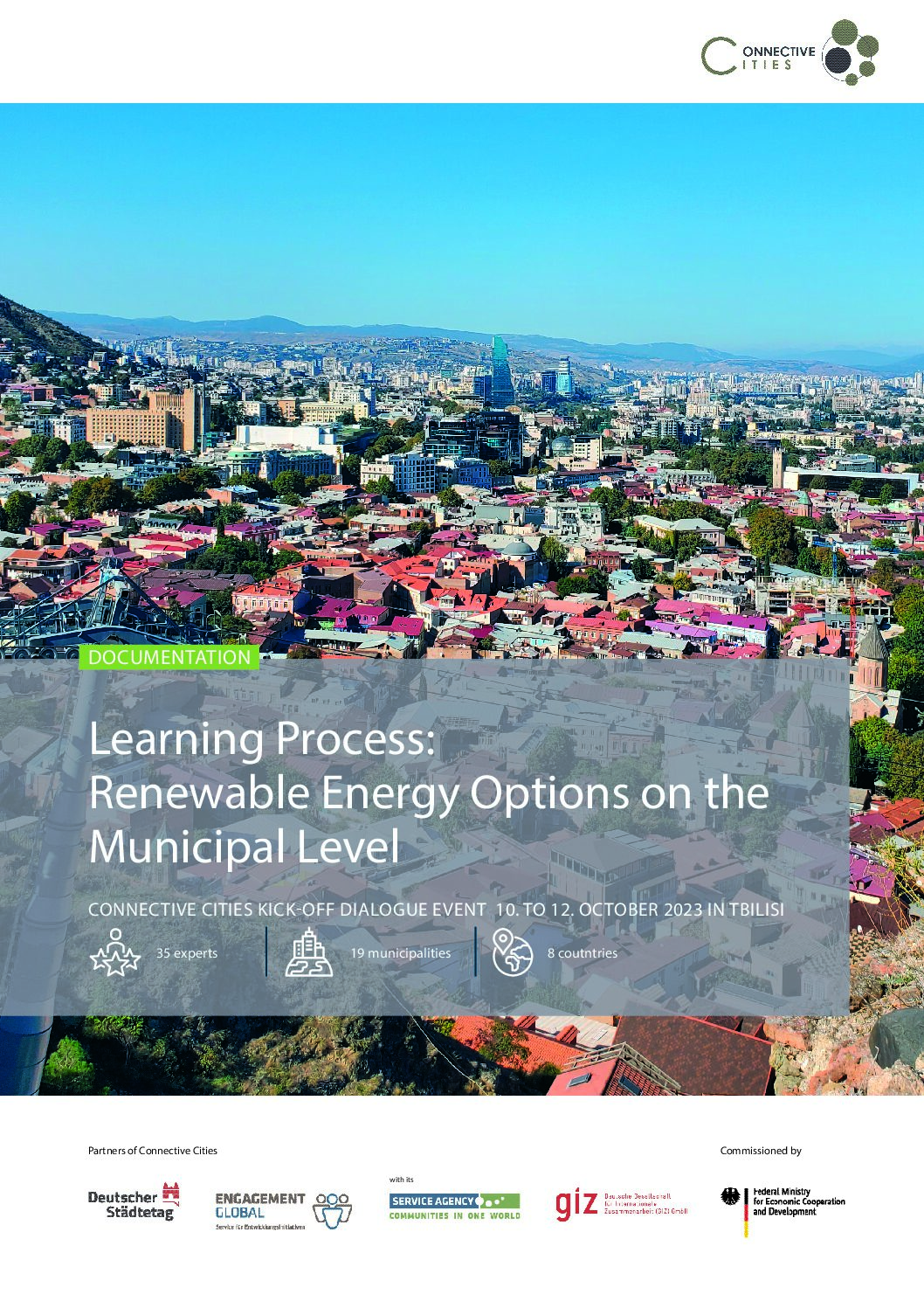
Learning Process: Renewable Energy Options on the Municipal Level

The Connective Cities Kick-off Dialogue Event, held from 10 to 12 October 2023, brought together municipalities from various countries to discuss and share insights on “Renewable Energy Options on the Municipal Level.” Key participating municipalities were represented from Albania, Bosnia and Herzegovina, Germany, Georgia, Moldova, Montenegro, Serbia, and Ukraine.

During the event, innovative strategies in renewable energy were showcased, with participating municipalities engaging in collaborative learning and group deliberations to delve into the nuances impacting their renewable energy endeavors. Utilizing a design thinking approach, the Dialogue Event sought to uncover and address gaps and obstacles within current municipal strategies by scrutinizing the unique circumstances of each participating city.

With a diverse attendance of over 35 individuals representing 19 municipalities across 8 countries in Southeast Europe and Germany, the event featured presentations of successful practices and projects from 9 municipalities, aimed at sparking interactive discussions among attendees. Many participants encountered similar challenges in advancing renewable energy initiatives, highlighting the necessity to bolster knowledge and expertise to progress in this area.

This event is the starting point for a learning process in which project ideas are developed over the course of approximately one year until they are ready for realisation.
This documentation shows the promising initial results.

All presentations and a photo gallery of the dialog event can be found on our Connective Cities Community: Group Topics | Connective Cities Network (connective-cities.net)

Building Resilience: Insights from the Project Planning Workshop

The Connective Cities Project Planning Workshop, themed “Resilience in Times of War – Municipal Exchange between Ukraine and Germany,” unfolded in Munich, Germany, from November 28th to 29th, 2023. This gathering brought together municipal representatives and technical experts with a collective goal – to strengthen a more resilient and sustainable future for Ukraine. The workshop, occurring just a month after the 6th German-Ukrainian Partnership Conference in Leipzig, aimed to emphasize the pivotal role of cities and municipalities in shaping the nation’s post-war trajectory.
 

Diverse Participation and Collaborative Learning

Representatives from diverse Ukrainian municipalities, such as Sambir, Sumy, Brovary, Lutsk, Vinnitsa, Trostyanets, Berenzhany, Zbarazh, Mykolaiv, Melitopol, and Novovolynsk, comprised the active participation of over 35 delegates in the Connective Cities event. Kosovo had representation from Prishtina and Gllogoc, and Germany was represented by Munich and Eichenau. The event also featured participation from municipal utilities Gersthofen & Cologne (RheinEnergie) and delegates from the private sector. The diverse mix aimed at fostering collaborative learning, as cities shared their successes and challenges, recognizing the importance of joint experiences in the journey towards resilience.

Thematic Focus Areas

The workshop delved into three crucial thematic areas:

  1. Regional and Local Economic Development
  2. Renewable Energy Options on the Municipal Level
  3. Integrated Urban Development

Skilled technical experts facilitated discussions on topics ranging from green urban development to energy grid optimization and cluster development, providing valuable insights for participants to implement in their respective municipalities.