Podcast with Magnolia Vega: Crisis Communication

Learn through Magnolia Vega, communication officer in a district of Bogotá, how to keep informed 7 million citizens during the pandemics and how to orchestrate between 60 communication officers – in a very personal effort – to unify their message under one brand.

More: https://youtu.be/CPOgSxQkRYs

Join us and watch a special series of videos and podcasts that will show how to overcome a crisis from many different points of view. More videos, podcasts and interviews coming soon on our COVID-19 page.

Podcast with Armin Berger: Digital Innovation

Welcome to Berlin, where thousands of artists lost their stages because of lockdown. Learn how Armin Berger got support from the senator of culture and how good ideas emerged during breakfast to fill Berlin with new life: Berlin(a)Live

More: https://youtu.be/UwqjbiMlIGE

Join us and watch a special series of videos and podcasts that will show how to overcome a crisis from many different points of view. More videos, podcasts and interviews coming soon on our COVID-19 page.

Podcasts with Salih Mahmod on Public Health Innovation

Meet Salih Mahmod, a young Iraqi that rebuilt his maker space entirely after ISIS left Mosul and knew what to do after the hospitals in his city lost their medical supplies in the middle of the pandemic.

More: https://youtu.be/JkgV4-eN9Ww

Join us and watch a special series of videos and podcasts that will show how to overcome a crisis from many different points of view. More videos, podcasts and interviews coming soon on our COVID-19 page.

Kiel: Entrepreneurship and Digitalisation

We traveled to Kiel, where we captured deep insights from a city that, as a digital champion, had to adapt quickly. How do you keep your StartUp community alive if people cannot meet personally?

More: https://youtu.be/-QxhW-Gx-3M

Join us and watch a special series of videos and podcasts that will show how to overcome a crisis from many different points of view. More videos, podcasts and interviews coming soon on our COVID-19 page.

Weimar: Economic response to COVID-19

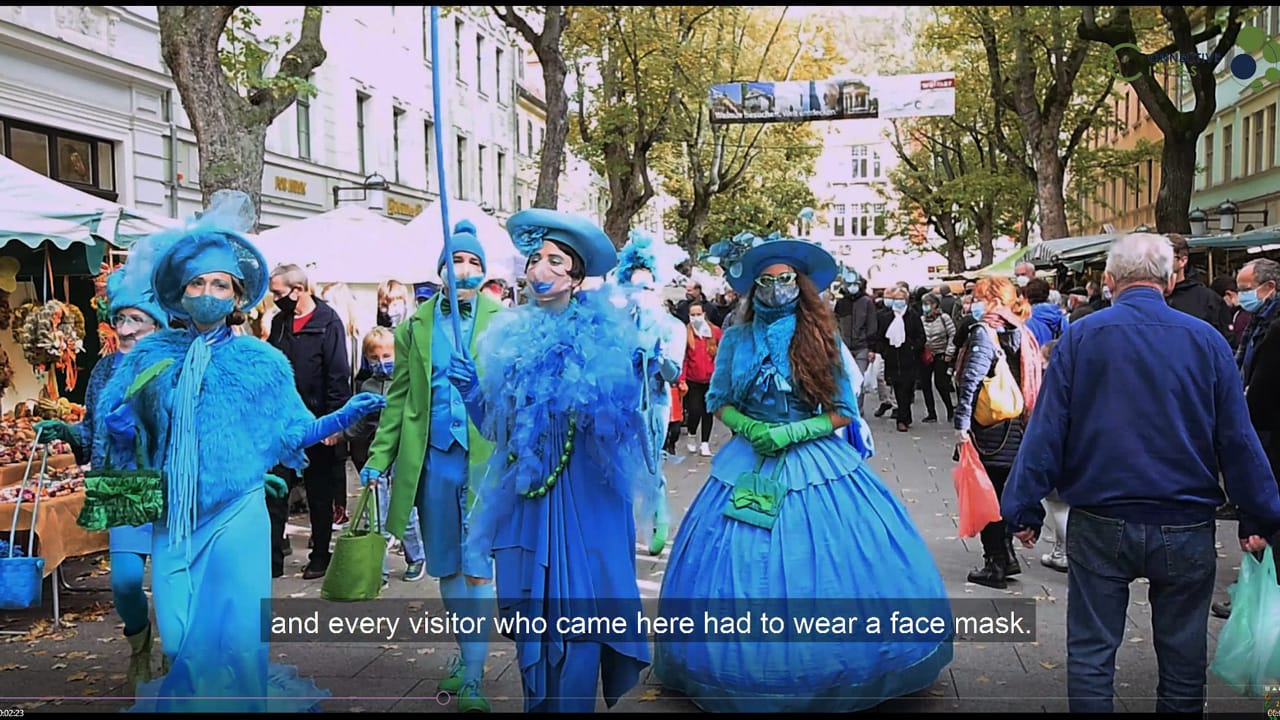
Weimar, a city that attracts thousands of tourists from all over the world every year. Watch how did the local city guides, hoteliers and small shop owners react to the lockdown? And what did the local authorities do?

Mehr: https://youtu.be/SxLgSY2aW6g

Join us and watch a special series of videos and podcasts that will show how to overcome a crisis from many different points of view. More videos, podcasts and interviews coming soon on our COVID-19 page.

Virtual Global Exchange

The exchange was designed to bring together urban practitioners from all over the globe. The goal was to ignite creativity, innovation, solidarity and motivation, while creating and enhancing this global community of practice around the common purpose of combating the global COVID-19 pandemic and its consequences with smart local solutions and strategies.

During the first week, urban practitioners and experts from different municipalities, the civil society, business and academia, presented a total of 56 Good Practices in 18 sessions and gave insights into their experienced challenges and local solutions to deal with the pandemic. The exchange were centered around the nine topics were Public Health, Crisis Management, Economic Response, Housing, Education, Digitalisation, Crisis Communication, Innovation, and Green Urban Recovery.

The second week was about receiving practical “How To” workshops with practical exercises on topics that came up repeatedly during the exchange events such as: social media usage, digital tools, and how to plan for virtual meetings. Finally, the newly learned mindsets and tools could be applied in a 4-hour solution design workshop.

Download documentation

Municipal expert exchange to COVID-19- compact

Topics: Public Health & Crisis Management / Economy, Housing & Education / Digitalisation & Communication / Innovation

Time: 23 November – 3 December 2020

Cities worldwide are severely affected by the impacts of COVID-19. Unlike national governments, municipalities are in close contact with their citizens and are responsible for the implementation of measures decided by governments to reduce the spread of Corona infections.

Cities worldwide also have collected important experiences, which will be of immense relevance in the global fight against the virus. The crisis has shown how important the resilience of municipalities is: this directly applies to local crisis management and disaster preparedness as well as to the need for constantly adaptive urban planning. The current crisis has shown and proven once again that resilience is an essential capacity of municipalities.

To continue tackling the challenges of the pandemic in the future and to find suitable solutions to minimise its negative impact, it is now necessary to learn from and share experiences that will support the joint development of further measures. In the framework of its COVID-19 Municipal response dialogue, Connective Cities is organising a virtual global exchange series on “Municipal Response to COVID-19” from 23 November to 3 December 2020 and kindly invites you to be part of this series of events. This international exchange effort takes place in cooperation with engaged urban practitioners, municipal experts as well as local experts from academia, civil society and business.

More information

Announcement: Prize of the Carl and Anneliese Goerdeler Foundation 2021

Topic: Exemplary measures to overcome the corona induced crisis

In memory of Carl Goerdeler’s communal political activities as Lord Mayor of the City of Leipzig and his resistance against the Nazi regime, the Carl and Anneliese Goerdeler Foundation awards a Communal Political Prize to honour outstanding achievements in communal administration practice. The award is intended to serve the peaceful cooperation of municipalities and municipal alliances that brings people together, especially in Europe (as defined by the Council of Europe) and abroad. At the same time, mutual learning for the benefit of the inhabitants is to be promoted.

The call for proposals is also in the context of the activities of the Connective Cities project, which is a cooperation between the Deutsche Gesellschaft für Internationale Zusammenarbeit (GIZ) GmbH, Engagement Global gGmbH / Servicestelle Kommunen in der Einen Welt and the German Association of Cities. Implementation partners include selected regional and national city associations in Africa, America, Europe and Asia and their member cities. The project is financed by the German Federal Ministry for Economic Cooperation and Development (BMZ).

Description of content and target group

The prize serves to honour outstanding achievements (“best practices”) in local government or regional communities of responsibility, if necessary also involving civil society forces. The award is intended to honour cooperation between municipalities or municipal alliances with the participation of a German municipality or municipal alliances. The cooperation should have taken place in areas relevant to the management of the pandemic (e.g. health, civil protection, security, urban services, mobility, schools/education, economic development or similar). This should have sustainable positive effects in the following areas: strengthening civil society and/or social cohesion, improving services of general interest, modernising public administration, strengthening economic power, promoting European and global integration.

Funding

Euro 2,000 (in the case of two or more equivalent applications, the prize money can also be split) and publicity award.

The application must be accompanied by documents (in German or English) which observe the following points (max. 10 pages)

  1.  Contact person/contact of the applying municipality or region
  2.  Information about the submitting municipality or region/presentation of the partner municipality or region
  3.  Presentation of the solution approach as “best practice”, if necessary also in virtual form (showcase)
  4.  Actors (who were involved)
  5.  Achieved benefits for citizens
  6.  Transfer potentials

Applications to be submitted by 16 November 2020 (extended)

The winner or winners will be selected by a jury of representatives of the participating institutions. The jury’s decision is made in accordance with the principles of strict party political neutrality.  The award ceremony takes place annually at the beginning of February to commemorate the anniversary of Carl Goerdeler’s death on February 2, 1945. The award is presented in close cooperation with the City of Leipzig and is performed by the Lord Mayor of the City of Leipzig at a ceremony.

Jury

  • Ellen Kramer, German Association for International Cooperation (GIZ), Chairwoman
  • Prof. Dr. Ulrich Brieler, City of Leipzig
  • Marianne Goerdeler, Carl and Anneliese Goerdeler Foundation
  • Lina Furch, Council of European Municipalities and Regions (CEMR), German Section
  • Dr. Ferdinand Schuster, Institute for the Public Sector

Contact

Ricarda Meissner, ricarda.meissner@giz.de,  Tel. 0049(0)228 4460 1138

Klaudia Sonntag, klaudia.Sonntag@giz.de , Tel: 0049 (0) 228 4460 1587

More information about the price:

Kommunalpolitischer Preis der Carl und Anneliese Goerdeler-Stiftung 2021
[pdf, 190 kb]
 

www.publicgovernance.de/goerdelerpreis

Call for participants: Prevent infections through distance, communication and support of the informal sector

Prevenir las infecciones mediante la distancia, la comunicación y el apoyo del sector informal

Intercambio virtual de experiencias sobre la pandemia de COVID-19 en América Latina el 14 de octubre y el 5 de noviembre de 2020

Para la versión en español, ver abajo.

———————————

Shortly after the COVID-19 outbreak in Europe, the virus also hit Latin America hard. The current challenges in combating the pandemic require a combined solution strategy consisting of medical care, regulatory infection control measures and short-term economic bridging measures – and all this with the help of appropriate and convincing communication. How can cities and municipalities make a contribution here?

Even though many Latin American countries imposed strict measures, including curfews in accordance with the above-mentioned distance rule, at a very early stage, the pandemic could not be contained – the number of infections continues to rise in many countries.

In Latin America, other important factors come into play: a decisive factor is the high proportion of workers in the informal (urban) sector, who have to commute from densely populated urban fringe areas to the city centre to perform their daily work. The home office option does not exist for the informal sector, and the renunciation of the daily wage is not sustainable. As a result, distance rules cannot in fact be observed for a large part of the population working in the informal sector.

In addition to economic support, it is essential to follow chains of infection. Without precise observation of those infected and the tracing of infection chains, distance rules will not lead to success. Communication and the strengthening of public awareness is also an important factor here.

Connective Cities offers cities and municipalities the opportunity to exchange their experiences and success strategies and to discuss challenges together. In the process, approaches to solutions from German cities and cities in the Latin American region will be presented. If you would like to present a practical example from your city or discuss a specific challenge, we invite you to participate in our event.

After the virtual session the participants can continue their exchange on the virtual platform of Connective Cities in special virtual working groups. A virtual follow-up event (on 05.11.2020) offers the opportunity to deepen the solutions developed and to further develop possible project ideas.

Date: 14 October 2020 (part 1) and 05 November 2020 (part 2)
Time: 16:00 – 18:30 CEST / CET
Language: Spanish / Portuguese

Registration deadline: 09 October 2020

—————————————–

Poco después del brote de COVID-19 en Europa, el virus también golpeó duramente a América Latina. Los desafíos actuales en la lucha contra la pandemia requieren una estrategia de solución combinada que consista en atención médica, medidas reguladoras de control de la infección y medidas económicas de transición a corto plazo, y todo ello con la ayuda de una comunicación adecuada y convincente. ¿Cómo pueden las ciudades y los municipios contribuir a ello?

Aunque muchos países latinoamericanos impusieron medidas estrictas, incluidos toques de queda de conformidad con la regla de la distancia mencionada anteriormente, en una etapa muy temprana no se pudo contener la pandemia – el número de infecciones sigue aumentando en muchos países.

En América Latina entran en juego otros factores importantes: un factor decisivo es la elevada proporción de trabajadores del sector informal (urbano), que tienen que desplazarse desde las zonas periféricas urbanas densamente pobladas hasta el centro de la ciudad para realizar su trabajo diario. La opción de la oficina en el hogar no existe para el sector informal, y la renuncia al salario diario no es sostenible. Como consecuencia de ello, las normas sobre la distancia no pueden observarse de hecho para una gran parte de la población que trabaja en el sector informal.

Además del apoyo económico, es esencial seguir las cadenas de infección. Sin una observación precisa de los infectados y el seguimiento de las cadenas de infección, las reglas de la distancia no conducirán al éxito. La comunicación y el fortalecimiento de la conciencia pública es también un factor importante en este sentido.

Connective Cities ofrece a las ciudades y municipios la oportunidad de intercambiar sus experiencias y estrategias de éxito y de debatir juntos los desafíos. En el proceso se presentarán enfoques de soluciones de las ciudades alemanas y de las ciudades de la región de América Latina. Si desea presentar un ejemplo práctico de su ciudad o debatir un desafío específico, le invitamos a participar en nuestro evento.

Después de la sesión virtual los participantes pueden continuar su intercambio en la plataforma virtual de Connective Cities en grupos de trabajo virtuales especiales. Un evento virtual de seguimiento (el 05.11.2020) ofrece la oportunidad de profundizar en las soluciones desarrolladas y seguir desarrollando posibles ideas de proyectos.

—————————————–

Further information / Más información: Konzeptpapier (DE), Papel de conceito (PT), Documento conceptual (ES)

If you are interested or have any questions, please contact us / Si está interesado o tiene alguna pregunta, por favor contáctenos:

Paulina Koschmieder, paulina.koschmieder@giz.de

Call for participants: Covid-19: Economic impact and recovery

The Covid-19 pandemic has had a deteriorating impact on the national and local government economic resources. In economies that largely depend on informal labour market, a lot of people have lost their livelihoods. The governments have been torn between life and livelihoods as the interaction of people propels the spread of the virus.

This shift affected the revenue stream for the local government especially in the cities as a result of shrinking businesses and also a mass migration of the urban population to the rural areas. This has a negative impact on effective operations of the municipalities and service provision.

Whilst the impact of this pandemic has been felt worldwide, cities have responded with different measures to avert the spread and cushion against long-term impacts and even future pandemics. It’s against this background that Connective Cities1 is offering a platform in which cities will share the challenges they have experienced and interventions that have either been implemented or are being planned to safeguard against the negative impacts and future pandemics.

In the second series  at10th & 12th November, 2020, 13:00- 15:00 (CET), we look at the economic impact of the pandemic, recovery and resilience of cities.

Conference language is English.

More information:Concept paper [pdf 3 pages]

Participation and contact

If you have further questions or would like to participate, please send an e-mail to Sophia Kamau (sophia.kamau@giz.de), Regional Coordinator for Connective Cities in Sub-Saharan Africa.