Power and informality interact in complex ways in urban shelter provision. This briefing is based on a study of three East African cities: Nairobi, Hawassa and Mogadishu. The three-year research project studied both financial constraints to accessing land or housing and non- financial constraints such as discrimination on the basis of identity. Our findings underline the importance of knowing who has power within the housing and land markets. Power does not just derive from wealth; politicians, traditional leaders, gatekeepers and others exercise influence in these markets. A person’s identity — and income — impacts the extent to which they can navigate these power structures, and the formal and informal systems that govern access to shelter. Governments and international donors need to improve the lives of the urban poor: notably with low-income, regulated rental schemes; slum-upgrading and affordable finance.
Author: erik
Digitalisation of the administration of Nablus
In continuation of the Connective Cities Dialogue Event “Strategies for a Digital City” held in Nuremberg in 2018, a lively exchange between the cities of Nuremberg and Nablus developed. In order to deepen the cooperation, two German municipal experts travelled to the Palestinian Territories to advise municipal actors on issues of municipal digitalisation.
Digitalisation and new technologies offer many opportunities to improve the public services offered by the municipalities. They can help to create direct interaction between the municipality and its inhabitants and thus make their services more accessible to citizens. This was demonstrated by a variety of good practices, for example from Ukraine or Rwanda at the Connective Cities Dialogue Event in Nuremberg in October 2018.
A Territorial Approach to the Sustainable Development Goals
In the face of megatrends such as globalisation, climate and demographic change, digitalisation and urbanisation, many cities and regions are grappling with critical challenges to preserve social inclusion, foster economic growth and transition to the low carbon economy. The 17 Sustainable Development Goals (SDGs) set the global agenda for the coming decade to end poverty, protect the planet and ensure prosperity for all. A Territorial Approach to the Sustainable Development Goals argues that cities and regions play a critical role in this paradigm shift and need to embrace the full potential of the SDGs as a policy tool to improve people’s lives. The report estimates that at least 105 of the 169 SDG targets will not be reached without proper engagement of sub-national governments. It analyses how cities and regions are increasingly using the SDGs to design and implement their strategies, policies and plans; promote synergies across sectoral domains; and engage stakeholders in policy making. The report proposes an OECD localised indicator framework that measures the distance towards the SDGs for more than 600 regions and 600 cities in OECD and partner countries. The report concludes with a Checklist for Public Action to help policy makers implement a territorial approach to the SDGs.
POLICY HIGHLIGHTS
Download here
Urban mobility
In many developing cities, connectivity is undermined by limited infrastructure and weak public transport systems. If people and goods are unable to move easily across a city, firms get locked into small-scale unproductive activities, and people cannot access basic goods and services.
Policymakers face difficult trade-offs in improving systems of mobility, both in addressing growing demands for private transport, and in investing in public transport links in a city. Learning from the experiences of cities across the world facing these challenges offers some key lessons for effective infrastructure investment and smart regulation to meet growing demands for transport.
We have the power to move the world
The leaders of 14 of the world’s most ambitious and successful sustainable transport cities explain why they are taking action, what they are implementing, the approaches they are taking, and their advice for other cities. Their intension is to inspire and support more cities to show the same leadership. The actions showcased range from expansion and electrification of mass transit, to restrictions on polluting vehicles and improved conditions for pedestrians and cyclists. All the cities featured are signatories to the C40 Green and Healthy (Fossil Fuel Free) Streets declaration.
Untreated and Unsafe
Cities must ensure universal access to safe, reliable, and affordable sanitation so that all urban residents can lead productive, healthy, and thriving lives. New analysis of 15 cities in the global South shows that on average, 62 percent of sewage and fecal sludge is unsafely managed somewhere along the sanitation service chain.
Global monitoring efforts have resulted in an underestimation of the urban sanitation crisis and the risks to public health, the economy, and the environment. New data and analysis at the city and sub-city level is needed to galvanize action.
Sewers are convenient, safe, sanitary, and work well in dense urban environments and in multistory buildings. From the perspective of the household, sewer connections and services are often less expensive than on-site sanitation options.
In the absence of universal access to sewers, cities need to find an optimal combination of off-site and on-site sanitation options. On-site sanitation systems place enormous responsibility on households and private providers, and thus require strong government capacity to regulate and enforce sanitation standards to ensure public health and safety.
Citywide upgrading of informal settlements can improve low-income households’ access to urban sanitation. City governments should work with community organizations, nongovernmental organizations, and federations to improve and extend sanitation to informal settlements and address affordability.
Global Gender Gap Report 2020
“Since 2006 the Global Gender Gap Index has been measuring the extent of gender-based gaps among four key dimensions: Economic Participation and Opportunity, Educational Attainment, Health and Survival, and Political Empowerment. The index is tracking progress towards closing these gaps over time. The 2020 edition of the report benchmarks 153 countries and provides country rankings that allow for effective comparisons across and within regional peers. The report highlights the growing urgency for action. Without the equal inclusion of half of the world’s tal- ent, we will not be able to deliver on the promise of the Fourth Industrial Revolution for all of society, grow our economies for greater shared prosperity or achieve the UN Sustainable Development Goals. At the present rate of change, it will take nearly a century to achieve parity, a timeline we simply cannot accept in today’s globalized world, especially among younger generations who hold increasingly progressive views of gender equality.”
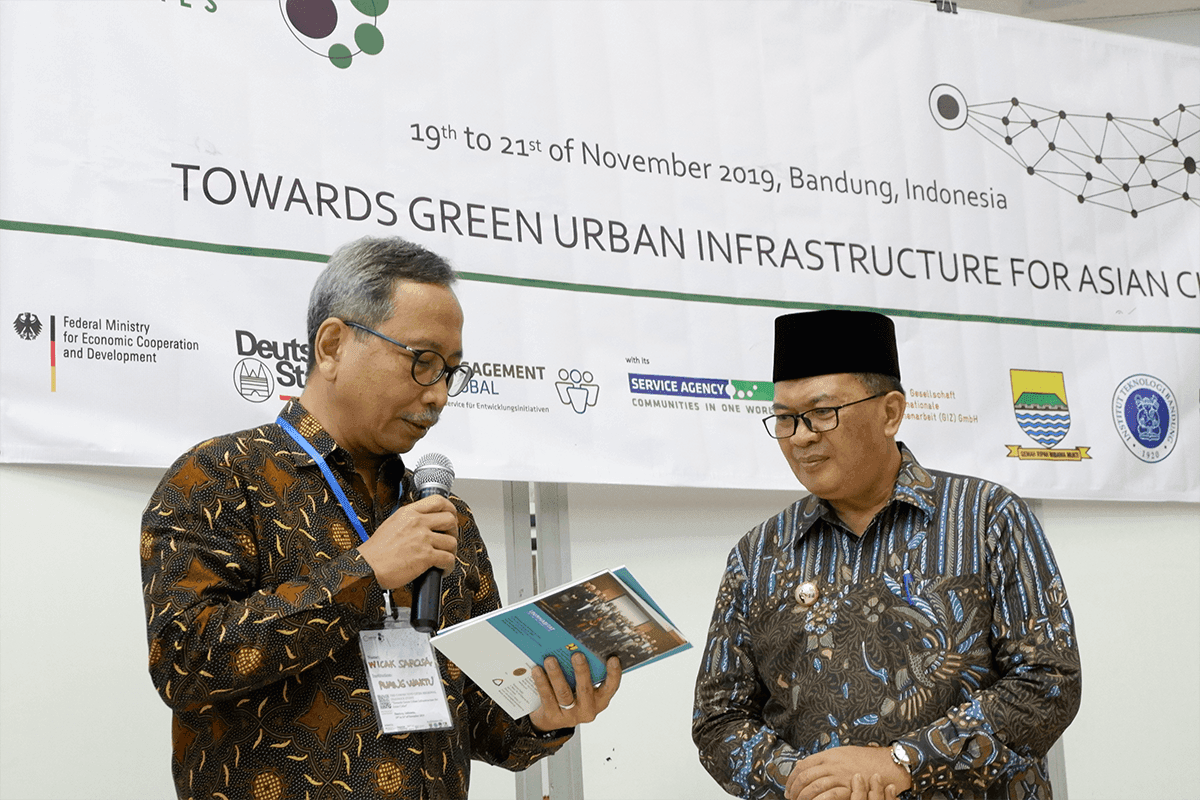
Towards Green Urban Infrastructure in Asian Cities
Connective Cities’ regional dialogue event “Towards Green Urban Infrastructure in Asian Cities” took place in Bandung/Indonesia from the 19th till the 21st of November 2019. More than 25 urban practitioners from Indonesia, Malaysia, Nepal and Germany participated and exchanged their experiences and good practices.
As Asia is one of the fastest growing urban regions in the world, it is in urgent need to optimize and benefit from the ongoing urbanisation as well as actively try to reduce any negative socioeconomic and environmental impacts. There is a fundamental necessity for Asian cities to adapt a greener (environmentally aware) development concepts of urban infrastructures through proper planning and management. The development of green cities is essential to ensure sustainable urbanisation, which also requires green urban infrastructure to provide public services for all and maintain the balance of the urban development impact.
There are a number of examples of green urban infrastructure, ranging from water management, green buildings, sanitation system, renewable energy, waste management, public space, etc. In many instances, cities already built some of the green urban infrastructure. However, the challenges related to accessibility and affordability remain.
Plastic waste: the contribution of municipal waste management to tackle the issue
Almost 40 local practitioners from 13 cities, 9 countries and 4 continents intensively exchanged their experiences on the topic of “plastic waste” and jointly developed solutions and project ideas. They followed the invitation of Connective Cities and the City of Hamburg to a dialogue event on “Plastic Waste – The Contribution of Municipal Waste Management Systems to Tackle the Issue”, which took place from 3 to 5 December 2019 in Hamburg.
Increasing amounts of plastic waste pose challenges for local authorities around the world. Only small quantities can be recycled by type to create closed cycles. But even recycling into lower types of plastic can alleviate landfills and generate income for vulnerable groups. However, avoiding plastic waste is the best option. Therefore, plastic waste is first and foremost a social challenge: changing the behaviour of consumers and producers is crucial.
Based on an exchange of experiences on good practices and projects in the cities implementation challenges were identified and finally eight project ideas were developed for eight cities, which could lead to an improvement of the respective strategies and implementation plans.
The event concluded with three parallel excursions to a waste incineration plant, a sorting station and a waste collection point in Hamburg.
Global Roadmap of Action
The report draws attention to the trend of isolated technologies – such as electric vehicles, for example – being over-promoted. The obvious idea is to cut greenhouse-gas emissions, but that will only happen if the electric power used is generated by renewable means, which often is not the case. Moreover, the authors warn that it is not healthy to reduce the diversity in the means of transport. While appreciating the progress made in some areas, the SuM4All report insists that the need for a fundamental, systemic transformation is not being met.
The report proposes a list of the most relevant policies for making transport systems sustainable. It offers no blueprint, because each country must take action according to its specific situation. However, SuM4All presents various instruments in four toolboxes:
- Regulatory and institutional instruments include rules on safety, vehicle use, emissions, transport services, cross-border traffic and data management.
- The technology toolbox covers the planning, provision and maintenance of transport infrastructure and services. In this context, the coordination of different means of transport is particularly important and deserves attention at every stage. Safety regulations must be observed as well.
- The economic and financial toolbox includes concerning taxation, subsidies, loans, pricing et cetera. Close coordination of the public sector, which bears responsibility for infrastructure, with profit-driven companies is essential. Private individuals and companies use the system, and the latter provide innovative technologies, products, services and business models.
- The communication toolbox helps to run awareness raising geared to changing behaviour, identifying transport alternatives and managing knowledge.