Urban Gardening Guidebook

From July to December 2020, an initial intensive global programme on ‘municipal response to the pandemic’ was conducted by Connective Cities that has been augmented with the programme ‘municipal recovery from the pandemic’ starting August 2021. The working group “Biodiversity and Environmental Protection” was the first group to be established as part of this programme.

This Guidebook is one result of an extensive exhange. It explains,  why Urban Gardening Matters? and guides the reader through all steps of an urban gardening project – from the first situational analysis, over the preparatory and implementation phase up to a final monitoring and evaluation.

Innovation for the environment

As the case with the majority of municipalities in Lebanon, Bikfaya municipality lacked support from the central government and was unable to provide viable solutions for solid waste management (SWM).  This motivated local residents to propose grassroot initiatives. A group of volunteers (with no prior technical knowledge in solid waste management), promoted recycling and sorting at source. Initially receiving technical support from a local environmental NGO, this case has eventually transformed into a best practice that is resonating in Lebanon and the MENA region.

Trash to Cash

Despite the weaknesses that permeate solid waste management in Lebanon, some municipalities have committed themselves to innovate solutions and overcome the challenges that include cost recovery issues, treatment and disposal difficulties, low capacity of dumpsites, lack of commitment from the local community for recycling, and a low demand for recycled products. Al Manara and Ghalboun municipalities are two examples on how municipalities were able to transform these challenges into opportunities.

Digitalisation in Madaba Municipality, Jordan

In line with the efforts in Jordan to drive economic transformation and application of international quality standards, Madaba municipality developed a vision towards achieving equitable growth and sustainability.  An integral part of this vision is the digital transformation of municipal services.

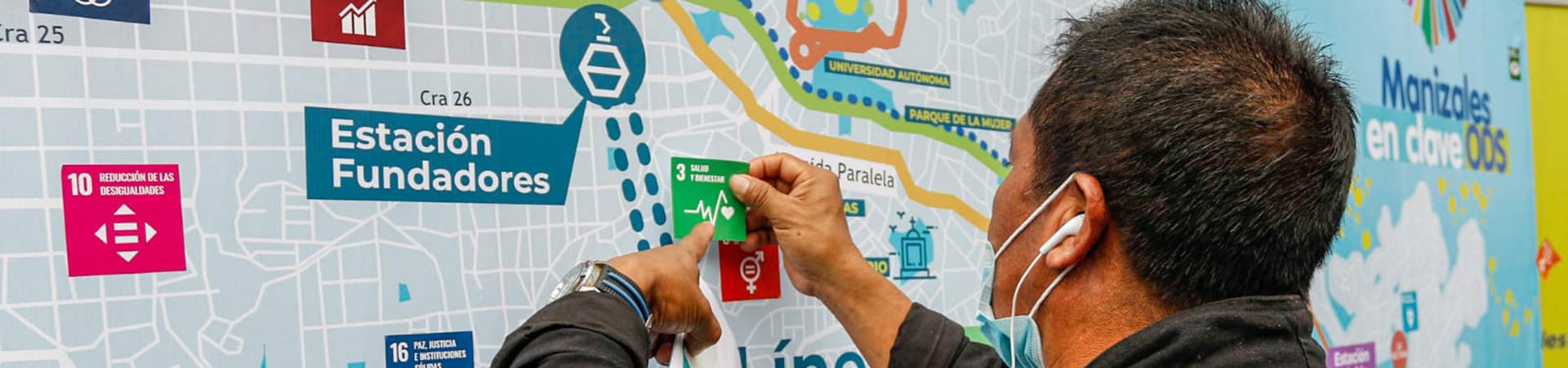
Raising awareness among the citizens of Manizales about the importance of the Sustainable Development Goals (SDGs) and their localisation through transformative actions

As part of the learning process “Strengthening Local SDG Implementation through Reporting and Monitoring” that Connective Cities initiated in 2021, three virtual exchanges took place virtually between September and November 2021 to support the city of Manizales in Colombia in bringing the SDGs closer to its citizens.

The idea to “develop a strategy to position the SDGs as aspirational goals for the citizens of Manizales to support the achievement of the 2030 Agenda” resulted from one of the working groups during the international virtual dialogue event in April 2021. Participants exchanged experiences and jointly developed this idea with Manizales as part of the topic: quality citizen dialogue and stakeholder engagement.

Data-driven local SDG reporting can be used to improve communication with citizens and raise awareness of the SDGs among citizens, engage different urban actors, make the municipality’s progress in SDG implementation more visible, and spark interest in accelerating action towards sustainable development. E.g., by defining a common language or using SDG-data in participative and stakeholder engagement processes.

Insights into the working group ‘digitalisation of public services in MENA’

Digitalisation is the path for improving service delivery to citizens, and is key in the municipal recovery from the impacts of the pandemic. Connective Cities program on municipal recovery from the pandemic has thus supported the establishment of the working group ‘digitalising public devices in the MENA region’. The working group has been very active and has involved the participation of representatives of more than 21 municipalities in the MENA region. As part of the activities, the following was accomplished:

  1.  The first virtual workshop for the working group was held on the 26 October 2021. The workshop incorporated a capacity building component focusing on the use of GIS for the collection, mapping and monitoring of geospatial data.  The working group’s members were introduced to the Geographic Information System (GIS) and its various applications in municipal roles and services.
  2. Good practice examples from Hazmieh municipality in Lebanon, Hebron Municipality in Palestine, and Madaba- Jordan were showcased. The presentations revealed how employing GIS contributes to improving municipal service provision, strategic planning, tax management and decision making at a municipal level. Furthermore, a full end-to-end digital transformation solution used by Zgharta municipality in Lebanon (AKA Al-FULK) was showcased as part of the workshop held on the 23 November 2021. This digital platform leverages municipal best practices, tools and technology and has resulted in increasing the efficiency and effectiveness of operations and service delivery in the municipality and improve interdepartmental coordination and regulatory compliance initiatives.
  3. Project ideas of six municipalities were developed into prototypes of GIS apps. Connective Cities conducted a round of intensive capacity building to train the relevant municipal staff on utilizing the apps. The municipalities of Bizerte- Tunisia, Abasan-Palestine, Menjez, Qaraoun, Matan al-Alaa- Lebanon, Jerash and Madaba-Jordan have benefitted from the capacity building and thus have progressed in the realization of their projects on GIS application in municipal management. 

Click here to view recording of the workshop on 26 October 2021

Click here to view the recording of the workshop on the 23 November 2021

Development of Covid-19 recovery solutions at municipal level in the area of digitalisation

To support digitalisation capacity building in cities and municipalities, four intensive workshops were conducted with urban practitioners and relevant representatives throughout SEE. The workshop consisted of two parts: a learning activity, followed by collective work. These events took place online, using Miro and video conference tools, with 2-4 facilitators. 

Watch video at YouTube ansehen:

https://youtu.be/3D3F4iKCENY

More: Digitalisation: Developing your own ideas based on international practice – Insights into the work of the Digitisation Working Group in South Eastern Europe

Development of Covid-19 recovery solutions at municipal level in the areas of Crisis Management

To support crisis management capacity building in cities and municipalities, four intensive workshops were conducted with urban practitioners and relevant representatives throughout SEE. The workshop consisted of two parts: a learning activity, followed by collective work. These events took place online, using Miro and video conference tools, with 2-4 facilitators.

Watch video at YouTube:
https://youtu.be/aHCv6FHJRYo

More: First Response Mechanisms, Fake News and Crisis Communication – Insights into the Southeast Europe (SEE) Crisis Management Working Group

Towards a gender sensitive urban development

Why do we need a gender sensitive approach in urban planning?

Existing urban public spaces as well as public transport were mostly designed by and to accommodate the needs of men. A lot of them are not fit for women’s needs – some even pose a threat to women’s safety, they complicate their everyday lives and reduce their possibilities to engage in community life. The COVID-19 pandemic has exposed and exacerbated existing gender inequalities in various aspects.

At the same time, this crisis can be an opportunity to make urban planning more gendersensitive, equitable and sustainable. There are a lot of gender sensitive practices already existing. The task is to implement these practices and help municipal actors achieve sustainable, inclusive and (gender) equitable development in the (post-)COVID era.

This was the aim of the two Connective Cities Working Groups on:

  1. Gender sensitive urban planning
  2. Gender responsive urban mobility

Connecting municipalities in their efforts towards a gender sensitive city

The participants of the working groups joined us from the municipalities of Nabeul and Sfax in Tunisia, Mexico City and Guadalaja in Mexico, Tena in Ecuador, Nairobi in Kenya as well as Uruguay and the Municipality of Gaza, Palestine.

In bringing municipal representatives and urban practitioners together to present and discuss their challenges and good practices they were supported to develop new project ideas through peer-learning and exchange. In this they were inspired by regional and international experts who shared their insights in gender sensitive planning approaches.

The first kick-off meeting was aiming to sensitize for the various risks of widening gender inequalities in urban development and to identify the roles cities administrations can play in this context.

Annika Dalén, Strategic development and gender equality officer, Municipality of Umeå, Sweden presented the efforts of the Swedish city of Umeå as a model city for gender sensitive urban planning and mobility. Until today, reliable data on how women move in cities is missing in a lot of countries. Therefore, to redesign cities and their transport systems to effectively respond to women’s needs, it is the first essential step to collect gender-specific data at the municipal and national levels.

Due to curfews and social restrictions, the pandemic put women at a higher risk to suffer from domestic violence. Katja Schülke, Gender equality officer, City of Bonn, Germany and Conny Schulte, General manager, Arbeitskreis Opferschutz Bonn/Rhein-Sieg presented their approaches for combating domestic violence of the City of Bonn.

A third keynote by Giada Cicognola, programme analyst, Cities Alliance introduced the participants to the programme Femmedina in Tunis, Tunisia. The programme’s goal is the rehabilitation of public spaces for women in the historic centre of Tunis, the Medina, through participatory decision-making.

During the following working group meetings, the participating municipalities identified one gender related challenge in their cities. They are exemplary for the issues women face in many places around the globe:

  1. Enhancing the integration of women in decision making processes in Tunis, Tunisia
  2. Improving the situation of commuting women from rural areas in urban environments in Tena, Ecuador
  3. Incorporating the needs of women in the implementation of e-mobility projects and addressing sexual and gender-based violence in the e-mobility space in Nairobi, Kenya
  4. Promoting cycling for women in Mexico City and Guadalaja, Mexico

Connective Cities working groups promote the idea of Peer-to-Peer Consulting so that the participating municipalities can benefit from each other’s experiences and good practices. If you are interested to learn more about this approach, you may find more information here. As an outcome of lively discussions, the groups developed Guidelines that can also help other municipal actors to get going. their guidelines for:

Guidelines:Towards a gender-sensitive urban development [pdf, 307 kb, 7 pp.]

Guidelines: Towards a gender responsive urban mobility [pdf, 337 kb, 8 pp.]

Without a gender sensitive approach to urban development, the pandemic could have far-reaching effects including the risk of widening gender inequalities in various areas. At the same time gender mainstreaming tools and good practices of gender-sensitive recovery strategies already exist, which, if used effectively, can mitigate the negative impacts of COVID-19 and contribute to an increased gender equality.

Find more useful resources on gender sensitive urban planning:

Gender Responsive Urban Planning and Design | UN-Habitat (unhabitat.org)

How Vienna designed a city for women (apolitical.co)

How to Design a City for Women – Bloomberg

Gender in Mainstreaming Urban Development (berlin.de)

Harsh-realities-Marginalized-women-in-cities-of-the-developing-world-en.pdf (unwomen.org)

Across eastern Europe, rethinking urban planning, infrastructure and safety bring changes in women’s lives | UN Women

A safe city for women and girls in El Alto, Bolivia | UN Women

Goal 11 | Department of Economic and Social Affairs (un.org)

Brief: COVID-19 and ensuring safe cities and safe public spaces for women and girls | Digital library: Publications | UN Women – Europe and Central Asia

Brief-Recommendations-COVID-19-Safe-Cities-and-Safe-Public-Spaces-en.pdf (unwomen.org)

TUMI’s 5 Principles to Empower Women in Transport