Launch of Digitalisation working group in Southeast Europe (SEE)

Taking place on 21 September 2021, the Kick-off event of SEE digitalisation working group gathered 29 urban practitioners from all over the region, coming together to embark on a journey of capacity building, peer-to-peer exchange and project development on various topics of digitalisation.  Participants from 19 municipalities from 7 countries – Albania, Bosnia and Herzegovina, Georgia, Moldova, North Macedonia, Serbia and Ukraine – are targeted as main participants of the group.

This initiative, that is part of Connective Cities COVID-19 Programme, is dedicated to supporting cities’ resilience during the COVID-19 pandemic by providing capacity-building activities in the directions of Digitalization.  For this objective several primary aims have been designed in collaboration Ms. Yulia Besplemennova, International Expert, who will be guiding participants on the journey of capacity development.

This working group will allow participants to learn from each other and build network of peers with similar initiatives, giving space for potential future collaborations, while focusing mainly on several prime goals:

  •  Improving cities’ ability to envision and design public digital services with a design-driven approach applying both human-centred and systemic lenses.
  • Learning the principles of stakeholders and user’s engagement in design and validation processes and of co-design practices.
  • Stimulating peer-to-peer exchange and hands-on learning dynamics.

Programme

During the session, Action plan of the group, upcoming activities, general methodology and tools were introduced to be used during working process of the group.

Along with presenting theoretical outline of the Action Plan, participating urban practitioners were introduced to one another, highlighting their interest and motivation for participating in the process.

Dates and themes of upcoming workshops were settled among the members of the group. These workshops (in the form of presenting ideas, ideations and breakout sessions) will be used for identifying the citizens needs and their profiles, mapping stakeholder and system maps and analysing the problematics involved, developing co-design initiatives to actively engage users for the delivery of the better digital services. Recording of the Kick-off event can be found here.

In the following weeks, the following workshops have already been held (a short review will be published soon):

Workshop I: Ideation

Workshop 2: Consolidation

Workshop III: Solutions & Opportunities

Successful Launch of Crisis Management working group in Southeast Europe (SEE)

On 20 September, the working group of crisis management, consisting of urban practitioners from 14 municipalities across 9 countries in Southeast Europe (SEE), was set in motion.  The Event gathered 22 participants from Armenia, Bosnia and Herzegovina, Bulgaria, Georgia, Kosovo, Moldova, Montenegro, Serbia and Ukraine. The kick-off introduced participants to the work plan, designed by two international experts, who will be leading the effort and learning process of the group. The event was also dedicated to familiarizing group members with one another and their common challenges or interests in the field of crisis management.

This initiative is part of Connective Cities COVID-19 programme and its objective is to strengthen the cities’ resilience during the COVID-19 pandemic by providing capacity-building activities in the direction of crisis management. For reaching this objective a working group is formed with several primary aims:

  1. identification of crisis management, resilience and Covid-19 response challenges in participating municipalities,
  2. analysis and definition of the challenges based on experiences, knowledge transfer and international discussion,
  3. solutions scan, assessment of resources and support of municipalities in development of applicable actions.

This working group will also allow participants to learn from each other and build a peer network with similar initiatives, giving space for potential future collaborations.

Programme

After a short welcome and insight into this year’s Connective Cities COVID-19 programme, Dr. Irakli Samkharadze, Regional Coordinator, GIZ gave word to representatives of Policy and Management Consulting Group (PMCG),  a consultancy agency managing two COVID response working groups in SEE region, who introduced the timeline and the international experts who would be working with the participants throughout the following three months.

Afterwards, the action plan of the group and its goals were introduced by the international consultants Mr. Edmunds Akitis and Mr. Sjirk Meijer. They set the scene for upcoming activities and explained the general methodology and tools to be used during the working process of the group.

As a getting to know each other activity, every urban practitioner participating in the event was given spotlight to introduce themselves, their municipalities and challenges they have come across during their work related to dealing with crises.

Finally, three upcoming workshop dates and themes were agreed upon by the members of the group. These workshops (in the form of presenting ideas and best practices, including the round table discussions) will be a combination of knowledge transfer and stepwise working towards the programme of projects exploiting the crisis management cycle – prevention, preparedness, response and recovery.

The recording of the Kick-off event can be found here.

Outlook

In the coming weeks planned workshops will take place on following occasions:

Workshop 1: identification of crisis management, resilience and Covid-19 response challenges

Workshop 2: analysis and definition of the challenges based on experiences, knowledge transfer and international discussion

Good Practice from Landshut, Germany: Assisted Learning

We visited Landshut, where we talked with various actors involved in and crucial for the successful running of the project project Betreutes Lernen. “Betreutes Lernen” translates to “Assisted Learning” in English and offers children overwhelmed by the challenges of digital learning, a possibility to catch up on their curriculum and regain an urgently needed daily structure. Since the beginning of the project, it has been perceived as big success by pupils, teachers and staff hence ensuring the learning progress of children during the lockdown when schools are closed.

Watch video at YouTube: https://youtu.be/1uDJCkrC-ok

More videos, interviews and podcasts at our COVID-19-topical page

Female power at the Insight Session on digital literacy

On August 18, the event “Digital literacy and digital municipal service design” took place virtually in the Connective Cities Community, with over 45 participants from Lebanon, Azerbaijan, Iraq, Germany, Kenya and Zambia, among others. Particularly noteworthy was the high level of female participation at the event. All three presentations were given by women, a good sign that the once purely male-dominated IT sector is slowly opening, and that people of all genders can contribute their innovative ideas. The event is part of the series “Insight Sessions: (Post-)COVID Urban Futures”, which facilitates a recurring exchange on various topics of sustainable urban development in the (post-)COVID-19 era between urban practitioners worldwide. In brief and concise exchange formats space is created to initiate reflection and present innovative solutions to local challenges.

The focus of the current event was on how municipal practitioners deal with the topic of digital literacy. The rapid digitisation process during the COVID-19 pandemic has excluded large parts of the population who either lack digital literacy or do not have access to the hardware to participate. This problem is particularly relevant for municipalities as they have an obligation to include all citizens in their activities and enable them to participate in society. The (new?) digital divide is evident in education, communication and many other aspects.

Programme

After a short insight into this year’s Connective Cities COVID-19 programme, Eva Schweitzer from the German Federal Institute for Research on Building, Urban Affairs and Spatial Development (BBSR) introduced the topic in her keynote “Smart cities and digital literacy”. In addition to a brief presentation of the Smart City Charter, which aims to ensure the digital inclusion and integration of citizens, she also presented the Civic Living Lab in Oldenburg as a positive example, where the digital skills of the population are to be strengthened through digital scavenger hunts, among other things.

Afterwards, Josephine Miliza, co-founder of TunapandaNET, presented a good practice on community networks in Kibera, Kenya. TunapandaNET is a low-cost community network run by the Tunapanda Institute that aims to build a digital ecosystem to address digital inequalities. TunapandaNET has 30 hotspots within the community, with each centre serving 50 to 500 users.

Another good practice was presented by Samar Baba, co-founder and former chair of IEEE Sight Tunisia. SIGHT is a network of IEEE volunteers worldwide that works with underserved communities and local organisations to use technology for sustainable development. In Tunisia SIGHT implemented the Tawasol project, which aims to create a connected Tunisia through the creation of digital infrastructure and educational projects and develop new leaders who can bring about effective social change.

Finally, the Connective Cities working groups on digitalisation in the context of the COVID-19 pandemic were presented. Among other things, they deal with the digital divide and public service design optimisation. Click here for more information if you want to be part of one of the working groups.

Presentations

Keynote Smart Cities and digital literacy, Eva Schweitzer

Good Practice: Keeping communities online during the COVID-19 pandemic in Kibera, Kenya, Josephine Miliza

Good Practices from IEEE worldwide on digital literacy, Samar Baba

The recording of the event can be found here: Insight Session: Digital literacy and digital municipal service design | Connective Cities Network (connective-cities.net)

Outlook

In the coming weeks, more Insight Sessions on exciting topics around COVID-19 Recovery will take place:

08.09.2021: Insight Session: Pop-up bike lanes – Long-term opportunities for green urban development?

29.09.2021: Insight Session: Crisis Management – Cross Border Solidarity in time of crisis

Wir laden Sie herzlich ein, an diesen Veranstaltungen teilzunehmen!

Supporting municipal digitalisation projects and strengthening digital participation

The last few years and their rapid turn of events have posed significant transformation challenges not only for individuals and companies, but also for municipalities and their teams. Digitalisation is one of them. Understanding what it means, what it demands and the opportunities and risks it implies are some of the topics addressed including discussing challenges and their solutions in the digitalisation cluster.

We are pleased to invite you to the kick-off event of our COVID Cluster “Digitalisation” on Tuesday, August 31st, 2021, from 14:00 to 16:00 CEST. The event promotes the exchange of challenges and good practices in the planning and implementation of municipal digitalisation measures by focusing on the following topics:

  • Digital divide
  • Digital literacy
  • Public service design optimization
  • Digitalisation of municipal services
  • City Lab collaborations

The cluster kick-off is the starting point for a journey of activities to support municipalities in their digitalisation efforts. The kick-off event will introduce the cluster working groups and will give an overview over the future roadmap. In addition, good practices will be shared, and the innovative City Lab will be presented.

The event brings together municipal representatives and urban practitioners to present and discuss their challenges and good practices and to develop new project ideas through peer-learning and exchange. This session will also set the ground for the formation of different working groups which will aim at further developing these project ideas by peer-to-peer exchange formats and with the support of relevant regional and international experts.

To register for the event and stay updated on the agenda, the announcement of speakers and further details of the session please follow the designated page in the Connective Cities Community: COVID Digitalisation Cluster kick-off

If you are interested in getting involved in one (or more) working group/s within the digitalisation cluster, please fill out the Open Call for Participation.

The event at a glance:

COVID Digitalisation Cluster Kick-off
Date: Tuesday, 31 August 2021
Time: 14:00-16:00 MESZ
Venue: Connective Cities Community (Online)
Event Language: English, simultaneous translation: Arabic, (Russian tbc.)
Contact: Fatina Toukan  fatina.toukan@giz.de

Municipal Response to COVID-19: Driving smart city development

Online workshop on April 29, 2021:

Overviewing EU Green Deal Agenda, smart cities models and concepts, acceleration of digitalisation processes and financial attraction possibilities in the period of a pandemic.

More: https://youtu.be/ti5vfBTsQn8

More good practices, articles, videos, podcasts and interviews on our COVID-19 page.

Digital literacy and digital municipal service design in Post-COVID-19 Cities

The event series “Insight Sessions: Post-COVID Urban Futures” is part of this year’s Connective Cities Corona programme and facilitates a regular, open exchange on relevant topics of the post-COVID-19 era for municipal practitioners and relevant experts worldwide. Different topics of sustainable urban development during and after the COVID-19 pandemic will be discussed and innovative approaches in this regard will be shared in brief and concise virtual exchange formats. The aim of these events is to provide impulses that encourage participants to reflect on their progress so far and think about innovative solutions. The open discussion rounds will take place on Wednesdays once every three weeks. 

We are pleased to invite you to the second event in the series on “Digital literacy and digital municipal service design in Post-COVID-19 Cities” on Wednesday August 18, 2021 from 10:00 – 11:30 CEST.

The COVID-19 pandemic accelerated the digital transformation of public services. With the establishment of pandemic response measurements like contact tracking or remote work there was the sudden need for the immediate digital implementation of municipal services.  Now that we are living with the pandemic for more than one year, the new digital reality has become the new normality for many, but not for all of us. 

Through the rapid digitalisation process many have been left out who either are missing in digital literacy or don´t have the access to technology to participate. This problem is especially relevant for municipalities as they have the responsibility to include all citizens in their activities and allow them to participate in the society. The (new?) digital divide becomes apparent in the fields of education, communication and many more.  In this session, we will exchange on and discuss the challenges municipalities are facing to overcome the digital divide while still enhancing their digital services and good examples in that regard.

A detailed agenda will be provided shortly. The event will take place virtually in the Connective Cities Community:

Insight Session: Digital literacy and digital municipal service design | Connective Cities Network (connective-cities.net)

Date: Wednesday, 18.08.2021

Time: 10:00-11:30 CEST

Event language: English (translation tba)

If you have any further questions, please do not hesitate to contact us.

Contact: paulina.koschmieder@giz.de

Research of good practices on the subject of health, business, and governance at municipal level during the COVID-19 pandemic

The report aims to explore municipal initiatives and measures taken to address health, governance, and business sector challenges caused by the COVID-19 pandemic.
The report is structured as follows:
The first part reviews the methodology of country identification for further investigation of good practices at national and city level.
The second, third, and fourth parts consist of good practices in the areas of health, governance, and business during the COVID-19 pandemic, including data analysis in selected countries and a brief overview of municipal practices in response to COVID-19. Good practices were selected from low and medium income countries from Africa, Asia and Southeast Europe.
In the final section, the cities’ challenges and recommendations for Connective Cities are reviewed and conclusions regarding the research findings are also presented.

Connective Cities’ COVID-19 programme 2021

After last year’s Connective Cities event series “Municipal Response to COVID-19”, which was well received by over 750 participants from different cities and municipalities around the world, Connective Cities is again offering a comprehensive programme on COVID-19 this year. Last year, the programme focused on sharing experiences of immediate municipal measures during the pandemic – this year, the perspective will be broadened to include municipal recovery from the pandemic, also in the context of the 2030 Agenda. Instead of pure exchange formats, the second part of the Corona programme will derive proven methods from Connective Cities as well as use new approaches to promote a deeper municipal exchange of experiences. In this sense, it is planned that municipal practitioners jointly address current COVID-19-related topics in compact learning processes. The aim here is the (further) development of (project) initiatives and guidelines for municipal challenges as well as the elaboration and dissemination of existing approaches to solutions. Building on the previous momentum, challenges related to COVID-19 can thus be dealt with in greater depth and in a practical manner.

Aspects already addressed in the previous year will thus be further developed. Connective Cities will focus on the following topics in this year’s COVID-19 programme:  

  • Local economy & industry   
  • Digitalisation & communication  
  • Public health & public services
  • Crisis management 
  • Climate neutral urban development
  • Gender sensitivity in the pandemic
  • Innovation

For more information on our COVID-19 activities this year, watch our information video and visit our
COVID-19 webpage.

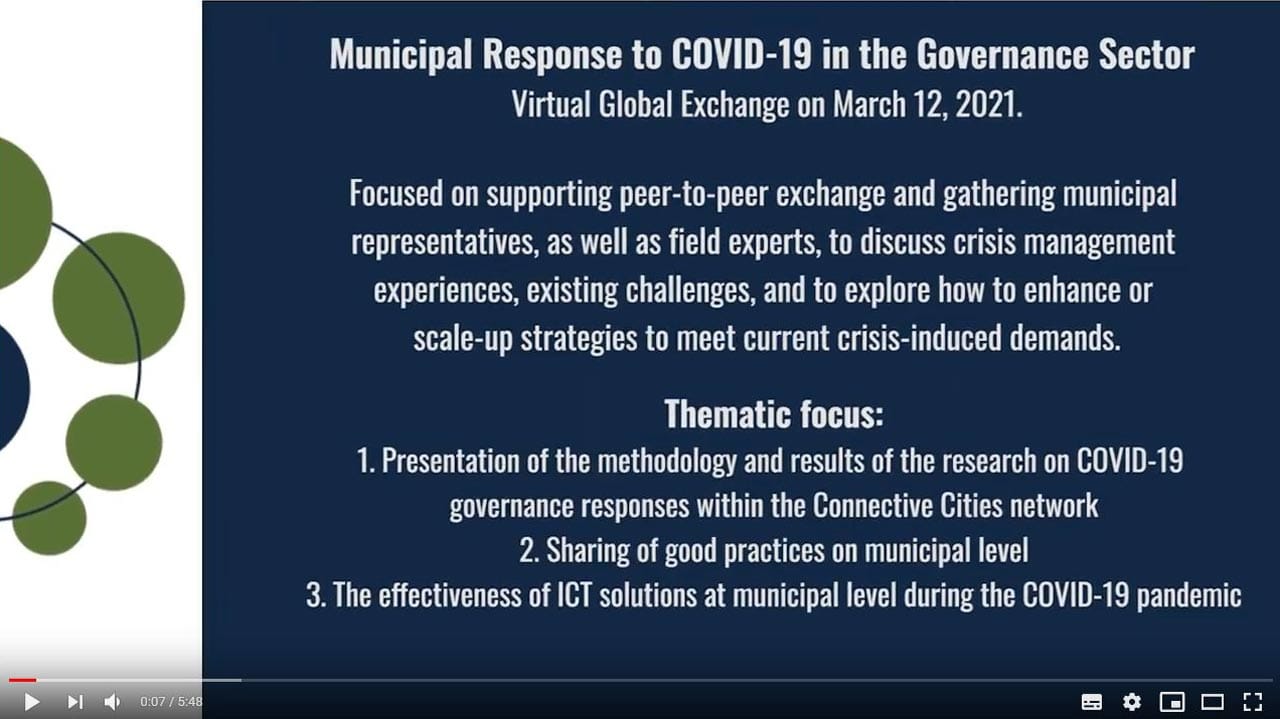
Municipal response to COVID-19 in the governance sector

Thematic focus:

1. Methodology and results of the research on COVID-19 governance responses within the Conncetive Cities network in Southeast Europe

2. Sharing good practices on municipal level

3. The effectiveness of ICT solutions at muncipal level

More: https://youtu.be/joIlOoZdPWg

More good practices, articles, videos, podcasts and interviews on our COVID-19 page.