Space-blind strategies don’t work for COVID-19

The Organisation for Economic Cooperation and Development (OECD) recently analysed how cities have responded to the COVID-19 pandemic. Soo-Jin Kim, Head of the OECD’s Urban Policies and Reviews Unit, calls for locally-adapted solutions now and for the post-COVID era.

Since March 2020, local health authorities have often dominated the headlines. Citizens’ trust in local politicians has significantly increased. Which role have municipalities played so far in responding to the COVID 19 crisis?

Soo-Jin Kim: Since the very beginning of the pandemic, municipalities have not waited for national governments to tell them what to do – they started to act immediately. They have deployed a range of measures to inform the public about necessary measures, ensure that people comply with social distancing and lockdown rules, support the shift to tele-working and take care of the most vulnerable such as the elderly and the poor. They have also worked to keep basic public services running, including the health system, and help the local economy survive the crisis. So I would describe municipalities as ‘essential workers’.

In addition, regardless of the crisis, we should not forget that municipalities are always key public actors. Subnational governments are responsible for an average of 40 per cent of all public spending across OECD countries. In federal states such as Germany or Switzerland, it’s even 50 to 60 per cent!

New working groups in the MENA network: Municipal recovery from the pandemic

Following the intensive knowledge-exchange program on municipal response to the pandemic that was conducted in 2020 to support the Connective Cities network in MENA, several working groups are being established to sustain the results of the peer learning activities. The working groups consist of municipal representatives and partners from the business sector, civil society, and academia. From a thematic standpoint, the topics under focus are:

  • Waste management and circular economy
  • Digitalisation for resilient cities
  • Biodiversity and environmental protection (kick-off event: August 9, 2021)
  • Crisis management in Palestinian municipalities
  • Social entrepreneurship and local economic development (kick-off event: August 12,2021)

Several meetings and preparatory activities have been conducted to formulate the road map of each working group. The core working group on ‘biodiversity and environmental protection’ has developed and submitted a concept note to the EU Call for Proposals on Biodiversity and Ecosystems Protection in Lebanon. In order to be eligible for this call, an effective consortium was established under the umbrella of Connective Cities network. The consortium members included Saint Joseph University (represented by Dr. Jocelyne Gerard and Dr. Zaarour), Green Line environmental NGO (represented by Dr. Ali Darwish), and Menjez municipality (represented by its Mayor Dr. Georges Yousef). Other potential local authorities’ beneficiaries include Beit Meri, Jezzine, Al Buhayra Union of municipalities, which will join at a later stage of the project.  

We are looking forward to include new members to these working groups. If you would like to be an active member of these working groups, please contact us at: muna.shalan@giz.de

Pandemic response in Aracaju, Brazil

Brazil is one of the countries most affected by the pandemic worldwide. Aracaju, the capital of the state of Sergipe in north-eastern Brazil, responded quickly and comprehensively to Covid-19.

In March 2020, a response plan was developed, and a crisis team was established. This meant that even before the first cases appeared in the region, people with symptoms could be isolated, tested and followed up. Random testing of citizens, for example, in public places, markets and train stations, was also very successful. Through this strategy, around 3,600 PCR tests and 1,200 rapid tests were conducted weekly in all 44 neighbourhoods of Aracaju. Testing allowed a-symptomatic cases to be detected and isolated. In addition, the protection of at-risk groups was vital for the Brazilian city. Therefore, they were tested especially frequently and at home. The prevention measures also included registering travellers at the airport.

In March 2020, the Aracaju city government set up eight medical centres, of which around 130,000 patients were cared for by October 2020. Furthermore, hospitals were equipped with respirators and beds were increased. The field hospital opened in May 2020 treated more than 450 patients. Thanks to these measures, the city’s health system was relieved.

Crisis communication was another key component in the strategic management of the pandemic in Aracaju. The citizens were informed about infection numbers in a daily briefing. Another concern of the city was to support the citizens emotionally. Therefore, Aracaju offered psychological counselling by telephone, an offer that was taken up more than 4000 times. Thanks to these comprehensive measures, Aracaju has recorded one of the lowest mortality rates in Brazil concerning Covid-19.

Further Information

Gestão Estratégica e medidas inovadoras no enfrentamento à pandemia em Aracaju/SE  –  Präsentation in Portugiesisch [PDF, 1,96 mb]

Event Recording in German, Spanish, and Portugiese (Presentation on Aracaju starts min. 73): Strategisches management zur Bekämpfung der Pandemie in Aracaju (Only for those registered on the Connective Cities Platform)

Contact

Frau Waneskade Souza Barboza,
Representative of the National Front of Mayors (FNP)
Secretary of Health of Aracaju Prefeitura Municipal de Aracaju, Aracaju, Brazil
waneska.barboza@aracaju.se.gov.br

Stari Grad – how vaccination campaigns can reach groups at risk

As in many other countries, people in Serbia who want to be vaccinated have to book an appointment online and then get their jabs at a vaccination centre. But what about the elderly and people without internet access, or those unable to operate digital devices? And what do people do who can’t travel to the vaccination centres on their own? Stari Grad, in Serbia, shows how municipalities can reach this important target group in their vaccination campaigns.

Communicate and coordinate – the key to successful vaccination campaigns

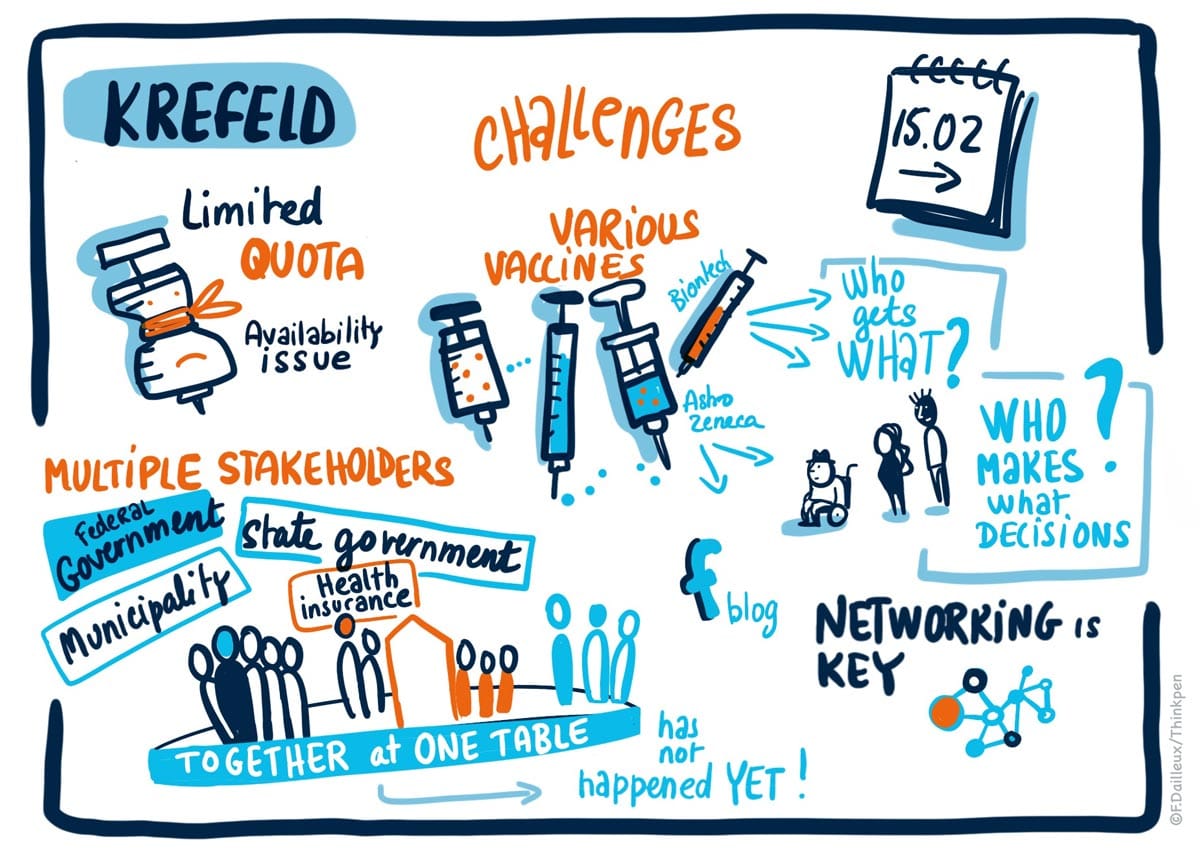
Impatient and sceptical citizens, the ongoing shortage of vaccines, constantly changing regulations that have to be rapidly implemented – these are some of the considerable challenges facing German municipalities in their vaccination campaigns. In its campaign, the City of Krefeld relies on communication and coordination. The concept has proven successful.

Municipal Response to COVID-19: Driving Smart City Development

On 29th of April a virtual workshop on Smart City Development took place as part of the ongoing applied research project “Research of good practices and moderation of virtual events on the subject of health, business and governance at municipal level in times of COVID-19”. 

Workshop centered on overviewing the EU Green Deal Agenda, smart cities models and concepts, as well as advantages of accelerating digitalization processes and financial attraction possibilities in the period of a pandemic.

Approximately 15 participants from Albania, Armenia, Bulgaria, Colombia, Kyrgyzstan, Moldova, Philippines, Poland, Ukraine, Georgia took part in the workshop.

The event focused on

  • Presenting the concept of European Green Deal
  • Introducing Smart cities development models and concepts
  • Providing digitalization solutions for municipalities in the pandemic period
  • Highlighting possible sources of financing
  • Providing conclusions and possible next step suggestions

After the event all attendees were given certificates of completion of the workshop.

Program

This virtual event was opened by welcoming remarks made by Dr. Piotr Żuber, Project Team Leader, PMCG. Dr. Żuber provided background information of the workshop and briefly overviewed the agenda. Following the introduction, Ms. Daiva Matonienė, International Consultant, advanced into the core sessions.

Two main topics of the sessions were:

  • Smart city development: innovations and key drivers
  • Acceleration of digitalization processes in the pandemic period

After each session, active discussions were held on relevant topics, where participants were given floor to present their practices and share challenges in the Smart City Development processes from their municipalities.

Presentations

European Green Deal and Smart City Development
Ms. Daiva Matonienė, International Consultant

Improvement of local actors, project management in Lithuania
Mr. Arunas Grazulis, Expert of Public Policy and European Union programmes

Smart cities development models and concepts
Ms. Daiva Matonienė, International Consultant

Digitalization- the future is today
Ms. Daiva Matonienė, International Consultant

“ALL-IN-ONE” solution suite for smart municipalities
Mr. Edgaras Engelmanas, Head of Export, IRTC

International practices of the deposit refund system
Ms. Daiva Matonienė, International Consultant

Financial attraction possibilities
Ms. Daiva Matonienė, International Consultant

Results

During this online workshop representatives from multitudes of municipalities exchanged their experiences and insights in the field of smart city development.

Participants were introduced to topics such as: development of green recovery plan, innovative tools for digitalization and public-private partnership. At the same time attendees were given some recommendations on atracting potential donors and funds as well as tips on steps forward. Contact information of field experts, as well as companies experienced in the field of smart development were given to municipal representatives to support further collaboration opportunities.

Multidimensional: The COVID-19 urban restoration programme “Lviv tomorrow”

Ukraine, like most countries around the world, is strongly affected by Corona since March 2020. Individual cities experience little government support and are largely left to their own devices to combat and deal with COVID-19. Despite this challenge and only limited financial resources within the city budget, the city of Lviv managed to take quick and effective action.

The city, which is in northwestern Ukraine and has a population of about 750,000, established the “Lviv tomorrow” program to mitigate the negative consequences of COVID-19 and create the preconditions for improving the social, economic and cultural situation in the city. The program consists of 80 different projects, of which more than 50 already have been implemented.

An important pillar of the program is safety and health. The city of Lviv doubled the number of hospital beds available and set up its own COVID-19 testing laboratory. This allowed the number of COVID-19 tests to increase from 200-400 to over 3000 per day, speeding up the tracking of infected individuals and thus simplifying pandemic response.

The city also established new digital solutions that make it easier for the population to stay at and work from home. For example, a portal was created where the population can pay digitally for city services.

Especially the cultural sector was hit hard by the restrictions necessary to combat the pandemic. The city of Lviv is countering this by promoting open-air events and smaller cultural events, for example on balconies. This way, not only jobs in the cultural industry can be preserved, but also part of the life quality in the city can remain. In the uncertain times of the pandemic, cultural events are also a important psychological support for the population.

Another component of the “Lviv tomorrow” program is economic development. One project, for example, supports local food producers. In cooperation with supermarkets, food produced in Lviv is promoted and labeled with “made in Lviv” stickers.

With its extensive “Lviv tomorrow” program, the city of Lviv is taking action on many different levels to combat the pandemic and its effects. Not only the immediate aspects of the pandemic, such as the number of hospital beds, but also other areas of coexistence, such as cultural life, are included. Thus, not only acutely fighting the spread of Corona, but also creating a long-term perspective for the post COVID-19 city.

Contact:

Mr. Oleksandr Kobzarev
Director of the City Institute. Center of strategic planning in Lviv, Ukraine
o.kobzarev@city-institute.org

More Information:

LVIV TOMORROW. RESTORATION PROGRAM [pdf 11 pp.]

Interaktive Präsentation über Lviv (Only for those registered on the Connective Cities Platform)

COVID-19 implications in the Mediterranean

The brief cites regional examples from the South Mediterranean, sub-Saharan Africa and Germany on how governments and municipalities developed data dashboards and platforms and employed them in the pandemic response.

The policy brief concludes with an elaborate discussion on the implications and recommendations on how the current crisis can be turned into an opportunity for regional collaboration and promoting data-driven processes in the recovery from the pandemic.

Recommended policy actions include mapping the population that is in urgent need for vaccination, strengthening public health preparedness through bilateral and multilateral cooperation and creating Communities of Practice that contribute to promoting health equity.

Recommendations to promote data sets and data analytics in municipalities are also proposed, including the suggestion to integrate User-Friendly GIS software that is customized specifically for municipal use and written in the country’s native language, which could allow unlocking the geospatial system’s full potential.

Amman – strengthening social responsibility

With a prudent vision, the Greater Amman Municipality implemented several hard and soft measures to curb the impact of the pandemic on the local community using a three-pillars response approach: health, community, and environment. With the special focus on ‘community health and wellbeing’, the social development division fulfilled its role during the pandemic by implementing a myriad of measures under the umbrella of social services to the local community.

Municipal Response to COVID-19 in the Area of Governance

Approximately 50 participants from Georgia, Ukraine, Belarus, Moldova, Montenegro, Poland, Kyrgyzstan, Romania, Czech Republic, Estonia, Bosnia and Herzegovina, Argentina, Bolivia, Armenia, Azerbaijan, Albania and Germany (16 countries) participated in the virtual event of the knowledge-exchange series on Municipal Response to COVID-19 in the area of governance.

The event focused on exploring the role of e-governance in combating COVID-19. It reviewed how municipalities manage to ensure the supply of essential municipal services with the help of efficient e-governance systems. During the event various topics were discussed, such as:

  • Crisis management experiences and existing challenges
  • Exploration of how we can enhance or scale-up strategies to meet current crisis-induced demands.

The web-seminar explored the impact of the COVID-19 outbreak on municipal plans/strategies and municipal services, the actions and communication strategies deployed in response, and the cooperation of municipalities with national governments as well as international organizations.  

Program

 In this virtual event, Dr. Giorgi Khishtovani presented the methodology and results of the research on COVID-19 governance responses within the Connective Cities network. Thereafter, two good practices were shared from Tartu (Estonia) and La Paz (Bolivia). The moderated panel discussion covered the topics of e-governance and the effectiveness of ICT solutions at municipal levels during the COVID-19 pandemic. The participants were then encouraged to continue with the exchange on the virtual platform Connective Cities where other resources were shared in addition to the session outputs.

Presentations of good practices

Municipal Business and Governance Response to COVID-19: Tartu Case
Raimond Tamm, Deputy Mayor of Tartu, Tartu, Estonia.

Public Services and I-Government in COVID-19 Era
Roberto Zambrana Flores, La Paz, Bolivia.

Results

During this online exchange representatives from multitudes of municipalities exchanged their experiences and insights in the fields of municipal response in health, business, and governance. This virtual exchange brought together city leaders and field experts in health, business, and governance to discuss prevalent trends, opportunities, and challenges emerging, along with the development and reinvention of municipal responses amid the COVID-19 pandemic.