Water Resilience – Preparing Municipalities for Drought and Heavy Rainfall

Water is becoming a key challenge for an growing number  of local authorities worldwide. On the one hand, they are increasingly exposed to heatwaves and drought. But on the other hand, heavy rain and high water levels are leading to more frequent flooding. These risks come together to not only impact public health, but jeopradize private property and public infrastructure. Global water demand could significantly exceed available supplies by 2030. Water is thus becoming a strategic resource. It is therefore critical for municipalities to strengthen their water resilience.

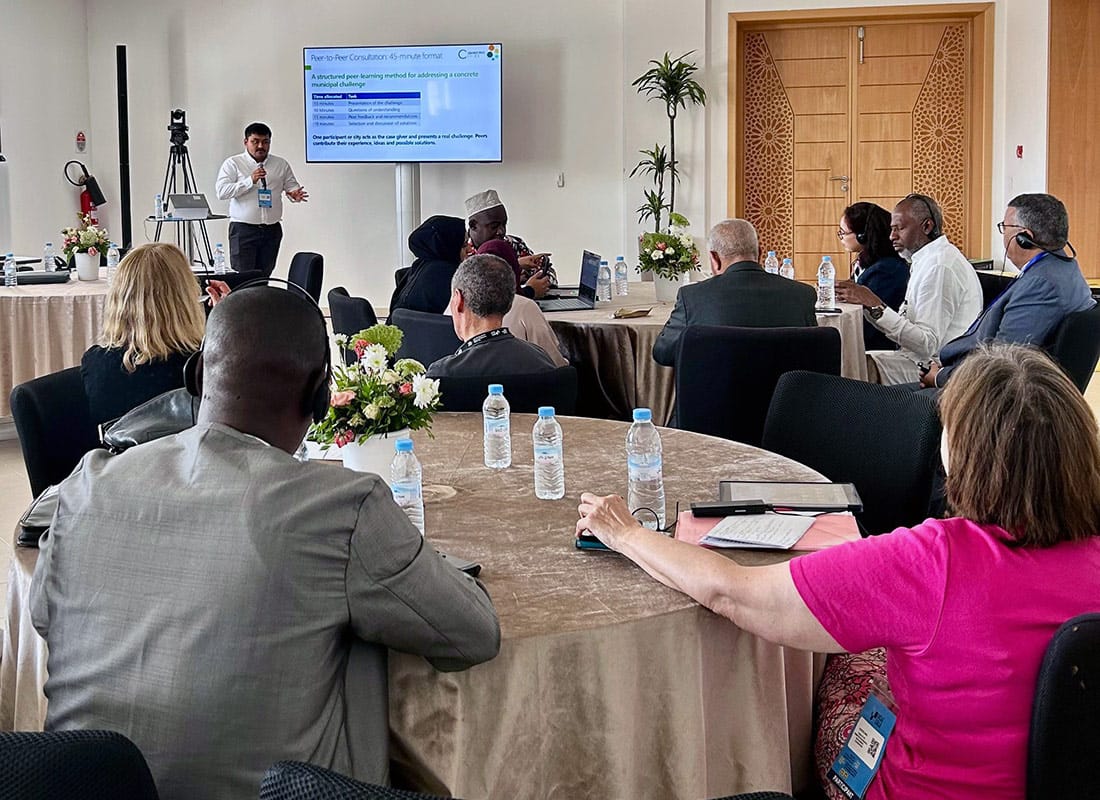
Examining their own challenges regarding water resilience, learning from experiences on other continents and developing the courage to implement innovative ideas – all these were the ingredients of the first in-person meeting as part of the Connective Cities Deep Dive, held from 5 to 7 May 2026 in Wuppertal. The group had already met for a virtual kick-off in March 2026. In early 2026, a total of 16 experts from the German municipalities of Dresden, Wunstorf and Wuppertal, as well as from Akkaraipattu (Sri Lanka), Homa Bay (Kenya), Hyderabad (India), Natitingou (Benin) and Niš (Serbia) have started a two-year long working together to explore and analyse innovative approaches such as sponge city concepts, blue corridors and integrated blue-green-red infrastructure, and the possibilities for their implementation. On this basis, they develop and implement locally adapted solutions to address their specific challenges.

The report describes practical examples from Wuppertal and Leipzig, outlines the planned pilot projects of the six municipalities and summarises the key takeaways from the process so far.

Connective Cities at the World Urban Forum 13 in Baku

At the 13th World Urban Forum in Baku, the German Association of Cities and Connective Cities hosted an interactive Academy Session on “AI-supported Visualisation for Affordable Housing and Informal Settlement Upgrading”. The session explored how AI-supported visual tools can help municipalities discuss challenges related to affordable housing, neighbourhood development and informal settlement upgrading in a more concrete and accessible way.

The session built on the work of the Connective Cities Working Group on Sustainable and Affordable Housing. It was deliberately designed not as a technology demonstration, but as a practice-oriented municipal learning format based on real municipal cases. The aim was to explore how visualisation can make complex planning questions more understandable and open new spaces for dialogue between municipalities, technical departments, decision-makers and local stakeholders.

The process started from real images provided from municipal contexts. With the support of CoPlan AI, these images were translated into possible development scenarios. The AI-generated visuals were not intended as final plans. Instead, they served as discussion inputs. They allowed participants to discuss housing quality, density, public space, greenery, climate adaptation, mobility, social infrastructure and possible implementation steps in a more tangible way.

A central added value of the format was the joint work around the images. The visualisations made abstract planning questions visible and enabled a creative, yet critical discussion: What future images are being created? Which assumptions lie behind them? Which opportunities and risks become visible? Which social, spatial, environmental, institutional and financial conditions would need to be assessed before an image can become a realistic planning step?

The session was moderated by Prof. Hilmar von Lojewski, German Association of Cities. Jelena Karamatijevic, Connective Cities / GIZ, provided the conceptual framing and introduced the Connective Cities perspective on municipal practice and peer learning. CoPlan AI, represented by Damiano Cerrone and Sampo Ruoppila, supported the participatory AI-based visualisation process.

Municipal case contributions and reflections came from Nairobi, Huye, Mariental, Hebron, Berlin and the Urban Development Fund in Egypt. Contributors included Godfrey Ngugi, Richard Ndicunguye, Sunday Haimbodi, Husam Shweiki, Lars Loebner and Dr. Marwa Ahmed. They reflected on the visual scenarios from the perspective of local planning realities, implementation constraints and possible next steps.

From Berlin, Lars Loebner from the Senate Department for Urban Development, Building and Housing contributed an important perspective on the role of images in public debates on housing and neighbourhood development. Visual representations can strongly influence how new housing is perceived. Used responsibly, they can help communicate not only abstract plans, but also positive and realistic images of liveable, socially mixed and green neighbourhoods.

A methodological input was provided by Ruvi Y. Suárez Subirana, GIZ / ProUrbano, Santa Cruz, Bolivia. Under the title “From AI Visualisation to Scenario Assessment”, she showed how AI-supported visualisation can be linked to scenario thinking and impact reflection. Her contribution complemented the discussion by underlining that AI images are not plans. Their value emerges when they are used to reflect jointly on impacts, trade-offs and possible implementation pathways.

The discussion showed that AI-supported visualisation can be a useful tool for making planning options more accessible and supporting joint learning. At the same time, participants underlined that visualisations must be used responsibly. They can create expectations and therefore cannot replace planning, participation, feasibility assessments, cost estimation or political decision-making.

From a Connective Cities perspective, the Academy Session provides an important starting point for a deeper exchange on affordable housing, informal settlement upgrading and implementation-oriented municipal project ideas. The added value lies not in the technology itself, but in its potential to strengthen municipal learning processes and help translate visualisation and mapping into realistic, inclusive and financeable urban development pathways.

Visual documentation: Current state / after AI-assisted visualisation

The following visualisations were developed as discussion inputs during the WUF13 Academy Session. They use real municipal images as starting points and AI-generated scenarios to support dialogue on affordable housing, informal settlement upgrading, public space, climate resilience and implementation pathways. The images are not final plans.
Source: Connective Cities, generiert mit CoPlan AI.

Ruanda, Huye — suburban affordable housing area

From serviced land to a liveable affordable housing neighbourhood with public space, shade and community facilities.

Initial scenario (left) and AI-generated discussion scenario (right)

Kenia, Nairobi County — Mji wa Huruma

From an informal settlement to upgrading, safer public space and climate-sensitive housing.

Initial scenario (left) and AI-generated discussion scenario (right)

Namibia, Mariental — incremental housing approach

From incremental housing conditions to a safer street environment with basic services, shade and walkability.

Initial scenario (left) and AI-generated discussion scenario (right)

Palestine, Hebron — affordable housing in context

From an existing street section to a scenario with mixed-use edges, greenery and pedestrian-oriented housing.

Initial scenario (left) and AI-generated discussion scenario (right)

Germany, Berlin — new neighbourhood development

From open land along a road to a dense, green and mixed-use housing scenario

Initial scenario (left) and AI-generated discussion scenario (right)

Egypt, Sharqia — urban infill and affordable housing

From underused urban land to a compact housing scenario with shaded courtyards and public space.

Initial scenario (left) and AI-generated discussion scenario (right)


The “Walkable Triangle” in Kisumu, Kenya

Kisumu, a port city on the shores of Lake Victoria and one of Kenya’s largest cities, is becoming increasingly important for the movement of goods and trade between Kenya and its neighbouring countries, Tanzania and Uganda. With an annual population growth rate of just under 4 per cent, the population has more than doubled in 15 years, rising from around 205,000 in 2001 to at least 422,000 in 2025. This has led to a series of major infrastructure projects, which, however, have primarily focused on motorised transport, even though 53 per cent of residents’ daily journeys are made on foot.

One project under the ‘Kisumu Sustainable Mobility Plan’ is the ‘Walkable Triangle’: the pedestrian-friendly redesign of the three main streets—Oginga Odinga, Ang’awa Ave and Jomo Kenyatta Ave—in a commercial district in the city centre. These streets form a triangle around a sports and park area and are used by over 2,200 pedestrians every day. The aim is to promote non-motorised transport along the 1.5-kilometre stretch, making it safer, more pleasant and accessible, whilst preserving and integrating the existing tree population.

In addition, the city is promoting e-mobility in public transport through a battery-swapping system for motorcycle taxis, known as ‘boda-bodas’, and three-wheeled taxis, known as ‘tuk-tuks’.

The documentation describes the approach as well as the outcomes achieved by this good practice.

Author: Burkhard Vielhaber

Copyright: Connective Cities


From Challenges to Pathways: Advancing Nature-Based Solutions in Urban Contexts

The Connective Cities learning process on “Nature at the Heart of Urban Resilience” was officially launched through a three-day kick-off workshop held in Naivasha, Kenya from 21 to 23 April 2026, bringing together 20 municipalities and cities from across Sub-Saharan Africa and Germany, alongside over 40 urban practitioners, technical experts, and institutional partners.

The workshop marked the starting point of a longer-term engagement aimed at supporting local governments in translating their urban challenges into concrete, implementable solutions through structured peer exchange and technical support.

The participants of the learning process | © Connective Cities

Cities at the Frontline: Climate Pressures and the Need for Nature-Based Solutions

Urban areas are increasingly where the impacts of climate change are most visible—and most intensely felt. Across Sub-Saharan Africa, cities and municipalities are facing a convergence of pressures: rapid urbanisation, environmental degradation, and growing exposure to climate risks such as flooding, drought, and heat stress. These pressures are not isolated; they interact in complex ways, amplifying vulnerabilities and placing strain on already limited infrastructure and institutional capacities.

At the same time, local governments are not passive actors. As highlighted in the opening of the workshop, they are at the forefront of both experiencing and addressing climate challenges.

Andreas Wolter | © Connective Cities

Andreas Wolter, President of Climate Alliance and City Councilor of Cologne, emphasized the critical importance of ensuring that cities are actively represented in the global climate discourse, as municipalities are where climate impacts are most immediate and where solutions must ultimately be implemented.

Complementing this perspective, Dr. Nelson Maara, representing Nakuru County, highlighted the importance of preserving ecosystem services as a foundation for resilience, drawing on local experience to illustrate how the degradation of natural systems directly translates into increased urban vulnerability for climate-related risks.

Together, these perspectives reinforce a growing recognition that municipalities must play a stronger role in shaping climate action, as they are responsible for translating high-level commitments into practical, locally grounded solutions. In this context, Nature-Based Solutions (NbS) offer a critical pathway—enabling cities to address environmental, social, and economic challenges simultaneously through the restoration and sustainable management of ecosystems. However, while the relevance of NbS is increasingly acknowledged, the ability to move from concept to implementation remains a complex issue. This is where the Connective Cities learning process plays a critical role, equipping municipal practitioners with the technical capacities and knowledge required through structured exchange formats.

From Exchange to Implementation: The Role of the Learning Process

The learning process is built on the principle that cities and municipalities learn most effectively when they engage directly with one another on real, shared challenges. Rather than focusing on abstract knowledge transfer, it creates a structured space for practitioners to jointly analyse their challenges, exchange experiences, and progressively develop reform measures—concrete actions or project concepts that can be taken forward within their local contexts.

Additionally, another key component of the Learning Process methodology is to strengthen the capacities of urban practitioners to design, plan, and advance these measures within their institutional environments. The peer-to-peer approach is particularly important given the diversity of participating municipalities, bringing together different governance structures, capacities, and experiences while highlighting that many of the underlying challenges are fundamentally shared.

The learning process is therefore not about transferring solutions from one context to another, but about enabling cities to adapt and refine ideas through dialogue, ensuring that they are both context relevant and practically implementable.

From Framing to Practice: Expert Inputs and Panel Insights

Building on the broader objectives and structure of the learning process, the kick-off workshop in Naivasha marked the first step in translating this approach for peer learning into practice. Over the course of three days, participating cities and municipalities engaged in a structured exchange that combined expert inputs, panel discussions, and peer learning sessions, allowing them to ground NbS in their own urban realities.
The expert inputs provided the theoretical basis for the participants to better understand the importance of NbS for sustainable municipal development:

Prof. Johanes Belle introduced NbS through the lens of ecosystem services, highlighting how natural systems provide essential functions such as flood regulation, water purification, and climate moderation.

Prof. Johanes Belle | © Connective Cities

In addition to their core infrastructural functions, Nature-Based Solutions also generate co-benefits, including improvements in psychological well-being of local residents, increased soil quality, and opportunities for job creation. By framing NbS in terms of these services, Dr. Belle underscored that ecosystems should be understood as functional infrastructure, central to urban resilience rather than peripheral environmental assets.

For example, wetlands and urban green spaces can absorb excess stormwater, reducing flood risk while simultaneously improving water quality in rapidly growing urban areas. This perspective was particularly relevant for participating cities, many of which are experiencing the direct consequences of ecosystem degradation in the form of increased flood risk, declining water quality, and heightened climate vulnerability.

The input from Deputy Mayor William Wolfgramm, from the City of Cologne’s Climate Department demonstrated how such concepts of NbS can be translated into practice within a structured comprehensive planning framework by presenting the City of Cologne’s ‘urban green space masterplan’. Drawing on concrete examples, the presentation showed how NbS are embedded within long-term planning instruments and supported through institutional coordination, data-driven analysis, and dedicated funding mechanisms.

Mayor William Wolfgramm | © Connective Cities

Measures such as de-sealing urban surfaces, expanding green corridors, and promoting green roofs and rainwater retention systems illustrated how NbS can be systematically implemented at scale when anchored in governance structures, through long-term planning processes and through taking a ‘whole-of-society’ approach.

The panel discussion further reinforced this shift from concept to application. Drawing on experiences from cities that had previously engaged in similar processes, panelists demonstrated through experiences from previous Connective Cities learning processes how initial ideas developed through peer exchange can evolve into tangible outputs—whether through feasibility studies, planning instruments, or pilot interventions. The discussion highlighted various concrete lessons:

  • eThekwini (South Africa): Emphasised the importance of adopting an all-of-society approach to disaster risk management, bringing together local government departments, technical experts, and communities. Particular attention was given to strengthening communication channels with local populations and ensuring that NbS are embedded within long-term, city-wide programmes and institutional frameworks.
  • Abelkuma, Accra (Ghana): Highlighted the importance of breaking down institutional ‘silos’ and ensuring coordination across departments in the development of foundational instruments such as urban greening guidelines and implementation plans. The intervention further underscored the need to strengthen technical detailing, local ownership, and financing pathways in order to move from concept to implementation.
  • Berlin (Germany): Emphasised the importance of clearly scoping technical challenges, anchoring them within appropriate institutional frameworks, and establishing clear lines of accountability. They further highlighted how inclusive, participatory processes—bringing together multiple stakeholders, including local communities—can strengthen implementation, supported by robust control mechanisms such as data systems, continuous monitoring, and regulatory frameworks.
  • Lusaka (Zambia): Emphasised the critical role of data collection and feasibility studies in advancing projects from concept to implementation. They highlighted the importance of partnerships in mobilising financing and noted the value of city networks in providing technical support and facilitating access to funding opportunities.


The Panelists | © Connective Cities

Commonly shared among the panelists was the insight, that while ideas often originate through exchange, their success depends on strong ownership —both in terms of institutional anchoring and the involvement of all relevant stakeholders— alongside the ability to translate concepts into structured an financeable interventions.

Cities in Dialogue: From Individual Challenges to Shared Patterns

With these insights in mind, the workshop moved into the peer learning phase, where participating cities and municipalities began to unpack their own challenges in greater detail. To facilitate focused exchange, participants were organised into five moderated working groups:

  • Group 1: Babadjou (Cameroon), Méagui (Côte d’Ivoire), Natitingou (Benin), Commune de Nanga-Eboko (Cameroon)
  • Group 2: Douala (Cameroon), Maputo (Mozambique), Huye (Rwanda), Cape Coast (Ghana)
  • Group 3: Tanga City (Tanzania), Köln (Germany), Mazabuka (Zambia), Ilemela (Tanzania)
  • Group 4: Embu (Kenya), Nakuru (Kenya), Mwanza (Tanzania), Tarkwa-Nsuaem (Ghana)
  • Group 5: Bosaso (Somalia), Sinda Town Council (Zambia), Kimberley (South Africa), Berlin (Germany)


Within these groups, municipalities presented their challenges, received peer feedback, and began refining possible directions for action. While the discussions initially reflected diverse local contexts, a clear pattern of shared challenges quickly emerged.

Group waork | © Connective Cities
© Connective Cities

Across the groups, municipalities repeatedly highlighted issues related to ecosystem degradation, water management, waste systems, and rapid urbanisation. These challenges were often closely interconnected. For instance, inadequate waste management was identified as a key contributor to flooding, as blocked drainage systems exacerbate water accumulation during heavy rainfall. Similarly, unplanned urban expansion into wetlands and riverbanks was found to increase exposure to climate risks.This reinforced the understanding that urban challenges are not isolated, but rather systemic in nature, requiring integrated responses that address environmental, institutional, and social dimensions simultaneously.

As discussions progressed, cities began to move beyond describing their challenges and toward identifying more structured pathways forward.

From Challenges to Action: Peer Recommendations and Emerging Directions

Through structured peer exchange, participants worked to refine and prioritize potential solutions. Rather than introducing entirely new ideas, this process helped cities to clarify the thoughts broad to the workshop and translate broad concepts into more concrete directions.

Key recommendations emerging from the discussions included the need to strengthen the evidence base for planning, through baseline studies, risk assessments, and feasibility analyses. Cities were also encouraged to integrate NbS within urban planning and governance frameworks, ensuring that interventions are embedded within long-term strategies rather than implemented as isolated projects.

© Connective Cities

Another strong theme was the importance of community engagement and behavioral change, particularly in areas such as waste management and environmental protection. Many cities recognised that technical solutions alone would not be sufficient without local ownership and awareness building measures.

Finally, there was a clear emphasis on the need to move toward structured project development, including cost-benefit analysis, clearer project definition, and preparation for financing.

From Ideas to Implementation: What Comes Next

While the initial phases of the workshop focused on understanding challenges and identifying potential solutions, time was also dedicated to looking ahead within the year-long learning process. The emphasis shifted towards how these ideas can be further developed into implementable and financeable interventions.

To support this, inputs were provided by the City Climate Finance Gap Fund and the Covenant of Mayors in Sub-Saharan Africa (CoM SSA). Both initiatives outlined their approaches to supporting cities in developing climate projects, including their selection criteria, support mechanisms, and application processes. Emphasis was placed on the importance of strong technical preparation, clear project scope, and alignment with climate and development priorities.

These inputs directly responded to the needs expressed by cities, particularly in relation to moving beyond early-stage ideas and accessing financing. Building on this, the workshop concluded with a forward-looking exercise in which cities presented initial concepts for reform measures, beginning to articulate more concrete project ideas and potential pathways for implementation.

© Connective Cities

Closing Reflection

What the workshop demonstrated is that cities are not lacking solutions. Across contexts, there is already a strong foundation of ideas, experiences, and emerging practices. The key challenge lies in structuring these ideas, strengthening the enabling environment, and advancing them toward implementation.

The Connective Cities learning process provides a platform to do exactly that—turning exchange into collaboration, and collaboration into tangible action.

Climate Proofing the Built Environment: Technical Support for Climate Resilient Infrastructure

The second Africa Urban Forum (AUF), organized under the African Union framework with the support from UN-Habitat and UNECA, took place from 8 to10 April 2026 at the Kenyatta International Conference Centre in Nairobi, Kenya. AUF welcomed a diversity of participants, among them politicians, private sector, civil society, development partners and interested members of the public as well, to discuss the conferences’ topic: ‘Adequate Housing for All: Advancing Socio-economic and Environmental Transformation towards the Realization of Agenda 2063’.

At AUF, Connective cities alongside GIZ partner projects Covenant of Mayors Sub Sahara Africa (CoMSSA) and Resilience Initiatve Africa (RIA) organized and facilitated a side event on 9 April, titled Climate proofing the built environment: Integrated Technical Support for Climate-Resilient Infrastructure.

The events’ panel-discussion included international experts, development finance institutions, and local administrations. Thereby, participants could gain insights from local government representatives from Embu, Kenya, and eThekwini, South Africa on how to combine collaborative governance with technical expertise for climate resilient infrastructure. In this regard, the launch of the Embu Final Prefeasibility Technical Assistance Report on Solid Waste Management Infrastructure illustrated the need for comprehensive data gathering prior to project implementation.

Next to the case studies, panelists discussed institutional arrangements and policy approaches related to financing sustainable urban infrastructure. For example, a representative of the European Bank for Reconstruction and Development emphasized that cities must leverage on digitalization of revenue collection to meet ever-rising financial demands and also demonstrate to potential financiers built-in capacity to collect, allocate, and use financial means effectively.

Furthermore, a program manager from the European Investment Bank noted that for development projects to be implemented efficiently, the national and sub-national levels of government must enter into collaborative modes of governance, whereby they complement each other in sourcing funds from potential financiers. The program manager further advocated for a non-fragmented approach towards infrastructure development to avoid wastage and duplication of effort and resources.

In sum, the AUF side-event, by bringing together financial institutions and local government leaders, provided valuable insights into how to comprehensively think sustainable urban development as a basis to successfully build climate-resilient infrastructure in African cities and beyond.

Nature at the Heart of Municipal Resilience

Connective Cities invites municipal and regional authorities from Sub-Saharan Africa and Germany to participate in a new international Learning Process on Nature-Based Solutions (NbS).

Local and regional governments are increasingly at the forefront of addressing climate change, biodiversity loss, and environmental degradation. Intensifying floods, droughts, heatwaves, and land sealing are placing growing pressure on urban systems and governance capacities. Against this backdrop, Nature-Based Solutions offer a cost-effective, multi-benefit pathway to strengthen climate adaptation while also delivering mitigation co-benefits such as carbon sequestration, stormwater management, and urban heating and cooling regulation.

About the Learning Process

The one-year Learning Process will convene municipal practitioners, technical experts, and policymakers through three in-person workshops and continuous virtual collaboration. Participants will progress from problem identification to solution co-development and implementation readiness, supported by peer learning, technical input, and targeted coaching.

The process aims to:

  • Strengthen municipal and regional capacities to plan and implement NbS
  • Facilitate structured peer-to-peer learning between Sub-Saharan African and German authorities
  • Co-create actionable NbS project concepts ready for piloting, financing, or integration into planning frameworks
  • Generate knowledge products to support replication and scaling across city networks


Thematic Focus Areas

Participants will collaborate within demand-driven thematic working groups, including:

  1. Nature & Urban Ecosystems – Urban greening, biodiversity, de-sealing, urban forests, heat reduction
  2. Water & Sponge Cities – Flood management, river and wetland restoration, rainwater management
  3. Greening Municipal Infrastructure – Integration of green and grey infrastructure, ecological corridors, climate-adaptive mobility and energy systems


Timeline

  • March 2026: Virtual kick-off and insight session on Nature-Based Solutions
  • From 21 to 23 April 2026: First in-person workshop
  • October 2026: Second in-person workshop
  • January 2027: Final in-person workshop


 Who Can Apply

The call is open to:

  • Municipal and regional authorities from Sub-Saharan Africa
  • German municipalities and counties

Participation of two experts per authority is encouraged, with the option to involve partners from ministries, civil society, or the private sector.

 How to Apply

Interested authorities are invited to submit an Expression of Interest via the Connective Cities Community Platform:

👉 Application link:
https://community.connective-cities.net/en/form/connective-cities-ssa-learning-p

Application deadline: 30 March 2026

Contact

Greater Climate Protection and Quality of Life: Green Corridors in the MENA Region

On April 7, 2026, the new Connective Cities learning process on “Green Corridors in the city and its surroundings” was officially launched. The event was organised by Connective Cities in cooperation with the GIZ project Capacity Building through Urban Infrastructure Development (CBUID II) and was offered simultaneously in Arabic, French and English

The workshop was attended by around 70 representatives from eight countries: Algeria, Egypt, Germany, Jordan, Lebanon, Morocco, Palestine and Tunisia. Municipalities and partner institutions from the MENA region as well as the German city of Erlangen were represented. In addition to the official participants of the learning process, an extended circle of municipal representatives was further involved in the virtual exchange.

The kick-off served as technical and methodological introduction to the learning process. The aim was to set initial thematic priorities, to make municipal challenges visible and to create a common basis for further cooperation. At the same time, the event served to prepare the next steps in the process, in particular the in-depth phase and the planned face-to-face conference in Egypt.

AI-supported Visualization as Innovative Tool for Urban Planning

A central element of the kick-off was the joint AI visualization exercise on green corridors and green neighborhoods, implemented via the CoPlan AI platform. Based on images from urban contexts in the participating cities, spatial development future scenarios for climate-resilient, greener and more usable urban spaces were developed.

Around 550 images were produced as part of the exercise. The visualisation served not only to illustrate spatial changes, but also as a methodological tool to stimulate discussion about the feasibility of green corridors. In this sense, the exercise proved to be a suitable introduction for bringing together perspectives from administration, planning and local government practice.

Key Workshop Findings

The kick-off showed that green corridors and green neighborhoods in the participating cities are envisioned predominantly in urban districts and less in the cities’ surroundings. The focus is accordingly not on planning in undeveloped areas, but on the gradual further development of existing urban spaces in which housing, mobility, public use and social functions are already closely intertwined.

In that sense, it also became clear that green corridors have to fulfil several functions at the same time. They contribute to climate adaptation, for example through shading, cooling, better air circulation and water absorption. But they also contribute to the upgrading of public spaces by improving the quality of life and encounters within the city. Especially in dense neighborhoods, green corridors must therefore always be considered as social spaces of mobility and connection.

Another central aspect was the importance of participation and local acceptance. Since identified spaces are usually already intensively used, the involvement of the population is an essential prerequisite for successful implementation. This applies to the usability for distinct groups such as children, families and residents as well as the question of how green measures can be integrated into the everyday urban life.

Contribution from the Urban Development Fund (UDF)

The Urban Development Fund (UDF) underlined the importance of institutional approaches for integrated and climate-resilient urban development in Egypt. The examples presented showed how strategic urban development, upgrading of existing districts, heat reduction and public space can be more closely linked. The UDF thus not only contributed concrete experience from Egyptian practice, but also an important perspective on scaling, institutional anchoring and long-term implementation capability.

Contribution of the City of Erlangen

The city of Erlangen’s contribution illustrated that green corridors must be implemented in conjunction with traffic, accessibility and conflicts over the use of urban space. In their presentation of the local project ‘From two quarters to one campus’, Erlangen representatives demonstrated how a green boulevard, tram, bicycle, pedestrian and motorised traffic, and an existing pedestrian bridge could be brought together within one coherent planning task. Thus, the contribution from Erlangen provided important impetus for an integrated planning approach to green corridors.

Example Cities and Good Practices

During the kick-off, several municipal and institutional examples were presented that are of particular relevance for the further learning process:

  • Erlangen (Germany): integrated planning approach to green corridors in existing urban space, with a focus on Green Boulevard, multimodal mobility, land use and conflicts of use.
  • Aswan (Egypt): Development of the Heat Action Plan for El-Sail Elgadid, including cooling stations, shaded recreation areas and specific offers for children and women.
  • Port Said (Egypt): Approaches to climate-adapted urban development and the upgrading of urban spaces under the specific climatic conditions of a Mediterranean city.
  • Telal Al-Fustat Park, Cairo (Egypt): large-scale greening approach in historic Cairo with positive effects on cooling, air quality and biodiversity.
  • Reviving Historical Cairo (Egypt): Upgrading historic urban areas as a combination of urban renewal, public space and historical identity.
  • Al-Asmarat (Egypt): Participatory upgrading of public spaces in the residential environment as an example of the linking of green and social functions in existing neighbourhoods.

Outlook

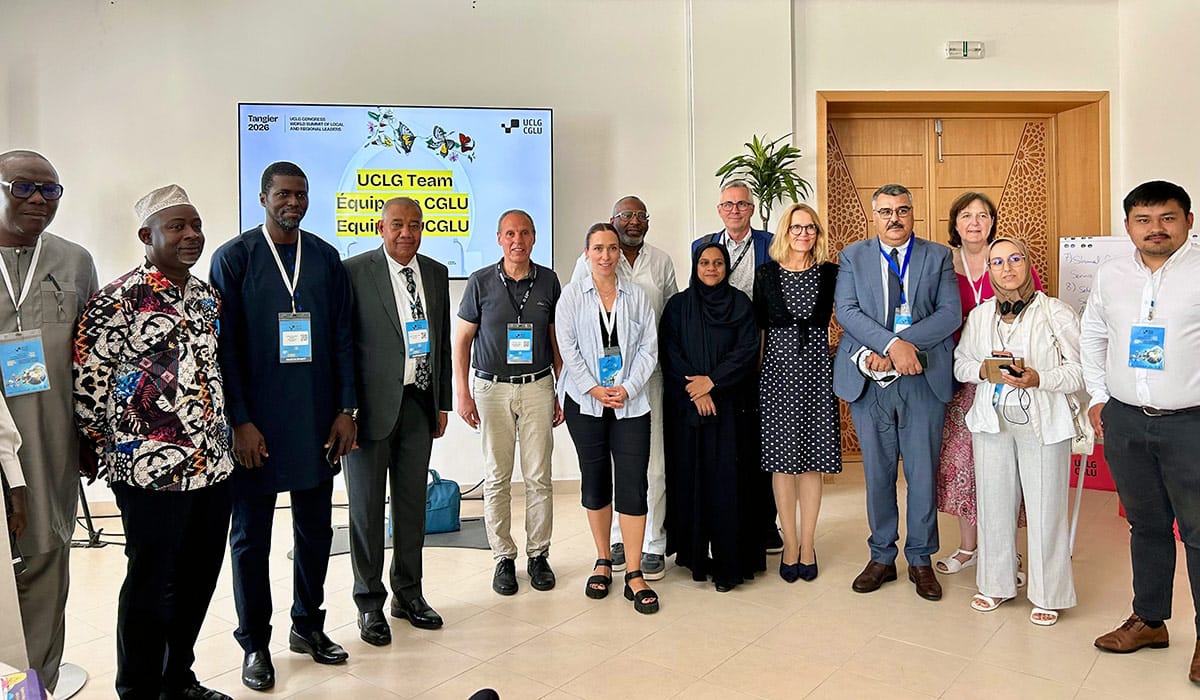
Some of the participants at the launch event

The digital kick-off has created a reliable technical basis for the next steps of the MENA learning process. It became clear that the added value of the format lies particularly in synergy effects between concrete municipal examples, institutional perspectives, inter-municipal exchange and visual methods. In the coming phases, the identified topics will be further deepened, approaches between the cities will be further developed and jointly concretized during both online and face-to-face exchanges.

Online Kick-Off for Municipal Water Resilience

24 March 2026 was the big day! The in-depth learning process “Water Resilience: Strengthening Municipalities against Drought and Heavy Rainfall Events” kicked off shortly after the World Water Day. Droughts, heatwaves, heavy rainfall and flooding are on the rise, putting a strain on infrastructure, public health and municipal budgets. At the same time, urbanisation is intensifying competition for water.

Many major cities are already experiencing severe water stress, and the global demand for water could significantly exceed the available supply by 2030.
Water scarcity has long been an obstacle to development for countries in the Global South, but in the future, all regions worldwide will have to adapt to fluctuating water availability and growing conflicts over its use. Water is set to become the defining strategic resource of the 21st century.

Key solutions are emerging at a local level. Although the broader circumstances vary greatly, local authorities face similar structural challenges, making exchange and collaborative learning particularly valuable.

As part of our ‘Deep Dive’ on the topic of ‘Water-Resilient Municipalities’, we are bringing together experts from eight municipalities in Benin, Germany, Kenya, India, Serbia and Sri Lanka. Over a two-year period, they will discuss innovative approaches, such as sponge city concepts, blue corridors and integrated blue-green-red infrastructure, and develop and implement locally tailored solutions to their respective challenges.

During the initial virtual meeting, the municipalities presented their local challenges, identified initial similarities, and prepared for the first in-person working meeting in Wuppertal in early May. Further updates from our ‘Deep Dive’ project will follow from May 2026.

The participating cities are: Natitingou (Benin), Dresden, Wunstorf and Wuppertal (Germany), Homa Bay (Kenya), Hyderabad (India), Niš (Serbia) and Akkaraipattu (Sri Lanka).