

How can different instruments for multi-level climate governance support the realisation of local climate mitigation and adaptation potentials? This study guides through the contemporary discourse, outlines the build-up of governance capacity and presents different applications and relevant stakeholders. Thereby, it strengthens the applicability of multi-level climate governance.
Category: Cities and climate change
Festivals as Integrative Sites Valuing Tangible and Intangible Heritage for Sustainable Development

The city is always suspended as a case of ‘heres’ and ‘elsewheres’, connected … and that is why artists may be doing a better job than southern, or northern, theorists in ‘painting’, ‘composing’, ‘dancing’ and ‘writing’ cities into being.
Festivals provide a window onto practices which integrate tangible and intangible heritage in the context of wider sustainable development challenges.
This report presents an anthology of festivals, collated by researchers and practitioners, which reveals the possibilities, promise and pitfalls of planning for culture and sustainable development.
How to get from Planning to Financing Sustainable Urban Mobility Projects?

Cities in Latin America have made a variety of advances towards designing projects that seek not only to confront the problems created in recent decades by urbanisation and the impact of climate change, but also to improve the quality of life for the whole population due to a healthier, better protected environment.
Bogotá, meanwhile, is currently drawing up a transformational sustainable mobility and urban development project with the support of the C40 Cities Finance Facility (CFF). It includes a 25-kilometre cycleway from the south to the north of the city, with finance being sought from a wide variety of sources. The support provided by the CFF will include the delivery of several technical studies and collaborative workshops to ensure project sustainability, capacity development and public participation.
This workshop served to promote an exchange of knowledge between cities in Colombia and Latin America which are in the process of preparing, financing or even implementing similar projects.
Taller de Proyecto de Connective Cities en América Latina

Ante la creciente urbanización en América Latina, las ciudades se ven enfrentadas a grandes desafíos de la movilidad urbana. También las ciudades de municipios alemanes, en muchos casos se ven frente a desafíos similares. Estos desafíos se refieren a temas como la integración de barrios menos privilegiados, al transporte eficiente entre vivienda y trabajo para los ciudadanos o al aseguramiento de un sistema de transporte en favor de un desarrollo económico local. Al mismo tiempo se busca garantizar una buena calidad del aire, mejorando así la salud de los ciudadanos y el clima urbano.
En respuesta a la demanda por parte de expertos de la práctica municipal latinoamericana y alemana, Connective Cities organizó en 2015 un evento en Bogotá Colombia acerca del tema Movilidad Urbana. Durante ese evento, se expresó la necesidad para la realización de otro taller con el enfoque en los sistemas integrados de movilidad y sus relaciones con inclusión social y mitigación del cambio climático. Ante esto, Connective Cities ofrece en mayo de 2016 un taller referente a Sistemas Integrados de Movilidad para Ciudades Inclusivas y Amables con el Clima. El presente documento resume los resultados de dicho taller.
4th Connective Cities Asian Dialogue Event

Road transport accounts for over 80% of the total transport emissions in Asia. If no countermeasures are taken, CO2 emissions resulting from the transport sector are projected to rise by 70% by 2050. At the same time, 64.5% of Asia’s population will be urban by 2050. Therefore, the extremely rapid increase of urban population in Asia and the rising CO2 emissions resulting from the transport sector lead to a high demand for climate-friendly means of urban transport.
The 4th Connective Cities Practitioners’ Workshop, which took place from 27 to 29 September 2016 in Bangkok, Thailand, brought together representatives from China, Georgia, Indonesia, the Philippines, Thailand and Germany to exchange on the varied and complex tasks of sustainable urban mobility and climate change focusing on climate-friendly means of urban transport to reduce air pollution.
Planning Integrated Solid Waste Management at Municipal Level
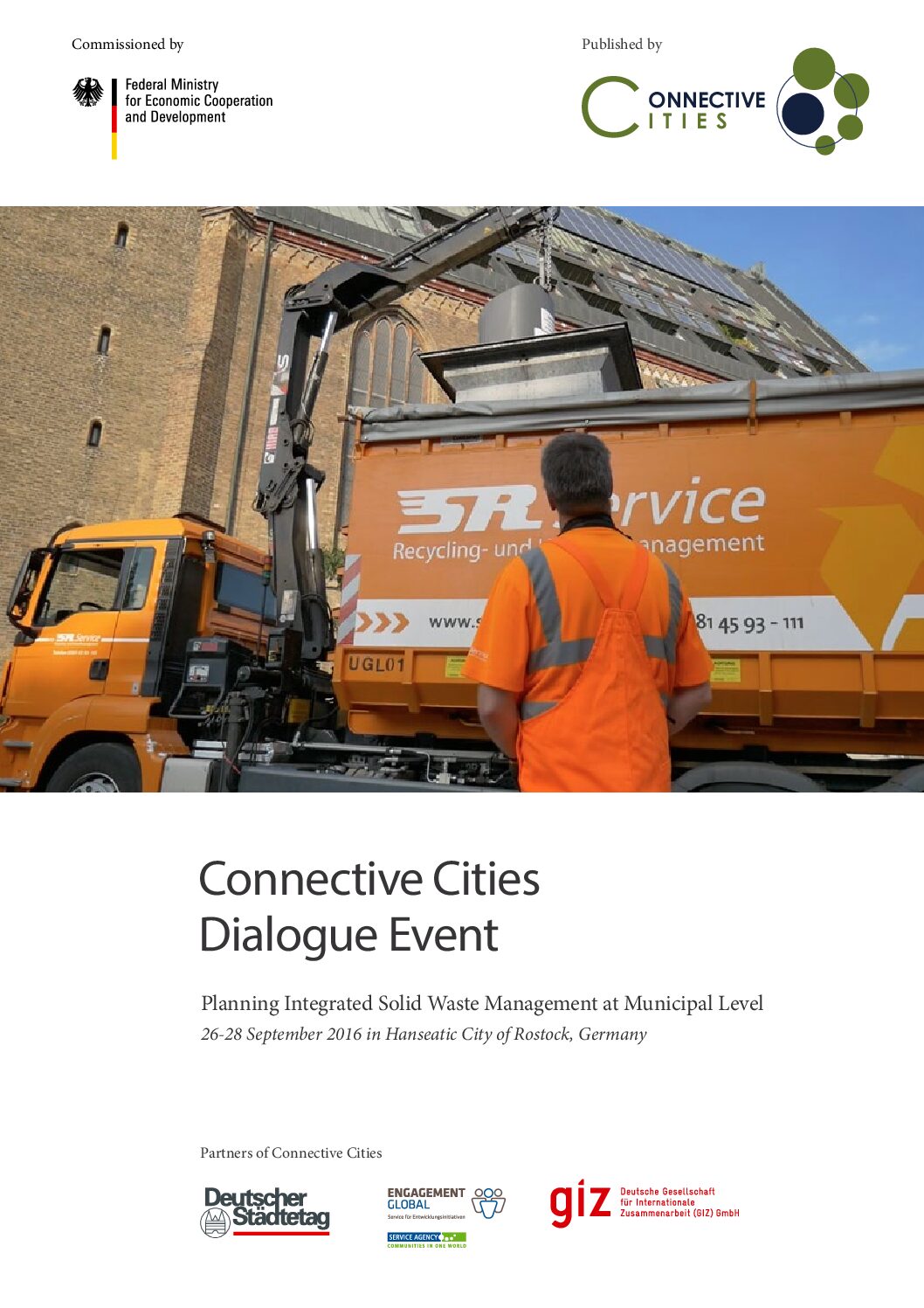
Rostock hosted and co-organised the event, and provided conference rooms in Rostock’s city hall. Representatives of the city gave interesting insights into the city’s solid waste management strategy and presented innovative projects on how to organise waste management in an environmentally safe and efficient way. They also organised highly informative site visits to illustrate different aspects of the city’s waste management system.
The Dialogue Event was attended by about 35 urban practitioners from Morocco, Tunisia, Egypt, Italy, France, Austria, Zimbabwe, Albania, and Germany. Two waste management experts respectively from the German Association of Cities (Deutscher Städtetag) and from the German Association of Local Public Utilities (Verband kommunaler Unternehmen e.V.) also contributed to the three-day exchange. Discussions benefited greatly from the vast experience of participants with different regional perspectives.
The publication documents the main results of the event. It contains a brief introduction to major aspects of Integrated Solid Waste Management and summarises local experiences presented at the event. The report also highlights key outcomes of the peer learning and action planning sessions. Action planning resulted in the development of four project ideas to improve waste management in different cities. These ideas are outlined briefly at the end of the publication.
The documentation also seeks to inform readers about the way Connective Cities works. It describes the approach as well as the methodology used at the event and explains how the initiative supports joint learning, knowledge exchange and municipal cooperation across the world.
Greening Cities and Promoting Urban Green Growth
Representatives of municipalities, business and science from Asian countries and from Germany met in Chiang Mai from the 4-6 November 2014 for the first Asian Dialogue Event of the International Community of Practice for Sustainable Urban Development, Connective Cities, to exchange experience on “Greening Cities and Promoting Urban Green Growth”.
Operationalizing the Urban NEXUS
This study “features an essential step ahead in putting the NEXUS intopractice for a sustainable urban future by delivering an approach, which encourages new ways of thinking and action in institutions, policy making and society at large.”
“The aim of this publication is to provide a conceptual foundation and hans-on approach that serves to inspire, identify and implement NEXUS solutions for integrated, resource-efficient development in metropolitan regions. It shall thereby spark exchange, debate, and learning across sectors and scales.”