Climate-friendly construction with organic and recycled materials

Steel and concrete are the most widely-used construction materials around the world, but producing and using them in construction produces high levels of carbon emissions. So how can we build the cities of the future in a more climate-friendly way? In this, using organic materials or recycling and reusing materials are promising approaches. This was the outcome of an international event held by Connective Cities in Potsdam from 13 to 15 November 2023 in partnership with the City of Potsdam as State Capital of Brandenburg, Bauhaus Erde and the Potsdam Institute for Climate Impact Research (PIK).

“Action for Cool Cities”

As part of the session organised by CitiesAdapt at the Adaptation Futures conference, the representative of the Kisumu county in Kenya (James Nyagol) participated in a panel discussion on nature-based solutions and involvement of the indigenous people for the sustainability of climate adaptation solutions. Mr. Nyagol, who holds the position of the Senior Climate Change Officer at Kisumu county, has shared his experience in developing solution to employ green infrastructure for inducing urban cooling and reducing risks of flooding along the Auji creek in Kisumu. The solution was developed as part of Connective Cities learning process “Action for Cool Cities”.

Furthermore, some of the outcomes of the learning process “Action for Cool Cities” were presented at 59th ISOCARP World Planning Congress. Under the title “Inclusive Climate Action in Cities: An elusive goal for local authorities?”, examples of the solutions developed were presented and discussed including the aspect of financing. Similarly, some insights from the learning process and the developed solutions were also presented at the Urban Thinkers Campus “Heat Stress Resilience: Translating Strategy into Urban Climate Actions” in Cairo.  

Similarly, the municipalities of Irbid, Bab Amman and Kufranja presented and discussed with their peers’ solutions developed on green infrastructure during the Green Action Workshop in Amman organised by “Cash for Work” project at GiZ Jordan in cooperation with the Ministry of Environment and Greater Amman municipality.

Renewable Energy Options on the Municipal Level

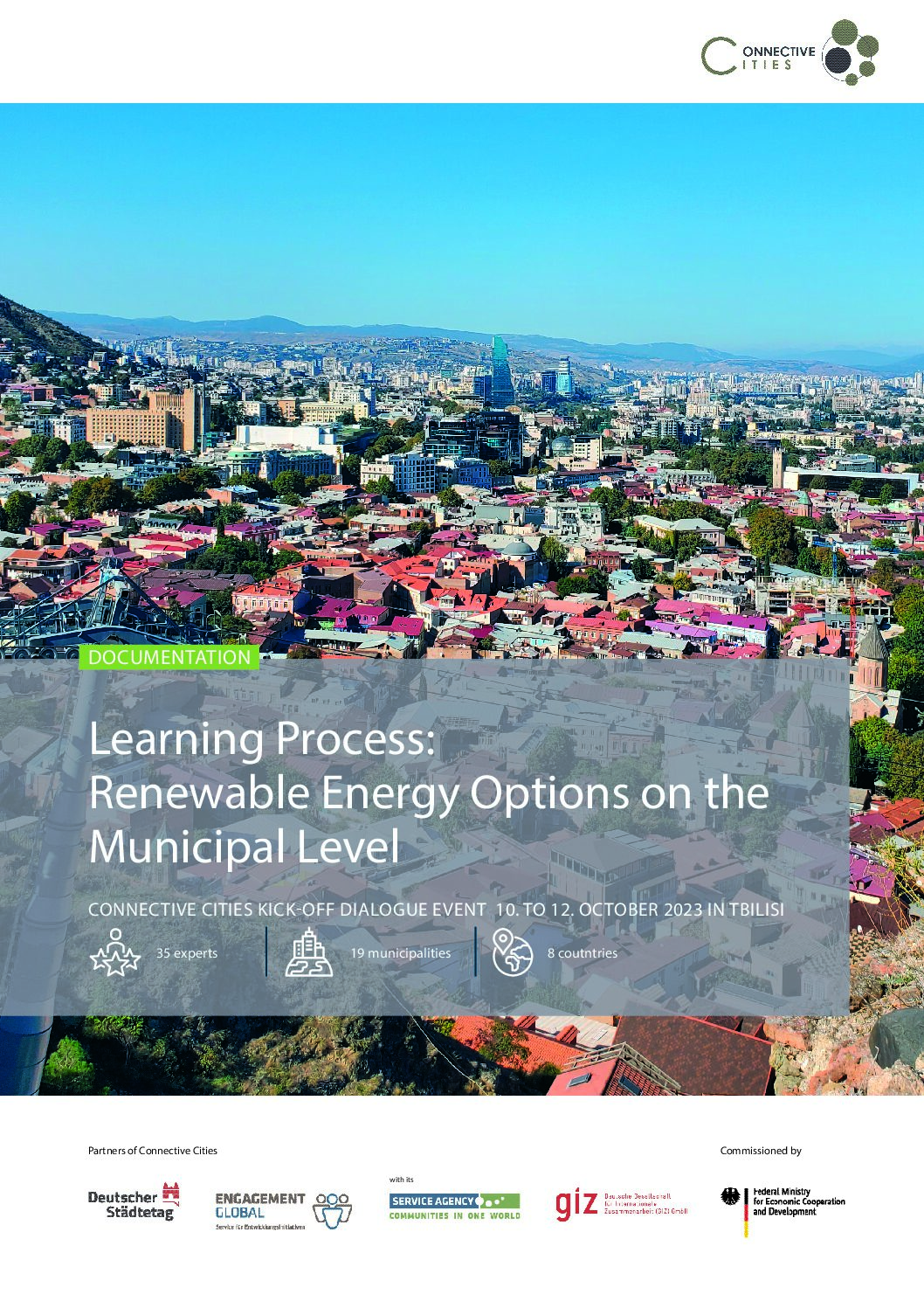
Discover the highlights of the Connective Cities Dialogue Event held from 10 – 12 October 2023, focusing on ‘Renewable Energy Options at the Municipal Level.’ In this insightful gathering in Tbilisi, Georgia, 35 urban practitioners from 19 municipalities across 8 countries convened to exchange experiences. Representatives from Albania, Bosnia and Herzegovina, Georgia, Germany, Moldova, Montenegro, Serbia, and Ukraine collaborated, sharing valuable insights and collectively crafting innovative solutions for sustainable energy practices at the municipal level. Dive into the dynamic discussions and collaborative efforts that unfolded during this event, driving positive change in the realm of renewable energy within diverse urban settings.

Watch video at YouTube:

https://youtu.be/uc1SMXGdHvs

Renewable Energy for Local Economic Development in Africa

The main objective of the workshop is to develop renewable energy projects in African cities.

The workshop was attended by 30 practitioners* from city governments, associations and the private sector representing 7 countries and 20 cities from Africa, as well as high-level guests including the Country Director of GIZ, the Kenyan Ministry of Energy, the head of the Romanian Development Agency (RoAid), the City of Gersthofen from Germany, and officials from the European Investment Bank (EIB) and the African Development Bank (AfDB). Representatives from various cities in Ghana, Kenya, Malawi, Nigeria, Senegal, Tanzania, and Tunisia also contributed to the success of the conference with their presentations of the framework conditions and project examples.

Connective Cities at the Africa Climate Summit 2023

4 – 6 September 2023 marked the inaugural Africa Climate Summit, with leaders around the world gathering in Nairobi to express their support for putting Africa at the forefront in addressing climate change and calling for more attention to be paid to Africa’s priorities and resources.

Climate change action must increasingly focus on the urban scale as cities are both significant contributors to greenhouse gas emissions and highly vulnerable to its impacts. With most of the global population now residing in cities, initiatives aimed at reducing emissions and building resilience at the urban level can have a substantial impact on overall climate goals. Sustainable urban planning, investments in clean energy and public transportation, and the development of climate-resilient infrastructure are crucial steps in mitigating climate change and safeguarding the well-being of urban populations. As cities continue to grow, it becomes imperative to prioritize sustainable urban development to ensure a more sustainable and climate-resilient future for all.

The rationale of having cities play an increased role in addressing climate change was realized through the Connective Cities side event on “Flood Risk Management, the essential role of cities and importance of municipal preparedness”. The side event aimed to underline the importance of the role which cities played in combatting climate change, and the benefits of peer learning and exchange in finding localized solutions for climate resilient development. The session was organized into a keynote delivered by Dr. Johanes Belle from the University of the Freestate in Bloemfontein, South Africa, followed by a panel discussion that included Dr. Abdourrahmane Maikanti, Mayor of Garoua lll council (CM); H.E. Benjamin Chesire Cheboi, Governor of Baringo County (KE); Andreas Wolter, Deputy Mayor of Cologne (DE) and; Enock Tumbo, Environmental Management Officer, Dar es Salaam (TZ).

Gender mainstreaming and inclusive governance in municipalities

Gender equality has emerged as a critical driver of social progress and inclusive governance, in which municipalities play a crucial planning and implementation role. To strengthen the municipal role in gender mainstreaming and inclusive governance, Connective Cities has co-organised a workshop on 8-10 August 2023 in Amman-Jordan for municipal actors and experts to showcase good practices in this field as well as to support the participating municipalities in developing measures to achieve sustainable, inclusive and gender-equitable development in their respective contexts. Get inspired by short video!

Watch video at YouTube: https://youtu.be/JHvDIx2e40k

Further information: https://www.connective-cities.net/en/news/gender-mainstreaming-and-inclusive-governance-in-municipalities

KOTOR – centuries young town on the map of the rainbow cities

A UNESCO-protected small town with a rich history and cultural heritage, Kotor is an attractive destination with a lot to offer.

The name itself, in the Greek variant Decaterum, appears in records from the 7th century and has since been known as a city of multi-harmony, openness and acceptance of differences in all matters.

In 2014, the Municipality of Kotor was the first municipality in Montenegro to sign a cooperation agreement with the Ministry of Human and Minority Rights to improve the status and rights of LGBTQIA+ persons. Since 2020, it has been a proud member of the Rainbow Cities Network, a global network for LGBTQIA+ equality.

Gender mainstreaming and inclusive governance in municipalities

Gender equality has emerged as a critical driver of social progress and inclusive governance, in which municipalities play a crucial planning and implementation role. To strengthen the municipal role in gender mainstreaming and inclusive governance, Connective Cities has co-organised a workshop on 8-10 August 2023 in Amman-Jordan for municipal actors and experts to showcase good practices in this field as well as to support the participating municipalities in developing measures to achieve sustainable, inclusive and gender-equitable development in their respective contexts. The collaboration included other programmes: WoMENA, the Municipal Know-how for Host Communities in the Middle East Programme (IKKN) (German-Jordanian-Lebanese) and PAL (German-Palestinian).

Watch video about the workshop at YouTube: https://youtu.be/JHvDIx2e40k

Dresden and Brazzaville embrace urban gardening

For Dresden and Brazzaville, urban gardening is a shared field of interest with future potential. Following a dialogue event by Connective Cities and reciprocal visits, the two cities and their partner institutions made use of a virtual exchange format to explore various possibilities for cooperation in the field of urban gardening – as part of their push for sustainable urban development.

Action for Cool Cities: Pathways for carbon reduction in buildings and improvement of outdoor thermal comfort

As the first step of the learning process ‘Action for Cool Cities – Pathways for carbon reduction in buildings and improvement of outdoor thermal comfort’, the virtual kickoff event was held on 30 Nov – 1 Dec 2022. During this event, good practices were showcased on the reduction of carbon emissions in building stock and improving outdoor thermal comfort as well as examples of faltering implementation in these key spheres of action.

As a second module of the learning process, Connective Cities workshop on ideation and prototyping took place in Amman, Jordan on the 7th-9th March 2023. The workshop focused on ideation and prototyping of solutions by the participating municipalities within the following thematic fields:

  1. Designing climate-responsive outdoor public spaces and promoting engagement of citizens
  2. Steering Structure: Interdepartmental Communication framework/platform in municipalities
  3. Optimizing existing building and urban design regulations by introducing key performance indicators and improving in-house capacity to drive change
  4. The role of municipality as a regulator and implementer: budget analysis and strategies for cost recovery of climate action measures

Participation in the second module of the learning process enabled the municipalities to share experiences, develop their capacities, and develop ideas for prototyping in their municipalities. The next stage or third module of the learning process gave a chance to these municipalities to test and optimize the envisioned prototypes in an iterative process that included conducting participatory sessions with stakeholders (including citizens, decision makers, and experts). The process revealed the significance of producing quantitative and qualitative evidence to back up the proposed seven solutions.