Connective Cities co-organized the Urban Thinkers Campus (UTC) that was held for the first time in Amman-Jordan. It aimed at generating insights and discussions to inform urban policies and strategies, fostering sustainable and inclusive urban development. Topics under focus were affordable/adequate housing, green infrastructure, and sustainable mobility. With representation from Jordanian and German municipalities, the Ministry of Transportation, NGOs, and academia, the UTC served as an inclusive forum for meaningful dialogue among urban researchers, practitioners, and policymakers, aimed at fostering constructive urban change.
Category: Urban renewal
Local Development Strategy Guidebook
This guidebook is an outcome of the working group ‘Local development strategies for municipalities in MENA’. It outlines a comprehensive methodology for municipalities to develop strategic sustainable planning with a mid- and long-term vision.
The objectives include:
- Strengthen Resilience and Capacity
- Enhance Participatory Strategic Planning
- Define Long-Term Development Strategies
- Improve Local Services
- Develop Project Card Templates
The manual also addresses the importance of having up-to-date data to improve the accuracy of analysis and decision-making processes. This includes staff training on data collection and interpretation methodologies.
Local Economic Development Forum in Tbilisi
Tbilisi, June 7th – Connective Cities Southeast Europe convened a parallel session during the Local Economic Development (LED) Forum in Tbilisi, focusing on “Renewable Energy Options at the Municipal Level.” This session provided a platform for mayors from Georgian municipalities, including Senaki, Eredvi, and Khoni, to exchange insights, challenges, and innovative approaches in advancing renewable energy initiatives within their jurisdictions. Furthermore, Dr. Irakli Samkharadze, Energy Advisor of Omnia, provided insights into the European Green Deal and its implications for municipalities, enriching the discussion with a broader perspective on sustainable energy transitions.
The Mayor of Senaki Municipality shared notable advancements, including the integration of renewable energy sources into municipal buildings and the installation of solar panels across various locations to raise awareness and support action plans aligned with the Covenant of Mayors.
Six municipalities join forces to combat increasing heat in cities
From 3 to 6 June 2024, the group came together in Heidelberg as part of the “Connective Cities Deep Dive” to substantiate their pilot projects and learn from the experiences of other cities.
Although the six cities have to adapt to increasing heat in different ways, they have two principles in common, as became clear during their exchange in Heidelberg. If you want to do something strategically and in the long term to combat heat in cities, you need a plan. This is just as true for Aswan in Egypt, where temperatures can reach 50 degrees Celsius in summer, as it is for Lüdenscheid, which is located in the cooler, densely wooded Sauerland region of Germany. They also strongly believe in the approach of initially testing innovative heat solutions in small pilot projects before implementing them on a larger scale.
There are many ways for cities to reduce the negative heat effects on the population: creating more green spaces, planting shade-providing trees, greening building facades, creating cooling corridors, for example through watercourses, raising public awareness and much more. To do this, it is first important to know where the heat builds up in a city.
Strategic planning in municipalities– Impediments, framework and benefits
Managing municipalities effectively and achieving sustainable development for residents are priorities for local authorities. As the link between the central authority and the local population, municipalities need to develop mid-term and long-term strategies to fulfill their developmental role in basic service provision, managing resources, infrastructure development, as well as achieving economic growth and sustainability. Strategic planning is key to shaping a vibrant community and economically competitive environment. It focuses on leveraging assets and strengths rather than overcoming challenges and are characterized by a sharp focus on the competitive advantage, key clusters of opportunity, workforce characteristics, quality of life standards and other economic and demographic differentiators.
However, long-term strategic planning is weak if not non-existent in the majority of municipalities in the MENA region. While some municipalities have made significant progress in adopting strategic planning, many face greater challenges related to urbanisation, service delivery, economic development, natural resources, environmental issues, social disparities, changing demographics, and response to crises. To overcome these challenges effectively, municipalities must have up-to-date local strategies that guide them in setting development scenarios, priorities, and making informed decisions to meet the diverse needs and challenges of the local population. In essence, local development strategies are the foundation upon which successful local governance is built.
Promoting Sustainable Mining Industries
The online event took place on 23 April and explored the challenges and opportunities in promoting sustainable mining industries and the critical role of cities in driving positive change in the sector. Key discussion points included:
- The role of cities in promoting sustainable mining industries: How can cities actively contribute to the promotion of sustainable mining practices, taking into account environmental and social impacts?
- Maximising benefits for local communities: What strategies are in place to ensure that mining activities best benefit local communities, both economically and socially?
- Repurposing closed mining sites: What innovative approaches exist to transform them into new assets for communities and promote sustainable development?
The event featured insightful inputs from various sources:
Climate-positive cities: circular economy and carbon accounting
Background
The construction industry is one of the most energy-intensive sectors of the economy and a major contributor to global climate change. It is responsible for up to 40 per cent of global CO2 emissions. However, there are ways to make construction more sustainable and hence more climate-friendly. Municipalities play a key role in initiating and supporting these processes locally.
Two examples of such municipal engagement were in the spotlight of a virtual exchange organised by Connective Cities on 27 February 2024 and were discussed by 18 (municipal) experts from six countries. The event was part of a one-year learning process that began in November 2023 with the international dialogue event “Climate-friendly construction with organic and recycled materials” in Potsdam, Germany.
Climate-positive construction with circular materials
Demand for living space is growing around the world, particularly within cities, which makes the construction industry a major sector in every economy. However, producing and processing raw materials for construction are significant contributors to environmental damage and carbon emissions. The construction sector also uses a lot of energy (sometimes known as “grey energy”) not only when producing construction materials and during the building phase itself, but also while the building is operated for heating, cooling and electricity use. Organic materials such as wood and bamboo could play a vital role in decarbonising the construction industry.
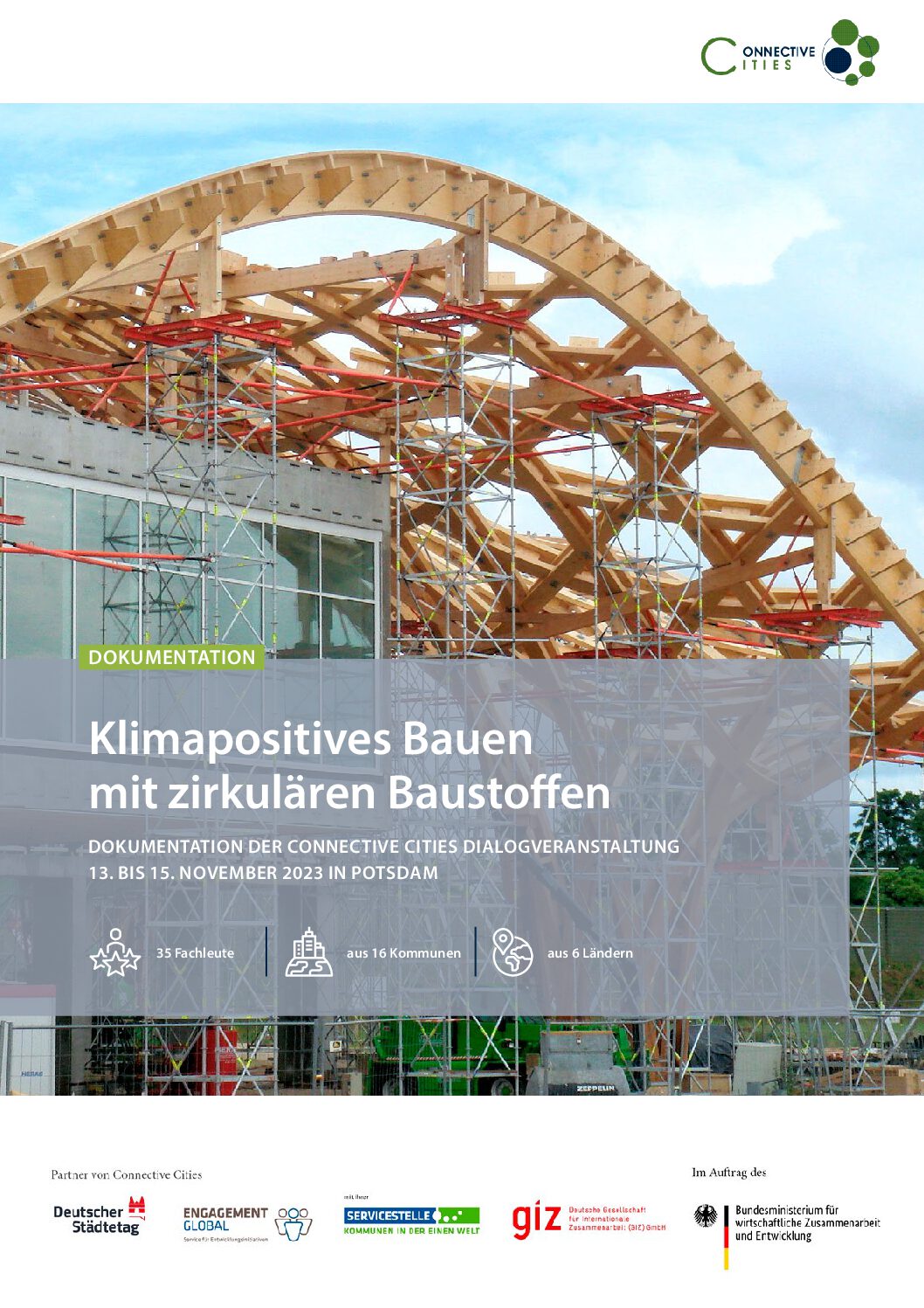
More than 30 representatives of municipalities, academia, business and civil society gathered at the Potsdam Institute for Climate Impact Research from 13 to 15 November 2023 for an event hosted by Connective Cities and the city of Potsdam to share ideas and experiences about the transformation to climate-friendly construction. They presented their experiences from Bhutan, Germany, Indonesia, Nepal, South Africa and Tanzania, and developed ideas for specific local projects. While in Potsdam they visited examples of good practice, such as a wood-built nursery school and the construction site of a pavilion which is being built with organic and recycled materials.
This documentation provides insights into the conference content and results.
Further impressions can also be found on the conference website “Climate-friendly construction with organic and recycled materials“
Banepa preserves traditional construction methods using bio-based materials
This good practice describes how the town of Banepa is restoring its historic centre and a retirement home using traditional building methods. Bio-based building materials such as wood, bamboo, brick and clay are much more sustainable and earthquake-resistant than cement or concrete.
Rebuilding, but better!
From the German participants, the urban planning offices of the cities of Münster and Munich presented current examples of integrated urban development. It became clear that “integrated” encompasses all levels, from spatial planning to the participatory design of a square. To link these levels, Munich relies on the development of specialist guidelines (climate change adaptation/sponge city, avoidance of heat islands, mobility, strong residential districts) and the definition of action areas. Münster relies above all on the instrument of center funds (smaller sums to promote new ideas for redesign, simple application) and, upgrading the city center as a leisure and recreation area.