German-Turkish Municipal Partnership Conference

In cooperation with the German Association of Cities and Towns (Deutscher Städtetag) together with the Association of Turkish Municipalities (Türkiye Belediyeler Birliği, TBB) and with the support of the city of Istanbul (Istanbul Büyükşehir Belediyesi, IBB), the German representations in Turkey are planning a two-day German-Turkish municipal partnership conference in Istanbul in the second half of 2020. The municipal partnership conference is intended to identify mutual issues and challenges as well as successful approaches for project cooperation.

As a kick-off to the German-Turkish municipal partnership conference, a virtual pre-conference will take place from 15 to 18 June 2020. Topics of the technical workshops are:

  1. Digital City
  2. Sustainable urban development
  3. The role of municipalities in protecting marginalised groups and refugees in the COVID 19 crisis
  4. Youth exchanges in municipal partnerships

Please refer to the conference announcement (in German) for further information on registration, programme and technical requirements. 

15 Pathways to localise the Sustainable Development Goals

This publication illustrates how the 15 pathways of the Basque Declaration can be used by towns and cities to localise the Sustainable Development Goals (SDGs).

In this publication, the 15 pathways of the Basque Declaration are illustrated with stories taken from the Transformative Action database of the Sustainable Cities Platform. Each of these stories are former applications to the Transformative Action Award 2017-2019 and have been reviewed by a jury of experts, which includes representatives from the European Committee of the Regions, the European Investment Bank, UNESCO Etxea, the City of Aalborg (Denmark) and ICLEI Europe.

The purpose of these stories is to provide local governments and other local stakeholders with inspiration for action, rather than the formulation of yet another action plan. The examples also give insight into how to implement the goals using an integrated approach across sectors and departments. For each story, the most relevant pathway and SDGs are indicated, based on an independent assessment by ICLEI Europe. They show the diversity of approaches across topics, geographical locations and local cultures.

Understanding Infrastructure Interdependencies in Cities

“Modern urban infrastructure and their systems of operation are highly interdependent. They are formed of multiple connections, feedback and feedforward paths, and intricate branching where services or information are transferred across city sectors. This means that if one system fails, it can have cascading impacts on other systems. Climate change can compound these impacts significantly. Some systems may be directly affected by climate change events – such as roads during flooding. Other systems may be affected indirectly, such as the health sector and the financial sector if there are power outages. The interdependencies of city systems combined with climate impacts can lead to a ripple effect of disruptions. Understanding infrastructure interdependencies and critical failure points is therefore vital to achieving long- term climate resilience across a whole city.”

Solutions for gender fair cities

"This report is the product of the Womanability research-action project. It reveals the numerous, and sometimes unexpected, obstacles to the equal access and enjoyment of public spaces by women, from a lack of green spaces, accessible public transportation, and public toilets, to persistent harassment and outright violence. Building on these experiences and observations, the report offers a series of recommendations and best practices, many developed by women themselves, for creating the gender equal cities of the future. […]"

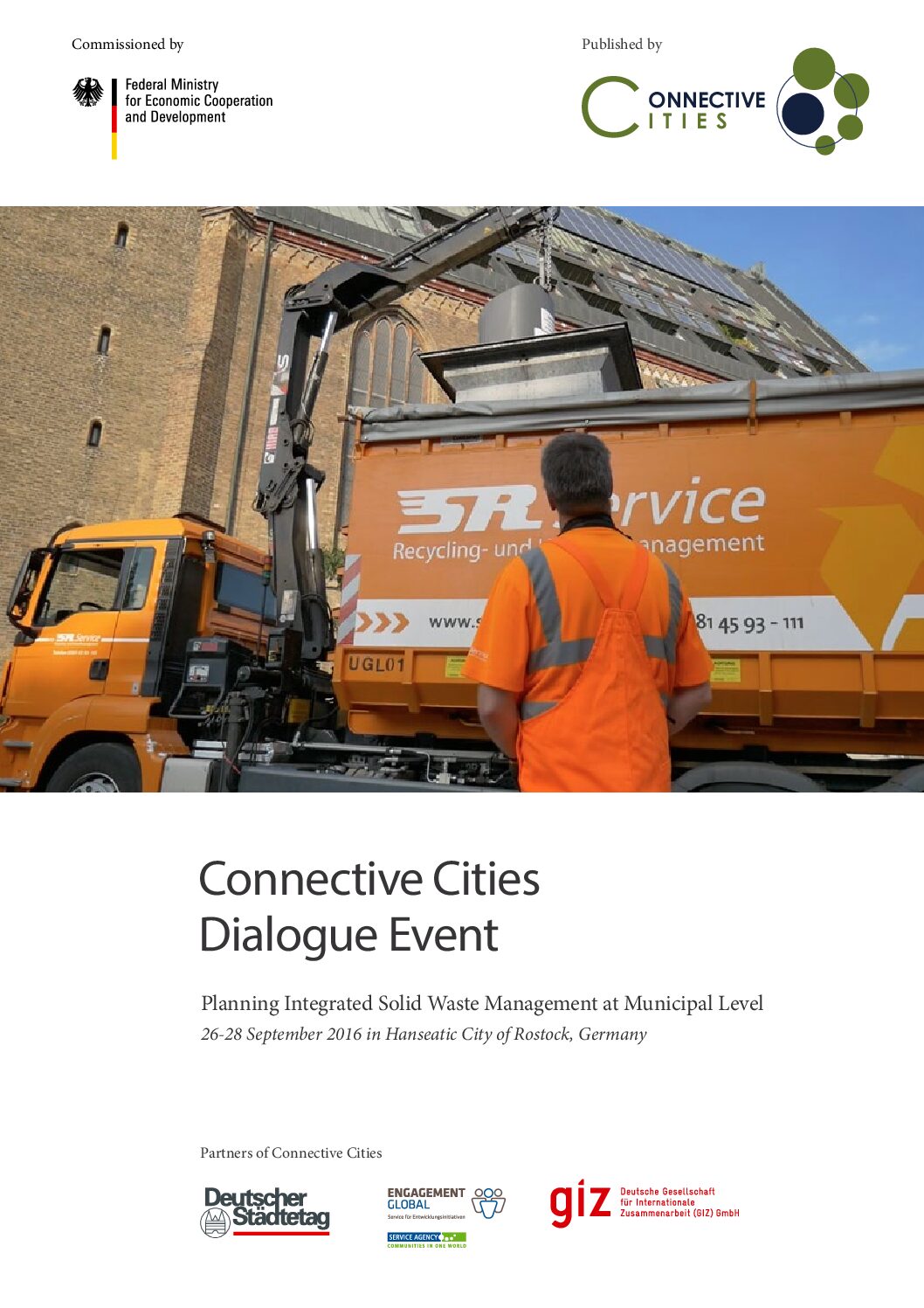
Planning Integrated Solid Waste Management at Municipal Level

Rostock hosted and co-organised the event, and provided conference rooms in Rostock’s city hall. Representatives of the city gave interesting insights into the city’s solid waste management strategy and presented innovative projects on how to organise waste management in an environmentally safe and efficient way. They also organised highly informative site visits to illustrate different aspects of the city’s waste management system.

The Dialogue Event was attended by about 35 urban practitioners from Morocco, Tunisia, Egypt, Italy, France, Austria, Zimbabwe, Albania, and Germany. Two waste management experts respectively from the German Association of Cities (Deutscher Städtetag) and from the German Association of Local Public Utilities (Verband kommunaler Unternehmen e.V.) also contributed to the three-day exchange. Discussions benefited greatly from the vast experience of participants with different regional perspectives.

The publication documents the main results of the event. It contains a brief introduction to major aspects of Integrated Solid Waste Management and summarises local experiences presented at the event. The report also highlights key outcomes of the peer learning and action planning sessions. Action planning resulted in the development of four project ideas to improve waste management in different cities. These ideas are outlined briefly at the end of the publication.

The documentation also seeks to inform readers about the way Connective Cities works. It describes the approach as well as the methodology used at the event and explains how the initiative supports joint learning, knowledge exchange and municipal cooperation across the world.