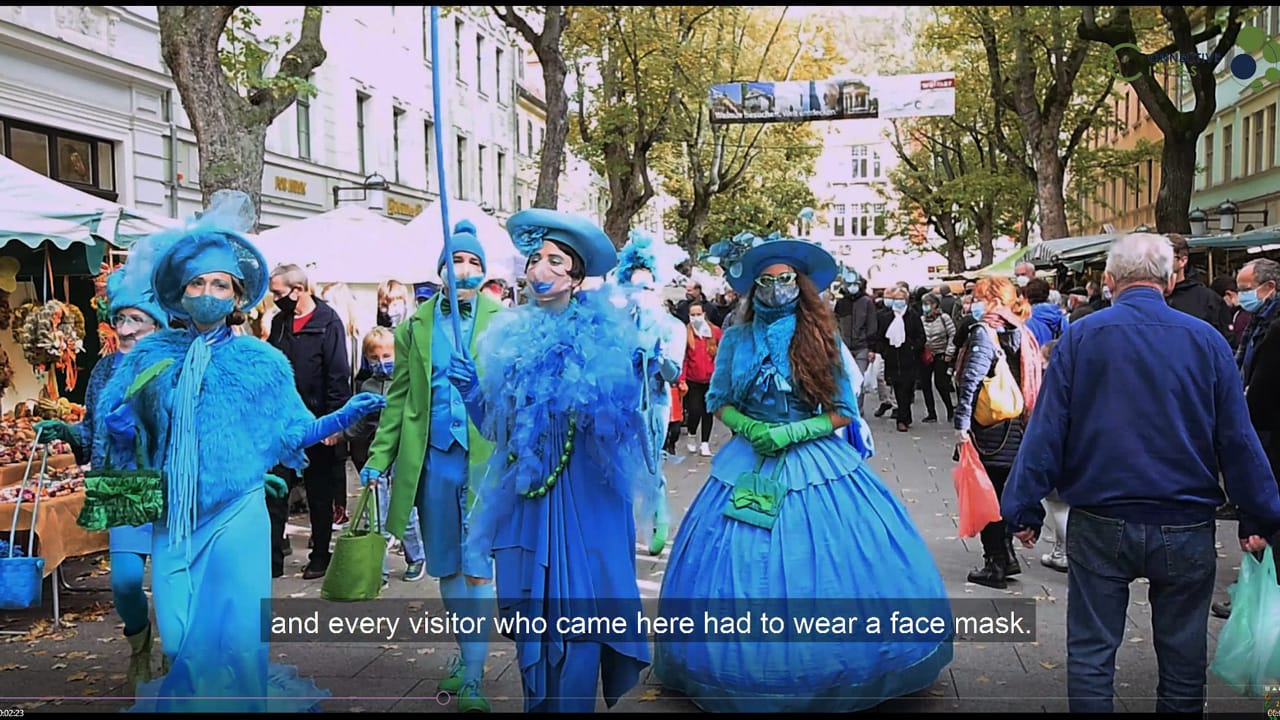
Weimar: Economic response to COVID-19

Weimar, a city that attracts thousands of tourists from all over the world every year. Watch how did the local city guides, hoteliers and small shop owners react to the lockdown? And what did the local authorities do?

Mehr: https://youtu.be/SxLgSY2aW6g

Join us and watch a special series of videos and podcasts that will show how to overcome a crisis from many different points of view. More videos, podcasts and interviews coming soon on our COVID-19 page.

Towards the Just City in Kenya

In the next 25 years, Africa’s urban population is set to double. By 2040, the majority of Africans will be living in cities. There are numerous reasons for this: climate change, violent conflicts and the hope of finding work or education, although this list could easily be extended. Urbanisation thus constitutes one of the greatest transformations facing Africa in the 21st century.

Despite the diversity of the African continent, however, they are so far mostly “unjust” cities that people are moving to. The majority live in informal settlements and work under precarious conditions, mostly in the informal sector, without employment contracts and social security.

Towards the Just City in Kenya is the first publication of its kind that explores the conceptualisation and application of the “just city” concept in Kenya. The authors explore the concept from various dimensions, namely:

  • Conceptualisation of the just city in Kenya.
  • Locating the just city in the constitutional, policy, legislative and institutional context.
  • Discussion of spatial justice in the context of planning and housing; and
  • Interrogating practical ways in which cities express injustice and how these can be practically addressed, with examples from the public transport sector.

The study offers recommendations on how the just city concept can be realised in Kenya, looking specifically at urban institutions, citizens’ rights, housing policies and urban public transport systems.

With its just city project, FES Kenya and its partners facilitate dialogues through working groups which bring together civil society, trade unions, Members of County Assemblies, Government representatives, and academia working in urban centres of Kenya with the objective to jointly work for a just city.

Local Economic Development and Job Creation in the Middle East and North Africa

More than 40 local urban practitioners from 22 municipalities and 10 countries from the MENA region and Germany took part of the virtual dialogue event organized by the Connective Cities project. The dialogue event consisted of five virtual sessions held between the Sep 29th – Oct 7th focusing on facilitating the exchange of know-how and experiences through peer-to-peer learning among municipal representatives and urban practitioners. Moreover, the dialogue event aimed at enriching the analysis and planning capacity of the participating municipal representatives to address existing challenges of implementing LED and job creation programs. The discussion also led to identifying the gaps in resources and the support needed to implement future LED projects.

Local economic development (LED) remains a top priority for cities in MENA and a driver for economic stability and job creation for a region with one of the highest unemployment rates in the world. A wide spectrum of stakeholders are engaged in fostering LED including governments, NGOs, the private sector, and development actors. Nevertheless, there remains the need to intensify exchange of practice-oriented experience and good practice among municipal representatives and urban practitioners  on related topics  such as strategizing for LED and creating partnerships with the private sector, sustainable livelihood programs and decent job creation, as well as green economic transformation.

The facilitation approach focused on designing, planning, and conducting a series of virtual knowledge-exchange activities in which several steps were taken:

  1. Clustering: of partners according to their regional distribution, municipal needs, and vision for future development for their cities;
  2. Defining: the subtopics for dialogue that are in harmony with their current ambitions and future objectives;
  3. Inviting: partners to virtual dialogue sessions after outlining the goal of this dialogue and defining roles and responsibilities agreed upon by all partners, as well as the anticipated outcome;
  4. Facilitating: the virtual exchange sessions in a manner that will ensure maximum interaction and knowledge exchange;
  5. Evaluation and Follow up:  with all partners after all sessions are completed to share the outputs of the dialogue to maintain ongoing knowledge exchange for future collaboration in between the different municipalities;
  6. Reporting: on all conducted activities and the overall summary of the dialogue.

The project has built a Network, an exchange platform for municipal representatives and urban practitioners, which provides a systematic access to practice-oriented solutions for sustainable urban development by facilitating change and providing mutual support.

Dialogue event introductory video: English version | Arabic version

Call for participants: Covid-19: Economic impact and recovery

The Covid-19 pandemic has had a deteriorating impact on the national and local government economic resources. In economies that largely depend on informal labour market, a lot of people have lost their livelihoods. The governments have been torn between life and livelihoods as the interaction of people propels the spread of the virus.

This shift affected the revenue stream for the local government especially in the cities as a result of shrinking businesses and also a mass migration of the urban population to the rural areas. This has a negative impact on effective operations of the municipalities and service provision.

Whilst the impact of this pandemic has been felt worldwide, cities have responded with different measures to avert the spread and cushion against long-term impacts and even future pandemics. It’s against this background that Connective Cities1 is offering a platform in which cities will share the challenges they have experienced and interventions that have either been implemented or are being planned to safeguard against the negative impacts and future pandemics.

In the second series  at10th & 12th November, 2020, 13:00- 15:00 (CET), we look at the economic impact of the pandemic, recovery and resilience of cities.

Conference language is English.

More information:Concept paper [pdf 3 pages]

Participation and contact

If you have further questions or would like to participate, please send an e-mail to Sophia Kamau (sophia.kamau@giz.de), Regional Coordinator for Connective Cities in Sub-Saharan Africa.

Municipal Response to the COVID-19 Pandemic III

More than 30 municipal representatives from around 20 cities in MENA and sub-Sharan Africa  participated in the third virtual event of the knowledge-exchange series on Municipal Response to the COVID-19 Pandemic.

Municipal representatives from both political and technical levels were invited and they engaged in knowledge-exchange to analyse and discuss practical examples of municipal response related to cushioning and the recovery from the economic impacts of the pandemic. 

Solutions for and by cities

"The Guangzhou International Award for Urban Innovation is dedicated to decentralised, city-to-city cooperation and sharing lessons learned from experience. Its focus covers the three pillars of sustainability: social, economic and environmental, and two additional domains – governance and technology.
The fourth edition of the Guangzhou Award was a remarkable show of these links between innovation and learning from different stakeholders. This publication is an attempt to extend the prestige of the initiatives that were shortlisted for the award, and to spread their legacy to even broader audiences."

Solutions for gender fair cities

"This report is the product of the Womanability research-action project. It reveals the numerous, and sometimes unexpected, obstacles to the equal access and enjoyment of public spaces by women, from a lack of green spaces, accessible public transportation, and public toilets, to persistent harassment and outright violence. Building on these experiences and observations, the report offers a series of recommendations and best practices, many developed by women themselves, for creating the gender equal cities of the future. […]"