15 Pathways to localise the Sustainable Development Goals

This publication illustrates how the 15 pathways of the Basque Declaration can be used by towns and cities to localise the Sustainable Development Goals (SDGs).

In this publication, the 15 pathways of the Basque Declaration are illustrated with stories taken from the Transformative Action database of the Sustainable Cities Platform. Each of these stories are former applications to the Transformative Action Award 2017-2019 and have been reviewed by a jury of experts, which includes representatives from the European Committee of the Regions, the European Investment Bank, UNESCO Etxea, the City of Aalborg (Denmark) and ICLEI Europe.

The purpose of these stories is to provide local governments and other local stakeholders with inspiration for action, rather than the formulation of yet another action plan. The examples also give insight into how to implement the goals using an integrated approach across sectors and departments. For each story, the most relevant pathway and SDGs are indicated, based on an independent assessment by ICLEI Europe. They show the diversity of approaches across topics, geographical locations and local cultures.
Improving public service delivery at local level – solutions for participatory and accountable management

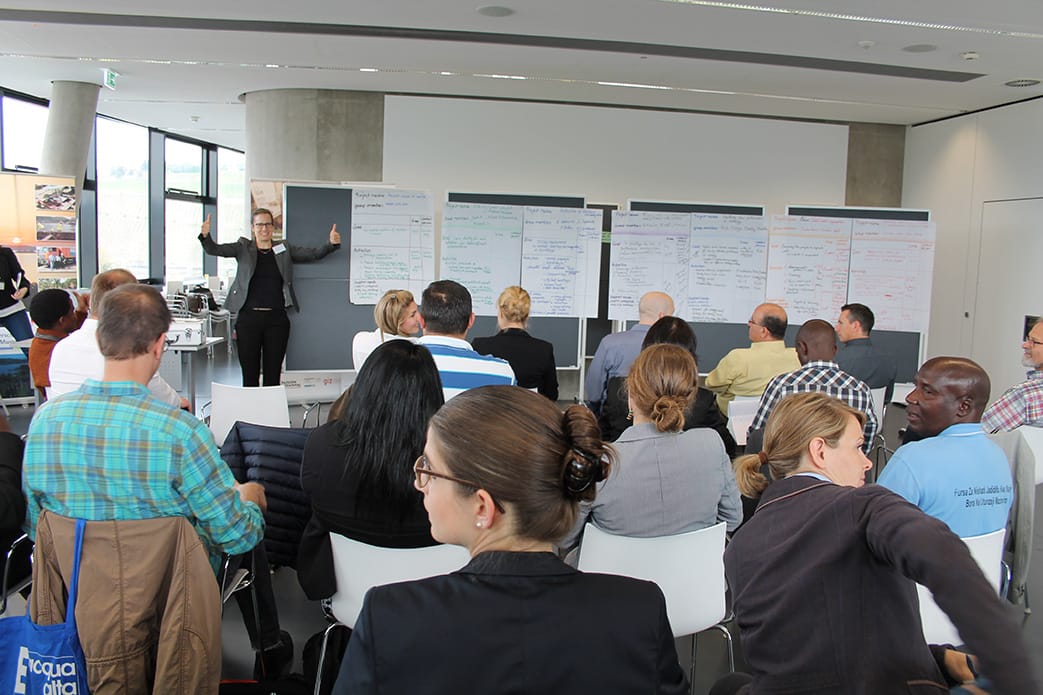
Connective Cities brought together urban practitioners from Sub-Sahara Africa and Germany to meet at the dialogue event “Improving public service delivery at local level – solutions for participatory and accountable management” in Harare, Zimbabwe from 20th to 22nd of August 2019.

Especially in Sub-Saharan Africa, dynamic urbanization and significant environmental and demographic changes are stating new challenges with regard to basic service delivery. Therefore, the focus was on developing approaches to improve public service delivery through public participation in order to achieve social accountability in the sectors of water, sanitation, waste management and transport.

Twenty-one representatives from Zimbabwean municipalities as well as a number of municipal practitioners from South Africa, Lesotho, Zambia, Kenya and municipal experts from Germany exchanged their experiences based on examples of Good Practices on public service delivery and defined possible solutions for the improvement of public service management.

The dialogue event was organized in cooperation with the GIZ project in Zimbabwe, “Strengthening the Urban Councils Association of Zimbabwe (UCAZ) to promote inter-regional and municipal knowledge transfer and capacity development”.

Resilient Cities, Resilient Lives

“The world is more densely populated and more interconnected than ever before. From extreme weather to refugee crises, from disease pandemics to cyberattacks, today’s state of play requires new models of governance to mitigate risk and respond to challenges. Business-as-usual models of reactive planning and siloed decision-making will not generate the fundamental strength and flexibility essential for us to thrive in the face of the shocks and stresses of the 21st century. […] The launch of 100 Resilient Cities program (100RC) by the Rockefeller Foundation acknowledged that the escalating trends of urbanization, globaliza- tion, and climate change pose tremendous risks, but also offer a tremendous opportunity. This report shares 100RC’s knowledge about what it takes to catalyze an urban resilience movement.”

Lifelines

From serving our most basic needs to enabling our most ambitious ventures in trade and technology, infrastructure services are essential for raising and maintaining people’s quality of life. Yet millions of people, especially in low- and middle-income countries, are facing the consequences of unreliable electricity grids, inadequate water and sanitation systems, and overstrained transport networks. Natural hazards magnify the challenges faced by these fragile systems. Building on a wide range of case studies, global empirical analyses, and modeling exercises, Lifelines lays out a framework for understanding infrastructure resilience — the ability of infrastructure systems to function and meet users’ needs during and after a natural shock — and it makes an economic case for building more resilient infrastructure.
It examines four essential infrastructure systems: power, water and sanitation, transport, and telecommunications. The focus is on spending better. Investing in regulations and planning, in the early stages of project design, and in maintenance can significantly outweigh the costs of repairs or reconstruction.

Lifelines concludes by identifying five obstacles to resilient infrastructure and offering concrete recommendations and specific actions that can be taken by governments, stakeholders, and the international community to improve the quality and resilience of these essential services, and thereby contribute to more resilient and prosperous societies.

Sustainable Development Report 2019

"The Sustainable Development Report 2019 presents an updated SDG Index and Dashboards with a refined assessment of countries’ distance to SDG targets. New indicators have been included, primarily to refine the indicator selection on agriculture, diets, gender equality and freedom of speech. Once again, Nordic countries top the SDG Index. Yet, even these countries face major challenges in implementing one or several SDGs. No country is on track for achieving all 17 goals with major performance gaps even in the top countries on SDG 12 (Responsible Consumption and Production), SDG 13 (Climate Action), SDG 14 (Life Below Water) and SDG 15 (Life on Land). Income and wealth inequalities, as well as gaps in health and education outcomes by population groups also remain important policy challenges in developing and developed countries alike."

Urban Transitions Alliance Roadmaps

Industrial legacy cities face unique challenges, as they transition towards vibrant, sustainable and equitable urban centers. Cities around the world can learn lessons from where these cities have been, and how they are moving forward. The new report, "Urban Transitions Alliance Roadmaps: Sustainability Transition Pathways from Industrial Legacy Cities" details four transition pathways that eleven post-industrial cities have undertaken, with implementation ideas and best practices for each. These cities are all a part of the Urban Transitions Alliance, which was built on the premise that by connecting industrial legacy cities from the US, Germany, Poland and China through their transition stories and visions of sustainable urban development, common challenges and transition pathways would emerge.
Reflecting the thematic priorities of the Alliance members, the chapters subsequently focus on challenges and solutions in the fields of Infrastructure, Energy, Mobility, and Social Transition. Each topic is explored in terms of background, barriers and opportunities related to the industrial legacy context. Transition priorities and innovative approaches from the different regions are outlined in key pathways and exemplified in case studies from the Alliance cities and districts. Some of the conditions described might apply in various degrees to cities beyond the industrial legacy context – that is why transition experiences and pathways from the Urban Transitions Alliance can be of value to cities around the globe.

Municipal sustainable energy production and efficiency: planning and implementing innovative solutions

Energy is a major component for both local and global economic development. It is needed for transport, industrial and commercial activities, buildings and infrastructure, water distribution, and food production. Most of these activities take place in or around cities, which are on average responsible for more than 75% of a country’s Gross Domestic Product (GDP) . With their high concentration of industry, transport systems, buildings and households, municipalities consume large amounts of energy (estimated between 60 and 80% of the global primary energy) and emit between 50 and 60% of the world’s total greenhouse gases. The majority of this energy consumption goes into buildings and transport. 
Despite the increasing energy demand in cities, it is at the municipal level that considerable potential to plan for and to produce energy sustainably and strengthen energy efficiency exists.

The international exchange platform Connective Cities and its initiators, the Deutsche Gesellschaft für Internationale Zusammenarbeit (GIZ) GmbH, the German Association of Cities and Engagement Global / Service Agency Communities in One World, organized a Dialogue Event on “Municipal sustainable energy production and efficiency: planning and implementing innovative solutions” from  9 to 11 May 2016 in Würzburg, Germany to specifically look into good practices, challenges and solutions to this crucial topic. 

The event took place at the Fraunhofer Institute for Silicate Research ISC in Würzburg and was organized in cooperation with the City of Würzburg.

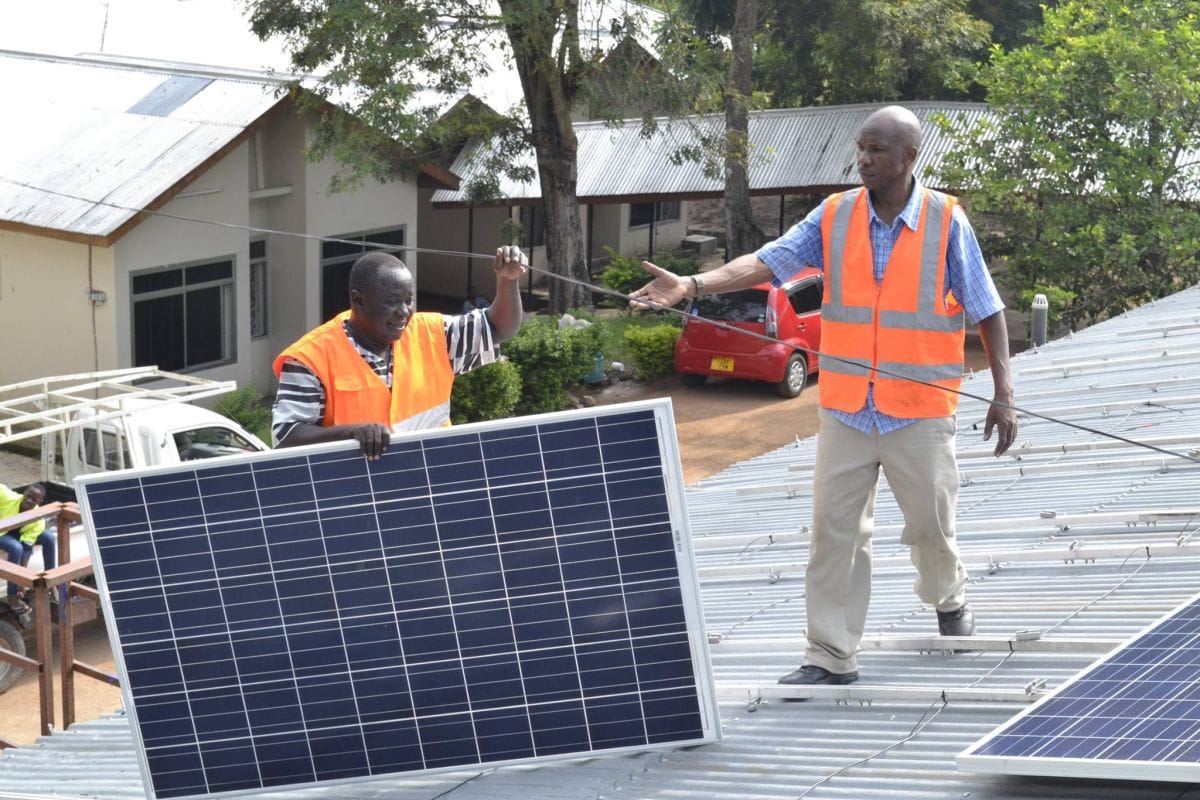
Würzburg and Mwanza share a gift from the sky

Climate change affects all cities. Anyone who wants to do something about it must reduce CO2 emissions. This can be achieved by increasingly replacing fossil fuels with renewable energies and generating solar power, for example. In Tanzania’s Mwanza, this is particularly worthwhile – and has welcome side effects.

Taller de Proyecto de Connective Cities en América Latina

Ante la creciente urbanización en América Latina, las ciudades se ven enfrentadas a grandes desafíos de la movilidad urbana. También las ciudades de municipios alemanes, en muchos casos se ven frente a desafíos similares. Estos desafíos se refieren a temas como la integración de barrios menos privilegiados, al transporte eficiente entre vivienda y trabajo para los ciudadanos o al aseguramiento de un sistema de transporte en favor de un desarrollo económico local. Al mismo tiempo se busca garantizar una buena calidad del aire, mejorando así la salud de los ciudadanos y el clima urbano.

En respuesta a la demanda por parte de expertos de la práctica municipal latinoamericana y alemana, Connective Cities organizó en 2015 un evento en Bogotá Colombia acerca del tema Movilidad Urbana. Durante ese evento, se expresó la necesidad para la realización de otro taller con el enfoque en los sistemas integrados de movilidad y sus relaciones con inclusión social y mitigación del cambio climático. Ante esto, Connective Cities ofrece en mayo de 2016 un taller referente a Sistemas Integrados de Movilidad para Ciudades Inclusivas y Amables con el Clima. El presente documento resume los resultados de dicho taller.

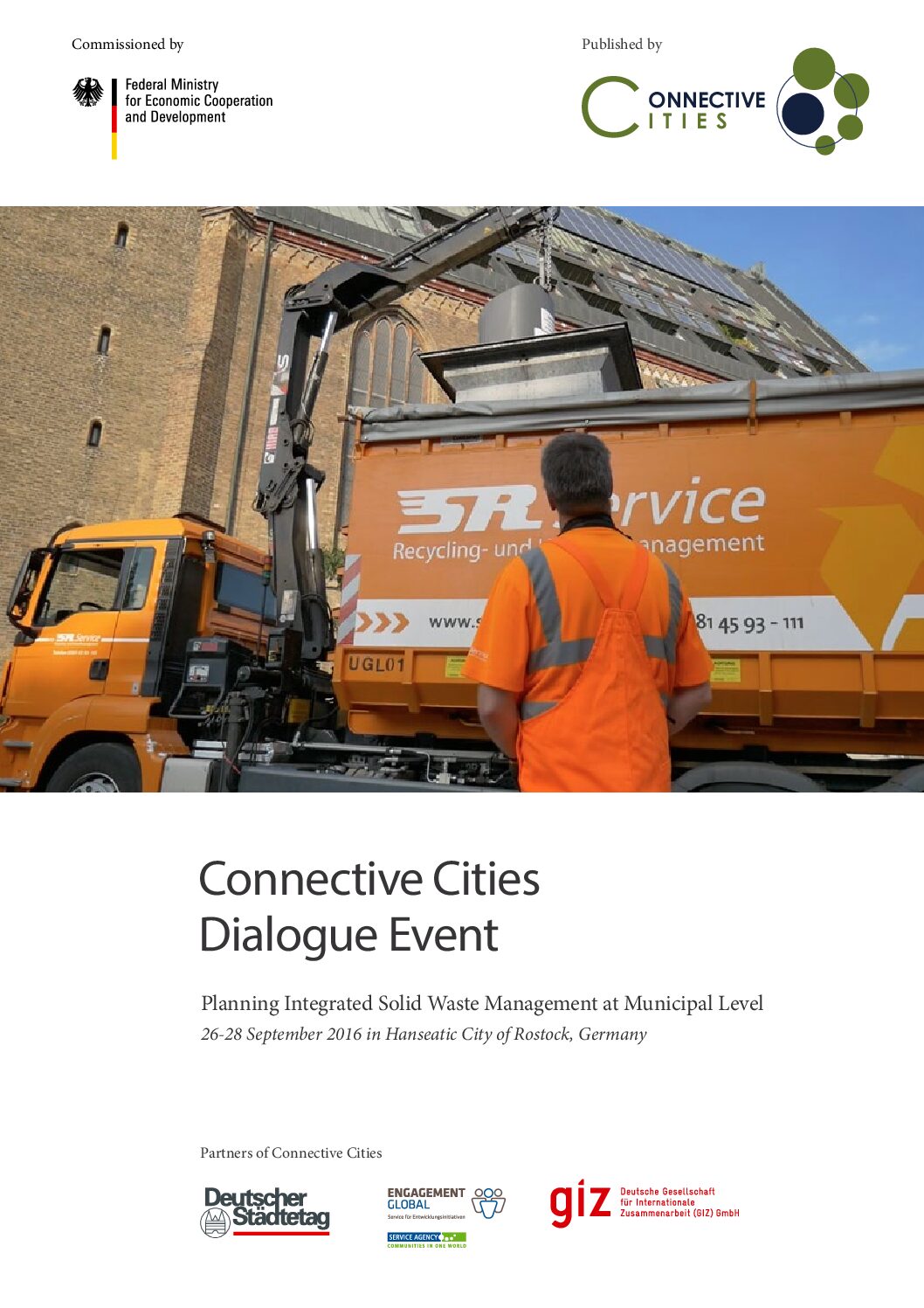
Planning Integrated Solid Waste Management at Municipal Level

Rostock hosted and co-organised the event, and provided conference rooms in Rostock’s city hall. Representatives of the city gave interesting insights into the city’s solid waste management strategy and presented innovative projects on how to organise waste management in an environmentally safe and efficient way. They also organised highly informative site visits to illustrate different aspects of the city’s waste management system.

The Dialogue Event was attended by about 35 urban practitioners from Morocco, Tunisia, Egypt, Italy, France, Austria, Zimbabwe, Albania, and Germany. Two waste management experts respectively from the German Association of Cities (Deutscher Städtetag) and from the German Association of Local Public Utilities (Verband kommunaler Unternehmen e.V.) also contributed to the three-day exchange. Discussions benefited greatly from the vast experience of participants with different regional perspectives.

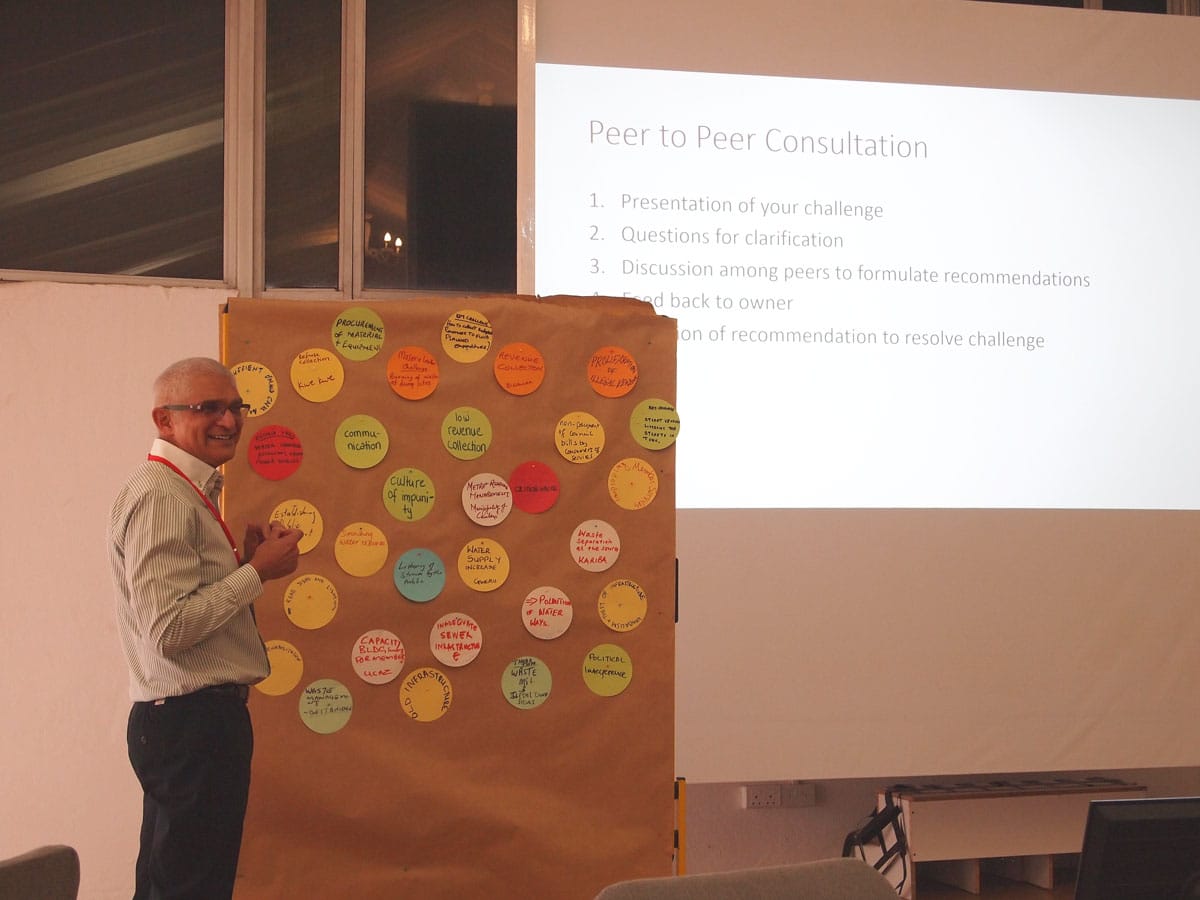
The publication documents the main results of the event. It contains a brief introduction to major aspects of Integrated Solid Waste Management and summarises local experiences presented at the event. The report also highlights key outcomes of the peer learning and action planning sessions. Action planning resulted in the development of four project ideas to improve waste management in different cities. These ideas are outlined briefly at the end of the publication.

The documentation also seeks to inform readers about the way Connective Cities works. It describes the approach as well as the methodology used at the event and explains how the initiative supports joint learning, knowledge exchange and municipal cooperation across the world.