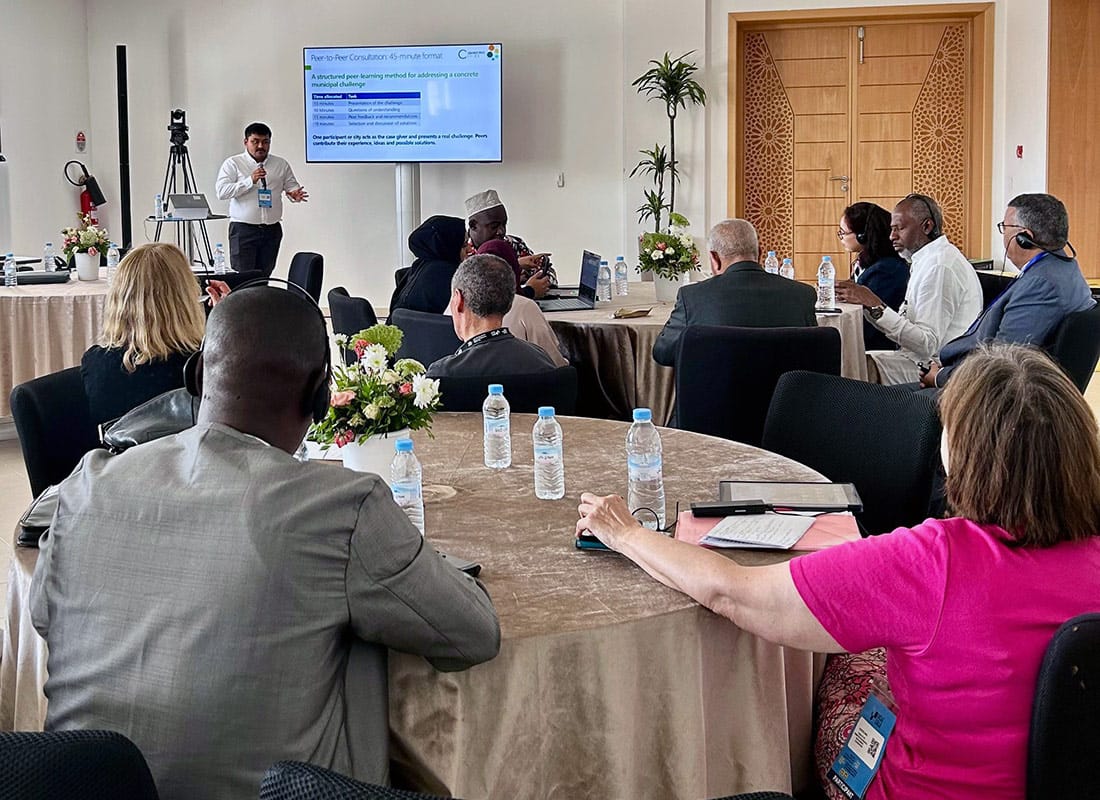
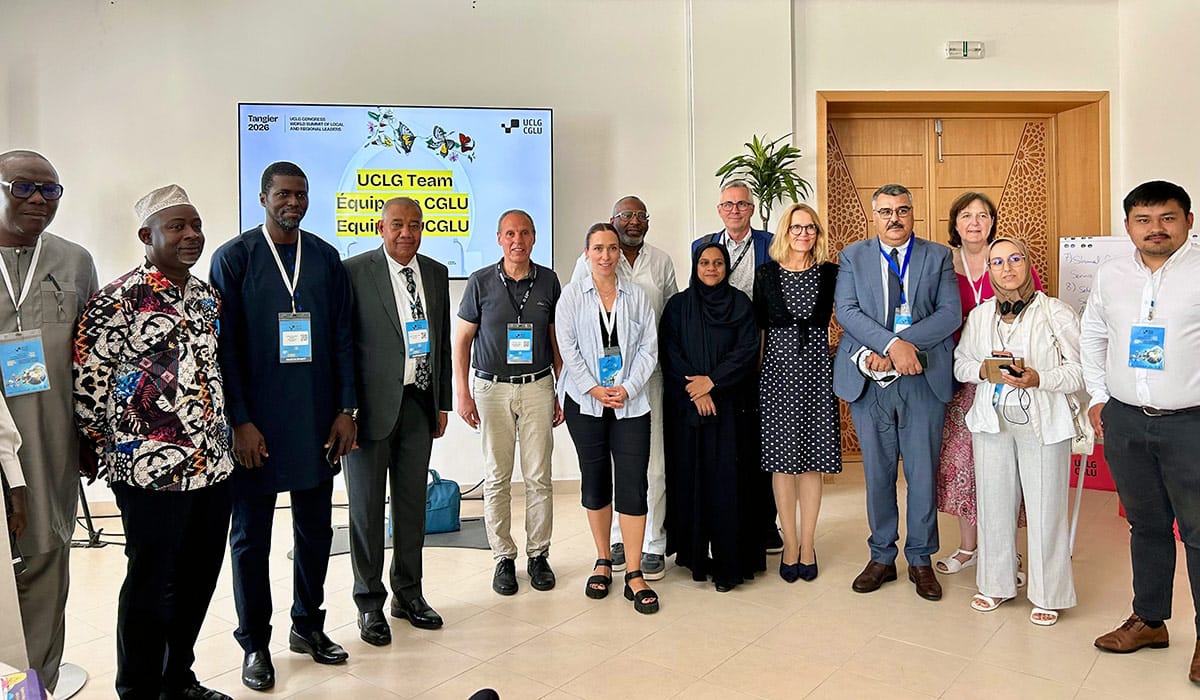
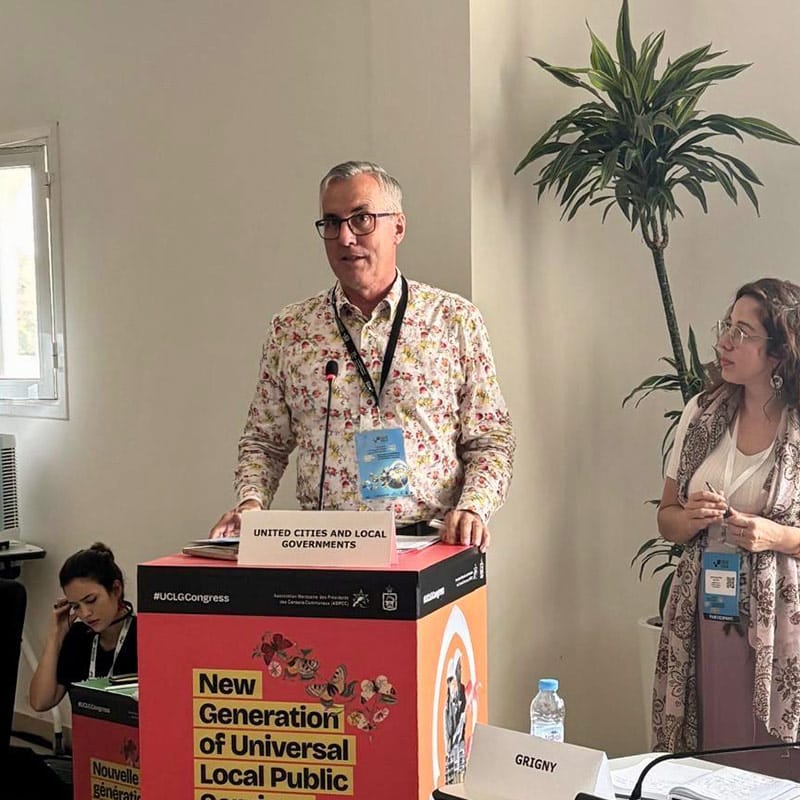
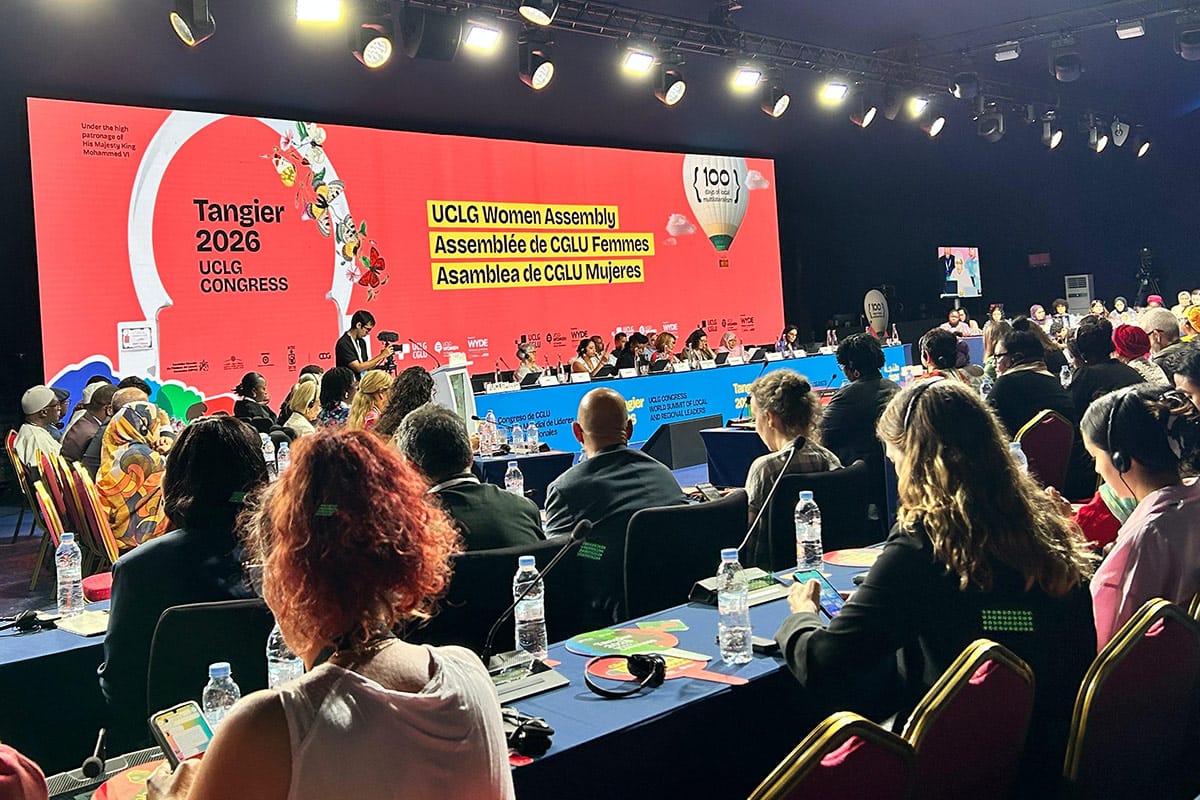
How can municipalities translate strategies and local development plans into effective public services? This question lies at the heart of the Connective Cities Lab “From Challenge to Practice: How Municipalities Turn Local Plans into Public Services”, organised in cooperation with the Association of German Cities.
Municipalities around the world face similar challenges when implementing local development plans. In this Lab, municipal representatives from different regions will share practical experiences: What obstacles had to be overcome? Which approaches proved successful? And what lessons can be adapted to other local contexts?
Following a series of short case presentations, participants will engage in a moderated peer-to-peer exchange to discuss challenges and jointly explore practical solutions for effective local public service delivery.
Objectives of the Lab
Exchange experiences on challenges related to local public service delivery
Share practical and transferable implementation approaches
Promote international networking and peer learning
We look forward to welcoming municipal practitioners, experts, and partner organisations from around the world.
Participation: The Lab will take place exclusively in person as part of the UCLG World Congress 2026. All participants and speakers must register through the official Congress registration system: https://registration.uclgcongresstangier2026.com/
International Community of Practice for Sustainable Municipal Development
NEWSLETTER – ISSUE NO. 95, June 2026
Dear Readers,
Water is not only a driver of development; it is increasingly becoming a strategic resource. Falling groundwater levels, more frequent and prolonged heatwaves and droughts, as well as heavy rainfall events, are creating major challenges for municipalities around the world. At the same time, relatively modest investments in nature-based and technological solutions can help balance local water systems, protect lives, and prevent far more costly damage to urban infrastructure.
With this in mind, 16 practitioners from six countries have embarked on a two-year Deep Dive on Water Resilience, working together to develop and implement innovative, locally adapted solutions to their specific challenges. Following a three-day in-person meeting in Wuppertal, we take stock of the progress achieved so far.
Can AI-generated visualizations help make housing projects more transparent and accessible for all stakeholders, or do they risk oversimplifying complex planning realities? This question sparked an insightful discussion during a professional conference organized by Connective Cities and the German Association of Cities at the World Urban Forum 13 in Baku, Azerbaijan. In this issue, we look back at the key insights and debates that emerged from the event.
The Kenyan city of Kisumu offers a practical example of how public spaces can be made more livable: pedestrian-friendly, nature-based, and climate-conscious through the promotion of e-mobility. The initiative serves as an inspiring pilot project and a model for future urban space improvements.
We would also like to draw your attention to several upcoming events.
At the UCLG World Congress 2026 on 25 June in Tangier, Morocco, we will explore how municipalities can successfully translate strategies and development plans into concrete public services. Through practical examples, participants will discuss challenges and solutions related to implementing local sustainability and development strategies.
Sustainability will also be the focus of our next dialogue event, taking place from 20–22 October 2026 in Berlin. The event will examine the implementation of sustainability strategies in the context of major sporting events. Municipal practitioners, particularly those working in event management, sports, and Education for Sustainable Development (ESD), are warmly invited to participate.
We hope you enjoy this issue and find inspiration in the experiences and ideas shared within it. We look forward to welcoming you to our upcoming events.
Yours sincerely,
The Connective Cities Team
REVIEW
Connective Cities at the World Urban Forum 13 in Baku
AI-Powered Visualisation for Affordable Housing and the Upgrading of Informal Settlements
At the 13th World Urban Forum (WUF) in Baku, the German Association of Cities, in collaboration with Connective Cities, organised an interactive academy session on how AI-powered visual tools can help local urban planners discuss housing challenges, the upgrading of informal settlements and neighbourhood development in a more concrete and accessible way. On the one hand, the AI visualisations proved very useful for making decision-making transparent, particularly in dialogue with the public. At the same time, however, they also carry the risk of oversimplifying complex planning realities or suggesting solutions before key issues have been clarified. This tension gave rise to an insightful discussion, which could well continue beyond WUF13.
The Pedestrian-friendly Redevelopment of a Commercial District
Making Kisumu a better place to live: In the city centre, the three main roads – Oginga Odinga, Ang’awa Avenue and Jomo Kenyatta Avenue – form a triangle around a sports and park area. These roads are used by over 2,200 pedestrians every day. The redesign of the so-called ‘Walkable Triangle’ into a more pedestrian-friendly space has made it safer, more pleasant and more accessible, whilst preserving and integrating the existing tree population. Furthermore, the city is promoting e-mobility in public transport through the introduction of a battery-swapping system for motorbike taxis, known as ‘boda-bodas’, and three-wheeled taxis, known as ‘tuk-tuks’.
Water Resilience – Municipalities Prepare for Drought and Heavy Rainfall
Documentation of the Connective Cities Deep Dive event held from 5 to 7 May 2026 in Wuppertal
Examining their own challenges in water resilience, learning from experiences on other continents, and finding the courage to put innovative ideas into practice – these were the key elements of the first in-person meeting as part of the Connective Cities Deep Dive, held in Wuppertal from 5 to 7 May 2026.
In early 2026, a total of 16 experts from the German municipalities of Dresden, Wunstorf and Wuppertal, as well as from Akkaraipattu (Sri Lanka), Homa Bay (Kenya), Hyderabad (India), Natitingou (Benin) and Niš (Serbia), have started a two-year long working together to analyse innovative approaches and how they might be implemented. On this basis, they are developing and implementing locally adapted solutions to their respective challenges. The meeting in Wuppertal is a first interim step.
From Challenge to Practice – How Municipalities Turn Local Plans into Public Services
Local4Action Track – Lab as part of the UCLG World Congress 2026 in Tanger, Morocco
How do municipalities succeed in translating strategies and development plans into concrete public services? The Connective Cities Lab, organised in collaboration with the German Association of Cities, will address this question as part of the UCLG World Congress 2026. Municipalities worldwide face similar challenges when it comes to implementing local development plans. In the Lab, international municipalities will share concrete practical experiences: What obstacles had to be overcome? Which approaches have proven successful? And what can be applied to other contexts?
Call for Participation – Global Green Sports: Implementing Sustainability Strategies for Major Sports Events
Invitation for Municipal Experts to the Dialogue Event in Berlin, 20–22 October 2026
How can sustainability strategies for major sporting events be embedded in policy? How are these strategies implemented within city administrations and event management? How can the public be engaged and informed about sustainable development during major sporting events? Organised by Connective Cities in collaboration with the Education for Sustainable Development Unit and the Berlin Senate Department for the Interior and Sport (SIUS), the event invites cities from around the world to exchange experiences, showcase best practices and jointly develop innovative solutions for sustainable sporting events.
Engagement Global gGmbH
Service Agency Communities in One World
Friedrich-Ebert-Allee 40, 53113 Bonn | Deutschland
Contact: Sibylle Loyeau
Email: sibylle.loyeau@engagement-global.de
Deutsche Gesellschaft für Internationale Zusammenarbeit (GIZ) GmbH
Friedrich-Ebert-Allee 32 + 36, 53113 Bonn | Deutschland
Contact: Ricarda Meissner
Email: ricarda.meissner@giz.de
Water is becoming a key challenge for an growing number of local authorities worldwide. On the one hand, they are increasingly exposed to heatwaves and drought. But on the other hand, heavy rain and high water levels are leading to more frequent flooding. These risks come together to not only impact public health, but jeopradize private property and public infrastructure. Global water demand could significantly exceed available supplies by 2030. Water is thus becoming a strategic resource. It is therefore critical for municipalities to strengthen their water resilience.
Examining their own challenges regarding water resilience, learning from experiences on other continents and developing the courage to implement innovative ideas – all these were the ingredients of the first in-person meeting as part of the Connective Cities Deep Dive, held from 5 to 7 May 2026 in Wuppertal. The group had already met for a virtual kick-off in March 2026. In early 2026, a total of 16 experts from the German municipalities of Dresden, Wunstorf and Wuppertal, as well as from Akkaraipattu (Sri Lanka), Homa Bay (Kenya), Hyderabad (India), Natitingou (Benin) and Niš (Serbia) have started a two-year long working together to explore and analyse innovative approaches such as sponge city concepts, blue corridors and integrated blue-green-red infrastructure, and the possibilities for their implementation. On this basis, they develop and implement locally adapted solutions to address their specific challenges.
The report describes practical examples from Wuppertal and Leipzig, outlines the planned pilot projects of the six municipalities and summarises the key takeaways from the process so far.
At the 13th World Urban Forum in Baku, the German Association of Cities and Connective Cities hosted an interactive Academy Session on “AI-supported Visualisation for Affordable Housing and Informal Settlement Upgrading”. The session explored how AI-supported visual tools can help municipalities discuss challenges related to affordable housing, neighbourhood development and informal settlement upgrading in a more concrete and accessible way.
The session built on the work of the Connective Cities Working Group on Sustainable and Affordable Housing. It was deliberately designed not as a technology demonstration, but as a practice-oriented municipal learning format based on real municipal cases. The aim was to explore how visualisation can make complex planning questions more understandable and open new spaces for dialogue between municipalities, technical departments, decision-makers and local stakeholders.
The process started from real images provided from municipal contexts. With the support of CoPlan AI, these images were translated into possible development scenarios. The AI-generated visuals were not intended as final plans. Instead, they served as discussion inputs. They allowed participants to discuss housing quality, density, public space, greenery, climate adaptation, mobility, social infrastructure and possible implementation steps in a more tangible way.
A central added value of the format was the joint work around the images. The visualisations made abstract planning questions visible and enabled a creative, yet critical discussion: What future images are being created? Which assumptions lie behind them? Which opportunities and risks become visible? Which social, spatial, environmental, institutional and financial conditions would need to be assessed before an image can become a realistic planning step?
The session was moderated by Prof. Hilmar von Lojewski, German Association of Cities. Jelena Karamatijevic, Connective Cities / GIZ, provided the conceptual framing and introduced the Connective Cities perspective on municipal practice and peer learning. CoPlan AI, represented by Damiano Cerrone and Sampo Ruoppila, supported the participatory AI-based visualisation process.
Municipal case contributions and reflections came from Nairobi, Huye, Mariental, Hebron, Berlin and the Urban Development Fund in Egypt. Contributors included Godfrey Ngugi, Richard Ndicunguye, Sunday Haimbodi, Husam Shweiki, Lars Loebner and Dr. Marwa Ahmed. They reflected on the visual scenarios from the perspective of local planning realities, implementation constraints and possible next steps.
From Berlin, Lars Loebner from the Senate Department for Urban Development, Building and Housing contributed an important perspective on the role of images in public debates on housing and neighbourhood development. Visual representations can strongly influence how new housing is perceived. Used responsibly, they can help communicate not only abstract plans, but also positive and realistic images of liveable, socially mixed and green neighbourhoods.
A methodological input was provided by Ruvi Y. Suárez Subirana, GIZ / ProUrbano, Santa Cruz, Bolivia. Under the title “From AI Visualisation to Scenario Assessment”, she showed how AI-supported visualisation can be linked to scenario thinking and impact reflection. Her contribution complemented the discussion by underlining that AI images are not plans. Their value emerges when they are used to reflect jointly on impacts, trade-offs and possible implementation pathways.
The discussion showed that AI-supported visualisation can be a useful tool for making planning options more accessible and supporting joint learning. At the same time, participants underlined that visualisations must be used responsibly. They can create expectations and therefore cannot replace planning, participation, feasibility assessments, cost estimation or political decision-making.
From a Connective Cities perspective, the Academy Session provides an important starting point for a deeper exchange on affordable housing, informal settlement upgrading and implementation-oriented municipal project ideas. The added value lies not in the technology itself, but in its potential to strengthen municipal learning processes and help translate visualisation and mapping into realistic, inclusive and financeable urban development pathways.
Visual documentation: Current state / after AI-assisted visualisation
The following visualisations were developed as discussion inputs during the WUF13 Academy Session. They use real municipal images as starting points and AI-generated scenarios to support dialogue on affordable housing, informal settlement upgrading, public space, climate resilience and implementation pathways. The images are not final plans. Source: Connective Cities, generiert mit CoPlan AI.
Ruanda, Huye — suburban affordable housing area
From serviced land to a liveable affordable housing neighbourhood with public space, shade and community facilities.
Initial scenario (left) and AI-generated discussion scenario (right)
Kenia, Nairobi County — Mji wa Huruma
From an informal settlement to upgrading, safer public space and climate-sensitive housing.
Initial scenario (left) and AI-generated discussion scenario (right)
Namibia, Mariental — incremental housing approach
From incremental housing conditions to a safer street environment with basic services, shade and walkability.
Initial scenario (left) and AI-generated discussion scenario (right)
Palestine, Hebron — affordable housing in context
From an existing street section to a scenario with mixed-use edges, greenery and pedestrian-oriented housing.
Initial scenario (left) and AI-generated discussion scenario (right)
Germany, Berlin — new neighbourhood development
From open land along a road to a dense, green and mixed-use housing scenario
Initial scenario (left) and AI-generated discussion scenario (right)
Egypt, Sharqia — urban infill and affordable housing
From underused urban land to a compact housing scenario with shaded courtyards and public space.
Initial scenario (left) and AI-generated discussion scenario (right)
Language: English – Turkish simultaneous translation
How can digital and AI applications help municipalities become more resilient and prepared for future risks?
As urban areas face growing climate and infrastructure-related risks, municipalities require digital tools that support rapid emergency response, long-term risk planning, and resilient urban governance. The Insight Session will introduce participants to the concept of “Digital Twins for Risk-Informed Urban Development” through practical applications and international good practices.
Urban Digital Twinning (UDT) refers to digital representations of urban systems connected to real-time data and predictive modelling tools. Increasingly used in urban development, UDT applications support areas such as mobility management, energy monitoring, disaster preparedness, infrastructure planning, and citizen participation. Successful examples can already be found in different countries, among them Japan, Singapore, Netherlands, Turkey, and Germany.
As a practical illustration, the session will present the ongoing work of practitioners, such as from the IT department of Bağcılar Municipality in Turkey, which is currently developing an AI-supported Digital Urban Twin platform focused on disaster resilience and data-driven municipal decision-making. The project integrates LiDAR-based 3D city modelling, IoT sensor infrastructure, GIS/MIS systems, panoramic urban imaging, and AI-supported analytics within a unified municipal data ecosystem.
After the presentations, a room for discussion will allow participants to ask questions and exchange thoughts on how to include digital urban twins into planning strategies and how to further advance the use of artificial intelligence for risk-informed and sustainable municipal development.
Kisumu, a port city on the shores of Lake Victoria and one of Kenya’s largest cities, is becoming increasingly important for the movement of goods and trade between Kenya and its neighbouring countries, Tanzania and Uganda. With an annual population growth rate of just under 4 per cent, the population has more than doubled in 15 years, rising from around 205,000 in 2001 to at least 422,000 in 2025. This has led to a series of major infrastructure projects, which, however, have primarily focused on motorised transport, even though 53 per cent of residents’ daily journeys are made on foot.
One project under the ‘Kisumu Sustainable Mobility Plan’ is the ‘Walkable Triangle’: the pedestrian-friendly redesign of the three main streets—Oginga Odinga, Ang’awa Ave and Jomo Kenyatta Ave—in a commercial district in the city centre. These streets form a triangle around a sports and park area and are used by over 2,200 pedestrians every day. The aim is to promote non-motorised transport along the 1.5-kilometre stretch, making it safer, more pleasant and accessible, whilst preserving and integrating the existing tree population.
In addition, the city is promoting e-mobility in public transport through a battery-swapping system for motorcycle taxis, known as ‘boda-bodas’, and three-wheeled taxis, known as ‘tuk-tuks’.
The documentation describes the approach as well as the outcomes achieved by this good practice.
International Community of Practice for Sustainable Municipal Development
NEWSLETTER – ISSUE NO. 94, May 2026
Dear Readers,
‘Resilience’ lies at the heart of our current learning processes and discussion forums. In materials science, it refers to materials that return to their original state even after being subjected to extreme stress. Just as trees bend supple in the wind and, after the storm has passed, resume their natural form as if untouched.
What does building climate-resilient infrastructure mean for municipalities? We discussed this question with experts, financial institutions and local authorities at the Africa Urban Forum, and it yielded interesting insights into coordinated approaches from technical, financial and participatory perspectives.
Nature-based solutions – as a possible answer – are at the heart of our new learning process in Sub-Saharan Africa, which began in April with 20 municipalities.
What role can AI play in this context? At the World Urban Forum on 21 May 2026 in Baku, AI-based visualisations will form the basis for critical discussions on affordable and climate-resilient housing.
And during a virtual insight session on 9 June, we will explore how digital twins can be used as a tool both for rapid responses in crisis situations and for long-term, risk-informed planning and resilient governance
Strengthening the resilience of municipalities to extreme weather events, urbanisation pressures, and technological and hybrid threats is also a central theme of our new learning process in South-Eastern Europe. This will launch in mid-June with a diverse range of local authorities from ten countries.
We would also like to invite you to apply for the 2027 Goerdeler Prize. Here too, outstanding examples of resilience in the context of cross-border local authority cooperation will be recognised.
We hope you find this an inspiring read and look forward to your participation!
Your Connective Cities Team
REVIEW
Technical Support for Climate Resilient Infrastructure
Connective Cities at GIZ Side-Event at the Africa Urban Forum
Climate-proofing the built environment: what does it take? At the African Urban Forum (AUF), Connective Cities organised a side event in collaboration with two GIZ partner projects: the Covenant of Mayors Sub-Saharan Africa (CoMSSA) and the Resilience Initiative Africa (RIA). Bringing together experts, financial institutions and local authorities, the event highlighted practical experiences from Embu (Kenya) and eThekwini (South Africa). The discussions focused on how collaborative governance, technical expertise, and innovative financing models can work together to promote climate-resilient infrastructure.
From Challenges to Pathways: Advancing Nature-Based Solutions in Urban Contexts
Recap of the Connective Cities Learning Process Kick-off Workshop in Naivasha, Kenya
The Connective Cities learning process on “Nature at the Heart of Urban Resilience” was officially launched through a three-day kick-off workshop held in Naivasha, Kenya from 21 to 23 April 2026, bringing together 20 municipalities and cities from across Sub-Saharan Africa and Germany, alongside over 40 urban practitioners, technical experts, and institutional partners. The workshop marked the starting point of a long-term commitment aimed at supporting local authorities in developing nature-based solutions to their municipal challenges through structured exchange and technical assistance.
AI-based Visualisation for Affordable Housing and Informal Settlement Upgrading
World Urban Forum 13 | Connective Cities Academy Event on 21 May 2026, from 09:30 to 11:30 Baku time (UTC+4)
At the World Urban Forum 13 (WUF13) in Baku, Connective Cities will contribute to the official WUF Academy programme with the interactive event “AI-based Visualisation for Affordable Housing and Informal Settlement Upgrading” on 21 May 2026, from 09:30 to 11:30 Baku time (UTC+4). The event is organised by the German Association of Cities in cooperation with Connective Cities and participating cities. Building on the recent Connective Cities working group exchange on affordable housing, the event works with real city cases from Nairobi, Huye, Mariental, Cairo, Hebron and Berlin. AI-generated visual scenarios will serve as a starting point for peer exchange and critical discussion on affordable housing, informal settlement upgrading, land use, density, public space, infrastructure, climate resilience, inclusion, financing, and implementation responsibilities.
Insight Session – Digital Twins for Risk-Informed Municipal Development
Call for participation to the online exchange on AI-driven urban innovation on 9 June 2026, 14:00 – 15:00 CEST (tbc)
How can digital and AI applications help municipalities become more resilient and prepared for future risks? As urban areas face growing climate and infrastructure-related risks, municipalities require digital tools that support rapid emergency response, long-term risk planning, and resilient urban governance. This Insight Session will present the concept of ‘digital twins for risk-informed urban development’ using practical applications and international best practices, including those from the Turkish municipality of Bağcılar.
Kick-off in Tirana: Strengthening Municipal Resilience Together
Dialogue Event launching the regional learning process in Southeast Europe/ South Caucasus from 16 to 18 June 2026
This dialogue event brings together municipalities of different sizes and structures, as well as representatives from various local public service sectors. Participants include local authorities from Albania, Armenia, Georgia, Kosovo, Montenegro, Serbia, Turkey and Ukraine, as well as Germany. This diversity enables practical discussions about different framework conditions, institutional structures, and the challenges of local development in the context of growing risks from extreme weather events, urbanisation pressures, and technological and hybrid threats. The kick-off event marks the beginning of a multi-stage learning process and lays the groundwork for future collaboration. It also serves to identify key areas of action and initial concrete steps. Join the discussion – online too!
Resilient Municipalities: Municipal Partnerships for Civil Protection, Critical Infrastructure and Crisis Preparedness
Connective Cities is pleased to once again support the call for applications for the Municipal Award 2027 of the Carl and Anneliese Goerdeler Foundation Fund (CAG), following its integration into the Leipzig Foundation. The award recognises outstanding achievements in local governance and administration. It highlights innovative and transferable good practices
on the theme of ‘Resilient Communities’ developed through cooperation between municipalities — particularly in an international context. The award therefore seeks cross-border municipal partnerships. A prerequisite for application is the involvement of a German municipality or a municipal alliance.The prize includes a high-profile award and is endowed with 2,000 euros. The deadline for applications is 31 August 2026.
Engagement Global gGmbH
Service Agency Communities in One World
Friedrich-Ebert-Allee 40, 53113 Bonn | Deutschland
Contact: Sibylle Loyeau
Email: sibylle.loyeau@engagement-global.de
Deutsche Gesellschaft für Internationale Zusammenarbeit (GIZ) GmbH
Friedrich-Ebert-Allee 32 + 36, 53113 Bonn | Deutschland
Contact: Ricarda Meissner
Email: ricarda.meissner@giz.de
The second Africa Urban Forum (AUF), organized under the African Union framework with the support from UN-Habitat and UNECA, took place from 8 to10 April 2026 at the Kenyatta International Conference Centre in Nairobi, Kenya. AUF welcomed a diversity of participants, among them politicians, private sector, civil society, development partners and interested members of the public as well, to discuss the conferences’ topic: ‘Adequate Housing for All: Advancing Socio-economic and Environmental Transformation towards the Realization of Agenda 2063’.
At AUF, Connective cities alongside GIZ partner projects Covenant of Mayors Sub Sahara Africa (CoMSSA) and Resilience Initiatve Africa (RIA) organized and facilitated a side event on 9 April, titled Climate proofing the built environment: Integrated Technical Support for Climate-Resilient Infrastructure.
The events’ panel-discussion included international experts, development finance institutions, and local administrations. Thereby, participants could gain insights from local government representatives from Embu, Kenya, and eThekwini, South Africa on how to combine collaborative governance with technical expertise for climate resilient infrastructure. In this regard, the launch of the Embu Final Prefeasibility Technical Assistance Report on Solid Waste Management Infrastructure illustrated the need for comprehensive data gathering prior to project implementation.
Next to the case studies, panelists discussed institutional arrangements and policy approaches related to financing sustainable urban infrastructure. For example, a representative of the European Bank for Reconstruction and Development emphasized that cities must leverage on digitalization of revenue collection to meet ever-rising financial demands and also demonstrate to potential financiers built-in capacity to collect, allocate, and use financial means effectively.
Furthermore, a program manager from the European Investment Bank noted that for development projects to be implemented efficiently, the national and sub-national levels of government must enter into collaborative modes of governance, whereby they complement each other in sourcing funds from potential financiers. The program manager further advocated for a non-fragmented approach towards infrastructure development to avoid wastage and duplication of effort and resources.
In sum, the AUF side-event, by bringing together financial institutions and local government leaders, provided valuable insights into how to comprehensively think sustainable urban development as a basis to successfully build climate-resilient infrastructure in African cities and beyond.
Migration policy may be a national matter – however, its success or failure is also determined at the local level. Convinced by this, around 50 local government professionals came together for a virtual Insight Session organised by Connective Cities. The focus was on the question of what role municipalities can play in the immigration of skilled workers and in supporting migrant entrepreneurship.
In addition to a study by the German Institute for Employment Research IAB, practical examples from the German Pinneberg District, Mersin (Türkiye) and Oberhausen (Germany), Munich (Germany) and Gharb Irbid (Jordan) formed the basis of in-depth working group discussions. These clearly demonstrated that local governments can play a crucial role in realising the economic potential of migration at the local level.
Municipalities and regions from Southeast Europe, the South Caucasus and Germany are invited to participate in the regional learning process “Planning for Municipal Resilience” and jointly develop approaches to protect critical infrastructure.
Municipalities are increasingly facing complex risks: climate-related extreme events, technical disruptions, growing inter-dependencies between infrastructure systems and new security challenges threaten the functioning of urban areas. Protecting critical infrastructure – energy, water, transport, communication and health – has therefore become a central task of modern local governance.
The learning process brings together municipalities from Southeast Europe, the South Caucasus and Germany to exchange practical experience, develop joint solutions and strengthen local capacities for risk-informed urban development. The focus lies on integrated planning, multi-risk governance and the development of implementable project approaches to protect and strengthen critical infrastructure.
Who is the call for participation addressed to?
Professionals and managers from municipal administrations, municipal utilities and regional authorities
Staff working in planning, infrastructure, disaster risk management and municipal management
Cities, municipalities, districts and regions from Southeast Europe, the South Caucasus and Germany
Timeline and Format
Virtual kick-off meeting: End of April 2026
First face-to-face workshop (3 days): Beginning of June
Duration: approx. 1 year
Formats: on-site workshops, digital exchange modules and short expert missions (“peer visits”)
The learning process is structured in three phases:
risk and vulnerability analysis,
integrated planning and solution development, and
implementation readiness and financing.
Thematic priorities include urban systems and critical infrastructure resilience, integrated risk governance, and data, early warning and continuity management. The structured process promotes peer-to-peer learning and technical cooperation between municipalities in Europe and the partner regions.
Participation and Contact
The participation costs (accommodation and board) are covered. The conference language is English