


Accra, the tropical capital of Ghana faces environmental and waste management issues. The Municipal Authority of Accra was initially responsible for waste management services. Due to the inadequate capacity of waste management, the Municipal Authority started the Hutalapi principle that has brought in other waste collection service providers with a target of the lower-middle-income neighbourhood of Accra.
Author: erik
Designing Disaster Risk Reduction strategies from local to national levels by harnessing the INFORM platform

The INFORM suite is a multi-stakeholder forum for developing shared, quantitative analysis that is relevant to humanitarian crises and disasters. Led by the Joint Research Centre of the European commission, INFORM also includes organisations from the humanitarian and development sector, donors, and various technical partners. Together, these actors have come together in developing a suite of quantitative and analytical products that support decision-making on humanitarian crises and disasters. Such products aim to empower and support decision making at different aspects of the disaster management cycle, specifically in the prevention, preparedness, and response phases. INFORM develops tools and methodologies for use at the global level and supports the application of their products at a subnational level. The scope and application of the various products from the INFORM suite can bridge the gap faced by many countries and cities, in harnessing data on risk for developmental planning.
The Global Initiative on Disaster Risk Management (GIDRM) and the Connective Cities project are grateful to the representatives from INFORM in delivering an Insight Moment on how to harness the platform and its applications in a real-world context to our Connective Cities Community. Specifically to Dr. Karmen Poljansek (JRC) who gave an introduction to the INFORM Suite and INFORM’s core principles; Dr. Andrew Thow (OCHA) who presented the subnational programme of INFORM and showcased the INFORM subnational model for the Sahel-Region; Mrs. Galiya Ibragimova (UNDRR) who presented the development and implementation of Central Asian and Caucasian, as well as the south-eastern Europe INFORM subnational models; and Dr. Luca Galimberti (JRC) who showed the prototype of INFORM subnational dashboard including other INFORM analytics.
The Insight Moment underlined the relevance of rigorous information systems as essential for Risk-informed Urban Development in obtaining high quality and real time data. The availability and accessibility of such a powerful tool like the INFORM platform and its various products prove to be effective solutions to such deeply rooted problems that act as a barrier for resilient and sustainable development globally. The INFORM suite developed by the JRC proves itself to be an invaluable tool, contributing to RIUD. INFORMS core principles Global, Open, Reliable and Flexible allow cities to harness high-quality and open-source data on the risks they face, to ensure that development and developmental gains can be secured at local as well as national and transboundary levels.
The recording of the session and the presentation files from the representatives can be accessed through the following page: Insight moment – Harnessing the INFORM platform as a tool for national authorities to design the DRR strategies at different levels, from local to national | Connective Cities Network (connective-cities.net).
Better prepared for future crises

Public transport in Yerevan, Armenia, is severely affected by the Covid-19 pandemic. Strict hygiene measures are indispensable to maintain operations and prevent infections.
A city designed for and with children: Quelimane, Mozambique

The economy of Quelimane is dependent on rain-fed agriculture and fishing. This has led to some families falling into extreme poverty due to the effects of climate change. Children, an important part of the population, have been affected as well. The good practice aims to promote children’s participation in the governance and planning of Quelimane city.
Turning waste into a resource

The City of Bizerte (Tunisia) introduced the separation and composting of organic waste, in cooperation with the City of Rostock (Germany). During a dialogue event and two reciprocal delegation trips, the idea for the project was jointly developed by experts from Rostock and Bizerte. With funding from the ‘Partnership Projects for Sustainable Local Development (Nakopa)’ programme of the Service Agency Communities in One World (SKEW), a composting plant was built and commissioned at the end of 2020.
Keeping the Community of Kibera online

We spoke to Josephine Miliza, co-founder of TunapandaNET, to find out how the NGO has scaled up its activities to ensure that people in Kibera, an informal settlement in south-west Nairobi, have a reliable internet connection – and thus access to crucial information during the pandemic.
It became apparent that the internet is one of the most important sources of information. Listen in to know how Kibera is keeping online and how this could shape digital literacy and digital municipal service design in a post-COVID-19 future!
Listen to the podcast at YouTube: https://youtu.be/oirb3zEsyXA
Digitalisation for efficient integrated risk management

Gütersloh is a city in North-Western Germany with a population of more than 100,000 people. It was essential for the city to develop lean technology solutions to deal with the uncertainty from the COVID-19 pandemic, to efficiently control the spread of the virus and ensure the protection of the people.
Climate impacts in municipalities with viticulture and tourism

Climate change and its impacts are increasingly being felt at the local level in various ways. Droughts, floods, heat waves and forest fires are visible aspects of a larger global challenge. The towns of Eltville on the Rhine in Germany and Tunuyán in Argentina are internationally renowned for their wine production and hospitality. That is why for both cities adaptation to climate change is a central issue.
Within the framework of the CC project, experts from both cities had the opportunity to exchange experiences related to climate change, wine production and tourism. The exchanges took place in December 2021 and as a result, both cities decided to formally cooperate, identify common challenges and jointly find practical solutions to them. During the virtual session on 9 December 2021, we welcomed the mayors of Eltville, Mr. Patrik Kunkel, and of Tunuyán, Mr. Martin Aveiro, who after giving some opening remarks, proceeded to sign a Memorandum of Understanding (MoU), each of them in their offices 12,000 kilometres apart. This MoU provided a framework for the exchange and the joint development of projects, enabling both cultural and social exchange, as well as enabling the opportunity for a common learning process. Almost 30 participants were there to celebrate the moment, including the representative of the Argentinean consulate in Frankfurt.
Toolbox citizen engagement for sustainable mobility planning and implementation

The success of sustainable mobility plans and projects often depends on the commitment and acceptance by citizens. Therefore, citizen engagement in planning and implementation of sustainable mobility in municipalities turns out to be a key success factor not only for impactful implementation of new concepts, but also for co-creating smart sustainable mobility measures. This happens when solutions are developed together with stakeholders.
Due to the consequences of the pandemic citizen engagement is limited or impossible. This can endanger the success and/or slowing down necessary sustainable mobility projects. For this reason, the Connective Cities working group «Sustainable Mobility after COVID-19» created a prototype for «Toolbox citizen engagement for sustainable mobility planning and implementation».
The toolbox covers different levels and degrees of participation. It is a collection of successful tools and roadmaps that can be used in different phases of sustainable mobility planning and implementation in and after the pandemic.
Urban gardening and the role of community-based initiatives
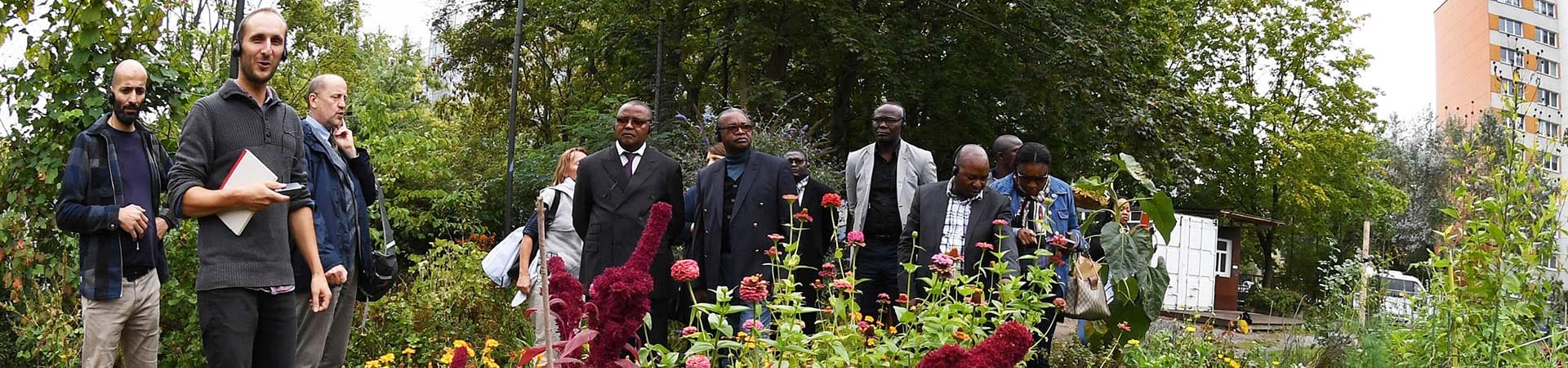
As part of the Connective Cities learning process on Urban Gardening, a virtual dialogue event was organised and hosted together with the city of Berlin in April 2021. The cities of Dresden and Brazzaville actively participated in the dialogue event and experts from Dresden had the opportunity to present the city’s experiences in implementing urban gardens and urban agriculture projects.
One of the outcomes of the event was the interest in further exchange on the thematic, its challenges and benefits. Therefore, Connective Cities supported the cities of Dresden and Brazzaville by organising a virtual project workshop on 16 November 2021. This exchange built on a long-standing partnership between the cities, as they are twin cities, and gave continuation to two technical visits that took place before the COVID-19 pandemic. The virtual session allowed experts from Brazzaville, Dresden and partner institutions to exchange ideas and experiences, share expectations and strategies, as well as to expand their knowledge in the field and further develop the project with a network of partners.
The structure of the session enabled the cities to present their impressions and past actions as well as to benefit from the discussion with the participants on the challenges of sustainable development challenges and the current needs that the cities could work on.