

Action-oriented studies show that the 2030 Agenda will only be successful if implemented at the urban level and together with urban actors. In fact, cities – as actors and places – are crucial to achieve two thirds of all SDG targets. This insight and the principle of interconnectedness underpin the urgency to follow integrated approaches for sustainable urban development to break down barriers between sectors and stakeholders, and between institutions and levels of government. […] The publication describes five development projects implemented by the Deutsche Gesellschaft für Internationale Zusammenarbeit (GIZ) GmbH on behalf of the German Ministry for Economic Development and Cooperation (BMZ). These projects applied an integrated urban development approach that led to comprehensive and sustainable results in urban areas thereby contributing to the implementation of the 2030 Agenda.
Author: erik
Unlocking the Potential for Transformative Climate Adaptation in Cities

"Cities are increasingly integrating climate adaptation priorities into development policies and plans. However, there remains a gap in understanding how incremental urban adaptation solutions can lead to more transformative change over the long term. Transformative adaptation reorients urban climate actions around addressing entrenched equity and climate justice challenges. It focuses on systemic changes to development processes that improve people’s quality of life, enhance the social and economic vibrancy of cities, and ensure sustainable, resilient, and inclusive urban futures. This paper systematically reviews literature and case studies across the global North and South to assess the barriers and enablers to transformative climate adaptation, focusing on examples and evidence from a wide range of cities."
Urban-Rural Linkages: Guiding Principles

"The reciprocal and repetitive flow of people, goods and financial and environmental services (defining urban-rural linkages) between specific rural, peri-urban and urban locations are interdependent; they are the reality of socio-spatial arrangements, creating places with distinct yet interwoven, socially constructed identities. The benefits of investing in connective infrastructure and services, while building capacity for inclusive and functional territories linking urban and rural communities, are immense in all three areas of sustainable development: economic, social and environmental. The goal of these Guiding Principles is to inform pragmatic strategies and propose a Framework for Action to build an enabling environment for more inclusive and functional urban-rural linkages. The Guiding Principles also provide a reference for revising national and subnational rural, urban and territorial policy frameworks."
Integration of shared mobility approaches in Sustainable Urban Mobility Planning

This document provides guidance on a specific topic related to Sustainable Urban Mobility Planning (SUMP). It is based on the concept of SUMP, as outlined by the European Commission’s Urban Mobility Package1 and described in detail in the European SUMP Guidelines (second edition).
Numerous sharing concepts have emerged in recent years, which have been developing dynamically ever since. Some sharing concepts – esp. station-based car sharing – address alternatives to car ownership in order to reduce the space consumption, but others serve rather as an additional mobility option to get around: free floating car sharing and public bike rental systems, newer phenomena in the form of e-Scooter sharing and e-Moped sharing, on-demand mobility concepts (ride hailing and ride sharing) as well as the shared transport of goods (freight transport). The following brochure concentrates in particular on sharing services and the starting points for municipalities within a SUMP. It shows the steps in sustainable urban mobility planning when particular planning aspects must be taken into account while integrating sharing modes.
Women in Politics

In short, this study provides a global overview of the situation concerning the participation and representation of women in politics in Europe from the firm standpoint that gender equality in decision-making is a right, but also a highly political issue, essential to the positive advancement of our democracies. Good governance can only arise from just and healthy decisions taken by women and men together for the good of society as a whole.
While some progress has been made over the last ten years, women are still under-represented and the situation in local and regional government is of particular concern. In Europe today, only 15.4% of mayors are women.
The average proportion of women in local councils remains stuck below 30% (28.9%) and is only slightly higher in regional assemblies (30.9%). At this rate, how many years will it take before a 50–50 gender balance is reached among women and men in politics?
The Future is Now: Science for Achieving Sustainable Development,

In 2016, Member States decided that the report should be produced once every four years, to inform the quadrennial SDG review deliberations at the General Assembly, and that it should be written by an Independent Group of Scientists appointed by the Secretary-General. They mandated that the Group would consist of 15 experts representing a variety of backgrounds, scientific disciplines and institutions, ensuring geographical and gender balance.
The Future is Now: Science for Achieving Sustainable Development, is the first Global Sustainable Development Report prepared by the Independent Group of Scientists appointed by the United Nations Secretary-General. It does not produce new evidence; rather it capitalizes on existing knowledge across disciplines, through an “assessment of assessments”. It highlights state-of-the-art knowledge for transformations towards sustainable development and identifies concrete areas where rapid, transformational change is possible. The Report is not only a product but also a process for advancing collaboration among actors in science, Government, the private sector and civil society in all regions of the world towards identifying and realizing concrete pathways for transformation driven by evidence.
Improving public service delivery at local level – solutions for participatory and accountable management
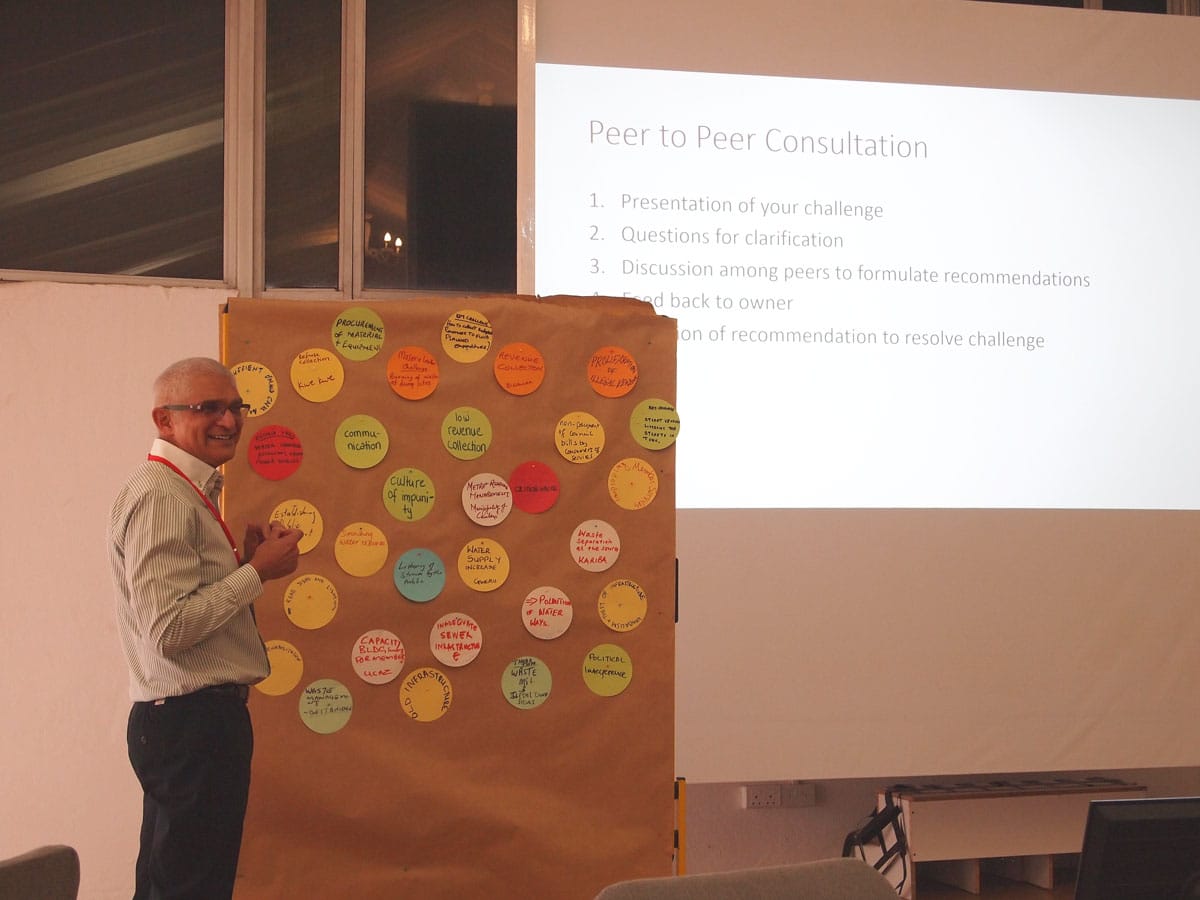
Connective Cities brought together urban practitioners from Sub-Sahara Africa and Germany to meet at the dialogue event “Improving public service delivery at local level – solutions for participatory and accountable management” in Harare, Zimbabwe from 20th to 22nd of August 2019.
Especially in Sub-Saharan Africa, dynamic urbanization and significant environmental and demographic changes are stating new challenges with regard to basic service delivery. Therefore, the focus was on developing approaches to improve public service delivery through public participation in order to achieve social accountability in the sectors of water, sanitation, waste management and transport.
Twenty-one representatives from Zimbabwean municipalities as well as a number of municipal practitioners from South Africa, Lesotho, Zambia, Kenya and municipal experts from Germany exchanged their experiences based on examples of Good Practices on public service delivery and defined possible solutions for the improvement of public service management.
The dialogue event was organized in cooperation with the GIZ project in Zimbabwe, “Strengthening the Urban Councils Association of Zimbabwe (UCAZ) to promote inter-regional and municipal knowledge transfer and capacity development”.
Adapt Now: A Global Call for Leadership on Climate Resilience

The report puts forward a bold vision for how to transform key economics systems, making them more resilient and productive. The Commission finds that climate adaptation can produce significant economic returns: the overall rate of return on investments in improved resilience is high, with benefit-cost ratios ranging from 2:1 to 10:1, and in some cases even higher.
The analysis specifically finds that investing $1.8 trillion globally in five areas from 2020 to 2030 could generate $7.1 trillion in total net benefits. The five areas of climate adaptation the report considers are: early warning systems, climate-resilient infrastructure, improved dryland agriculture, mangrove protection, and investments in making water resources more resilient. These represent just a portion of the total investments needed and total benefits available.
Recent events have shown that climate change affects people everywhere. Furthermore, without action, millions of people will be pushed further into poverty, leading to increased conflict and instability.
Climate Proofing Urban Development

Almost 30 local practitioners from 12 cities, 10 countries and four continents accepted the invitation of Connective Cities and the city of Dortmund to a dialogue event on the topic of “Climate proofing urban development”, which took place from 3 to 5 September 2019 in Dortmund, Germany.
Climate change and the effects of more frequent climate impacts and extreme weather events such as heavy rainfall, severe thunderstorms, storms, prolonged droughts and heat waves are posing major challenges for cities around the world. In addition, climate change is a cross-cutting issue that affects all areas and departments of a city administration and therefore requires a cross-departmental approach.
Starting with an exchange of experiences on good practices and projects in the cities, implementation challenges were identified and eventually the participants developed six project ideas for six cities, which could lead to an improvement of the respective strategies and implementation plans.
The event concluded with an excursion to Lake Phoenix – a mega-project of the city of Dortmund to transform an industrial wasteland into a new vibrant area providing new housing, workplaces and recreation opportunities around an artificial lake. The transformation of the area also had positive effects on the climate of the area contributing to local climate adaptation.
Urban Migration: Strengthening Cooperation with Civil Society

"While migration is often seen as a national issue, and most of the mandate around immigration, refugees and asylum falls to the central government, it is often cities and local governments that have to directly deal and address the needs of newly arrived migrants, and the inclusion of long-term migrant residents. […] At the same time, civil society organizations (CSOs) have taken an increasingly important role in supporting migrants by undertaking initiatives that raise awareness, facilitate access to basic services, advocate for their rights and strengthen social inclusion. The role of CSOs as key partners for local authorities in the governance of migration and other urban governance issues is widely recognized, but it is not always clear how to articulate these partnerships and coordinate efforts while securing the autonomy of these organizations and avoiding potential tensions or conflicts of interest."
In June 2019, UCLG ́s Learning team coordinated a workshop and peer learning event focusing on “Building trust through strengthened cooperation: the role of civil society in the urban governance of migration” in Sfax, Tunisia. The workshop was part of the Mediterranean City to City Migration (MC2CM) project. In the process of the event some key learnings and recommendations have been worked out. The documentation includes case studies from Sfax, Tunisia; Malaga, Spain; Brital, Lebanon; Douala, Cameroon and Meknes, Morocco.