


As the world moves towards a more sustainable future, municipalities across Southeast Europe and the Caucasus are actively seeking innovative solutions to address their energy needs. In this context, Connective Cities facilitated two peer-to-peer exchange activities as part of a regional learning process on renewable energy options at the municipal level. These exchanges not only fostered collaboration but also provided valuable insights and inspiration for future projects. Let’s delve into these transformative experiences:
Category: Cities and climate change
Climate-positive cities: circular economy and carbon accounting

Background
The construction industry is one of the most energy-intensive sectors of the economy and a major contributor to global climate change. It is responsible for up to 40 per cent of global CO2 emissions. However, there are ways to make construction more sustainable and hence more climate-friendly. Municipalities play a key role in initiating and supporting these processes locally.
Two examples of such municipal engagement were in the spotlight of a virtual exchange organised by Connective Cities on 27 February 2024 and were discussed by 18 (municipal) experts from six countries. The event was part of a one-year learning process that began in November 2023 with the international dialogue event “Climate-friendly construction with organic and recycled materials” in Potsdam, Germany.
Nature-Based Solutions, Biomimicry, and Flood Management Lessons Learned from the U.S and Europe

On 29 March 2024, the insight session on Nature-Based Solutions, Biomimicry, and Flood Management Lessons Learned from the U.S. and Europe was held, delivered by thematic experts from Jacobs company.
This insight session was organized by Connective Cities and the Resilience Initiative Africa’s Southern Africa component, and presented to the Connective Cities global community, encompassing urban practitioners, national government actors, researchers from academia, non-governmental organizations, and local community members.
The insight session was kicked off with a presentation from Mr. Andrew Potts on Blue-Green Stormwater Infrastructure. Mr. Potts holds 24 years of expertise encompassing green stormwater infrastructure (GSI), stormwater management, water resources, and sustainable site design, and spoke in depth about his experiences in implementing Blue-Green Stormwater Infrastructure in cities across the United Kingdom and the United States.
The goal of Blue-Green Stormwater Infrastructure is to manage stormwater at the source by combining man-made “blue” infrastructure such as pipes and culverts, with nature-based “green” infrastructure such as green roofs and bioswales. The combination of such infrastructures offers a more resilient and sustainable method of managing urban stormwater runoff and peak flow rates, enhancing water quality and biodiversity within urban areas. Mr. Potts referred to several examples from his work in implementing Blue-Green Stormwater Infrastructure:
- Sidmouth, a town on England’s southwest coast, has endured regular stormwater floods, with overland flow paths flowing to a low point immediately in the town’s center, leaving 150 residential and commercial properties at risk.
- Jacob’s team along with the local government worked jointly to develop flood prevention measures that would not only address Sidmouth’s challenges with draining water from the town center but also create a new public space for the surrounding local communities.
- The Amphitheater was hence developed a floodwater storage area. Water from the highways and the streets running through the town would drain into the amphitheater. In days without heavy rainfall, the amphitheater acts as a public space, hosting many of the town’s events and festivals. During heavy rainfall days, however, the amphitheater acts as a valuable source of water storage, being able to hold 700 cubic meters of water.
Examples from the US.
- The development of Rodney Cook, Sr. Park in Atlanta Georgia by creating a multi-functional public space within the neighborhood not only allowed for an effective medium of stormwater drainage but also created a space for residents to enjoy.
- At the Rams Head Center of the University of North Carolina – Chapel, 1-acre blue-green roof plaza on top of a multistory parking garage along with a 56,000-gallon cistern below the sidewalks, to efficiently drain stormwater during heavy rainfall events.
Mr. Potts also spoke on how to effectively plan and design Blue Green Stormwater infrastructure, talking about various design criteria such as:
- External factors – Changing precipitation patterns, incorporating flood models into the design, addressing seasonal variation in infiltration rates and groundwater models.
- Basic factors – The project site of the infrastructure planned, the scale of the project, the level of maintenance required, geotechnical considerations, and cost implications.
Complementing the input from Mr. Potts, Mr. Chris Allen further gave a presentation on Biomimicry, exploring how to quantify nature’s benefits through ecosystem intelligence. Examples such as micro-bioretention and bioactive walls were mentioned. Mr. Allen has over 30 years of consulting and strategic management experience and collaborates with technical teams worldwide to incorporate Regenerative and Nature-Based Solutions into planning and design for diverse clients.
Over 3.8 billion years, nature has devised highly efficient answers to most of the problems we face. Biomimicry is a design and innovation strategy that takes inspiration from nature’s inventiveness, leveraging its patterns, methods, and effective approaches to improve and innovate solutions that promote ideal conditions for all living forms to thrive. When applied to built environments, biomimicry produces design solutions that mimic the life-sustaining benefits, also known as ecosystem services, supplied by natural habitats. As a result, these buildings assist the surrounding ecosystems by providing socioeconomic and environmental benefits such as improved air and water quality, better carbon absorption, and increased biodiversity. The overall goal is for buildings to function similarly to neighboring undisturbed ecosystems, providing equivalent benefits to the natural landscapes they surround.
Mr. Allen gave an example of how Ford Motor Company in their Michigan Central Station had implemented biomimicry measures to not only improve local water quality but also led to positive outcomes in carbon cycling and biodiversity. Ford Motor Company carried out the following measures:
- The implementation of restoration workdays, where employees of the company would embark on restoring the wetlands in the surrounding areas of the Michigan Central Station. Employees contributed to the development of bioretention ponds, restored the local streambanks, planted native species of plants along the wetlands, and developed bioswales to drain stormwater
- Local forests were also restored, and recreational trails were developed along the local forests to improve the habitats for birds. Additionally, pollinator gardens were developed. To regreen the Central station, the areas previously allocated for employee parking were redeveloped into forest areas, with the planting of native forest trees.
- A mix of blue and green stormwater infrastructures was also implemented in the central station with the development of subsequent green and blue roofs to intercept and collect precipitation. Eco-machines were also installed to treat stormwater that fell on the blue-green roofs, feeding into either stormwater cisterns or drained into the local wetlands. Footpaths around the campus and the newly developed parking lots were built on pervious surfaces, to allow water to drain into the ground.
After sharing the example of the Ford Motor Company, Mr. Allen then presented two tools that could be used by the participants to utilize and implement biomimicry solutions in their own cities:
The Positive Performance Methodology
- An assessment and innovation technique to assist business clients in developing and implementing regenerative best practices, thereby enhancing the overall well-being of ecosystems and the communities that rely on them.
- Using local intact ecosystems as inspiration and a benchmark against which future performance is measured, it guides organizations and design teams in developing place-based, regenerative design approaches that provide an array of benefits for ecosystems, communities, and businesses.
The Ecosystem Intelligence Identification and Inventory Tool
- The Ecosystem Intelligence Identification and Inventory tool has been developed to identify and quantify the ecosystem services supplied by a site. Data produced by the tool can be used to to visualize cost-benefit potential for optimizing natural landscape and built-environment performance, or be used for various engineering and finance models, as a crucial source of evidence-based planning.
The insight session held, acted as a valuable input for the Learning Process on Flood Risk Management for Risk-informed Urban Development, giving participating cities innovative and unique perspectives on solutions that could be implemented within their urban catchments. Not only did the insight session provide the participants with different perspectives on combatting urban flooding but also to shift the paradigm of urban risk management away from a single hazard focus, more towards a multi-hazard focus and systemic approach towards risk management.
The recording and the soft copies of the presentations delivered by the team at Jacobs can be accessed through the following link – https://community.connective-cities.net/en/node/1464.
Connective Cities and the Resilience Initiative Africa would like to thank the speakers from Jacobs for their excellent and engaging inputs. Should you be interested in similar events, we would welcome you to our upcoming insight sessions:
- Showcasing the Amman Urban Observatory – 24/04/2024
- Application of the Sponge City Concept in the Sub-Saharan Africa context – 16/05/2024
- Harnessing Artificial Intelligence for Risk-Informed Urban Development and Climate Action in the SADC region – 20/06/2024
Lörrach plans Germany’s first timber-built commercial area

In 2020 the town of Lörrach purchased the 8.5-hectare Lauffenmühle site which had formerly been home to a textile factory. The purchase was made possible by urban development grants worth €9.1 million from Germany’s federal government and the state of Baden-Württemberg.
Following discussions with the Potsdam Institute for Climate Impact Research, the idea arose of creating a timber-built climate-neutral commercial area on the site.
The historic factory buildings on the site and their stone facades are not protected monuments, but the project still plans to repair and retain their basic structure in order to utilise them for new commercial purposes. By doing this, the project hopes that people will be able to identify with the project, particularly in the surrounding areas.
The project can serve as a model for other municipalities in Germany and around the world, providing that entire commercial areas can be built of timber.
For more impressions, take a look at our Good Practice website!
Resilience in Times of War – Municipal Exchange between Ukraine and Germany

Discover innovative strategies for rebuilding infrastructure and fostering resilience in Ukrainian municipalities amidst the aftermath of Russian aggression. Join us in exploring the outcomes of the Connective Cities’ Project Planning Workshop, ‘Resilience in Times of War – Municipal Exchange between Ukraine and Germany.’ Held from November 28 to 29, 2023, in Munich, Germany, this workshop brought together over 35 participants, including representatives from 12 Ukrainian municipalities. Through dialogue and experience sharing, attendees delved into key focus areas such as sustainable energy development, local and regional economic growth, and strategic/urban planning. Learn from the insights of esteemed guest speakers and delegates from Kosovo municipalities, as they offer perspectives on German and international municipal experiences, paving the way for collaborative efforts in rebuilding and fortifying Ukrainian communities.
All presentations can be found here: https://community.connective-cities.net/en/group/215/topics
Deep Dive: Heat in the city

As a second milestone of the Deep Dive process, a workshop was held in Nairobi from 4 to 7 March 2024. The workshop marked the transition from the phase of sensemaking of the local contexts towards prioritization of challenges and solution options. Participants representing the cities of Nairobi, Aswan, Mombasa, Lviv, Lüdenscheid and Heidelberg discussed the observations and findings from the initial participatory field research including insights into how stakeholders and relevant actors perceive challenges related to the phenomenon of urban heat. Additionally, participants had the opportunity to learn about projects and initiatives implemented in Nairobi that are relevant to building resilience to urban heat.
Lörrach plans Germany’s first timber-built commercial area

There is more than enough wood available in the town of Lörrach and its proximity to the Black Forest. The idea was born to build a climate-neutral industrial estate in timber construction on the Lauffenmühle site. To date, there have only been individual commercial buildings constructed from wood in Germany, but no industrial estate with a comparable concept. Parts of the historic factory buildings on the site with their natural stone façades are to be integrated into the new utilisation structure.
Climate-positive construction with circular materials
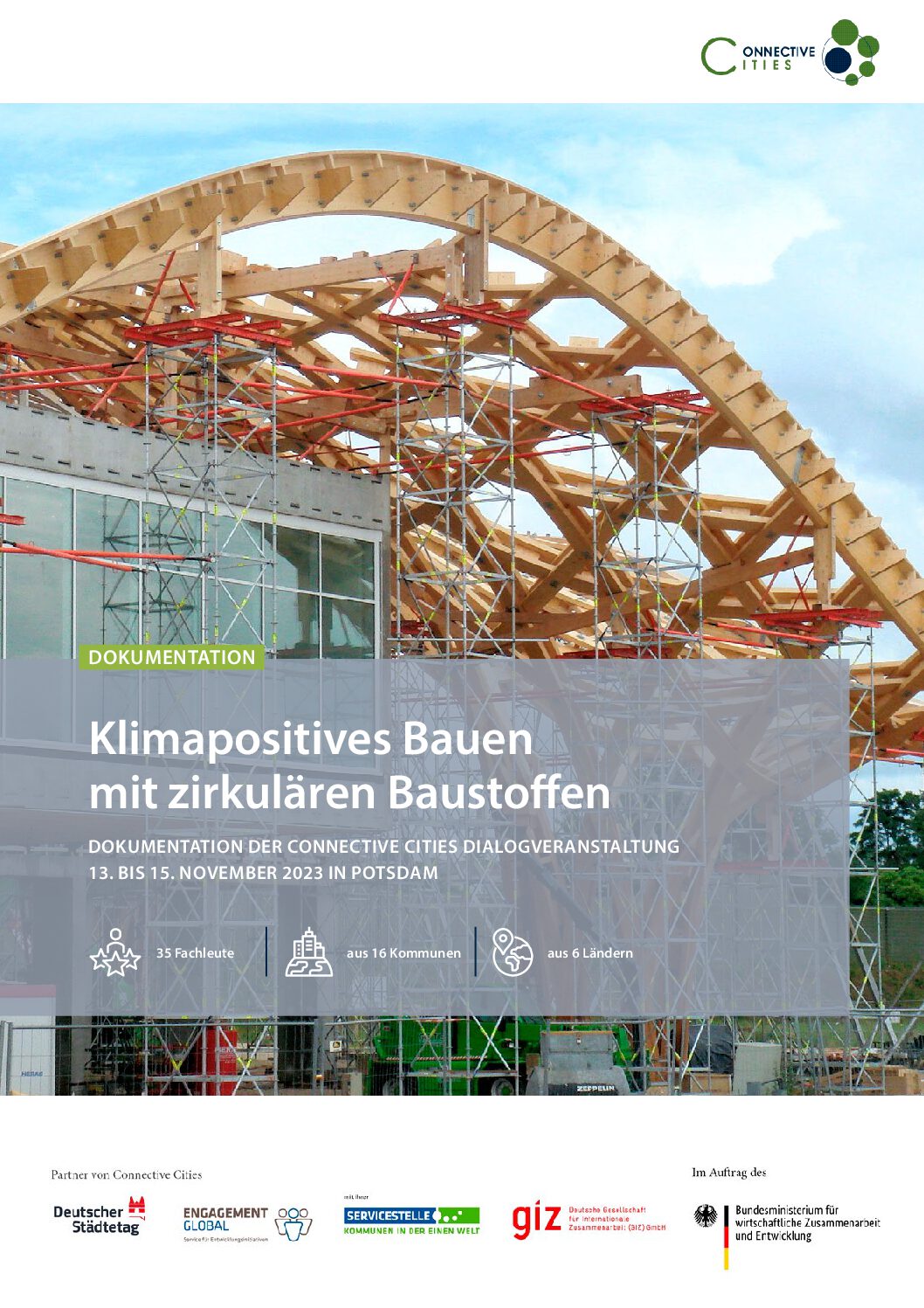
Demand for living space is growing around the world, particularly within cities, which makes the construction industry a major sector in every economy. However, producing and processing raw materials for construction are significant contributors to environmental damage and carbon emissions. The construction sector also uses a lot of energy (sometimes known as “grey energy”) not only when producing construction materials and during the building phase itself, but also while the building is operated for heating, cooling and electricity use. Organic materials such as wood and bamboo could play a vital role in decarbonising the construction industry.
More than 30 representatives of municipalities, academia, business and civil society gathered at the Potsdam Institute for Climate Impact Research from 13 to 15 November 2023 for an event hosted by Connective Cities and the city of Potsdam to share ideas and experiences about the transformation to climate-friendly construction. They presented their experiences from Bhutan, Germany, Indonesia, Nepal, South Africa and Tanzania, and developed ideas for specific local projects. While in Potsdam they visited examples of good practice, such as a wood-built nursery school and the construction site of a pavilion which is being built with organic and recycled materials.
This documentation provides insights into the conference content and results.
Further impressions can also be found on the conference website “Climate-friendly construction with organic and recycled materials“
Banepa preserves traditional construction methods using bio-based materials

This good practice describes how the town of Banepa is restoring its historic centre and a retirement home using traditional building methods. Bio-based building materials such as wood, bamboo, brick and clay are much more sustainable and earthquake-resistant than cement or concrete.
Learning Process: Renewable Energy Options on the Municipal Level
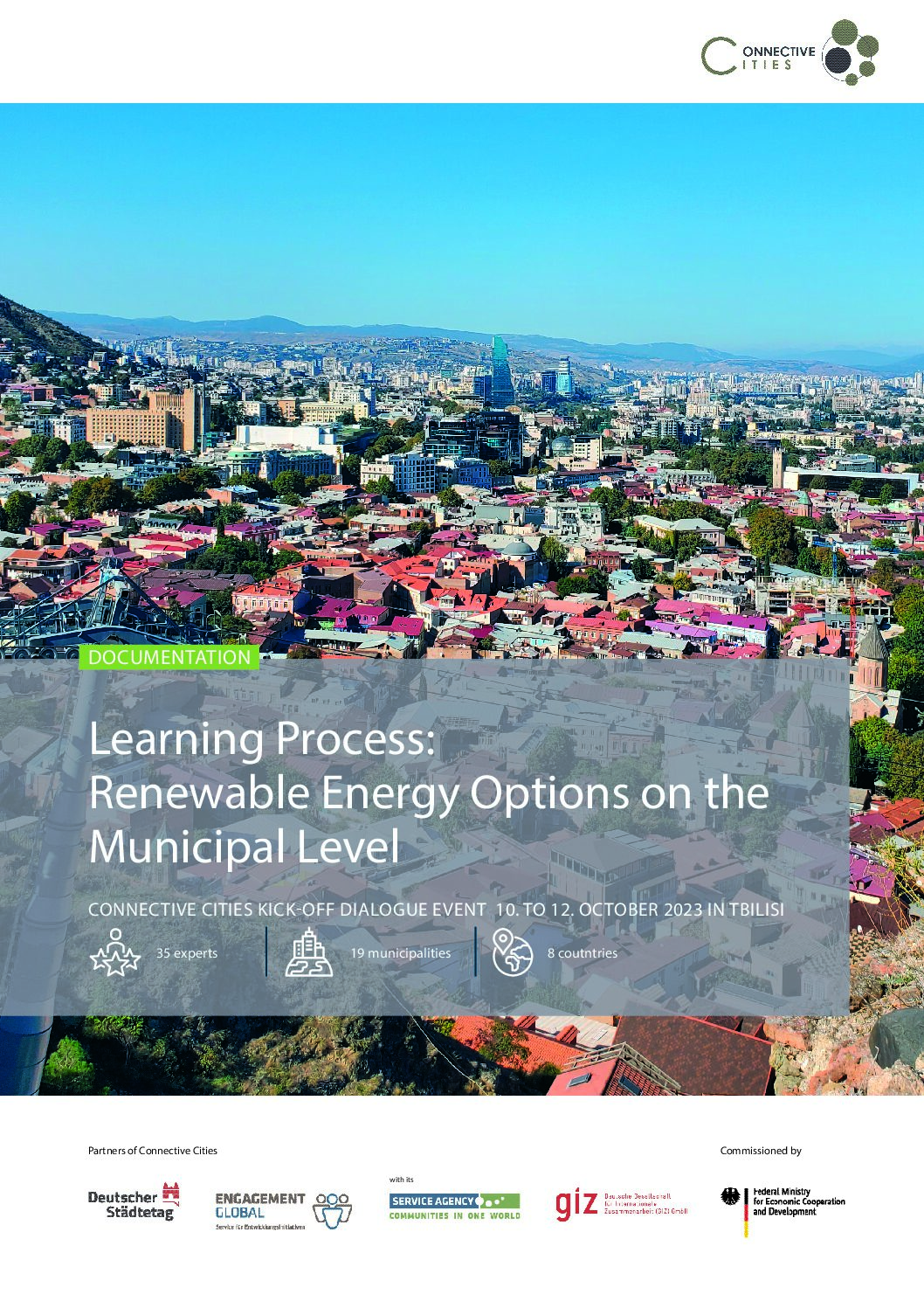
The Connective Cities Kick-off Dialogue Event, held from 10 to 12 October 2023, brought together municipalities from various countries to discuss and share insights on “Renewable Energy Options on the Municipal Level.” Key participating municipalities were represented from Albania, Bosnia and Herzegovina, Germany, Georgia, Moldova, Montenegro, Serbia, and Ukraine.
During the event, innovative strategies in renewable energy were showcased, with participating municipalities engaging in collaborative learning and group deliberations to delve into the nuances impacting their renewable energy endeavors. Utilizing a design thinking approach, the Dialogue Event sought to uncover and address gaps and obstacles within current municipal strategies by scrutinizing the unique circumstances of each participating city.
With a diverse attendance of over 35 individuals representing 19 municipalities across 8 countries in Southeast Europe and Germany, the event featured presentations of successful practices and projects from 9 municipalities, aimed at sparking interactive discussions among attendees. Many participants encountered similar challenges in advancing renewable energy initiatives, highlighting the necessity to bolster knowledge and expertise to progress in this area.
This event is the starting point for a learning process in which project ideas are developed over the course of approximately one year until they are ready for realisation.
This documentation shows the promising initial results.
All presentations and a photo gallery of the dialog event can be found on our Connective Cities Community: Group Topics | Connective Cities Network (connective-cities.net)