Climate-positive cities: circular economy and carbon accounting

Background

The construction industry is one of the most energy-intensive sectors of the economy and a major contributor to global climate change. It is responsible for up to 40 per cent of global CO2 emissions. However, there are ways to make construction more sustainable and hence more climate-friendly. Municipalities play a key role in initiating and supporting these processes locally.

Two examples of such municipal engagement were in the spotlight of a virtual exchange organised by Connective Cities on 27 February 2024 and were discussed by 18 (municipal) experts from six countries. The event was part of a one-year learning process that began in November 2023 with the international dialogue event “Climate-friendly construction with organic and recycled materials” in Potsdam, Germany.

Peer-to-peer exchange session between Eredvi and Senaki Municipalities, Georgia

Discover highlights of the Connective Cities Southeast Europe Region, a peer-to-peer exchange session that took place under the umbrella of the Learning Process Renewable Energy Options at the municipal level from April 10th to April 11th. This event brought together representatives from the Municipality of Eredvi, Georgia, and the Municipality of Senaki, Georgia, for a productive discussion. Both municipalities have experience implementing renewable energy projects in IDP settlements. During the session, participants exchanged best practices and addressed common challenges faced by their municipalities. Additionally, we had the opportunity to visit Tech Park Senaki, a prominent technology hub supporting startups and businesses in Senaki, Georgia.

Watch video at YouTube: https://youtu.be/iI6mujbmwdw

Further Information:

Publication about the good practice:

Eredvi Municipality (Georgia) grants renewable energy solutions for IDP settlements

Resilience in Times of War – Municipal Exchange between Ukraine and Germany

Discover innovative strategies for rebuilding infrastructure and fostering resilience in Ukrainian municipalities amidst the aftermath of Russian aggression. Join us in exploring the outcomes of the Connective Cities’ Project Planning Workshop, ‘Resilience in Times of War – Municipal Exchange between Ukraine and Germany.’ Held from November 28 to 29, 2023, in Munich, Germany, this workshop brought together over 35 participants, including representatives from 12 Ukrainian municipalities. Through dialogue and experience sharing, attendees delved into key focus areas such as sustainable energy development, local and regional economic growth, and strategic/urban planning. Learn from the insights of esteemed guest speakers and delegates from Kosovo municipalities, as they offer perspectives on German and international municipal experiences, paving the way for collaborative efforts in rebuilding and fortifying Ukrainian communities. 

All presentations can be found here: https://community.connective-cities.net/en/group/215/topics

Eredvi Municipality (Georgia) grants renewable energy solutions for IDP settlements

Eredvi Municipality, located just five kilometers from Tskhinvali, has been navigating the challenges stemming from the 2008 Russian-Georgian War, remaining under the de facto control of the breakaway Republic of South Ossetia. Despite these challenges, the local government, operating from Tbilisi, has dedicated efforts to aid internally displaced families dispersed throughout Georgia.

The Eredvi Municipality’s Good Practices center on implementing sustainable solar power projects in internally displaced persons (IDP) settlements in eastern Georgia. Through a collaborative initiative with Lithuanian companies and financing, the municipality aims to address energy needs, providing free electricity to 692 families and municipal facilities while drawing inspiration from Lithuania’s successful experience in renewable energy solutions.

Learning Process: Renewable Energy Options on the Municipal Level

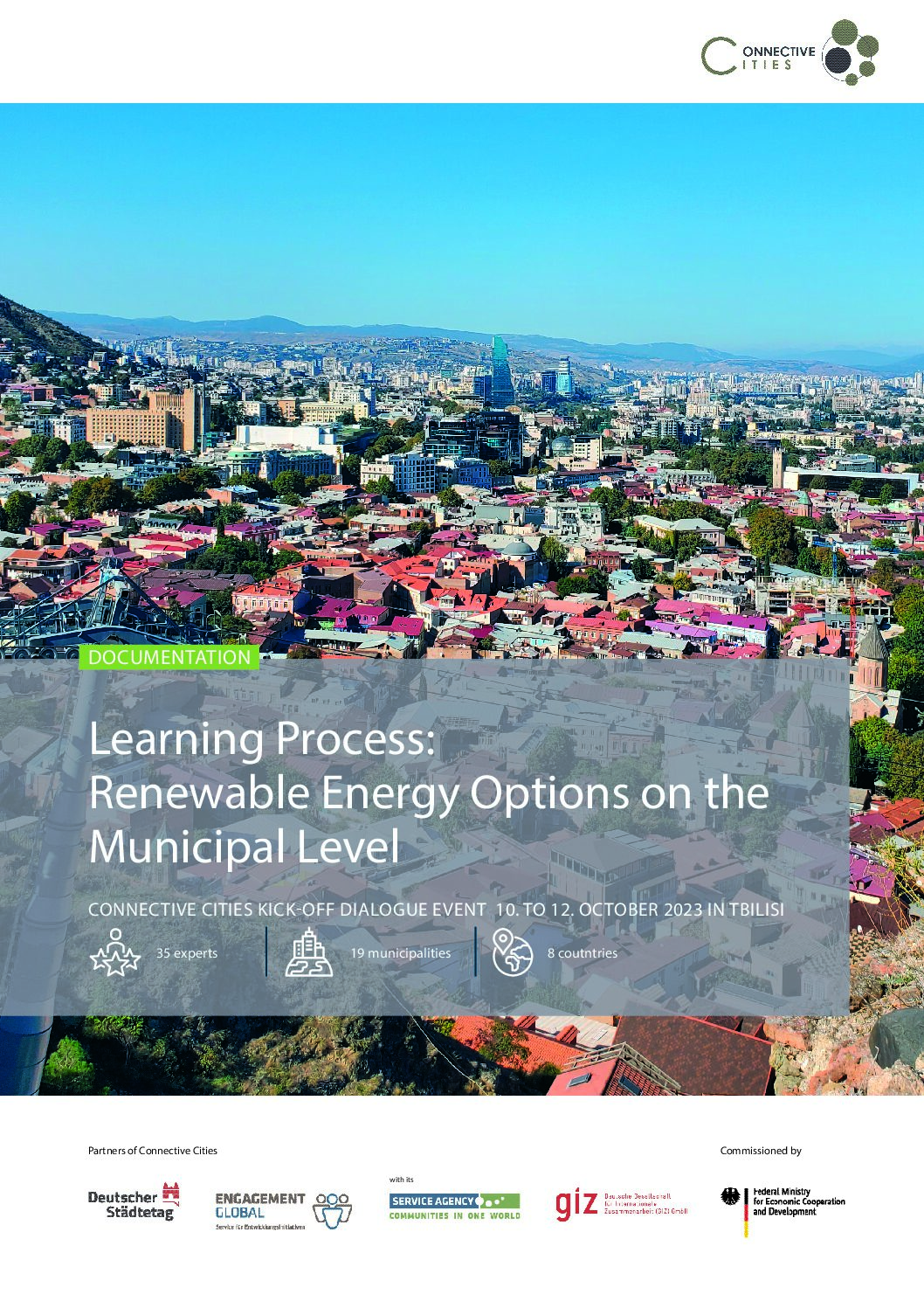
The Connective Cities Kick-off Dialogue Event, held from 10 to 12 October 2023, brought together municipalities from various countries to discuss and share insights on “Renewable Energy Options on the Municipal Level.” Key participating municipalities were represented from Albania, Bosnia and Herzegovina, Germany, Georgia, Moldova, Montenegro, Serbia, and Ukraine.

During the event, innovative strategies in renewable energy were showcased, with participating municipalities engaging in collaborative learning and group deliberations to delve into the nuances impacting their renewable energy endeavors. Utilizing a design thinking approach, the Dialogue Event sought to uncover and address gaps and obstacles within current municipal strategies by scrutinizing the unique circumstances of each participating city.

With a diverse attendance of over 35 individuals representing 19 municipalities across 8 countries in Southeast Europe and Germany, the event featured presentations of successful practices and projects from 9 municipalities, aimed at sparking interactive discussions among attendees. Many participants encountered similar challenges in advancing renewable energy initiatives, highlighting the necessity to bolster knowledge and expertise to progress in this area.

This event is the starting point for a learning process in which project ideas are developed over the course of approximately one year until they are ready for realisation.
This documentation shows the promising initial results.

All presentations and a photo gallery of the dialog event can be found on our Connective Cities Community: Group Topics | Connective Cities Network (connective-cities.net)

Building Resilience: Insights from the Project Planning Workshop

The Connective Cities Project Planning Workshop, themed “Resilience in Times of War – Municipal Exchange between Ukraine and Germany,” unfolded in Munich, Germany, from November 28th to 29th, 2023. This gathering brought together municipal representatives and technical experts with a collective goal – to strengthen a more resilient and sustainable future for Ukraine. The workshop, occurring just a month after the 6th German-Ukrainian Partnership Conference in Leipzig, aimed to emphasize the pivotal role of cities and municipalities in shaping the nation’s post-war trajectory.
 

Diverse Participation and Collaborative Learning

Representatives from diverse Ukrainian municipalities, such as Sambir, Sumy, Brovary, Lutsk, Vinnitsa, Trostyanets, Berenzhany, Zbarazh, Mykolaiv, Melitopol, and Novovolynsk, comprised the active participation of over 35 delegates in the Connective Cities event. Kosovo had representation from Prishtina and Gllogoc, and Germany was represented by Munich and Eichenau. The event also featured participation from municipal utilities Gersthofen & Cologne (RheinEnergie) and delegates from the private sector. The diverse mix aimed at fostering collaborative learning, as cities shared their successes and challenges, recognizing the importance of joint experiences in the journey towards resilience.

Thematic Focus Areas

The workshop delved into three crucial thematic areas:

  1. Regional and Local Economic Development
  2. Renewable Energy Options on the Municipal Level
  3. Integrated Urban Development

Skilled technical experts facilitated discussions on topics ranging from green urban development to energy grid optimization and cluster development, providing valuable insights for participants to implement in their respective municipalities.

City-to-city collaboration is key to streamlining climate neutrality and decentralized energy production

Together with the Connective Cities, the Association of German Cities organized a side event in the German Pavilion at the COP28 World Climate Conference in Dubai on the question of “What solutions are there for sustainable and decentralized energy generation and supply at local level”. On 6 December at 2 p.m. local time, representatives from German and African cities (Cologne, Bonn, eThekwini and Abuja) discussed their local innovations for climate-friendly energy solutions.

In her keynote speech, Katja Dörner, Vice-President of the German Association of Cities, Mayor of Bonn, and ICLEI Co-Chair for Climate Action, emphasized the importance of a socially just and participatory approach to a climate and energy transition. She emphasized that the voice of cities in climate negotiations is essential to achieve global goals.

She showed how the city of Bonn can achieve climate neutrality by 2035 and called on the federal level to make swift changes to support the local level. The EU and the German federal level must create the framework for a climate-friendly energy transition. She again emphasized the importance of making climate protection and adaptation a mandatory task for local authorities.

Renewable Energy Options on the Municipal Level

Discover the highlights of the Connective Cities Dialogue Event held from 10 – 12 October 2023, focusing on ‘Renewable Energy Options at the Municipal Level.’ In this insightful gathering in Tbilisi, Georgia, 35 urban practitioners from 19 municipalities across 8 countries convened to exchange experiences. Representatives from Albania, Bosnia and Herzegovina, Georgia, Germany, Moldova, Montenegro, Serbia, and Ukraine collaborated, sharing valuable insights and collectively crafting innovative solutions for sustainable energy practices at the municipal level. Dive into the dynamic discussions and collaborative efforts that unfolded during this event, driving positive change in the realm of renewable energy within diverse urban settings.

Watch video at YouTube:

https://youtu.be/uc1SMXGdHvs

Renewable Energy for Local Economic Development in Africa

The main objective of the workshop is to develop renewable energy projects in African cities.

The workshop was attended by 30 practitioners* from city governments, associations and the private sector representing 7 countries and 20 cities from Africa, as well as high-level guests including the Country Director of GIZ, the Kenyan Ministry of Energy, the head of the Romanian Development Agency (RoAid), the City of Gersthofen from Germany, and officials from the European Investment Bank (EIB) and the African Development Bank (AfDB). Representatives from various cities in Ghana, Kenya, Malawi, Nigeria, Senegal, Tanzania, and Tunisia also contributed to the success of the conference with their presentations of the framework conditions and project examples.

Action for Cool Cities: Pathways for carbon reduction in buildings and improvement of outdoor thermal comfort

As the first step of the learning process ‘Action for Cool Cities – Pathways for carbon reduction in buildings and improvement of outdoor thermal comfort’, the virtual kickoff event was held on 30 Nov – 1 Dec 2022. During this event, good practices were showcased on the reduction of carbon emissions in building stock and improving outdoor thermal comfort as well as examples of faltering implementation in these key spheres of action.

As a second module of the learning process, Connective Cities workshop on ideation and prototyping took place in Amman, Jordan on the 7th-9th March 2023. The workshop focused on ideation and prototyping of solutions by the participating municipalities within the following thematic fields:

  1. Designing climate-responsive outdoor public spaces and promoting engagement of citizens
  2. Steering Structure: Interdepartmental Communication framework/platform in municipalities
  3. Optimizing existing building and urban design regulations by introducing key performance indicators and improving in-house capacity to drive change
  4. The role of municipality as a regulator and implementer: budget analysis and strategies for cost recovery of climate action measures

Participation in the second module of the learning process enabled the municipalities to share experiences, develop their capacities, and develop ideas for prototyping in their municipalities. The next stage or third module of the learning process gave a chance to these municipalities to test and optimize the envisioned prototypes in an iterative process that included conducting participatory sessions with stakeholders (including citizens, decision makers, and experts). The process revealed the significance of producing quantitative and qualitative evidence to back up the proposed seven solutions.