Climate Proofing Urban Development

The impacts of climate change include extreme weather events such as heavy rainfalls, severe thunderstorms, prolonged droughts and heat waves. These impacts pose major challenges for cities around the world. Although climate change is a global challenge, adapting to its impacts is largely a local process.

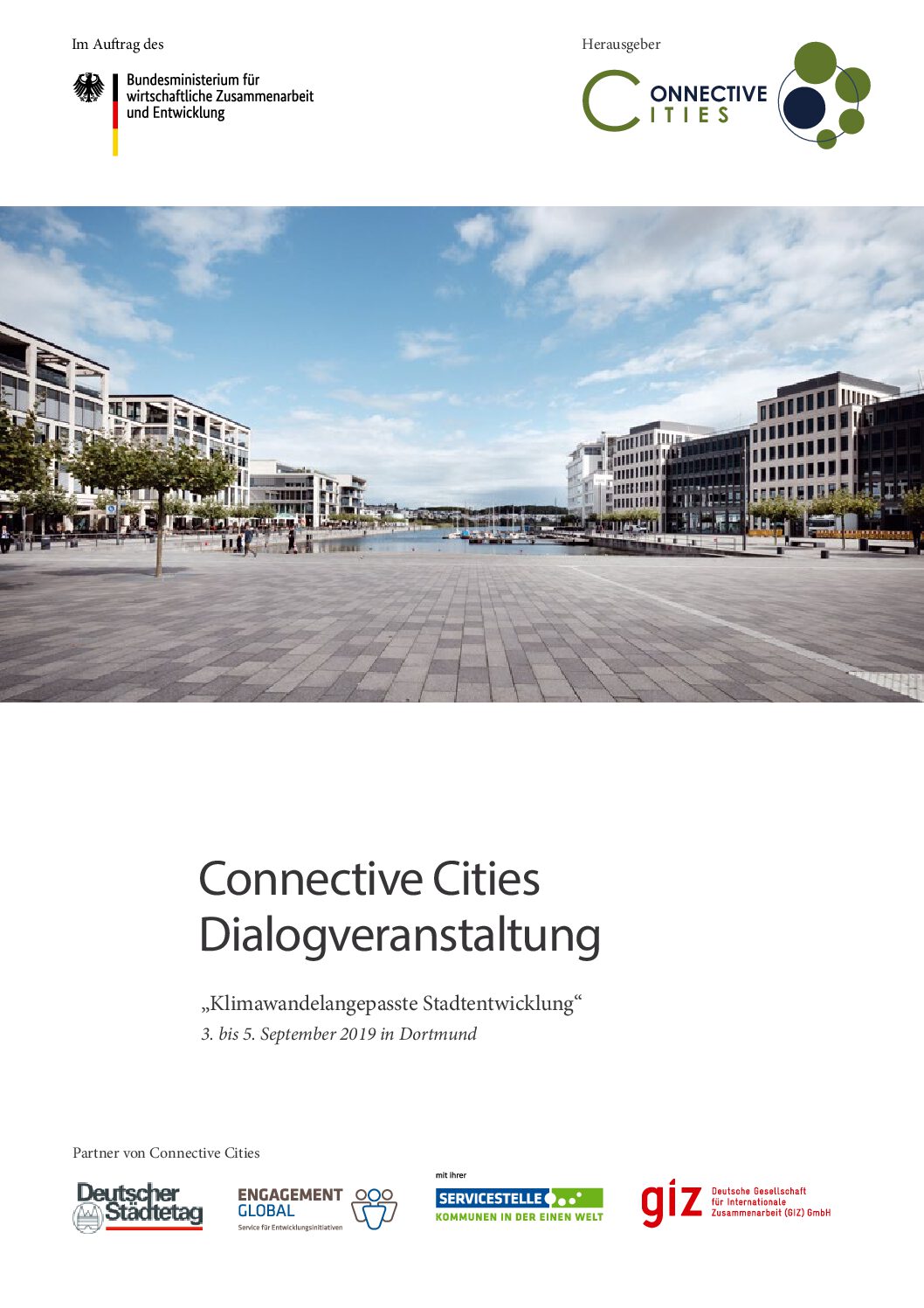
Almost 30 local practitioners from 12 cities, 10 countries and four continents accepted the invitation of Connective Cities and the City of Dortmund to a dialogue event on the topic of ‘Climate proofing urban development’, which took place from 3 to 5 September 2019 in Dortmund, Germany. This report documents the discussed good practices, solution approaches and developed project ideas.

UN-Habitat COVID-19 Response Plan and Campaign

The continuing spread of the COVID-19 crisis threatens the most vulnerable in cities and communities, particularly the one billion people living in slums and informal settlements. To address the crisis, UN-Habitat is launching an urgent COVID-19 Response Plan for 64 countries focusing on immediate action in poor and densely populated areas. This is supported by the COVID-19 Campaign to mobilize support among national, city and local governments and community leaders through its network of urban professionals, grassroots organizations and businesses.

Over 95 per cent of the world’s coronavirus cases are in urban areas across over 210 countries in nearly 1,500 cities.  People in informal settlements are particularly at risk as they live in overcrowded conditions, lack adequate housing and basic services such as water and sanitation and many are informal workers surviving from one day to the next.  This makes it extremely hard to implement measures to slow transmission such physical distancing, self-quarantine, handwashing or community-wide lockdowns.

UN-Habitat, which has over 40 years of urban experience, much of it in humanitarian situations, is working with its partners on the ground including mayors, governors, transport and utility providers, women, youth and community organizations and NGOs to urgently deliver the USD 72 million Response Plan in Africa, the Arab States, Asia Pacific, and Latin American and the Caribbean.

This catalytic support will amplify the impact of ongoing initiatives by central and local governments, communities and other UN agencies. Funding requirements will be updated as the situation evolves and needs are further assessed.

Over 70 per cent of the support will be used to help informal settlements to improve affordable access to water and sanitation, raise awareness about COVID-19, and support initiatives to prevent people becoming homeless by providing temporary shelter or alternative income generating activities.  Ensuring safe transport and repurposing buildings to isolate those infected are other priority areas.

To ensure that urban responses, such as provision of water, food, housing, health services and livelihoods, are targeted to the most vulnerable and high risk areas, UN-Habitat will assist with data collection, mapping of existing and emerging hot spots and analysis working with its network of local and global partners. This will help evidence-based decision making by local governments and key stakeholders.

As the pandemic plunges the world’s economy into a global recession, UN-Habitat is focusing on policies and measures to mitigate the local social and economic impact of COVID-19 and is working with a coalition of global thought leaders and stakeholders in public and private spheres.

UN-Habitat has already provided seed funding of over USD 1.3 million for scaling up  projects in 13 countries with community preparedness, outreach and hygiene support. The agency has also jointly launched with United Cities and Local Governments and Metropolis, a #BeyondTheOutbreak virtual live learning series for mayors and local leaders to share urban solutions. 

“The UN-Habitat team is working night and day to help city and community leaders on the frontline of this pandemic to reduce the risks in informal settlements and help the most vulnerable. 

“With our extensive network of partners as well as our in-house experts, UN-Habitat is working closely with cities and communities to find innovative and targeted solutions to provide water and sanitation, safe transport and to mitigate the economic impact on the urban poor,” said UN-Habitat’s Executive Director, Maimunah Mohd Sharif.

“We want to help build up the resilience of our community partners to respond to specific and varied challenges over the coming months and beyond.”

At the global level, UN-Habitat shares good practice and solutions and identifies successful policy, legal measures and governance approaches to respond to current needs and long term resilience.

In Africa, UN-Habitat will support 20 countries, prioritizing the coordination of emergency preparedness and response, improving access to food and basic services including water, sanitation and hygiene, and promoting entrepreneurship. UN-Habitat’s response in 11 countries in the Arab region focuses on improving water, sanitation, and hygiene, ensuring safe transport, securing livelihoods, vulnerability assessments and risk area mapping.

 In 17 countries in the Asia-Pacific region, the agency will collate, analyse and produce relevant data, improve hygiene, water, sanitation and health facilities and raise public awareness. And in 16 countries in Latin America and the Caribbean, UN-Habitat will strengthen the capacity of local authorities, help mitigate the economic impact of the pandemic on the urban poor and join regional efforts to bring investment to vulnerable areas.

To amplify the impact and broaden the reach of the Response Plan, UN-Habitat is launching a COVID-19 Campaign ‘Take action with us in cities and communities’ which calls on civil society organizations, community groups, professional, academic and research institutions, businesses and local authorities to commit online to acting in solidarity to fight the pandemic in cities and helping the most vulnerable communities. The Campaign will provide a central place to network and share solutions, initiatives, good practice, lessons and stories from partners and strengthen integrated action to improve the resilience of cities and communities.

The Response Plan and the COVID-19 Campaign provide a roadmap and rallying point for the combined commitment of UN-Habitat and its network of urban actors to support cities’ proactive responses to protect their populations, halt the pandemic and work towards recovery and resilience.

For more information contact: Susannah Price, UN-Habitat Chief of Communication

Email: Susannah.price@un.org Tel: +254 722719867

UN-Habitat COVID-19 Response Plan

“The world is living through an unprecedented crisis as COVID-19 continues to spread, with tens of thousands of lives lost and over two hundred countries affected. In just a few months, the pandemic has transformed the way we live, work, travel and socialize. The world’s cities are generally reacting quickly to this urban humanitarian crisis and how they respond is critical to protect their population, halt the pandemic and set the scene for resilience and recovery.”

Näher – Öffentlicher – Agiler

Which future prospects do sustainable and crisis-proof cities have after the Corona pandemic? It is becoming increasingly clear that the corona crisis marks a turning point – politically, economically, socially, and individually. The future of cities and their links with the surroundings must also be rethought. The “post-corona city” will be “closer”, “more public” and “more agile” and can provide impulses for a “post-corona world” – more social, greener, more diverse.

This article is only available in German.

culture 21 – #CULTUREcovid19

COVID-19 is severely hitting the cultural life of our cities. Cultural venues as libraries, theaters and museums had to close and events had to be cancelled, with harsh consequences for freelance artists and creative professionals. The UCLG Committee for Culture has established a page listing the actions that cities and local governments are undertaking to ensure the right to culture for all citizens: http://www.agenda21culture.net/culturecovid19.

This page is updated periodically by the UCLG Culture Committee, using Twitter to share this page, using the tag #CultureCOVID-19

This page is part of the BeyondTheOutbreak initiative, the “Live Learning Experience: beyond the immediate response to the outbreak”, developed by UCLG.

Tackling coronavirus (COVID‑19) Contributing to a global effort

On its microsite about COVID-19 the OECD is compiling data, analysis and recommendations on a range of topics to address the emerging health, economic and societal crisis, facilitate co-ordination, and contribute to the necessary global action when confronting this enormous collective challenge.

In addition it offers “a country policy tracker”.
What are countries doing to contain the spread of the coronavirus? How are countries helping people, small businesses and the economy to weather the crisis and beyond? This Country Policy Tracker helps you to navigate the global response.

http://oecd.org/coronavirus/en/?fbclid=IwAR2fvsMo0Y86zUxab4nK4lNtK7JGpBMl3KSXTuF2r41ejnpOslxFAt6d6Tc#country-policy-tracker

In addition – on city level – a summary can be found in the briefing note on
Cities policy responses
https://read.oecd-ilibrary.org/view/…
Cities may be better equipped than the rest of their country to respond to the COVID19 crisis due to their well-developed health care facilities. However, cities are densely populated places where people live and gather, thus at risk of spreading the virus due to the close proximity among residents and challenges to implement social distancing. The briefing note provides examples of measures taken by cities to respond to the current coronavirus epidemic, clustered around six categories: i) communication and awareness raising, ii) workplace and commuting; iii) social distance; iv) vulnerable groups; v) local service delivery; and vi) support to business.

If you wish to submit examples of how your cities respond to COVID-19, please contact

CFEcities@oecd.org

Incremental community-based exit strategies for initiating and removing COVID-19 lockdowns

“Many nations across the Asia-Pacific have implemented guidelines for social distancing and introduced lockdowns to control COVID-19. However, now many leaders face the question of how they will be able to relieve their communities of the protective constraints in place. Who decides when safe is ‘safe enough’, or what level of residual risk is acceptable? Getting this wrong is something no leader can afford. By applying a community-based incremental approach to the easing of lockdowns, tailored to demographic and social stratifications of risk, much of the guesswork can be eliminated.”

Cities for Global Health

As of  2 April, 1 p.m., 43 cities shared already 144 initiatives – worth browsing it! And share your own!

The global crisis generated by the COVID-19 outbreak is pushing cities of all shapes to give immediate answers to an emergency that is seriously threatening not only citizens’ health, but the social cohesion, the economy and the infrastructures of our territories.

While the virus spreads regardless of administrative boundaries, territorial scales or weather conditions, affecting millions of individuals simultaneously in different ways, it drives us to overcome management barriers. In metropolitan spaces, the collaboration of central cities and peripheries can make a huge difference to ensure that quality of life is not further threatened under scenarios of fragility and that no one is left behind.

Collaboration between administrations of different levels is key to deal with this crisis. Seeking to foster collective responses and facilitate the access of decision-makers to first-hand experiences about how urban areas across the globe can deal with situations alike, local and regional governments of all sizes from across the globe are invited to share:

Initiatives (e.g. plans, strategies, policies) designed specifically as a reaction to the COVID-19 outbreak

Initiatives designed to face other health emergencies such as sanitary crisis or epidemics.

https://www.citiesforglobalhealth.org/

COVID-19 in informal urban settlements

“Most of the information about COVID-19 and who is at risk is based on data from middle and high income contexts. Many of the recommendations (to wash hands, self-isolate and physically distance) assume basic living conditions and access to essential services (e.g. water, space etc). […] Many of these strategies will not be possible to the same degree in low and middle income countries (LMICs), and especially not in urban informal settlements. With 1 billion people living in informal settlements, there is an urgent need to consider feasibility and develop locally appropriate approaches. This brief sets out key considerations for protecting informal urban settlements from the spread and impacts of COVID-19 and discusses what is known about vulnerabilities and how to support local action.”

Public Health Protection and Epidemic Control at Municipal Level

What kind of measures are necessary to sustainably protect citizens from infectious diseases and epidemics? How have German municipalities organised their response model? And what is the situation like in other cities and regions around the world? Moreover, what can be done to strengthen local health systems? These questions were at the heart of the dialogue event ‘Public Health Protection and Epidemic Control at Municipal Level’.

In cooperation with the City of Frankfurt’s Public Health Department, the international urban networking platform Connective Cities invited German and international stakeholders from Brazil, Jordan and Liberia to exchange their experience and showcase their good practices in Frankfurt from 25 to 27 November. This event attracted medical doctors and staff from municipalities, state governments and ministries as well as experts from the field of infectious disease control and crisis management.

The primary objective of this event was to map out practicable prevention strategies and to collectively identify project ideas for controlling and responding to biological hazards

Much of this is more relevant today than ever.

Further information and impressions of the event in the short documentation, in the detailed report and in the video (on YouTube)