


“The world is more densely populated and more interconnected than ever before. From extreme weather to refugee crises, from disease pandemics to cyberattacks, today’s state of play requires new models of governance to mitigate risk and respond to challenges. Business-as-usual models of reactive planning and siloed decision-making will not generate the fundamental strength and flexibility essential for us to thrive in the face of the shocks and stresses of the 21st century. […] The launch of 100 Resilient Cities program (100RC) by the Rockefeller Foundation acknowledged that the escalating trends of urbanization, globaliza- tion, and climate change pose tremendous risks, but also offer a tremendous opportunity. This report shares 100RC’s knowledge about what it takes to catalyze an urban resilience movement.”
Category: Urban renewal
How to Formulate a National Urban Policy

Many governments have difficulty in formulating a NUP due to insufficient capacity, ever changing political contexts, complex relationships between government departments/ministries, and political pressures from interest groups. Consultation is key during the formulation phase to build consensus. Good policy formulation requires political will, visionary leadership, organizational know-how, effective consultative mechanisms, and good negotiating skills on the part of the ministry or department in charge of urban issues. This Guide suggests that before starting the formulation process, it is essential that a thorough diagnosis of the urban sector is carried out, with extensive data collection, review and analysis. It is also advisable to assess the available capacity (human, financial, institutional and technical). Following this, aspects to consider in the formulation of a NUP include the selection of the lead agency, the quality of the data and information that is available, how the various stakeholders will participate, what resources are available, how the process will be coordinated, and what the context is – the needs and issues that will frame the policy.
According to this practical guide, a national urban policy (1) responds to the country’s development priorities, (2) is based on sound evidence, and (3) is focused on outcomes. This handbook provides practical steps and a coordinated process to formulate an urban policy that adheres to five key principles: participation, inclusion, affordability, sustainability and implementability.
Solutions for and by cities

"The Guangzhou International Award for Urban Innovation is dedicated to decentralised, city-to-city cooperation and sharing lessons learned from experience. Its focus covers the three pillars of sustainability: social, economic and environmental, and two additional domains – governance and technology.
The fourth edition of the Guangzhou Award was a remarkable show of these links between innovation and learning from different stakeholders. This publication is an attempt to extend the prestige of the initiatives that were shortlisted for the award, and to spread their legacy to even broader audiences."
Urban Transitions Alliance Roadmaps

Industrial legacy cities face unique challenges, as they transition towards vibrant, sustainable and equitable urban centers. Cities around the world can learn lessons from where these cities have been, and how they are moving forward. The new report, "Urban Transitions Alliance Roadmaps: Sustainability Transition Pathways from Industrial Legacy Cities" details four transition pathways that eleven post-industrial cities have undertaken, with implementation ideas and best practices for each. These cities are all a part of the Urban Transitions Alliance, which was built on the premise that by connecting industrial legacy cities from the US, Germany, Poland and China through their transition stories and visions of sustainable urban development, common challenges and transition pathways would emerge.
Reflecting the thematic priorities of the Alliance members, the chapters subsequently focus on challenges and solutions in the fields of Infrastructure, Energy, Mobility, and Social Transition. Each topic is explored in terms of background, barriers and opportunities related to the industrial legacy context. Transition priorities and innovative approaches from the different regions are outlined in key pathways and exemplified in case studies from the Alliance cities and districts. Some of the conditions described might apply in various degrees to cities beyond the industrial legacy context – that is why transition experiences and pathways from the Urban Transitions Alliance can be of value to cities around the globe.
Culture in City Reconstruction and Recovery

Tackling the impact of destructions – whether they stem from natural hazards, armed conflict, or acute urban distress – requires responses that consider the needs of all social groups and provides opportunities for social inclusion and economic development, while also acknowledging the specific needs, priorities, and identities of communities.
For this reason, culture – including tangible and intangible cultural heritage and creativity – is essential both as an asset and as a tool for city reconstruction and recovery. Placing culture at the heart of urban reconstruction and recovery strategies and processes is critical to effectively restoring the physical and social fabrics of cities.
Culture – an often overlooked and underestimated framework and value – is the foundation upon which cities are built. Cities are not just a collection of buildings but are people, their stories, and how they interact with each other through their cultural identity and sense of place.
Investing in cultural institutions, spaces, and heritage can help build bridges between sparring communities in post-conflict urban areas and make disaster recovery quick, sustainable, and more effective.
This joint Position Paper of World Bank and UNESCO serves as a guide for urban practitioners, operating on the ground, as well as national and local authorities, to integrate culture, both as an asset and as a tool, in all phases of city reconstruction and recovery.
Regional Peer-Learning and Action Planning Workshop
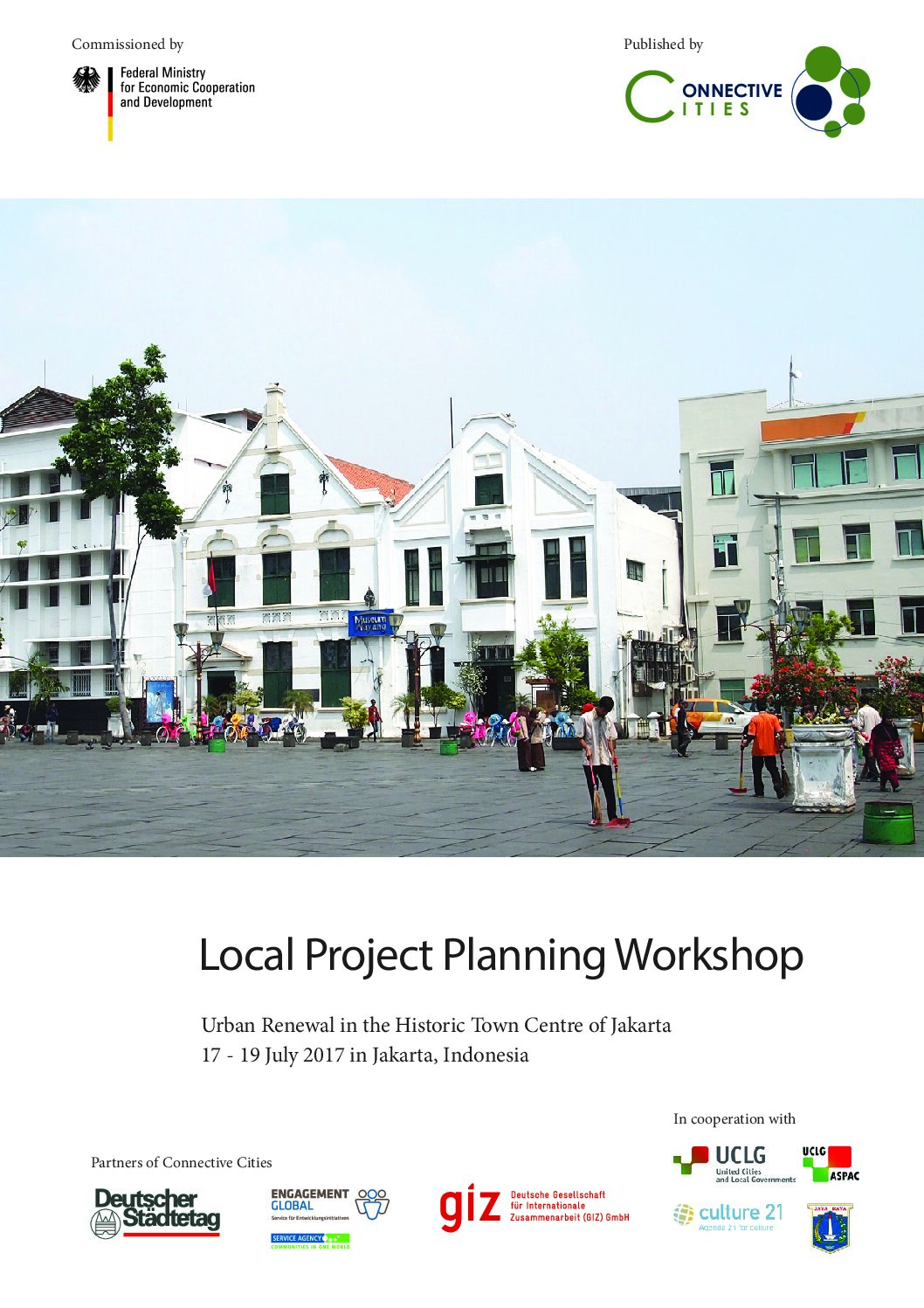
Together with UCLG World Secretariat and UCLG Asia-Pacific, Connective Cities organised the Regional Peer-Learning and Action Planning Workshop on “Urban Renewal in Historic Town Centres and Public Space Improvement” in Jakarta, Indonesia from 17 – 19 July 2017.
During the three-day workshop urban heritage specialists and planners from the Asian region and Germany discussed and advised the ongoing urban renewal of Jakarta’s Historic Town Centre Kota Tua as well as supported the proccess of drafting the application for UNESCO World Heritage Site.
This short report provides summary of the workshop, describing particular challenges faced in Kota Tua, featuring good practices presented at the event and summarising the recommendations developed in a joint work of experts.