Sustainable and resilient, regional and intermunicipal land management

The three sustainability dimensions “ecologically sound”, “economically successful” and “socially just” are always in focus in municipal urban development projects. This also applies to municipal land management. The integration of these three aspects and the resilience factor in land use planning and zoning strategies as well as in existing development under constantly changing conditions is one of the main tasks of municipal experts. Conflicts of objectives and interests often arise, which are not always easy to solve.

Nearly 30 municipal practitioners from 14 cities, 7 countries and three continents intensively exchanged their experiences on the topic of “sustainable and resilient, regional and intermunicipal land management” and developed joint approaches and project ideas. They had accepted the invitation of Connective Cities and the city of Trier to join the virtual dialogue event, which took place from November 18 to 20, 2020.

Starting with an exchange of experiences on good practices and projects in the cities, challenges in implementation were identified and finally two project ideas were developed for Amman (Jordan) and Rostock (Germany), which may lead to an improvement of the respective strategies and implementation plans in this thematic area.

Local Development Program for the City of Agadir in Morocco

Agadir municipality has pursued ambitious policies aimed at enhancing the quality of life of the city’s inhabitants, while protecting the environment and fostering sustainable development. The undertaken efforts targeted various key areas, in which the requirements and responsibilities for achieving environmental, social and economic sustainability were met.

Green Urban Infrastructure in Asian Cities

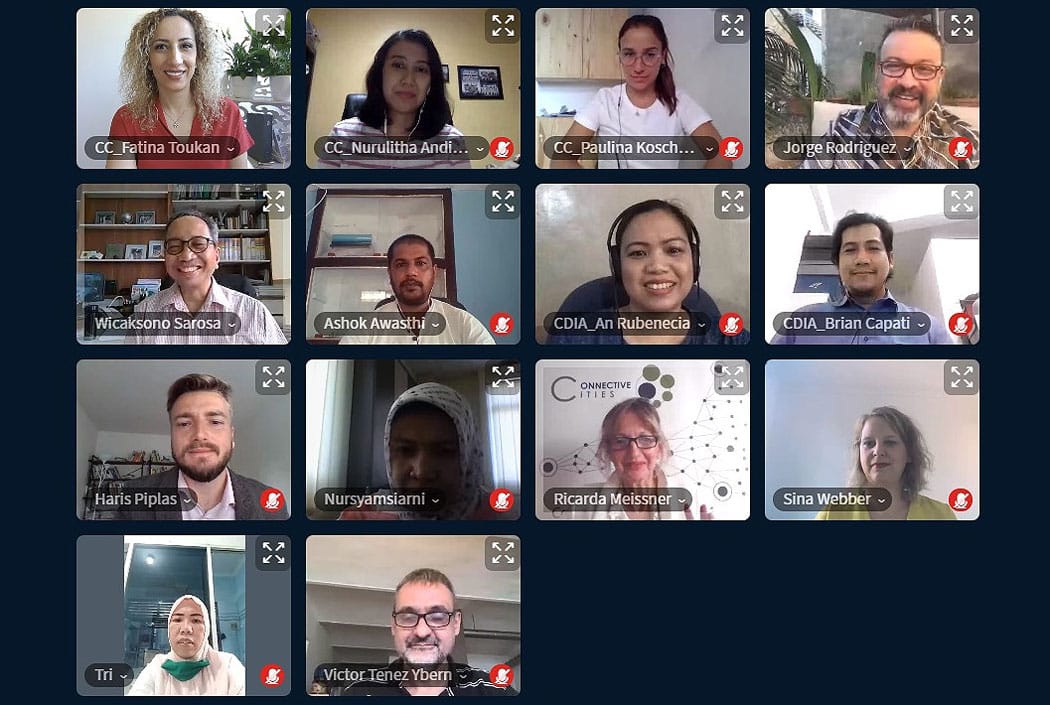
From August 3rd until August 14th, 2020 around 30 urban practitioners from 6 Asian Cities came together virtually to exchange their experiences and expertise in the field of Green Urban Infrastructure. Especially challenges in waste management and water sanitation were discussed intensively, as they represent pressing issues for many Asian cities.

The aim of the workshop was to further develop existing project ideas by discussing arising challenges and trying out new methods to find new perspectives and approaches to urban planning. The event was a follow-up to the dialogue event in Bandung, Indonesia in November 2019.

Due to the restrictions imposed on all of us by the Covid-19-pandemic, the event was conducted virtually by using the Connective Cities Platform. To ensure an enriching learning experience, the event took place over two weeks and included synchronous workdays with various keynote presentations as well as asynchronous days on which the participants could work on their project ideas at their own pace.

Six projects from Indonesia and Nepal were presented and further developed (see presentations).

C40 Mayors’ Agenda for a Green and Just Recovery

As the tragedy of the COVID-19 pandemic unfolds, mayors’ immediate priority is to face this unprecedented crisis and protect lives. At the same time, the city leaders who together established the Global Mayors COVID-19 Recovery Task Force are leading in taking the first steps towards recovery. They have committed to providing the swiftest and strongest possible rebound for their citizens and reaffirmed commitment to the principles of the Global Green New Deal — to protect our environment, strengthen economies and build a more equitable future – and reach out to other cities, youth, unions, business and civil society to join in this effort.
[…]
By taking a sustainable path at this critical juncture, by respecting science, fostering unity and embracing a spirit of innovation and purpose, cities will secure the best recovery they can and avoid the worst impacts of the climate crisis. Amid the devastation of this global pandemic, mayoral leadership has never been more important.

Nine principles for a green and just recovery are elaborated that can support cities’ recovery efforts.
More

So coronavirus will change cities – will that include slums?

for David Sanderson, it’s hard to see how the COVID-19 pandemic will lead to any better outcomes for the close to a billion or so people who live in fast-growing, low-income, informal settlements, or slums, that cram cities throughout Africa, Asia, Latin America and the Pacific. These settlements are some of the densest and most poorly serviced places on Earth.

The Ebola outbreak of 2014-16 killed over 11,000 people across Guinea, Liberia and Sierra Leone and had devastating impacts on economies, lives and health-care systems. However, yet evidence of post-Ebola improvements in urban planning are hard to find. The coronavirus — just one more tragedy for many who live in slums?

Read full article at The Conversation

More inclusive cities in East Africa: working with politics and informality

Power and informality interact in complex ways in urban shelter provision. This briefing is based on a study of three East African cities: Nairobi, Hawassa and Mogadishu. The three-year research project studied both financial constraints to accessing land or housing and non- financial constraints such as discrimination on the basis of identity. Our findings underline the importance of knowing who has power within the housing and land markets. Power does not just derive from wealth; politicians, traditional leaders, gatekeepers and others exercise influence in these markets. A person’s identity — and income — impacts the extent to which they can navigate these power structures, and the formal and informal systems that govern access to shelter. Governments and international donors need to improve the lives of the urban poor: notably with low-income, regulated rental schemes; slum-upgrading and affordable finance.

Towards a Financing Mechanism for Slum Upgrading at Scale in Nairobi

In 2017, the County Government of Nairobi declared Mukuru to be a Special Planning Area (SPA), paving the way for the preparation of an integrated Local Physical Development Plan (LPDP) for this large informal settlement in collaboration with its residents and partner organizations.
The SPA covers Mukuru Kwa Njenga, Mukuru Kwa Reuben and Viwandani which together accommodate around 300,000 low-income residents, many of them living in extreme income poverty.
Implementing this ambitious integrated plan will require finance for a wide range of infrastructure services and affordable housing as well as complementary financial interventions to support micro- and small enterprises.
This publication sets out a financing mechanism for the envisaged upgrading investments in informal settlements in Nairobi, pejoratively called “slums”. Mobilizing the vast amounts of capital required will face critical challenges, with affordability and land tenure at the forefront.
An important aspect of this report is how the upgrading of Mukuru and other informal settlements in Nairobi could be linked to these institutional innovations which seek to deliver infrastructure services and affordable housing at scale.
International experience on slum upgrading finance is examined early in the report in order to draw out general trends that provide a useful backdrop for Nairobi. The cases of India, Morocco and Egypt are set out and a general approach to slum upgrading finance presented.

Climate Proofing Urban Development

Almost 30 local practitioners from 12 cities, 10 countries and four continents accepted the invitation of Connective Cities and the city of Dortmund to a dialogue event on the topic of “Climate proofing urban development”, which took place from 3 to 5 September 2019 in Dortmund, Germany.

Climate change and the effects of more frequent climate impacts and extreme weather events such as heavy rainfall, severe thunderstorms, storms, prolonged droughts and heat waves are posing major challenges for cities around the world. In addition, climate change is a cross-cutting issue that affects all areas and departments of a city administration and therefore requires a cross-departmental approach.

Starting with an exchange of experiences on good practices and projects in the cities, implementation challenges were identified and eventually the participants developed six project ideas for six cities, which could lead to an improvement of the respective strategies and implementation plans.

The event concluded with an excursion to Lake Phoenix – a mega-project of the city of Dortmund to transform an industrial wasteland into a new vibrant area providing new housing, workplaces and recreation opportunities around an artificial lake. The transformation of the area also had positive effects on the climate of the area contributing to local climate adaptation. 

Resilient Cities, Resilient Lives

“The world is more densely populated and more interconnected than ever before. From extreme weather to refugee crises, from disease pandemics to cyberattacks, today’s state of play requires new models of governance to mitigate risk and respond to challenges. Business-as-usual models of reactive planning and siloed decision-making will not generate the fundamental strength and flexibility essential for us to thrive in the face of the shocks and stresses of the 21st century. […] The launch of 100 Resilient Cities program (100RC) by the Rockefeller Foundation acknowledged that the escalating trends of urbanization, globaliza- tion, and climate change pose tremendous risks, but also offer a tremendous opportunity. This report shares 100RC’s knowledge about what it takes to catalyze an urban resilience movement.”

How to Formulate a National Urban Policy

Many governments have difficulty in formulating a NUP due to insufficient capacity, ever changing political contexts, complex relationships between government departments/ministries, and political pressures from interest groups. Consultation is key during the formulation phase to build consensus. Good policy formulation requires political will, visionary leadership, organizational know-how, effective consultative mechanisms, and good negotiating skills on the part of the ministry or department in charge of urban issues. This Guide suggests that before starting the formulation process, it is essential that a thorough diagnosis of the urban sector is carried out, with extensive data collection, review and analysis. It is also advisable to assess the available capacity (human, financial, institutional and technical). Following this, aspects to consider in the formulation of a NUP include the selection of the lead agency, the quality of the data and information that is available, how the various stakeholders will participate, what resources are available, how the process will be coordinated, and what the context is – the needs and issues that will frame the policy.
According to this practical guide, a national urban policy (1) responds to the country’s development priorities, (2) is based on sound evidence, and (3) is focused on outcomes. This handbook provides practical steps and a coordinated process to formulate an urban policy that adheres to five key principles: participation, inclusion, affordability, sustainability and implementability.