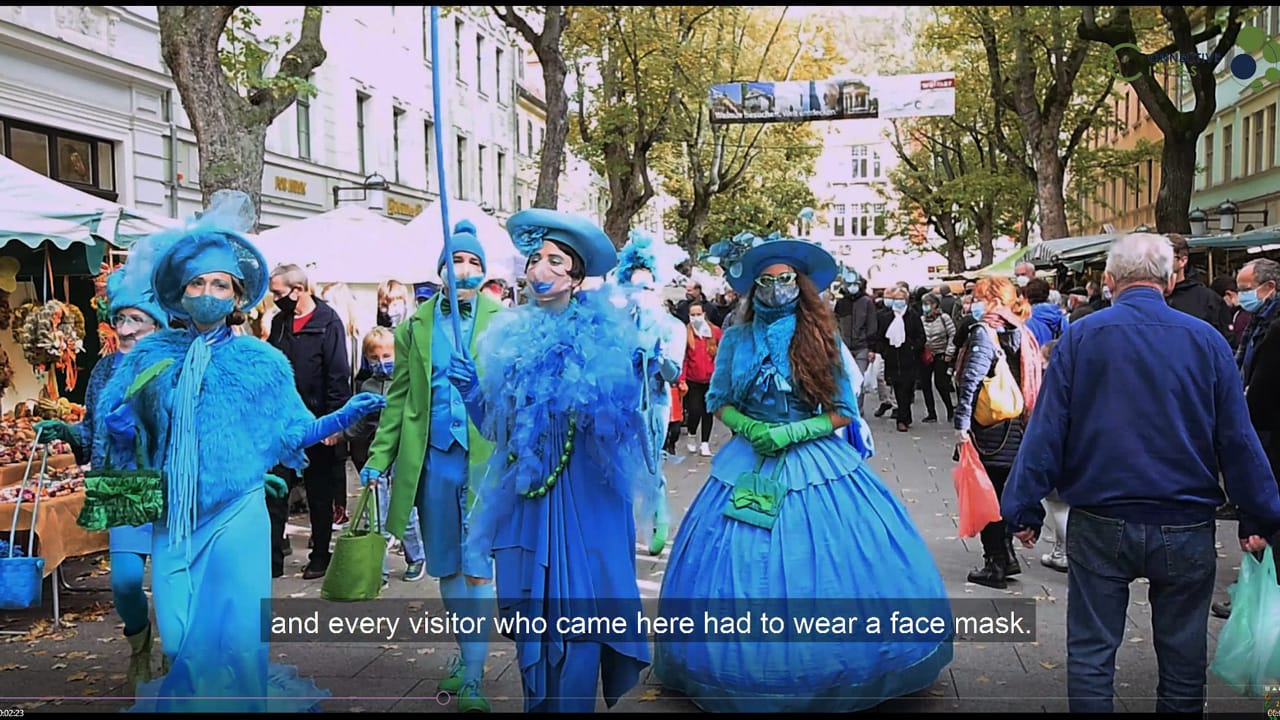
Weimar: Economic response to COVID-19

Weimar, a city that attracts thousands of tourists from all over the world every year. Watch how did the local city guides, hoteliers and small shop owners react to the lockdown? And what did the local authorities do?

Mehr: https://youtu.be/SxLgSY2aW6g

Join us and watch a special series of videos and podcasts that will show how to overcome a crisis from many different points of view. More videos, podcasts and interviews coming soon on our COVID-19 page.

Waste to positive energy in Mafraq governorate in Jordan

The establishment of the composting plant to produce organic fertilizers was part of the plan for solid waste management in Jordan. The project was jointly planned by the Ministry of Local Administration and the UNDP in its first phase, and then it received technical and financial support from the GIZ in its second and third phases. The project aims to serve Mafraq governorate which hosts a large number of livestock farms, through the collection and treatment of animal manure to produce organic fertilizers to be used in agricultural land in the city.

Towards the Just City in Kenya

In the next 25 years, Africa’s urban population is set to double. By 2040, the majority of Africans will be living in cities. There are numerous reasons for this: climate change, violent conflicts and the hope of finding work or education, although this list could easily be extended. Urbanisation thus constitutes one of the greatest transformations facing Africa in the 21st century.

Despite the diversity of the African continent, however, they are so far mostly “unjust” cities that people are moving to. The majority live in informal settlements and work under precarious conditions, mostly in the informal sector, without employment contracts and social security.

Towards the Just City in Kenya is the first publication of its kind that explores the conceptualisation and application of the “just city” concept in Kenya. The authors explore the concept from various dimensions, namely:

  • Conceptualisation of the just city in Kenya.
  • Locating the just city in the constitutional, policy, legislative and institutional context.
  • Discussion of spatial justice in the context of planning and housing; and
  • Interrogating practical ways in which cities express injustice and how these can be practically addressed, with examples from the public transport sector.

The study offers recommendations on how the just city concept can be realised in Kenya, looking specifically at urban institutions, citizens’ rights, housing policies and urban public transport systems.

With its just city project, FES Kenya and its partners facilitate dialogues through working groups which bring together civil society, trade unions, Members of County Assemblies, Government representatives, and academia working in urban centres of Kenya with the objective to jointly work for a just city.

Local Economic Development and Job Creation in MENA

Local Economic Development (LED) remains a top priority for the MENA countries as a driver for economic stability and job creation for a region with one of the highest unemployment rates in the world. While many resources are invested in fostering local economic development in the MENA countries led by governments, however, there is often a lack of systematic access to practice-oriented solutions.

More than 40 local urban practitioners from 22 municipalities and 10 countries from the MENA region and Germany took part of the virtual dialogue event organized by the Connective Cities project. The dialogue event consisted of five virtual sessions held between the Sep 29th – Oct 7th 2019, focusing on facilitating the exchange of know-how and experiences through peer-to-peer learning among municipal representatives and urban practitioners. Moreover, the dialogue event aimed at enriching the analysis and planning capacity of the participating municipal representatives to address existing challenges of implementing LED and job creation programs.

Throughout the Dialogue event, participants showed tremendous commitment to the program with a level of excitement that remained high till the last day of the dialogue where they learned how to present their LED project concepts in less than 3 minutes; an activity that reflected their understanding of project development process as well as the peer-to-peer exchange methodology.

This report reflects in detail the main results of the virtual dialogue event.

Principles for Better Cities

We are now living through a period during which we are both struggling to find adequate ways to characterize the dominant urban challenges and to respond adequately to those challenges. It is indicative of this complexity that we live in a period that is simultaneously being criticized as ‘the Anthropocene’ and, more optimistically, called ‘the Urban Age’. This is the era in which humans have had a profound impact upon the earth’s ecological systems. It is also the period during which the planet has become overwhelmingly urbanized. Likewise, social relations are ever more global, and thus, at one level, diffuse. To address local challenges, global targets have been set up to inspire and guide common efforts in sustainable development.

Arguably, responding well to the current challenges is best achieved by a set of integrated principles that firstly link highlevel aspirations to on-the-ground practical guidelines. Secondly, it is best realized through recognizing global and generalizing patterns while being sensitive to local particularities and priorities. Thirdly, it requires simple and aspirational principles at the top level but, at the same time, a grounding in more complex detail as the process goes deeper.

Principles for Better Cities is a collective response to that set of tensions. The document attempts to meet those contradictory needs by outlining a set of layered principles (Part I) while providing a method for translating between other existing charters, frameworks and sets of principles such as the Sustainable Development Goals (Part II).

Women’s Training and Development Center in Hay Al-Andalus municipality in Libya

The Centre for Women’s Development and Training was planned as a socio-economic project that aims at women’s economic empowerment and promoting female entrepreneurship. The center provides job matching services and capacity development courses that include trainings on various scientific and social topics as well as recreational activities that target the wellbeing of the beneficiaries.

The project is part of the European Union and Bundesministerium für wirtschaftliche Zusammenarbeit und Entwicklung (BMZ)- funded “Support to Municipalities” programme in Libya, which is implemented by GIZ in cooperation with the Libyan Ministry of Local Governance and the Municipality of Hay Al-Andalus. Other key stakeholders included the local civil society, the office of women’s empowerment in the presidential council, the Ministry of Labour and businessmen in the municipality.

International exchange of experiences: lessons learned in the Covid-19 crisis

As soon as it was clear that the Covid-19 would pose serious challenges to municipalities around the world, the Federal Ministry for Economic Cooperation and Development (BMZ) addressed Connective Cities to adapt its methodology to provide municipal practitioners with an opportunity to share their experiences in an agile and flexible way.

In many ways, local authorities are constantly at the forefront of global challenges, as they are the first level of government to feel the impact of any crisis. Yet municipalities also have the potential to act as fruitful sources of innovative solutions in addressing these challenges, and those solutions would also require cooperation with different levels of government and the involvement of many different types of stakeholders: Academia, Civil Society, Private Sector, etc..

The series started in July/2020 and had the objective to help improving the responsiveness and resilience of urban actors through exchange and peer-to-peer learning by promoting the exchange of practical solutions between practitioners and to disseminate good practices. The explosive spread of the virus put existing municipal structures and capacities to the test. On the other hand, the interconnectivity and digitalisation opened up the possibility of offering a series of exchange events 100% virtually.

Hardly all the benefits of a well-organised personal exchange can be fully replaced by the current technologies. Nevertheless, in a crisis like the one caused by the Covid-19, technology made it possible to organise more than 35 response dialogue events with the participation of more than 800 specialists in such a short time.

Our main objective was to bring together experiences to be presented during and discuss how local authorities can cooperate, learn from each other and ultimately build their capacity to address global challenges. On the 9th of December, Connective Cities organised the official final event of the series “Municipal Response to COVID-19”.

Besides a keynote presentation from the Head of the Urban Policies and Reviews Unit the OECD, the event on the 9th of December included a showcase of examples from Stuttgart-Germany, Belo Horizonte-Brazil, Aman-Jordan, Tshwane-South Africa and Lviv-Ukraine. In closing an e-learning course on crisis management was presented by Dr. Peter Tinnemann, Head Global Health Science Unit, from the Charité – Universitätsmedizin Berlin.

During our additional session of 2020 on the 10th of December, tools and protocols that cities employ to monitor and control the infection chains during the COVID-19 pandemic were explored. While taking a closer look at the efficiency and effectivity of the tracking systems applied in the South Eastern Europe and the Caucasus, discuss existing challenges, and explore how can we enhance or scale-up tracing strategies. Speakers shared their experiences from different levels of local governance and research from Georgia, Serbia and Germany.

The Connective Cities team would like to thank all the inspiring and impressive urban practitioners who invested their time in sharing and discussing their good practices in response to the pandemic. In 2021 Connective Cities will continue to offer events and exchanges focused on the municipal needs connected to the Covid-19 pandemic. We warmly invite you to stay connected through our website and all our social media channels and stay tuned for updates and future events.

Local Development Program for the City of Agadir in Morocco

Agadir municipality has pursued ambitious policies aimed at enhancing the quality of life of the city’s inhabitants, while protecting the environment and fostering sustainable development. The undertaken efforts targeted various key areas, in which the requirements and responsibilities for achieving environmental, social and economic sustainability were met.

Local Economic Development and Job Creation in the Middle East and North Africa

More than 40 local urban practitioners from 22 municipalities and 10 countries from the MENA region and Germany took part of the virtual dialogue event organized by the Connective Cities project. The dialogue event consisted of five virtual sessions held between the Sep 29th – Oct 7th focusing on facilitating the exchange of know-how and experiences through peer-to-peer learning among municipal representatives and urban practitioners. Moreover, the dialogue event aimed at enriching the analysis and planning capacity of the participating municipal representatives to address existing challenges of implementing LED and job creation programs. The discussion also led to identifying the gaps in resources and the support needed to implement future LED projects.

Local economic development (LED) remains a top priority for cities in MENA and a driver for economic stability and job creation for a region with one of the highest unemployment rates in the world. A wide spectrum of stakeholders are engaged in fostering LED including governments, NGOs, the private sector, and development actors. Nevertheless, there remains the need to intensify exchange of practice-oriented experience and good practice among municipal representatives and urban practitioners  on related topics  such as strategizing for LED and creating partnerships with the private sector, sustainable livelihood programs and decent job creation, as well as green economic transformation.

The facilitation approach focused on designing, planning, and conducting a series of virtual knowledge-exchange activities in which several steps were taken:

  1. Clustering: of partners according to their regional distribution, municipal needs, and vision for future development for their cities;
  2. Defining: the subtopics for dialogue that are in harmony with their current ambitions and future objectives;
  3. Inviting: partners to virtual dialogue sessions after outlining the goal of this dialogue and defining roles and responsibilities agreed upon by all partners, as well as the anticipated outcome;
  4. Facilitating: the virtual exchange sessions in a manner that will ensure maximum interaction and knowledge exchange;
  5. Evaluation and Follow up:  with all partners after all sessions are completed to share the outputs of the dialogue to maintain ongoing knowledge exchange for future collaboration in between the different municipalities;
  6. Reporting: on all conducted activities and the overall summary of the dialogue.

The project has built a Network, an exchange platform for municipal representatives and urban practitioners, which provides a systematic access to practice-oriented solutions for sustainable urban development by facilitating change and providing mutual support.

Dialogue event introductory video: English version | Arabic version

The role of innovation in curbing the impacts of the pandemic

More than 15 municipal representatives from around 15 cities in MENA and sub-Sharan Africa participated in the virtual event of the knowledge-exchange series on Municipal Response to the COVID-19 Pandemic, which took place on the 14th October 2020.

Municipal representatives from both political and technical levels were invited and they engaged in knowledge-exchange to analyse and discuss practical examples on how innovation contributes to curbing the impacts of the pandemic.

Program

As part of the virtual event, four good practices from Aachen (Germany), Biskra and Batna (Algeria), and Mosul (Iraq) were showcased. The virtual event aimed at facilitating the sharing of experiences of interventions undertaken from a production, innovation, and scientific point of view to mitigate the impacts of COVID-19 on cities in MENA and Germany.

Moreover, the following set of questions were addressed:

  1. How did the local actors implement innovative initiatives to curb the impacts of the pandemic?
  2. What have been the core challenges in developing the innovative solutions?
  3. How can partnerships initiate strategic and operational response to the short-term challenges resulting from Covid-19, as well as the long-term planning recovery?
  4. What are the lessons learned from the perspective of local and national entities, research institutions and the private sector in developing these initiatives?

Presentations

Fight Corona.AC initiative in RWTH Aachen university, Germany
Prof. Jan Borchers, RWTH Aachen university, Germany
English   Arabic

COV-Fight Project in Biskra, Algeria
Mr. Imad Tibermacine, Biskra, Algeria
English   Arabic

3D printing technology for the production of medical supplies in Batnah, Algeria
Mr. Belcasem Islam, Batnah, Algeria
English   Arabic

Mosul Space in Mosul, Iraq
Ms. Susan Long, Innovation Lead for Middle East at Field Ready
Mr. Salih Mahmod, Mosul Space
English   Arabic

Results

The showcasing of good practices resulted in an opportunity for cooperation between the innovation hub in Mosul, Iraq and Algerian good practices. Connective Cities will facilitate this cooperation.