


This study outlines the objectives, structure and work programme of the PREVENT Waste Alliance and provides a background to the prevention of plastic waste by describing the need for action, environmental impacts and risks to human health. To pool the know-how and practical experience of the various stakeholders in the PREVENT Waste Alliance re-garding plastic waste prevention, the study presents examples of smart practices along the plastic value chain implemented by members of the working group “Conserving re-sources” and their partners. The focus is on multi-actor partnerships and examples that can be transferred to other countries. The examples cover education & consulting, the establishment of reusable options, the development of waste prevention infrastructure, innovative products, studies on plastic waste prevention as well as guidelines & over-views of best practice examples.
Finally, the study offers recommendations for the further work of the PREVENT Waste Al-liance. This includes success factors for plastic waste prevention, necessary next steps and conclusions regarding required policy frameworks.
Category: Solid waste management and recycling
Dealing with the Corona Virus

Local utilities all over the world face unprecedented challenges in dealing with the Corona Virus. German utilities have exchanged their respective experiences and the measures they have taken in order to support one another and learn from one another. The German Association of Local Public Utilities has compiled, written down, and translated these experiences into English so that they may benefit utilities worldwide.
Plastic waste: the contribution of municipal waste management to tackle the issue

Almost 40 local practitioners from 13 cities, 9 countries and 4 continents intensively exchanged their experiences on the topic of “plastic waste” and jointly developed solutions and project ideas. They followed the invitation of Connective Cities and the City of Hamburg to a dialogue event on “Plastic Waste – The Contribution of Municipal Waste Management Systems to Tackle the Issue”, which took place from 3 to 5 December 2019 in Hamburg.
Increasing amounts of plastic waste pose challenges for local authorities around the world. Only small quantities can be recycled by type to create closed cycles. But even recycling into lower types of plastic can alleviate landfills and generate income for vulnerable groups. However, avoiding plastic waste is the best option. Therefore, plastic waste is first and foremost a social challenge: changing the behaviour of consumers and producers is crucial.
Based on an exchange of experiences on good practices and projects in the cities implementation challenges were identified and finally eight project ideas were developed for eight cities, which could lead to an improvement of the respective strategies and implementation plans.
The event concluded with three parallel excursions to a waste incineration plant, a sorting station and a waste collection point in Hamburg.
Improving public service delivery at local level – solutions for participatory and accountable management
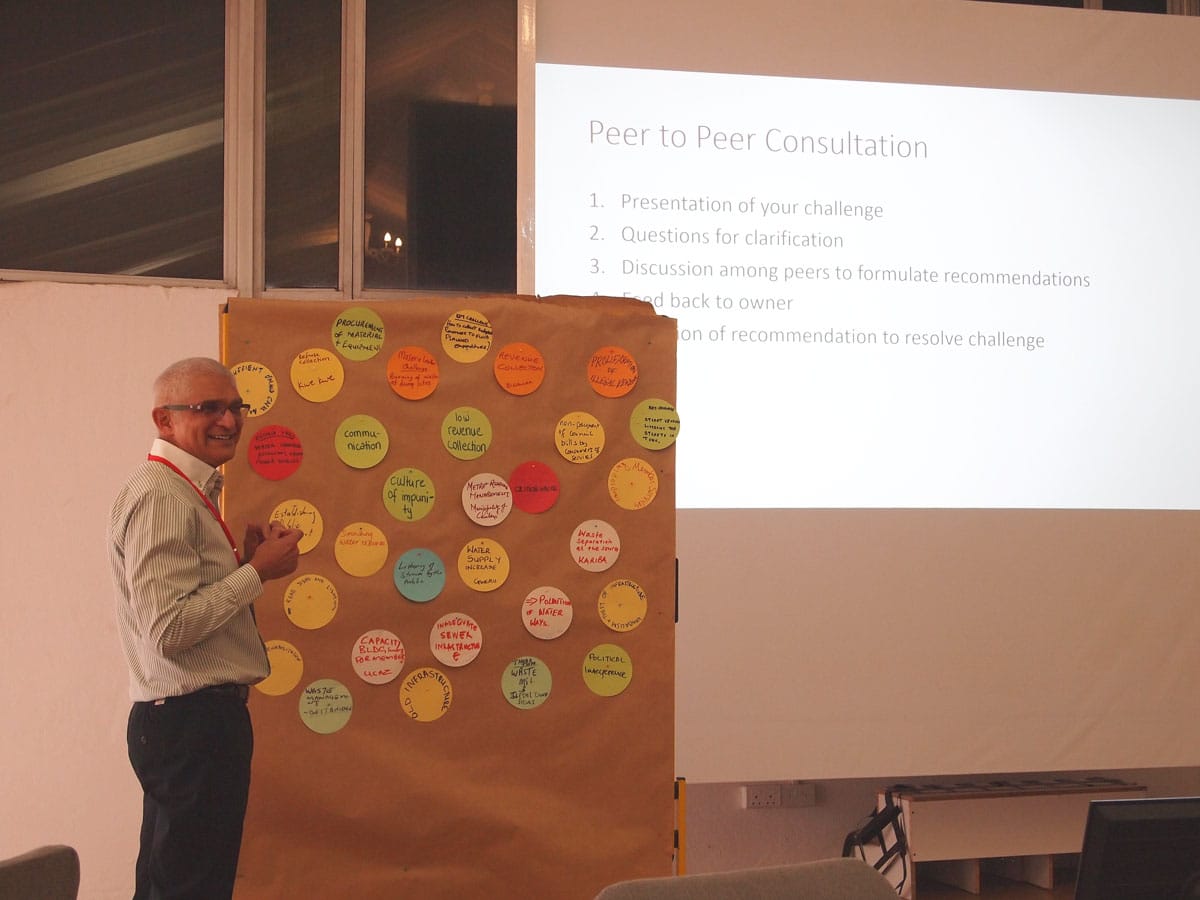
Connective Cities brought together urban practitioners from Sub-Sahara Africa and Germany to meet at the dialogue event “Improving public service delivery at local level – solutions for participatory and accountable management” in Harare, Zimbabwe from 20th to 22nd of August 2019.
Especially in Sub-Saharan Africa, dynamic urbanization and significant environmental and demographic changes are stating new challenges with regard to basic service delivery. Therefore, the focus was on developing approaches to improve public service delivery through public participation in order to achieve social accountability in the sectors of water, sanitation, waste management and transport.
Twenty-one representatives from Zimbabwean municipalities as well as a number of municipal practitioners from South Africa, Lesotho, Zambia, Kenya and municipal experts from Germany exchanged their experiences based on examples of Good Practices on public service delivery and defined possible solutions for the improvement of public service management.
The dialogue event was organized in cooperation with the GIZ project in Zimbabwe, “Strengthening the Urban Councils Association of Zimbabwe (UCAZ) to promote inter-regional and municipal knowledge transfer and capacity development”.
The Future of Urban Consumption in a 1.5°C World

New ways of measuring the climate footprint of cities show that urban consumption is a key driver of global GHG emissions. Cities therefore have a responsibility to significantly reduce their GHG emissions. This work has mostly focused on transport, buildings, energy and waste. This report assesses the impact of urban consumption on climate breakdown and explores the type and scale of changes needed to ensure that cities reduce their GHG emissions in line with internationally agreed, climate-safe limits.
The Future of Urban Consumption in a 1.5°C World
New ways of measuring the climate footprint of cities show that urban consumption is a key driver of global GHG emissions. Cities therefore have a responsibility to significantly reduce their GHG emissions. This work has mostly focused on transport, buildings, energy and waste. This report assesses the impact of urban consumption on climate breakdown and explores the type and scale of changes needed to ensure that cities reduce their GHG emissions in line with internationally agreed, climate-safe limits.
Sustainable Development Report 2019

"The Sustainable Development Report 2019 presents an updated SDG Index and Dashboards with a refined assessment of countries’ distance to SDG targets. New indicators have been included, primarily to refine the indicator selection on agriculture, diets, gender equality and freedom of speech. Once again, Nordic countries top the SDG Index. Yet, even these countries face major challenges in implementing one or several SDGs. No country is on track for achieving all 17 goals with major performance gaps even in the top countries on SDG 12 (Responsible Consumption and Production), SDG 13 (Climate Action), SDG 14 (Life Below Water) and SDG 15 (Life on Land). Income and wealth inequalities, as well as gaps in health and education outcomes by population groups also remain important policy challenges in developing and developed countries alike."
Solutions for and by cities

"The Guangzhou International Award for Urban Innovation is dedicated to decentralised, city-to-city cooperation and sharing lessons learned from experience. Its focus covers the three pillars of sustainability: social, economic and environmental, and two additional domains – governance and technology.
The fourth edition of the Guangzhou Award was a remarkable show of these links between innovation and learning from different stakeholders. This publication is an attempt to extend the prestige of the initiatives that were shortlisted for the award, and to spread their legacy to even broader audiences."
Urban Transitions Alliance Roadmaps

Industrial legacy cities face unique challenges, as they transition towards vibrant, sustainable and equitable urban centers. Cities around the world can learn lessons from where these cities have been, and how they are moving forward. The new report, "Urban Transitions Alliance Roadmaps: Sustainability Transition Pathways from Industrial Legacy Cities" details four transition pathways that eleven post-industrial cities have undertaken, with implementation ideas and best practices for each. These cities are all a part of the Urban Transitions Alliance, which was built on the premise that by connecting industrial legacy cities from the US, Germany, Poland and China through their transition stories and visions of sustainable urban development, common challenges and transition pathways would emerge.
Reflecting the thematic priorities of the Alliance members, the chapters subsequently focus on challenges and solutions in the fields of Infrastructure, Energy, Mobility, and Social Transition. Each topic is explored in terms of background, barriers and opportunities related to the industrial legacy context. Transition priorities and innovative approaches from the different regions are outlined in key pathways and exemplified in case studies from the Alliance cities and districts. Some of the conditions described might apply in various degrees to cities beyond the industrial legacy context – that is why transition experiences and pathways from the Urban Transitions Alliance can be of value to cities around the globe.
Including Urban Metabolism Principles in Decision-Making

Circular economy and urban metabolism concepts have recently received great attention both in the political and academic arenas, starting a roll-over process of the “take, make, and dispose” dominant economic model that is leading to an ongoing increase of resource consumption and waste generation. However, there is a relative lack of guidelines for introducing such concepts in a decision-making process able to support the design of appropriate policies and strategies and the definition of specific actions to cope with such challenges. This paper attempts to contribute to the recent efforts at incorporating these concepts in policy and decision-making processes by providing a methodology for the development of strategic plans for waste prevention and resource management. The proposed methodology, developed within the Urban_WINS project, combines different quantitative–analytical and qualitative methods and tools, together with a participatory process. The methodology was tested in eight EU cities and allowed to formulate several measures and actions aimed at addressing the challenges posed by the current consumption patterns. Moreover, the participatory approach led to the legitimization of the strategic plans, as well as to raise awareness among stakeholders. Although it might require specific tailor-made adjustments, this methodology is suitable to be replicated in other contexts.