Cities SHIFT: Capacity building and networking for climate- and people-friendly mobility report

“With the pressing issues of congestion, air pollution, inequality, and climate change, the question is no longer if a sustainable and ecomobile transportation system will exist but when. Effective implementation can be realized by making an informed decision. This is imperative because you cannot manage what you do not know. This report demonstrates how the EcoMobility SHIFT+ tool can be adopted to assess and measure the transportation system of six cities in China, India, and Uganda. The EcoMobility SHIFT+ is a useful tool for local authorities to measure, assess, and act to improve ecomobility. Furthermore, evaluation and monitoring is an essential step in the process of developing sustainable urban mobility plans.”

Climate Proofing Urban Development

The impacts of climate change include extreme weather events such as heavy rainfalls, severe thunderstorms, prolonged droughts and heat waves. These impacts pose major challenges for cities around the world. Although climate change is a global challenge, adapting to its impacts is largely a local process.

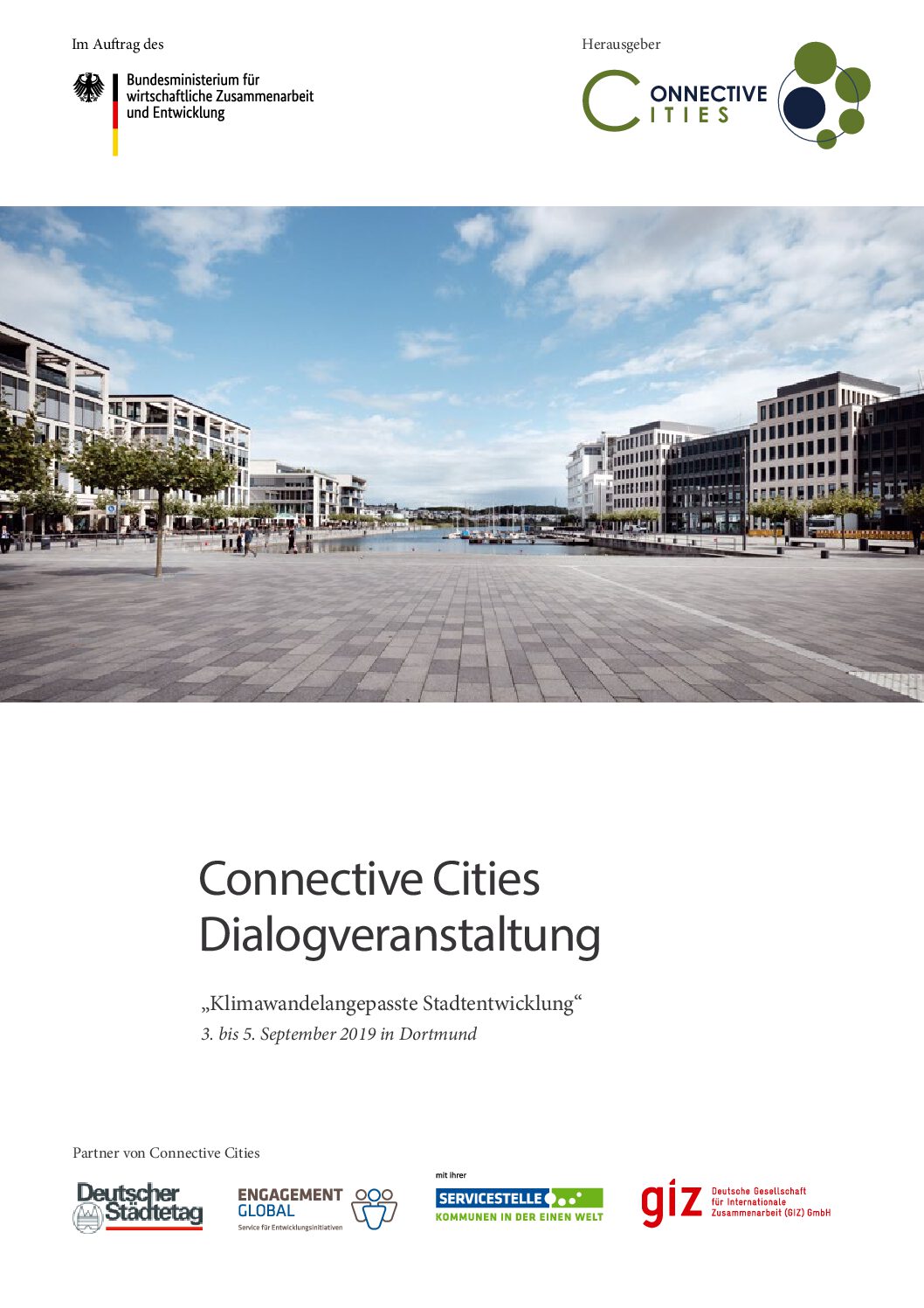
Almost 30 local practitioners from 12 cities, 10 countries and four continents accepted the invitation of Connective Cities and the City of Dortmund to a dialogue event on the topic of ‘Climate proofing urban development’, which took place from 3 to 5 September 2019 in Dortmund, Germany. This report documents the discussed good practices, solution approaches and developed project ideas.

COVID-19 in informal urban settlements

“Most of the information about COVID-19 and who is at risk is based on data from middle and high income contexts. Many of the recommendations (to wash hands, self-isolate and physically distance) assume basic living conditions and access to essential services (e.g. water, space etc). […] Many of these strategies will not be possible to the same degree in low and middle income countries (LMICs), and especially not in urban informal settlements. With 1 billion people living in informal settlements, there is an urgent need to consider feasibility and develop locally appropriate approaches. This brief sets out key considerations for protecting informal urban settlements from the spread and impacts of COVID-19 and discusses what is known about vulnerabilities and how to support local action.”

The Covid-19 pandemic from an urban planning perspective

From an urban planning perspective, epidemics historically have always left their traces in our cities. Now COVID-19 joins a long list of infectious diseases – such as the Spanish flu of 1918 in New York and Mexico City or the Ebola epidemic in West Africa in 2014.

CityLab has talked to Michele Acuto, Professor of Global Urban Politics at the University of Melbourne, about the intersections of urban planning and public health in the age of digitalization and globalization.

Read more

Reclaiming Play in Cities Report

The report, launched at the 10th World Urban Forum, reviews the evidence around learning through play and the impact that city and urban environments have on children’s access to play and ultimately, their overall development.

Play is increasingly being recognised as the engine of optimal child development, future happiness and achievement. Modern play has become a multi-dimensional, multilayered experience, where narratives and characters flow easily between different play-spaces. From virtual, online and augmented life-worlds into the physical domain and back again, play has become a seamless set of interlinked experiences and opportunities for learning and pleasure.

It is therefore imperative that we design and build cities that meet the needs of children: seeking their input during the design process, providing them with access to play and education, and facilitating their social and cultural interactions.

To better understand the complexity of play in cities and support the design of play-based interventions for children optimal development the report offers a first-of-its-kind Urban Play Framework. The Urban Play Framework assesses four Dimensions
critical to ensure a play-friendly environment for optimal childhood development: they focus on children’s needs, time and opportunity to play, the support and facilitation that enable Learning through Play, and the socio-cultural and urban systems that contribute to play in cities.

Urban Girls Catalogue

The Urban Girls Catalogue is a guide in inclusive urban planning, a deep dive into the process behind#UrbanGirlsMovement and an encyclopedia of good examples that showcase how feminist and participatory urban planning can lead to improved living conditions for society at large.
These are the results from #UrbanGirlsMovement, where we have composed a catalogue featuring: Global good practices of feminist urban development (part II); the results from the pilot case #UrbanGirlsMovement Botkyrka (part III); lessons learned from the entire initiative (part IV), as well as guidelines and policy recommendations for implementing parties and local, regional, national and global policy-makers (part V). The aim of this catalogue is for you, the reader, to find the necessary arguments for challenging set norms in your specific urban development context.

Heatwave Guide for Cities

"Heatwaves are deadly and their impacts are on the rise globally due to climate change. People living in urban areas are amongst the hardest hit when a heatwave occurs because these are hotter than the surrounding countryside. Along with climate change, urbanization is one of the most transformative trends of this century and the last. Over half the world now lives in urban areas and this is projected to increase to two-thirds by 2050. It is crucial that cities incorporate heat-reduction tactics such as green spaces into their plans for growth or retrofit them in built areas. […] This practical guide is designed with, and for, people working in city government to understand, reduce the risk of, and respond to, heatwaves in their cities."

The Silent Revolution of Public Spaces in Afghanistan

"The Silent Revolution of Public Spaces in Afghanistan is the untold story of hope and peace in urban areas. The provision of public spaces in cities across Afghanistan is shaping the lives of the citizens, especially women and the poor, and the relationship with their cities. It is a social and cultural revolution that has empowered women, created jobs for the poor and improved the living standards of the citizens. It is a silent and peaceful revolution that has transformed the people and the city, building trust and confidence in public institutions. The photobook serves to portray the Afghan government’s response to the immediate urban challenges through impactful photos and stories. […]"

The 8 Principles of Sidewalks

"Walking is the most democratic way to commute. It is the oldest and most common mode of transport in the world, not to mention being a far healthier option – for both people and cities. The 8 Principles of Sidewalks systematizes the most relevant Brazilian and international references into a single publication about the planning, design and construction of sidewalks that meet the needs of people walking. The goal of this guide is to provide deeper insight into the role of sidewalks in spaces that provide opportunity for social interaction among people."

Solutions for and by cities

"The Guangzhou International Award for Urban Innovation is dedicated to decentralised, city-to-city cooperation and sharing lessons learned from experience. Its focus covers the three pillars of sustainability: social, economic and environmental, and two additional domains – governance and technology.
The fourth edition of the Guangzhou Award was a remarkable show of these links between innovation and learning from different stakeholders. This publication is an attempt to extend the prestige of the initiatives that were shortlisted for the award, and to spread their legacy to even broader audiences."