Climate Resilient Urban Development in Southeast Europe

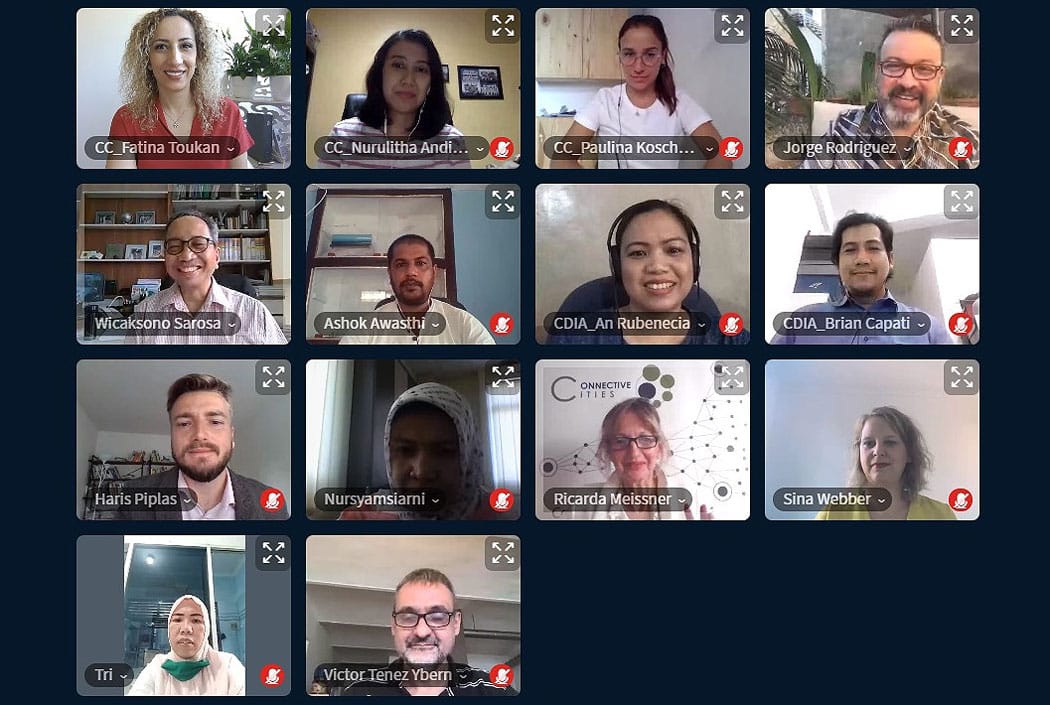
From October 26th until November 6th 2020 around 30 urban practitioners from 11 Southeast European cities (from 8 different countries Georgia, Bosnia and Herzegovina, Montenegro, Belarus, Serbia, Slovenia, Ukraine, Germany) came together virtually to exchange their experiences and expertise in the field of Urban Mobility and Green Urban Infrastructure. Especially challenges in waste management, transportation and public lighting system and water revitalization were discussed intensively, as they represent pressing issues for many Southeast European cities.

The aim of the workshop was to jointly work out comprehensive project plans which can be the basis for technical and financial proposals for funding. The workshop focused on the following topics:

  1. Green Infrastructure – based on the notion that protecting and enhancing nature and natural processes are consciously taken into consideration in the context of spatial planning and territorial development.
  2. Urban Mobility – developing and implementing sustainable urban mobility plans (SUMP) including private as well as public transportation.

The event was a follow-up to the virtual dialogue event conducted in June 2020 with representatives of 24 municipalities as well as international experts. Where, based on innovative methodologies such as Design Thinking, participants from 9 countries worked on their first project ideas.

These two weeks of synchronous and asynchronous workshops were participated by the officials from institutions, representatives from urban networks that share the project’s objectives, and experienced professional from the civil society and the private sector, who work in the thematic areas as well as academia in the field of urbanism, spatial planning, geography, climate change and other disciplines. During the workshop, also donor organizations were invited to get to know the projects, to answer questions of the municipalities and to support financial proposals and grant applications written in a professional way.

How ‘school streets’ could create safer, healthier cities

Amid the COVID-19 pandemic, communities living in cities need cleaner air to breathe and outdoor public space to be social yet physically distanced.

Recognition of these issues has led public health experts, architects and urban planners to discuss how to design cities to respond to the pandemic.

One idea put forward has been the establishment of “school streets”: closing roads outside schools to motor traffic during school drop-offs and pick-ups.

School streets often involve other local action, too. This includes promoting active travel, such as walking and cycling, to get to school, getting local people involved in citizen science projects to monitor air quality and putting on events to celebrate the road closure.

Our research focuses on public health and air pollution. We recently worked with Holt House Infant and Carterknowle Junior schools in Sheffield, as well as with Sheffield City Council, to pilot the first school street in the city. The Sheffield pilot provides an excellent example of the valuable role that school streets could play in our cities, especially during a pandemic.

More

The Value of Sustainable Urbanization

“The world we live in has been transformed in a manner not witnessed in recent times. In a rapidly urbanizing and globalized world, cities have been the epicentres of COVID-19. The virus has spread to virtually all parts of the world; first, among globally connected cities, and now, through community transmission and from the city to the countryside.
The World Cities Report 2020 shows that the intrinsic value of sustainable urbanization can and should be harnessed for the wellbeing of all. The report provides evidence and policy analysis of the value of urbanization from an economic, social and environmental perspective, including the unquantifiable value that gives cities their unique character; and also explores the role of innovation and technology, local governments, targeted investments and the effective implementation of the New Urban Agenda in fostering the value of sustainable urbanization.”

Green Urban Infrastructure in Asian Cities

From August 3rd until August 14th, 2020 around 30 urban practitioners from 6 Asian Cities came together virtually to exchange their experiences and expertise in the field of Green Urban Infrastructure. Especially challenges in waste management and water sanitation were discussed intensively, as they represent pressing issues for many Asian cities.

The aim of the workshop was to further develop existing project ideas by discussing arising challenges and trying out new methods to find new perspectives and approaches to urban planning. The event was a follow-up to the dialogue event in Bandung, Indonesia in November 2019.

Due to the restrictions imposed on all of us by the Covid-19-pandemic, the event was conducted virtually by using the Connective Cities Platform. To ensure an enriching learning experience, the event took place over two weeks and included synchronous workdays with various keynote presentations as well as asynchronous days on which the participants could work on their project ideas at their own pace.

Six projects from Indonesia and Nepal were presented and further developed (see presentations).

Climate-proof and Resilient Urban Development

In view of the current situation worldwide, attendance formats for international meetings are neither sensible nor formally possible. Nevertheless, the international community of practice for sustainable urban development Connective Cities continued its offer in Latin America and invited municipal practitioners from Latin America and Germany to participate in the follow-up (LINK NITEROI) virtual workshop on the topic of “Climate-proof and resilient urban development – project planning of municipal adaptation measures”.

This time, 29 participants from eight different countries (Brazil, Ecuador, Argentina, Colombia, Mexico, Germany, Spain, USA) came together virtually to exchange experiences and knowledge. The aim of the event was to further develop the project ideas by revising strategic approaches with peer support and reflecting on examples from municipal practice.

Following project ideas were presented and jointly further developed:

  1. Project: Improving the resilience of people and environmental communities in areas vulnerable to climate change / Municipality: Portoviejo, Ecuador
  2. Project: Strengthening the ecosystem-based adaptation measures at the tourist location San Miguel de Allende / Municipality: San Miguel de Allende, México
  3. Project: Adaptation of existing and new households to the forecast increase in temperatures and precipitation for the Risaralda administrative area / Municipality: Quinchía, Colombia
  4. Project: Colina Verde – Strengthening of security conditions by limiting the risk of landslides and fires in the community of Boa Vista / Municipality: Niterói, Brazil
  5. Project: The importance of agroforestry systems as an adaptation measure to climate change and as an economic sector for the community of Tomé-Açu / Municipality: Tomé-Açu, Brazil

Climate Resilient Urban Development in South East Europe

More than 40 local urban practitioners from 24 municipalities and 8 countries, fitting under the EU’s regional dimension of Eastern Partnership and Western Balkans, intensively exchanged their experiences/municipal expertise within 2 weeks of digital experience on the topic of “climate resilient urban development” and jointly developed solutions and project ideas. They followed the invitation of Connective Cities to an unprecedented and unique experience: Virtual Dialogue Event: “Climate Resilient Urban Development” on 8-19 June 2020.

It has been increasingly understood that rapid urbanization and climate risks mean greater vulnerability to urban development. Many cities worldwide face significant challenges arising from natural hazards. The Southeast European region is no exception, whereas the climate resilient urban development becomes a central pillar of local sustainability policies. Most of the countries in the region continue to face environmental and climate change challenges.

This event offered a virtual platform to discuss these challenges and supported municipalities in developing locally adapted solutions for climate challenges; in exchanging cities’ significant experience of developing successful possible options and good practises; in transforming innovative urban project ideas into digital solutions especially in the aftermath of the COVID-19 outbreak, as this latter continues to impact heavily the lifestyle at all levels including the sustainable urban development workers and it’s needed to adapt to more innovative and agile ways of working for future crises responses.

During the 2 weeks asynchronous and synchronous digital experience participants listened to inspiring Keynote presentations from leading European scientists and shared insights with peers in carefully curated Peer2Peer collaboration and exchange formats. They learned how to collaborate digitally and got acquainted with some tools, methods and the overall mindset Design Thinking.

The project has built a Network, an exchange platform of urban players, which provides a systematic access to practice-oriented solutions for sustainable urban development by facilitating change and providing mutual support.

Towards the Localization of the SDGs – 4th Report

LOCAL AND REGIONAL GOVERNMENTS’ REPORT TO THE 2020 HLPF 4th REPORT

The fourth report of the local and regional governments (LRGs) to the HLPF: Towards the Localization of the SDGs (2020) has been produced at a difficult time, when the world is suffering the effects of a global pandemic. The impact of this crisis on the social and economic fabric of our communities is, however, still difficult to measure. Within this context, the words “solidarity” and “cooperation” take on an even more relevant meaning. This was the message of the UN Secretary-General in his report to the HLPF and it reflects the feelings of our constituency, based on the experiences of numerous cities and territories.

The transformative framework of the universal development agendas remains essential for a more sustainable future. Local and regional governments from all over the world are reinstating their strong commitment to achieve the transformation that their societies call for after the pandemic through the potential of the SDGs and the universal development agendas.

In this context, the report analyses the evolution of the process of SDG localization in cities and territories throughout the world, particularly focusing on the 47 countries reporting this year. In doing this, it builds upon the information presented in the Voluntary National Reviews (VNRs) and on the views expressed by LRGs through their own reports (more than 40 Voluntary Local Reviews from cities and regions and six reports from LGAs which provide a wider, subnational view of the localization process in the countries reporting this year). It also collects together the answers to the GTF survey, with the visions of LRGs from 75 countries. This report will be presented during the Local and Regional Governments’ Day at the 2020 High-Level Political Forum.
Political Forum.

Cities Policy Responses

This note was developed by the OECD Centre for Entrepreneurship, SMEs, Regions and Cities (CFE) in collaboration with the OECD Working Party for Urban Policy and the OECD Champion Mayors Initiative for Inclusive Growth. It is an update of the earlier versions released on 27 March and 13 May, which expands the examples of measures taken by cities to respond to COVID-19 and recover from the economic and social crisis. The note provides analysis on issues related to the economic, social and environmental impacts, lessons learned in terms of digitalisation, mobility, density, urban design and collaborative governance, and action-oriented guidance to build back better cities, building on previous work on urban resilience. Short and medium term responses provided by cities are clustered around six categories: i) social distancing; ii) workplace and commuting; iii) vulnerable groups; iv) local service delivery; v) support to business; and vi) communication, awareness raising and digital tools. The note also includes updated information on how cities are progressively exiting the lockdown.

Climate Resilient Urban Development in Southeast Europe

The virtual event was the first component of the learning process conducted by Connective Cities in Southeast Europe. The aim of the virtual event was to support knowledge exchange and networking by increasing the visibility of good practices from municipalities in SEE region on one hand, and on the other hand by facilitating the needed virtual space and tools to create innovative solutions for local challenges through knowledge exchange and peer-to-peer consultations.

The virtual event, thus, supported transforming dialogue and exchange possibilities into a digital and remote format especially during and in the aftermath of the COVID-19 outbreak affecting heavily the lifestyle of urban dwellers and planers. As this will include effects on sustainable urban development, municipal urban practitioners need to develop more innovative and agile processes to improve future crises responses. Here, the interest was mainly in pragmatic solutions and approaches that can be applied or adapted to the different regional/local contexts. Furthermore, the event offered a virtual platform to discuss the challenges around the theme of climate resilient urban development and supported municipalities in developing new project ideas among peers that can be further implemented in the respective home communities or in the framework of existing or new thematic municipal partnerships.

COVID-19 in African cities

“COVID-19, a global pandemic declared by the World Health Organization (WHO), is crippling the global economy and upending people’s lives thereby threatening sustainable development across all its dimensions. Africa is also facing the dire consequences of the crisis, necessitating timely response, recovery and rebuilding policies and strategies. Globally, urban areas are the epicenters of the epidemic accounting for most of the confirmed COVID-19 cases. UN-Habitat in collaboration with UN Economic Commission for Africa (UNECA), UN Capital Development Fund (UNCDF), United Cities and Local Governments of Africa (UCLG), African Development Bank (AfDB), and Shelter Afrique have joined hands to produce this new report: COVID-19 in African Cities: Impacts, Responses and Policies. The report proposes several interventions to promptly and effectively address the challenges of COVID-19 pandemic in Africa at the urban level led by national and local governments supported by international and regional development institutions.”