Voices from Connective Cities – Abasan Al-Kabira municipality

The representatives of Abasan Al-Kabira municipality in Palestine talk about how they are acting as Connective Cities’ Ambassador in Palestine, by organising several workshops for municipalities in Gaza to promote the regional network’s activities in different thematic areas such as crisis management, response to the Covid-19 pandemic, circular economy, local economic development and renewable energy. They also confirmed that working with Connective Cities on several projects and benefitting from knowledge exchange with their peers have enabled the municipality to progress in achieving its SDG-related targets and has resulted in developing capacities of the municipal employees.

Watch video at YouTube:

https://youtu.be/HcA0zewDtaQ

India Urban Data Exchange (IUDX)

To build cities of the future, which provide good quality of life, improved economic robustness, and harmony with nature, India needs unique solutions that are not only efficient but also offer services and benefits to all segments of society. It has chosen to leverage data in creating these solutions by facilitating the real-time sharing of data among stakeholders through an open, neutral, and secure platform, the India Urban Data Exchange (IUDX).  IUDX is all about the use of data for public good and enabling data providers to create innovative services and generate value.

Concretising land use planning: Adapt laws, involve landowners, set standards

Under the general title Sustainable and resilient, regional and inter-municipal land management: Challenges and opportunities for growing urban and regional centers the cooperation project between the Planning Department of the Greater Amman Municipality and the German Cities of Frankfurt, Munich and Berlin aimed at developing an Exemplary community development planning scheme for Al Dafyaneh (Tareq B) in the northwest of Amman.

In a first stage the general conditions of municipal planning have been explored and compared. This concerned both planning laws and building codes and in particular provisions for land readjustment. The latter being of imminent importance for urban planning in Jordan / Amman, since heritage law result in highly split-up landownership.

The first stage of the learning process ended in December 2021 and was completed with recommendations on legislative changes to strengthen the Amman City Council vis-à-vis the landowners. Rainer Müller-Jökel (former head of the Surveying Office of the City of Frankfurt) and Gerhard Gross (former project manager in the Department of Urban Development Planning in the Office for Urban and Regional Planning of the City of Munich) wrote an official letter to the government in Amman.

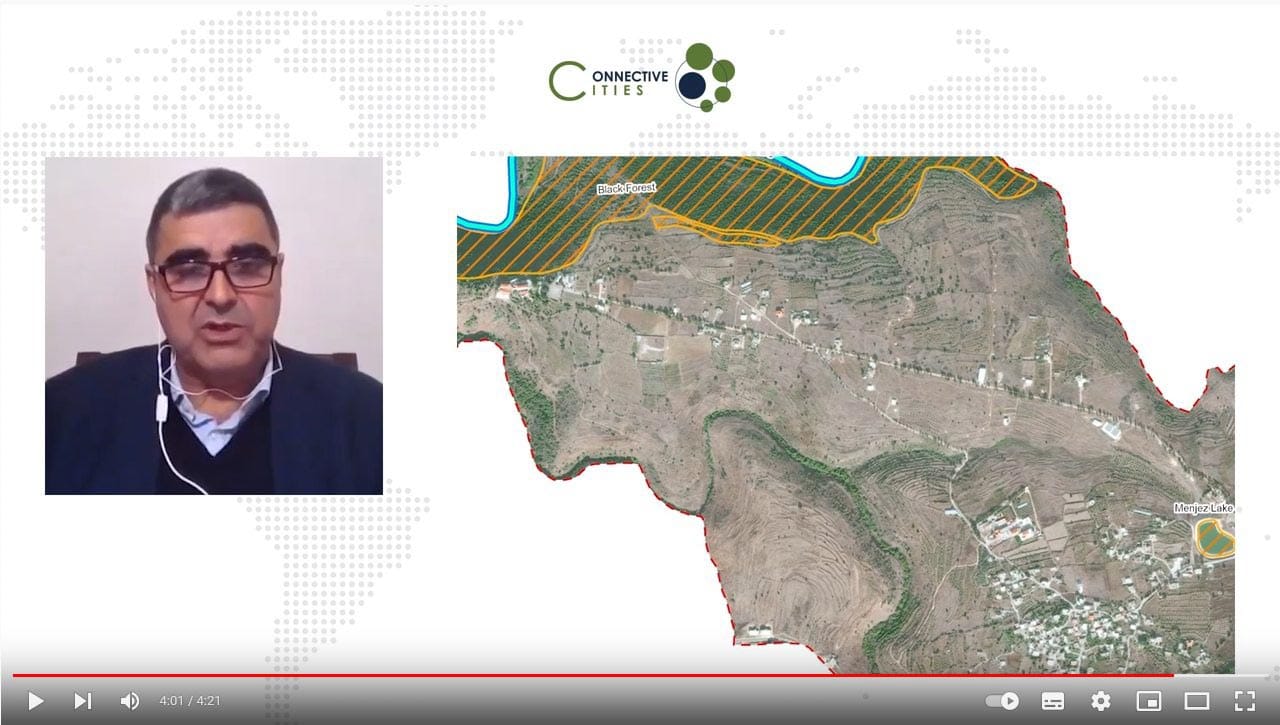
Menjez: A model-municipality in northern Lebanon rural area

The city of Menjez is considered a model of how a recently established small municipality can advocate for the conservation of nature and biodiversity, improve infrastructure and ultimately achieve many SDGs.

Connective Cities interviewed Dr. Georges Youssef, Mayor of Menjez, to learn how the municipality in the northern Lebanon rural area managed to turn its ecosystem into a priority.

– English and Arabic subtitles available –

Watch video at YouTube:

https://youtu.be/tjhfh3KhuBs

Envisaging the Future of Cities

Urbanization is intertwined with several existential global challenges: Cities do not exist in isolation from global challenges. The emergence of urbanization as a global megatrend is intertwined with the existential challenges that the world has faced in the last 50 years, including climate change, rising inequality and the rise in zoonotic viruses with the latest being the novel coronavirus pandemic, which triggered the worst public health crisis in a century and the worst economic recession since the Great Depression. These challenges will in different ways, leave their imprints on the future of cities.

In UN-Habitat’s new World Cities Report 2022 – Envisaging the Future of Cities, three scenarios, or three paths were identified, that the world’s cities could take at this critical juncture.

  • In the worst-case or “high damage” scenario, we assume that policy-making and governance will become even weaker and more ineffective. The destructive effects of the pandemic, climate change, inequality, poverty, and long-running conflicts, if not adequately addressed, will have disastrous consequences for cities in both developed and developing countries, though the latter would suffer most because of existing vulnerabilities. If 80 per cent of the economic damage inflicted by COVID-19 persists for a decade, then the number of people living in poverty could increase by more than 200 million by 2050.
  • The middling, or “pessimistic scenario”, foresees a reversion to the status quo before the pandemic. This business-as-usual approach would be characterised by exploitation and exclusion of informal sector workers, systemic discrimination of the urban poor, unimaginative policies and poor implementation on the climate crisis, public transport, or urban regeneration programmes and renewal. Cities could be locked into cycles of poverty, poor productivity, unhealthy living conditions and become inequality traps for decades.
  • The report, however, also envisages an optimistic future. Governments and donors would invest in urban development sufficiently to create just, resilient, healthy, and prosperous cities everywhere. By 2050, there could be 260 million people lifted out of poverty compared to the pre-COVID baseline. National governments would embrace peace and diplomacy to resolve their differences rather than pursuing military action, avoiding drastic global economic consequences such as those inflicted on the supply of food and energy by the war in Ukraine. Governments would manage the remainder of the COVID-19 pandemic competently, balancing health outcomes and economic recovery, and thus smoothing out global supply chains. They would also prepare adequately for the next pandemic.

Sustainable Urban Energy Planning in Southeast Europe (SEE)

Video about Connective Cities’ learning process II conducted in May 2021 – June 2022 to support municipalities in fine-tuning their project ideas in the fields of energy efficiency and renewable energy and developing them further towards bankable project proposals.

Watch video at YouTube:

https://youtu.be/TET3myNbj2I

More information on the dialogue event in November 2021:

Development of bankable project proposals for sustainable urban energy planning in Southeast Europe

Partnerships for Circularity

Through strategic partnerships, Jerash municipality in Jordan was able to overcome impediments in solid waste management and embark on a path of circularity.  By partnering with multiple stakeholders, the municipality succeeded in designing strategies for effective solid waste management and overcoming challenges related to insufficient operating budget, low collection coverage, waste dumping, and the associated environmental and public health concerns.