Local Economic Development (LED) and Job Creation in Middle East and North Africa

Six municipalities from the MENA region have participated in the Local Projects Workshop, which was a 2-days virtual workshop held on the 19th-20th January 2021. The workshop consisted of a series of virtual discussions among the participating municipal representatives and technical and financial experts. The workshop was followed by two virtual sessions on proposal writing for funding and financing of municipal projects held on the 21st and 25th of January 2021 respectively.

The Local Projects Workshop was designed such that the activities are following a normal growth curve of what has been established during the LED Virtual Dialogue taking place in 2020. The harmony established among participants and the understanding of the rationale of the Connective Cities methodology was expanded on to foster peer-to-peer learning with more attention given this time to individual municipalities needs and visions. The Local Projects Workshop approach leveraged the progress made to date by the 6 participating municipalities while addressing further actions including:

  • The interlinkages between LED projects and other areas like education, health, gender, environment, etc.
  • Adapting the LED projects to national and global objectives and priorities
  • Adapting the LED projects to available resources and existing expertise
  • Establishing Strategic and impactful partnerships for the projects
  • Risk forecasting and mitigation measures planning
  • Best approaches to fund projects with different financing mechanisms and tools.
     

The role of Local Government Associations in localising the Sustainable Development Goals

Several Local Government Associations ( LGAs) have been implementing successful projects for the localisation of the Sustainable Development Goals (SDGs) in cooperation with their member cities, some are just getting started and some others have a good understanding of the Agenda 2030 but have not yet formal ideas of how its implementation could look like as a project in their LGA.

31 experts from 16 local government associations joined the Connective Cities virtual dialogue event on LGAs and their role in localising the SDGs on 1st, 2nd and 4th September 2020.

The participants from Albania, Belgium, Brazil, Germany, Indonesia, Nepal, the Netherlands, North Macedonia, Mozambique, Palestinian territories, Serbia, Tanzania and Turkey as well as from the event partners PLATFORMA, UCLG and its Capacity and Institution Building (CIB) working group secretariat presented their good practices on localising the SDGs and supported each other in the peer-to-peer consultation sessions focusing on local challenges and in the development of joint project ideas in this thematic area.

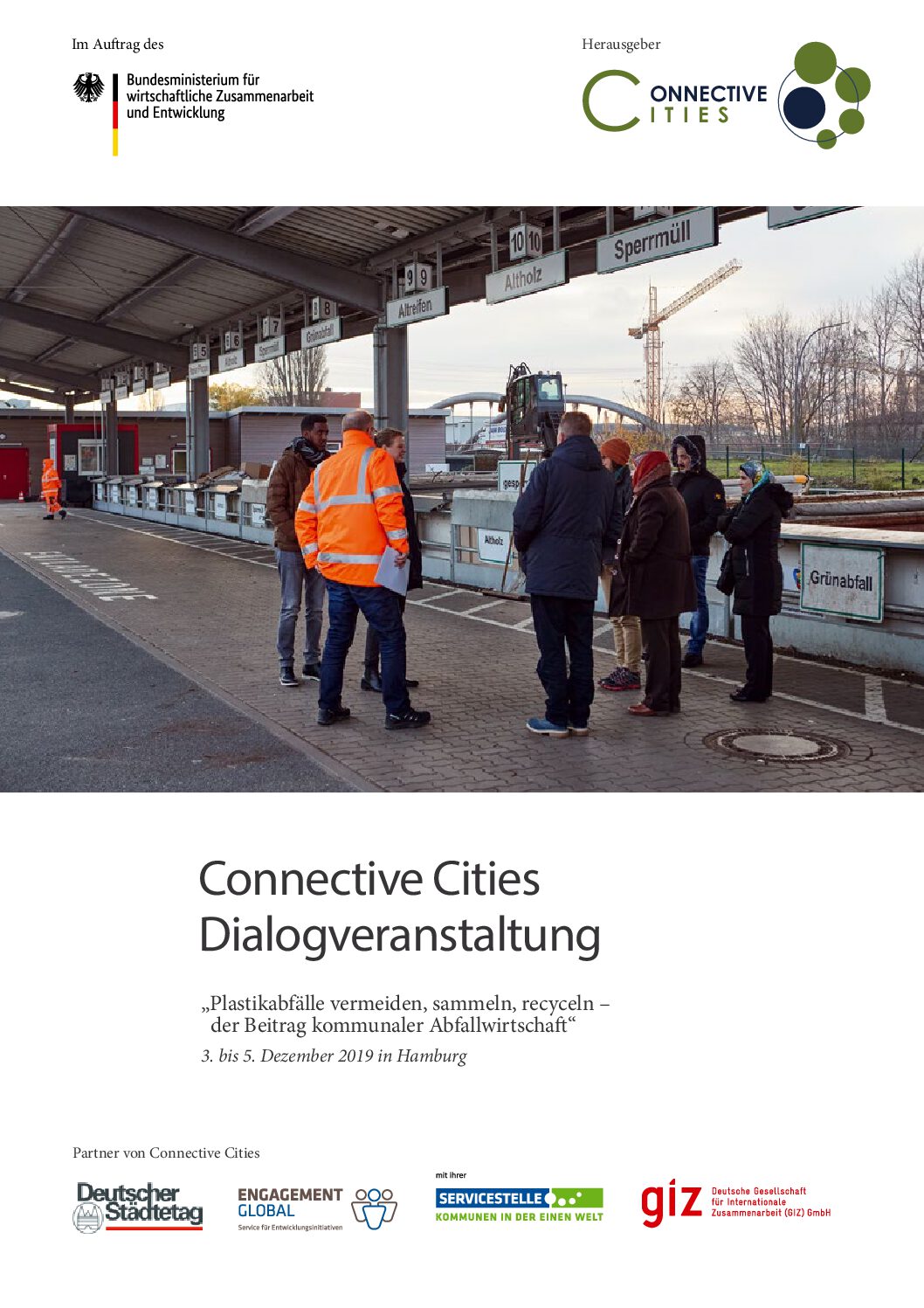
Avoiding, Collecting and Recycling Plastic Waste – The Contribution of Municipal Waste Management Systems

Almost 40 local practitioners from 13 cities, 9 countries and 4 continents intensively exchanged their experiences on the topic of ‘plastic waste’ and jointly developed solutions and project ideas. They followed the invitation of Connective Cities and the City of Hamburg to a dialogue event on ‘Avoiding, Collecting and Recycling Plastic Waste – The Contribution of Municipal Waste Management Systems’, which took place from 3 to 5 December 2019 in Hamburg.

At the end of the conference, eight concrete project ideas were developed which have great potential for implementation. The spectrum ranged from the establishment of an umbrella organisation for waste collectors in Mitrovica, the establishment of a recycling centre in Himara, the economically sustainable organisation of the collection of recyclable waste in Vushtrri, the automation of the recycling plant in Kandy, the development of a communication strategy for the recycling project in Quito, the establishment of waste separation at household level in Hawassa, the certification of sustainable shops in La Unión, to action planning for greater quality and competition in waste collection in Mogadishu.

The documentation describes in detail the format of the dialogue event, the good practices and results of the working groups as well as the planned further steps to implement the developed project ideas.

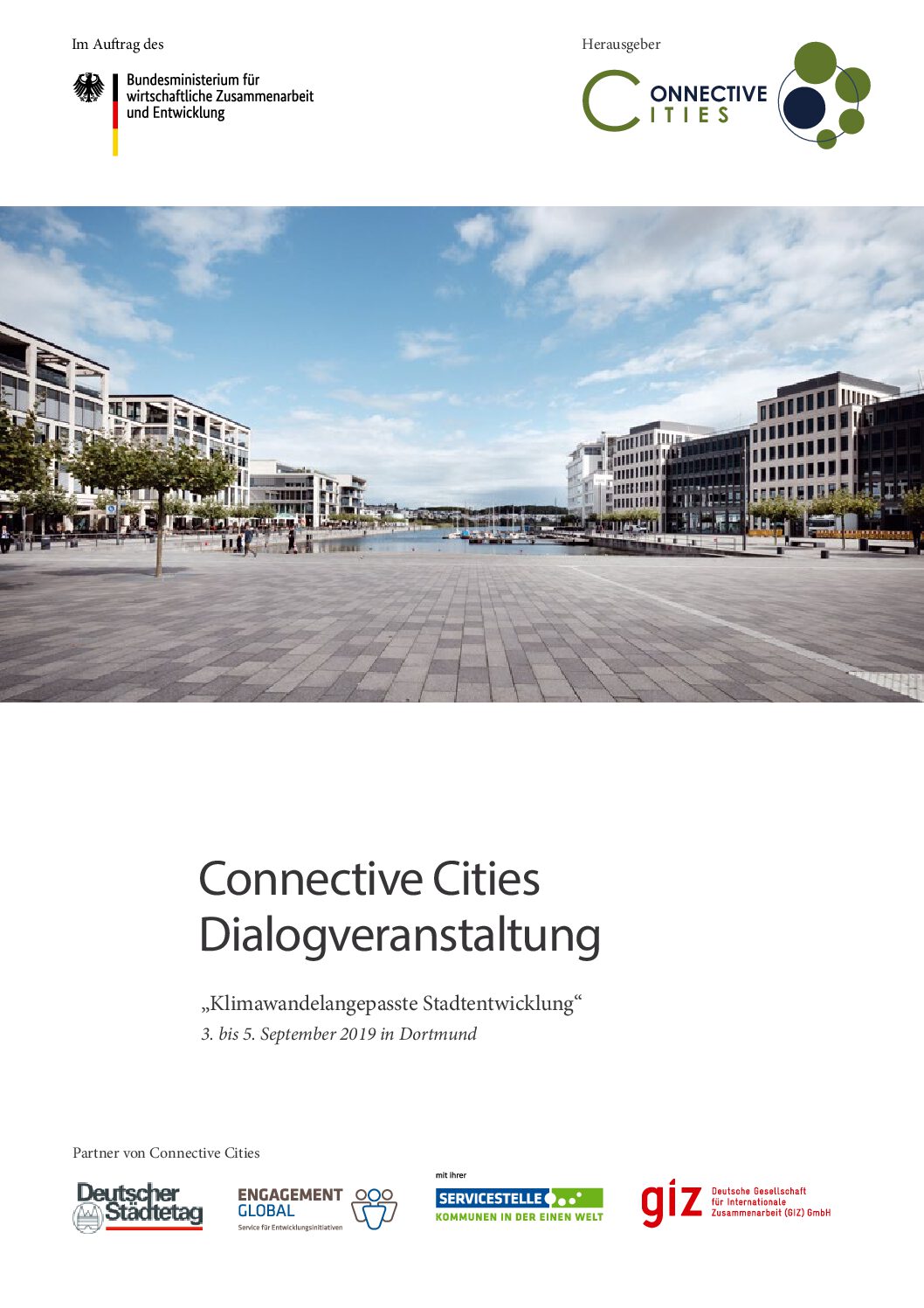
Climate Proofing Urban Development

The impacts of climate change include extreme weather events such as heavy rainfalls, severe thunderstorms, prolonged droughts and heat waves. These impacts pose major challenges for cities around the world. Although climate change is a global challenge, adapting to its impacts is largely a local process.

Almost 30 local practitioners from 12 cities, 10 countries and four continents accepted the invitation of Connective Cities and the City of Dortmund to a dialogue event on the topic of ‘Climate proofing urban development’, which took place from 3 to 5 September 2019 in Dortmund, Germany. This report documents the discussed good practices, solution approaches and developed project ideas.

Climate Resilience and Urban Development

Many cities in the Latin American region have been pioneers in the implementation of environmental measures and policies, as well as in resilience building and adaptation of their territories to the incre- asing effects of climate change. Planning for the future is key for the well-being of our communities, and we need to continue working with and for them in order to mitigate and adapt to the impact that climate change will continue to have on our territories in the coming decades.

This peer-learning note summarizes good practices of Latin American cities with a focus on four different thematic areas: risk assessment, comprehensive planning, finance, and citizen engagement. The practices were discussed during our ConnectiveCities peer-learning event hosted by the city of Niteroi, Brazil between November 26-28, 2019.

More information: 

• Read the Peer Learning Note 26 about Climate Resilience and Urban Development in English, Spanish, or Portuguese.
Short documentation with all presentations and pictures of the events

Climate just and climate proof urban development

As a prelude to the new learning process of Connective Cities in Latin America, the dialogue event “Climate just and climate proof urban development” took place in Niterói, Brazil, from 26-28 November 2019. Cooperation partners of the event were the city of Niterói and UCLG Learning.

The 32 participants in the event, mainly local practitioners, came from 17 cities in six countries: Brazil, Germany, Ecuador, Colombia, Argentina and Mexico. All participants work in their cities or projects on the topic of climate resilience/climate adaptation in the context of sustainable urban development. The aim of the event was to exchange experience and knowledge among local practitioners on the subject, to get to know good practices and to give mutual advice to colleagues, as well as to develop project ideas for further processing in subsequent events.

During an excursion, the group first got to know some of the current and completed projects of the Niterói Municipality in situ, and then gained further insights during a meeting with the Mayor Rodrigo Neves.

15 Pathways to localise the Sustainable Development Goals

This publication illustrates how the 15 pathways of the Basque Declaration can be used by towns and cities to localise the Sustainable Development Goals (SDGs).

In this publication, the 15 pathways of the Basque Declaration are illustrated with stories taken from the Transformative Action database of the Sustainable Cities Platform. Each of these stories are former applications to the Transformative Action Award 2017-2019 and have been reviewed by a jury of experts, which includes representatives from the European Committee of the Regions, the European Investment Bank, UNESCO Etxea, the City of Aalborg (Denmark) and ICLEI Europe.

The purpose of these stories is to provide local governments and other local stakeholders with inspiration for action, rather than the formulation of yet another action plan. The examples also give insight into how to implement the goals using an integrated approach across sectors and departments. For each story, the most relevant pathway and SDGs are indicated, based on an independent assessment by ICLEI Europe. They show the diversity of approaches across topics, geographical locations and local cultures.

Urban Girls Catalogue

The Urban Girls Catalogue is a guide in inclusive urban planning, a deep dive into the process behind#UrbanGirlsMovement and an encyclopedia of good examples that showcase how feminist and participatory urban planning can lead to improved living conditions for society at large.
These are the results from #UrbanGirlsMovement, where we have composed a catalogue featuring: Global good practices of feminist urban development (part II); the results from the pilot case #UrbanGirlsMovement Botkyrka (part III); lessons learned from the entire initiative (part IV), as well as guidelines and policy recommendations for implementing parties and local, regional, national and global policy-makers (part V). The aim of this catalogue is for you, the reader, to find the necessary arguments for challenging set norms in your specific urban development context.

Improving public service delivery at local level – solutions for participatory and accountable management

Connective Cities brought together urban practitioners from Sub-Sahara Africa and Germany to meet at the dialogue event “Improving public service delivery at local level – solutions for participatory and accountable management” in Harare, Zimbabwe from 20th to 22nd of August 2019.

Especially in Sub-Saharan Africa, dynamic urbanization and significant environmental and demographic changes are stating new challenges with regard to basic service delivery. Therefore, the focus was on developing approaches to improve public service delivery through public participation in order to achieve social accountability in the sectors of water, sanitation, waste management and transport.

Twenty-one representatives from Zimbabwean municipalities as well as a number of municipal practitioners from South Africa, Lesotho, Zambia, Kenya and municipal experts from Germany exchanged their experiences based on examples of Good Practices on public service delivery and defined possible solutions for the improvement of public service management.

The dialogue event was organized in cooperation with the GIZ project in Zimbabwe, “Strengthening the Urban Councils Association of Zimbabwe (UCAZ) to promote inter-regional and municipal knowledge transfer and capacity development”.

Urban Migration: Strengthening Cooperation with Civil Society

"While migration is often seen as a national issue, and most of the mandate around immigration, refugees and asylum falls to the central government, it is often cities and local governments that have to directly deal and address the needs of newly arrived migrants, and the inclusion of long-term migrant residents. […] At the same time, civil society organizations (CSOs) have taken an increasingly important role in supporting migrants by undertaking initiatives that raise awareness, facilitate access to basic services, advocate for their rights and strengthen social inclusion. The role of CSOs as key partners for local authorities in the governance of migration and other urban governance issues is widely recognized, but it is not always clear how to articulate these partnerships and coordinate efforts while securing the autonomy of these organizations and avoiding potential tensions or conflicts of interest."
In June 2019, UCLG ́s Learning team coordinated a workshop and peer learning event focusing on “Building trust through strengthened cooperation: the role of civil society in the urban governance of migration” in Sfax, Tunisia. The workshop was part of the Mediterranean City to City Migration (MC2CM) project. In the process of the event some key learnings and recommendations have been worked out. The documentation includes case studies from Sfax, Tunisia; Malaga, Spain;  Brital, Lebanon; Douala, Cameroon and Meknes, Morocco.