


The City of Bizerte (Tunisia) introduced the separation and composting of organic waste, in cooperation with the City of Rostock (Germany). During a dialogue event and two reciprocal delegation trips, the idea for the project was jointly developed by experts from Rostock and Bizerte. With funding from the ‘Partnership Projects for Sustainable Local Development (Nakopa)’ programme of the Service Agency Communities in One World (SKEW), a composting plant was built and commissioned at the end of 2020.
Category: Cities and climate change
Quito: not returning to the “old normal” after Covid-19

In Quito, many people have started travelling by bike during the Covid-19 pandemic. This momentum has to be used to change people’s mobility behaviour also in the long-term.
Call for participants: How to promote locally-driven knowledge networks for climate neutral city development solutions

“How to assure a locally-driven and knowledge network-oriented approach to Climate neutral City Development?” is one of the key questions the 2nd Green City Pioneers of Change Workshop will provide answers to. Join us in this 2nd Pioneer-Event and register here!
As part of the Connective Cities’ recovery program on “Municipal response to COVID-19” the topical cluster “Green Urban Development” is currently working on synergies between mobility and urban space solutions involving cities like e.g. Kigali, Kisumu, Hamburg, Hanoi, Dortmund, Belo Horizonte, Kochi, Lalitpur, Quito, and Buenos Aires.
The cluster wants to encourage an exchange between Green City Pioneers of Change which involves, apart from peer-learning between the above-mentioned cities, two public events.
The first of the two planned Green City Pioneers of Change Workshops was conducted on 19. January 2022. It focused on the presentation of inspirational international practices and encouraged a reflection among city pioneers on how to promote first green initiatives and the role of pioneers in facilitating them (see video and case documentation here).
This 2nd Green City Pioneers of Change Workshop on 25 February 2022 will focus on the reflection of critical success criteria for the promotion of bottom-up approaches to Climate neutral City Development. The cities cooperating in the cluster and the experts facilitating the cluster will share their efforts and their way of learning in
- the creation of local knowledge networks that integrate young researchers und local universities, change makers in the local administration, existing firms and start-ups with new business models
- promoting several smaller “learning by doing” and implementation-oriented initiatives that are becoming building blocks for a more systemic transformation approach in the respective cities.
Based on the presentation of these concrete experiences we will reflect with the participants in an interactive way on the need and ways to promote a locally versus mainly externally driven approach to Climate neutral City Development.
Join us in this 2nd City Pioneer of Change Event! Register now here.
Conference language is English.
Urban Gardening Guidebook

From July to December 2020, an initial intensive global programme on ‘municipal response to the pandemic’ was conducted by Connective Cities that has been augmented with the programme ‘municipal recovery from the pandemic’ starting August 2021. The working group “Biodiversity and Environmental Protection” was the first group to be established as part of this programme.
This Guidebook is one result of an extensive exhange. It explains, why Urban Gardening Matters? and guides the reader through all steps of an urban gardening project – from the first situational analysis, over the preparatory and implementation phase up to a final monitoring and evaluation.
Unturning the Stones – Exploring Climate Finance for Asian Cities

In the event 25 urban practitioners and experts from 6 countries exchanged on innovative and efficient financing approaches to build climate resilient and low-carbon cities. They were united by the fact that all of them are working at the forefront of climate change mitigation and adaptation measures in their cities. The event was jointly organised by Connective Cities, TURBOCLIC (Transformation – Urban Opportunities – Climate Change), an initiative from GIZ’s sector networks TUEWAS (Transport Environment Energy and Water in Asia) and SNGA (Governance Asia).
Southeast European (SEE) Regional Network continues exchange on recovery methods and practices

A total of up to 100 urban practitioners and experts participated in the Network Events held on behalf of Connective Cities international network initiative and Covid-19 Program. Two separate events held on 12th of November and 13th of December 2021, served as final big get-togethers of the year 2021 for the SEE Network members, leaving them with some food for thought and the floor for exchanges widely open for an upcoming year.
First Event on November 12, 2021 – “Connective Cities virtual exchange discussing the Southeast European Network’s development and presenting good municipal practices in the area of digitalization and crisis management” – was devoted to supporting peer-to-peer exchange and gathering municipal representatives, as well as field experts, to discuss crisis management and digitalization experiences, existing challenges, and to explore how scale-up strategies could be enhanced to meet crisis-induced demands. To cover these topics, the event was divided into three parts ensuring representation of all types of interaction as well as exchange. The web-seminar featured a Keynote speaker, who focused on COVID-19 and long-term challenges for territorial policies, followed by 3 case-study presentations on municipal responses to COVID-19 in terms of digitalization and crisis management from Melitopol (Ukraine), Tbilisi (Georgia) and Mostar (Bosnia and Herzegovina) – these examples demonstrated diverse practices taken up by each municipality during recent times. A panel discussion about the importance of digitalization for efficient crisis management at local governance level amid COVID-19 served as a closing ground of the event, ensuring an all-encompassing discussion on challenges, visions and possible peer-to-peer exchanges in the regards of topics discussed all throughout the day.
Recording and resources of the first session can be found on Connective Cities Platform here.
Sustainable urban energy planning in Southeast Europe
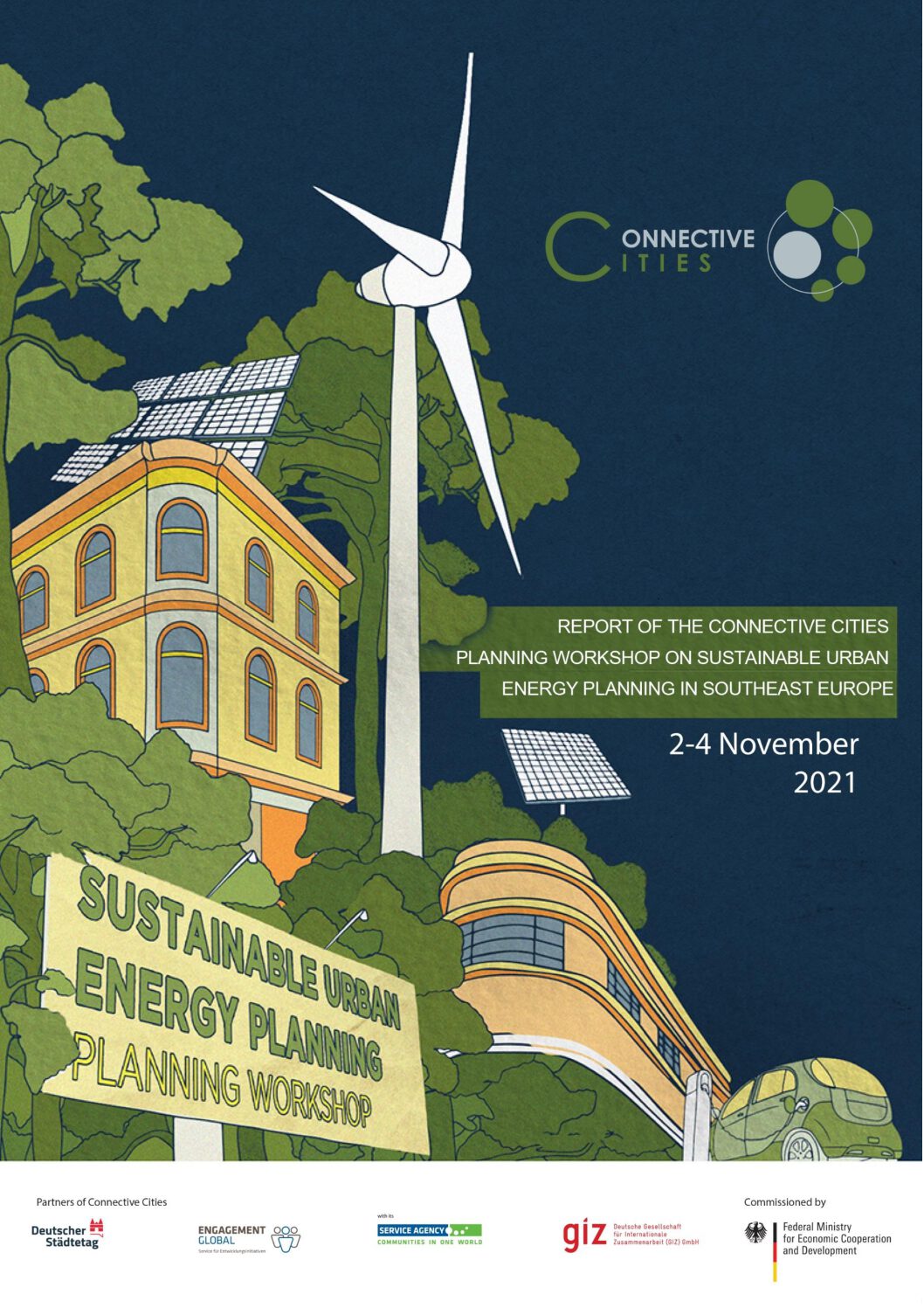
Sustainable Urban Energy Planning was a continuation theme for this year’s event gathering representatives of municipalities from Belarus, Ukraine, Kosovo and Georgia along with other interested practitioners in the field. These countries are the parties to international climate agreements and aim to harmonize their legislation with the energy acquis.
The Connective Cities Planning Workshop, held on 2-4 November 2021, represented a follow-up learning process for those 10 municipalities that were keen to engage after the Dialogue Event held in May 2021. The workshop aimed at supporting the municipalities in fine-tuning their project ideas and developing them further towards bankable project proposals. Due to COVID-19 pandemic it was decided to conduct the event virtually.
“Firewatch” – State-of-the-art technology for early forest fire detection

Both the frequency and intensity of wildfires are increasing worldwide as a result of climate change. If wildfires are out of control, they can have a devastating effect, endangering human lives and causing long-term damage such as biodiversity loss. To minimise this danger, the State Forests Department of Lower Saxony, Germany has installed a system for the early detection of wildfires.
Building. Forward. Better

We look back on an eventful year. Hopes of getting the Corona pandemic under control quickly fizzled out. The World Climate Conference cast its shadow ahead, only to end with a mediocre result. Despite, or perhaps because of, these setbacks, experts at the municipal level intensified their cooperation to better meet the challenges of the pandemic and climate change. Our networks expanded, project proposals became more concrete, working groups more agile, and some “champion municipalities” are themselves doing much to move the networks forward. It is time to pause for a moment, look back and dare to look forward to the future. Our coordinators of the regional networks in South Eastern Europe, the MENA region and Sub-Saharan Africa describe this from their own personal perspective.
The Future of the Southeast Europe Region – by Irakli Samkharadze and Elene Samukashvili
As the year comes to a close Connective Cities Southeast European Region celebrates achievements of every concurrent Learning and Peer-exchange processes held with the support of urban practitioners, experts, consultancies and technical personnel from all over the world.
Activities under Learning Processes on Climate Resilient Urban Development and Sustainable Urban Energy Planning, underway in SEE region will continue into the upcoming year with an updated roadmap. We will proceed with expert missions, financial advisory and project proposals polishing support, in close synergy with financial institutions. This support will be provided for projects identified through Dialogue Events and Planning Workshops held in past two years.
In 2021 under Connective Cities COVID-19 Programme, Southeast European Region (SEE) gathered amazing and motivated professionals from all over the region who worked in two directions of Crisis Management and Digitalisation. As of new year, Programme Teams aims to maintain the close contact with the groups, through the Network, providing them with further news, updates and guidance.
As the network of the region is constantly expanding, planned activities are also amplifying and growing in their directions and frequency. 2022 promises to be a very active and highly engaging time for the network. Our topics include but are not limited to Sustainable Urban Development, Energy Efficiency & Renewable Energy, Urban Planning, Green Technologies, Infrastructure and recovery, Crisis management & Digitalisation, while also constantly looking into new directions according to preferences of Network Members and political Developments in the region.
Kontakt: Irakli Samkharadze (irakli.samkharadze@giz.de)
Sub-Saharan Africa – an outlook to 2022 – by Sophia Kamau
We have braved another year of virtual learning, networking and finding solutions to our urban challenges. Thank you for being part of this journey by sharing good practices, challenges, contacts and expertise.
We look over the skies into the endless opportunities that time gives and envision 2022. Based on the networks built, relationships established, and ideas exchanged, we would like to share our thoughts with you as we get into a reflective season.
In 2022 we will finalize the learning processes on urban basic services and sector governance and land management and land use planning. This will be through support to municipalities working on their proposals and those seeking expertise support. Through partnerships with like-minded institutions, we will have more opportunities to learn and exchange through the thematic working groups; solid waste management, urban green spaces, climate change and urban mobility.
We welcome you to join this community of transformers in the region.
From the Sub Saharan Africa desk, we appreciate your cooperation and wish you happy holidays!
Contacts: Sophia Kamau (sophia.kamau@giz.de)
Connective Cities in the MENA region: Champion Cities taking ownership of the network in 2022 – by Muna Shalan
Over the past year, the vibrant network of Connective Cities in the MENA region has grown and has intensified its activities: we are now at 235 registered members! To sustain the momentum and ensure the sustainability of the network, champion cities will take the lead in steering the activities of the different thematic working groups starting next year. This will include peer learning, good practice presentation and joint proposal development. Upon showcasing the outcomes of the activities in the planned regional event in January 2022, the network members will be able to nominate themselves or vote for the steering committee of the regional working groups that include local economic development and job creation, municipal energy efficiency projects, biodiversity and environmental protection, digitalisation of municipal services, social entrepreneurship and circular economy.
We are also looking forward for new partnerships with regional city associations in 2022. This includes our recently signed MoU with UCLG MEWA to strengthen decentralised regional cooperation.
Contact: Muna Shalan (muna.shalan@giz.de )
A green infrastructure plan for Mexico City

In collaboration with public administration, academia and urban society, the Secretariat of Environment and Natural Resources of the City of Mexico has developed a comprehensive master plan for the development of green infrastructure in Mexico City. The master plan aims to preserve and create green urban spaces ranging from parks and gardens to larger nature reserves. Another focus is the renaturation of urban rivers. Especially in one of the world’s largest cities, the pandemic highlights the importance of access to public green spaces for residents. This good practice from Mexico shows how the design process of a master plan can succeed in an inclusive and dynamic way with the involvement of diverse population groups.
Watch video at YouTube: