


As part of its support during the COVID 19 pandemic, Tbilisi has adopted a number of measures and social projects to support vulnerable groups during the pandemic and has involved businesses, the Red Cross and many volunteers in its implementation.
Category: Integrated urban development
Innovation for the environment

As the case with the majority of municipalities in Lebanon, Bikfaya municipality lacked support from the central government and was unable to provide viable solutions for solid waste management (SWM). This motivated local residents to propose grassroot initiatives. A group of volunteers (with no prior technical knowledge in solid waste management), promoted recycling and sorting at source. Initially receiving technical support from a local environmental NGO, this case has eventually transformed into a best practice that is resonating in Lebanon and the MENA region.
Digitalisation in Madaba Municipality, Jordan

In line with the efforts in Jordan to drive economic transformation and application of international quality standards, Madaba municipality developed a vision towards achieving equitable growth and sustainability. An integral part of this vision is the digital transformation of municipal services.
Towards a gender sensitive urban development

Why do we need a gender sensitive approach in urban planning?
Existing urban public spaces as well as public transport were mostly designed by and to accommodate the needs of men. A lot of them are not fit for women’s needs – some even pose a threat to women’s safety, they complicate their everyday lives and reduce their possibilities to engage in community life. The COVID-19 pandemic has exposed and exacerbated existing gender inequalities in various aspects.
At the same time, this crisis can be an opportunity to make urban planning more gendersensitive, equitable and sustainable. There are a lot of gender sensitive practices already existing. The task is to implement these practices and help municipal actors achieve sustainable, inclusive and (gender) equitable development in the (post-)COVID era.
This was the aim of the two Connective Cities Working Groups on:
- Gender sensitive urban planning
- Gender responsive urban mobility
Connecting municipalities in their efforts towards a gender sensitive city
The participants of the working groups joined us from the municipalities of Nabeul and Sfax in Tunisia, Mexico City and Guadalaja in Mexico, Tena in Ecuador, Nairobi in Kenya as well as Uruguay and the Municipality of Gaza, Palestine.
In bringing municipal representatives and urban practitioners together to present and discuss their challenges and good practices they were supported to develop new project ideas through peer-learning and exchange. In this they were inspired by regional and international experts who shared their insights in gender sensitive planning approaches.
The first kick-off meeting was aiming to sensitize for the various risks of widening gender inequalities in urban development and to identify the roles cities administrations can play in this context.
Annika Dalén, Strategic development and gender equality officer, Municipality of Umeå, Sweden presented the efforts of the Swedish city of Umeå as a model city for gender sensitive urban planning and mobility. Until today, reliable data on how women move in cities is missing in a lot of countries. Therefore, to redesign cities and their transport systems to effectively respond to women’s needs, it is the first essential step to collect gender-specific data at the municipal and national levels.
Due to curfews and social restrictions, the pandemic put women at a higher risk to suffer from domestic violence. Katja Schülke, Gender equality officer, City of Bonn, Germany and Conny Schulte, General manager, Arbeitskreis Opferschutz Bonn/Rhein-Sieg presented their approaches for combating domestic violence of the City of Bonn.
A third keynote by Giada Cicognola, programme analyst, Cities Alliance introduced the participants to the programme Femmedina in Tunis, Tunisia. The programme’s goal is the rehabilitation of public spaces for women in the historic centre of Tunis, the Medina, through participatory decision-making.
During the following working group meetings, the participating municipalities identified one gender related challenge in their cities. They are exemplary for the issues women face in many places around the globe:
- Enhancing the integration of women in decision making processes in Tunis, Tunisia
- Improving the situation of commuting women from rural areas in urban environments in Tena, Ecuador
- Incorporating the needs of women in the implementation of e-mobility projects and addressing sexual and gender-based violence in the e-mobility space in Nairobi, Kenya
- Promoting cycling for women in Mexico City and Guadalaja, Mexico
Connective Cities working groups promote the idea of Peer-to-Peer Consulting so that the participating municipalities can benefit from each other’s experiences and good practices. If you are interested to learn more about this approach, you may find more information here. As an outcome of lively discussions, the groups developed Guidelines that can also help other municipal actors to get going. their guidelines for:
Guidelines:Towards a gender-sensitive urban development [pdf, 307 kb, 7 pp.]
Guidelines: Towards a gender responsive urban mobility [pdf, 337 kb, 8 pp.]
Without a gender sensitive approach to urban development, the pandemic could have far-reaching effects including the risk of widening gender inequalities in various areas. At the same time gender mainstreaming tools and good practices of gender-sensitive recovery strategies already exist, which, if used effectively, can mitigate the negative impacts of COVID-19 and contribute to an increased gender equality.
Find more useful resources on gender sensitive urban planning:
Gender Responsive Urban Planning and Design | UN-Habitat (unhabitat.org)
How Vienna designed a city for women (apolitical.co)
How to Design a City for Women – Bloomberg
Gender in Mainstreaming Urban Development (berlin.de)
Harsh-realities-Marginalized-women-in-cities-of-the-developing-world-en.pdf (unwomen.org)
A safe city for women and girls in El Alto, Bolivia | UN Women
Goal 11 | Department of Economic and Social Affairs (un.org)
Brief-Recommendations-COVID-19-Safe-Cities-and-Safe-Public-Spaces-en.pdf (unwomen.org)
Unturning the Stones – Exploring Climate Finance for Asian Cities

In the event 25 urban practitioners and experts from 6 countries exchanged on innovative and efficient financing approaches to build climate resilient and low-carbon cities. They were united by the fact that all of them are working at the forefront of climate change mitigation and adaptation measures in their cities. The event was jointly organised by Connective Cities, TURBOCLIC (Transformation – Urban Opportunities – Climate Change), an initiative from GIZ’s sector networks TUEWAS (Transport Environment Energy and Water in Asia) and SNGA (Governance Asia).
Turning social business ideas into reality with yooweedoo

Founders of social start-ups – so-called social entrepreneurs – have a one-stop contact point in Schleswig-Holstein: the yooweedoo programme. Based at Kiel University, yooweedoo facilitates social entrepreneurship with workshops, project advice, an ideas competition and an active network for sharing lessons learned.
Southeast European (SEE) Regional Network continues exchange on recovery methods and practices

A total of up to 100 urban practitioners and experts participated in the Network Events held on behalf of Connective Cities international network initiative and Covid-19 Program. Two separate events held on 12th of November and 13th of December 2021, served as final big get-togethers of the year 2021 for the SEE Network members, leaving them with some food for thought and the floor for exchanges widely open for an upcoming year.
First Event on November 12, 2021 – “Connective Cities virtual exchange discussing the Southeast European Network’s development and presenting good municipal practices in the area of digitalization and crisis management” – was devoted to supporting peer-to-peer exchange and gathering municipal representatives, as well as field experts, to discuss crisis management and digitalization experiences, existing challenges, and to explore how scale-up strategies could be enhanced to meet crisis-induced demands. To cover these topics, the event was divided into three parts ensuring representation of all types of interaction as well as exchange. The web-seminar featured a Keynote speaker, who focused on COVID-19 and long-term challenges for territorial policies, followed by 3 case-study presentations on municipal responses to COVID-19 in terms of digitalization and crisis management from Melitopol (Ukraine), Tbilisi (Georgia) and Mostar (Bosnia and Herzegovina) – these examples demonstrated diverse practices taken up by each municipality during recent times. A panel discussion about the importance of digitalization for efficient crisis management at local governance level amid COVID-19 served as a closing ground of the event, ensuring an all-encompassing discussion on challenges, visions and possible peer-to-peer exchanges in the regards of topics discussed all throughout the day.
Recording and resources of the first session can be found on Connective Cities Platform here.
Sustainable urban energy planning in Southeast Europe
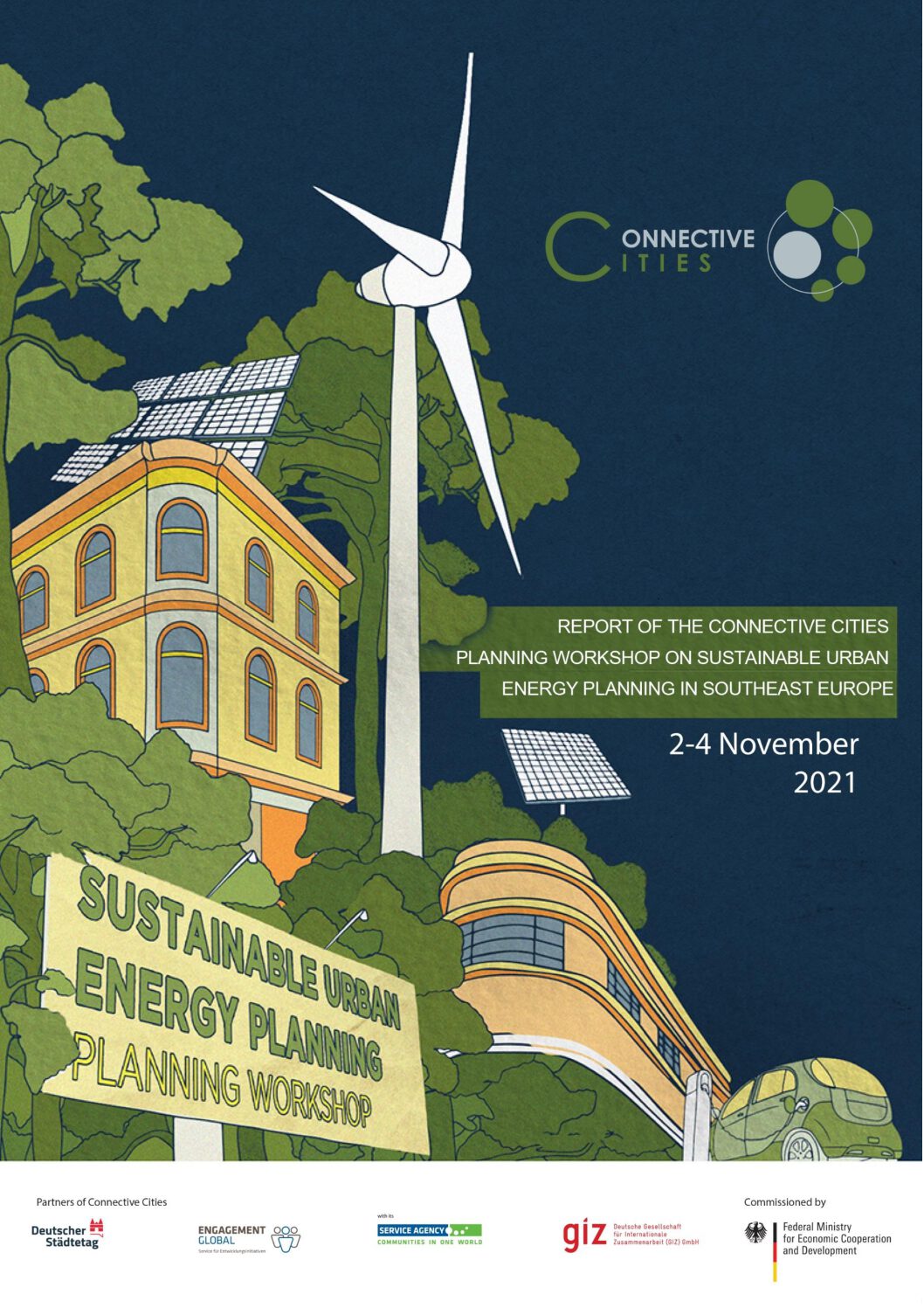
Sustainable Urban Energy Planning was a continuation theme for this year’s event gathering representatives of municipalities from Belarus, Ukraine, Kosovo and Georgia along with other interested practitioners in the field. These countries are the parties to international climate agreements and aim to harmonize their legislation with the energy acquis.
The Connective Cities Planning Workshop, held on 2-4 November 2021, represented a follow-up learning process for those 10 municipalities that were keen to engage after the Dialogue Event held in May 2021. The workshop aimed at supporting the municipalities in fine-tuning their project ideas and developing them further towards bankable project proposals. Due to COVID-19 pandemic it was decided to conduct the event virtually.
Sustainable Urban Mobility and COVID-19

The Covid-19 pandemic has led to fundamental changes in urban mobility worldwide. Some impacts are short-term, especially during lockdowns. Others are long-term changes in the way urban mobility and traffic will operate in the future. Sustainable urban mobility and Covid-19 was the focus of the Connective Cities Virtual Dialogue Event in partnership with United Cities and Local Governments (UCLG) and UN-Habitat and hosted by the City of Wiesbaden – Germany that took place on 19, 20 and 22 July 2021. This peer-learning note summarizes good practices of participating cities with a focus on local public transport, bicycle traffic and sustainable urban logistics.
In addition to the English version, there is also a German and Spanish version.
Additional information: a summary of the event including all presentations is available here.
“Firewatch” – State-of-the-art technology for early forest fire detection

Both the frequency and intensity of wildfires are increasing worldwide as a result of climate change. If wildfires are out of control, they can have a devastating effect, endangering human lives and causing long-term damage such as biodiversity loss. To minimise this danger, the State Forests Department of Lower Saxony, Germany has installed a system for the early detection of wildfires.