Final Report: Virtual Global Exchange

The exchange was designed to bring together urban practitioners from all over the globe. The goal was to ignite creativity, innovation, solidarity and motivation, while creating and enhancing this global community of practice around the common purpose of combating the global COVID-19 pandemic and its consequences with smart local solutions and strategies.

During the first week, urban practitioners and experts from different municipalities, the civil society, business and academia, presented a total of 56 Good Practices in 18 sessions and gave insights into their experienced challenges and local solutions to deal with the pandemic. The exchange were centered around the nine topics were Public Health, Crisis Management, Economic Response, Housing, Education, Digitalisation, Crisis Communication, Innovation, and Green Urban Recovery.

The second week was about receiving practical “How To” capsules with practical exercises on topics that came up repeatedly during the exchange events such as: social media usage, digital tools, and how to plan for virtual meetings. Finally, the newly learned mindsets and tools could be applied in a 4-hour solution design workshop.

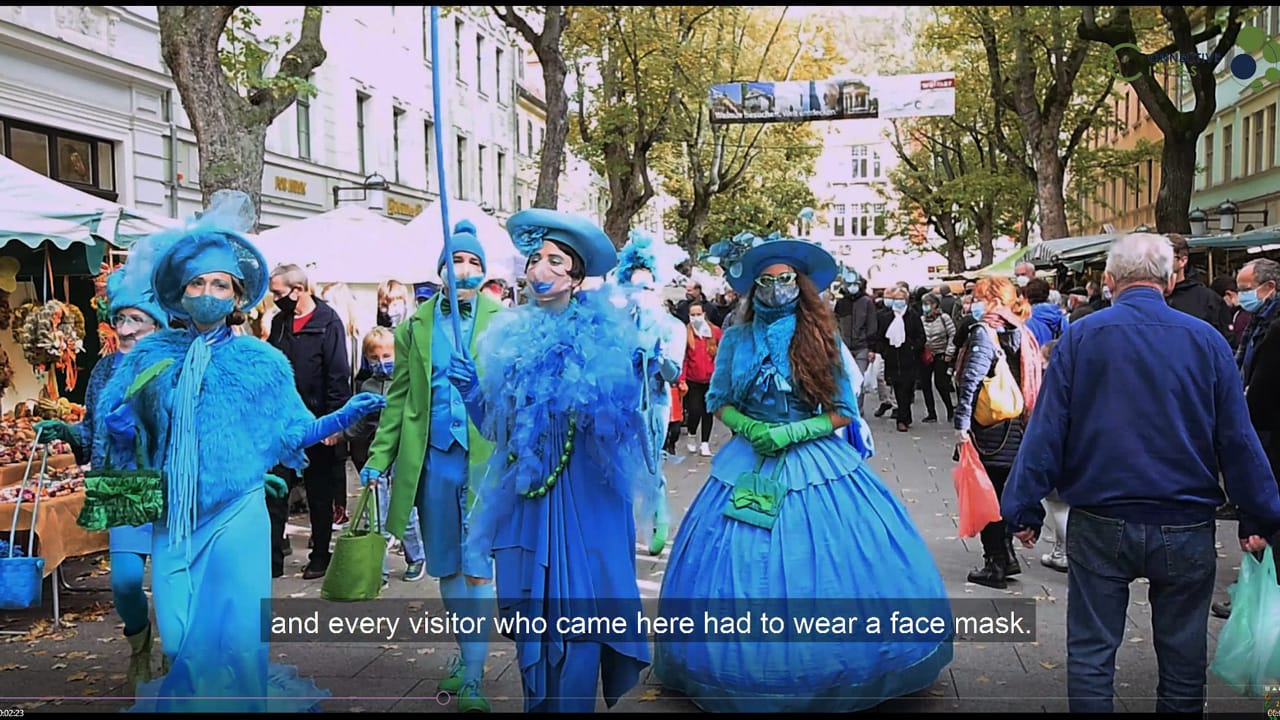
Weimar: Economic response to COVID-19

Weimar, a city that attracts thousands of tourists from all over the world every year. Watch how did the local city guides, hoteliers and small shop owners react to the lockdown? And what did the local authorities do?

Mehr: https://youtu.be/SxLgSY2aW6g

Join us and watch a special series of videos and podcasts that will show how to overcome a crisis from many different points of view. More videos, podcasts and interviews coming soon on our COVID-19 page.

Provision of basic services: water supply

Water has been a critical commodity in the fight against the Corona. It has been used in regularly washing hands and maintaining hygiene. Cities/ municipalities therefore, have been in the forefront in ensuring that there is enough supply of water.

On the 27th of October, 2020, 13 participants from various cities/ municipalities in Kenya, South Africa, Tanzania, Zambia and Zimbabwe came together to engage on the subject of water supply. The composition of the participants varied from cities/municipalities to local government associations including Kiambu, Lusaka, Mbeya, Nairobi and Pretoria. The aim was to engage each other on the challenges being faced and the changes that need to be adopted going forward in the Water, Sanitation and Hygiene (WASH) sector.

Program

Four presentations were made in this session and the scope covered views and experiences from the cities (Nairobi City County), research work and civil society organizations (Ferrial Adam – researcher & Water and Sanitation for the Urban Poor- WSUP). The session was moderated and gave room for response to the presentations and sharing of experiences from other cities. The session sought to respond to the following questions:

  1. What have been the core challenges for the municipalities?
  2. What measures have municipalities put in place?
  3. How do the municipalities deal with vulnerable groups which were most affected by the pandemic?
  4. Have there been any lessons learned already for long term strategies to improve cities’ resilience (i.e. preparedness for pandemics or similar events in the future)?

Presentations

A Civil Society Response to the Water Crisis During Covid-19 – a Place for Activist Citizen Science
Ms. Ferrial Adam

Nairobi City County Response to Covid-19
Mr. Mario Kainga

How can the Global WASH Sector Respond Better in Future Crises?
(Blog: https://www.wsup.com/blog/how-can-the-global-wash-sector-respond-better-in-future-crises/)
Mr. Kariuki Mugo & Ms. Eden Mati

Results

The presentations and discussions confirmed that most cities in SSA have inadequate coverage of the basic service; water. The sector players need to look into more sustainable solutions to the gap in provision of the service as opposed to short term measures in response to emergencies that are not long lasting. The highlights of the session were:

  • most of the countries in Africa are still water scarce.
  • there had to be sporadic interventions to reach the vulnerable in society who had no water & that the actors should not ignore the poor at their peril.
  • water has value hence encouraging the consumers not to pay has a negative impact on the service providers.
  • water utilities need operational sustainability plans that will stand in emergencies.
  • need for structured mandates & coordination mechanisms for institutions.
  • ensure equity in access to basic urban services.
  • the mapping of the water stressed communities using online tool by the activists is commendable and worth upscaling and replicating.

Asset Management to Optimize Water and Wastewater Infrastructure

Cost-intensive infrastructures such as drinking water and wastewater systems require carefully considered and target-oriented investment decisions from the management. The basis for this is Asset Management: the systematic inventory and documentation of all components, including a condition assessment and an evaluation of a possible extent of damage. The sustainable management of the water and wastewater infrastructure is thus based on a risk-based maintenance strategy. On the one hand, this is to maintain the most undisturbed operation of the facilities possible, and on the other hand, the limited resources are to used as efficiently as possible.

That is the theory! However, what does this mean in practice? About 25 municipal practitioners from 10 cities in Germany, the Palestinian Territories, Tanzania and Uganda exchanged ideas, developed solutions and project ideas together. They had accepted the invitation of Connective Cities and Hamburg Wasser to the virtual dialogue event, which took place from 30.11. – 02.12.2020.

Starting with an exchange of experiences on good practices and projects in the cities, challenges in implementation were identified and ultimately three project ideas were developed for Songea (Tanzania), Bethlehem (Palestinian Territories) and small and medium utilities in Uganda, which can lead to an improvement in efficiency and organisational framework for asset management.

Global Mayors Challenge 2021

The Corona pandemic has changed the daily lives of all of us. In cities around the globe, it has created many courageous, creative and inspiring responses. Bloomberg Philanthropies is launching the Global Mayors Challenge 2021, an urban leadership competition to identify the 50 best urban solutions that will help communities emerge stronger from the crisis.

The 50 leading cities will receive support from internationally renowned experts who will assist them in developing their proposals. Fifteen grand prize winners will then receive $1 million each to begin the implementation of their breakthrough ideas.

The Global Mayors Challenge 2021 is open to all cities with more than 100,000 inhabitants. The deadline for applications is 21 March 2021.

All further information can be found on the Bloomberg Philantropies website.

Infection chains – preventing infections through distance, communication and support for the informal sector

Around 100 municipal practitioners from more than 20 Latin American and European cities, including Brazil, Peru, Mexico, Colombia, Costa Rica, Chile, Ecuador, El Salvador, Spain, the United Kingdom and Germany, participated in two virtual events on the topic of “Infection Chains – preventing infection through distance, communication and supporting the informal sector”.

During the virtual exchange of experiences, which was held as part of the series of events on “Municipal response to COVID-19”, the participants presented and discussed practical examples from their cities and exchanged experiences on the topics of infection chains and prevention measures, as well as on the topic of crisis communication.

In the first virtual event, the challenges in the areas of infection chain tracing and Covid-19 testing strategies were discussed intensively, because they represent urgent problems for many Latin American cities. The exchange of experiences revealed that crisis communication in particular is an important concern for municipalities – in European as well as Latin American cities alike.

Municipal practitioners face the challenge of raising public awareness of the need for the measures taken over a long period of time. Therefore, the focus of the second event was on the topic of communication. Among other things, strategies of cities were presented on how municipal crisis communication can be designed. It was discussed how cities can inform their residents about public restrictions and Covid-19 in a transparent, inclusive and understandable way.

The virtual events provided space for an interactive exchange of experiences, which was very positively received. All participants took part in a lively discussion and were in favour of continuing the offer.

The languages offered included Spanish, Portuguese, English and (partly) German.

Programme

During the two events, six good practices from Essen and Stuttgart (Germany), Aracaju, Niterói, Belo Horizonte (Brazil) and Naucalpan (Mexico) were presented.

Participants also gained a new perspective on the pandemic from the presentation of three studies on municipal management of Covid-19 by the Brazilian municipal associations “Asociación Brasileña de Municipios” and “Confederación Nacional de Municipios,” as well as “Design Thinkers Group Spain” and “Whiteboard Innovation Israel”.

The aim of the virtual event was also to actively involve the participants. The space for questions between the presentations and the subsequent discussion were used intensively for exchange.

The following questions were discussed during the two events:

  1. What measures can be taken to interrupt infection chains and what role can the municipality play in this?
  2. How can infections be traced and what are local challenges in doing so?
  3. What is the role of the informal sector in relation to infections?
  4. What strategies can be taken to make crisis communication inclusive, transparent and understandable?
  5. How can communities with limited access to digital communication tools be reached?

Good practice presentations

Presentations on 14.10-2020

Decentralised mobile sample collection strategy of the city of Essen.
Jörg Spors, Hygiene Officer of the Fire Department of the City of Essen, Germany

Measures taken by municipalities to combat the COVID-19 pandemic.
Eduardo Tadeu Pereira, Director “Asociación Brasileña de Municipios” (ABM), Brazil

Fighting the pandemic with strategic management and innovative measures, Aracaju, Brazil.
Waneska de Souza Barboza, Aracaju Health Department, Aracaju City Hall, representative of the National Front of Mayors (FNP), Brazil

Government action to combat Covid-19 in Naucalpan, Mexico.
Mauricio Eduardo Aguirre Lozano, Secretary of the Municipality of Naucalpan, Mexico

Survey on covid-19: focus on local government and support from federal agencies.
Carla Albert, Health Worker, Confederación Nacional de Municipios (CNM), Brazil

Presentations on 05.11.2020

Opening Speech “Global Human Research Project”. Jorge Roriguez Nieto,
Design Thinkers Group Spain and Amir Hoshia, Whiteboard Innovation Isreal.

Integrative Crisis Communication, Stuttgart, Germany.
Ayşe Özbabacan, Integrative Crisis Communication Officer, Stuttgart, Germany,
Simone Fischer, Integration Policy Officer, Stuttgart, Germany,
Reinhard Schröter, Operations Manager Bus and Tram, Stuttgarter Verkehrsbetriebe, Stuttgart, Germany.

Covid-19 and the implications on the sewage system, Niterói, Brazil.
Camilla Franco, Undersecretary of Health, Niterói Municipal Health Secretariat, Niterói, Brazil

Communication in Crisis: Citizens, Passers-by & Customers, Belo Horizonte, Brazil.
Hugo Salomão França, Director of International Relations, Belo Horizonte City Hall, Brazil.

Results

Through peer consultation, participants were able to share their knowledge and experiences around the topics of infection chains and crisis communication, as well as analyse common challenges. Furthermore, thanks to international expertise and the presentation of good practice examples, new approaches to solutions were disseminated.

After the virtual session, participants can continue their exchange on the Connective Cities virtual platform.

Waste to positive energy in Mafraq governorate in Jordan

The establishment of the composting plant to produce organic fertilizers was part of the plan for solid waste management in Jordan. The project was jointly planned by the Ministry of Local Administration and the UNDP in its first phase, and then it received technical and financial support from the GIZ in its second and third phases. The project aims to serve Mafraq governorate which hosts a large number of livestock farms, through the collection and treatment of animal manure to produce organic fertilizers to be used in agricultural land in the city.

Towards the Just City in Kenya

In the next 25 years, Africa’s urban population is set to double. By 2040, the majority of Africans will be living in cities. There are numerous reasons for this: climate change, violent conflicts and the hope of finding work or education, although this list could easily be extended. Urbanisation thus constitutes one of the greatest transformations facing Africa in the 21st century.

Despite the diversity of the African continent, however, they are so far mostly “unjust” cities that people are moving to. The majority live in informal settlements and work under precarious conditions, mostly in the informal sector, without employment contracts and social security.

Towards the Just City in Kenya is the first publication of its kind that explores the conceptualisation and application of the “just city” concept in Kenya. The authors explore the concept from various dimensions, namely:

  • Conceptualisation of the just city in Kenya.
  • Locating the just city in the constitutional, policy, legislative and institutional context.
  • Discussion of spatial justice in the context of planning and housing; and
  • Interrogating practical ways in which cities express injustice and how these can be practically addressed, with examples from the public transport sector.

The study offers recommendations on how the just city concept can be realised in Kenya, looking specifically at urban institutions, citizens’ rights, housing policies and urban public transport systems.

With its just city project, FES Kenya and its partners facilitate dialogues through working groups which bring together civil society, trade unions, Members of County Assemblies, Government representatives, and academia working in urban centres of Kenya with the objective to jointly work for a just city.

Local Economic Development and Job Creation in MENA

Local Economic Development (LED) remains a top priority for the MENA countries as a driver for economic stability and job creation for a region with one of the highest unemployment rates in the world. While many resources are invested in fostering local economic development in the MENA countries led by governments, however, there is often a lack of systematic access to practice-oriented solutions.

More than 40 local urban practitioners from 22 municipalities and 10 countries from the MENA region and Germany took part of the virtual dialogue event organized by the Connective Cities project. The dialogue event consisted of five virtual sessions held between the Sep 29th – Oct 7th 2019, focusing on facilitating the exchange of know-how and experiences through peer-to-peer learning among municipal representatives and urban practitioners. Moreover, the dialogue event aimed at enriching the analysis and planning capacity of the participating municipal representatives to address existing challenges of implementing LED and job creation programs.

Throughout the Dialogue event, participants showed tremendous commitment to the program with a level of excitement that remained high till the last day of the dialogue where they learned how to present their LED project concepts in less than 3 minutes; an activity that reflected their understanding of project development process as well as the peer-to-peer exchange methodology.

This report reflects in detail the main results of the virtual dialogue event.