


“The world we live in has been transformed in a manner not witnessed in recent times. In a rapidly urbanizing and globalized world, cities have been the epicentres of COVID-19. The virus has spread to virtually all parts of the world; first, among globally connected cities, and now, through community transmission and from the city to the countryside.
The World Cities Report 2020 shows that the intrinsic value of sustainable urbanization can and should be harnessed for the wellbeing of all. The report provides evidence and policy analysis of the value of urbanization from an economic, social and environmental perspective, including the unquantifiable value that gives cities their unique character; and also explores the role of innovation and technology, local governments, targeted investments and the effective implementation of the New Urban Agenda in fostering the value of sustainable urbanization.”
Category: The social city
Call for solutions until 9 November: #SolutionsForCities

Worldwide cities face similar challenges. This has become even more visible through the outbreak of the Covid-19 pandemic. The pandemic situation has generated inspiring creativity and solidarity. How can we transfer innovative solutions from the pandemic to the future? How can we promote sustainable urban development for the common good? To tackle these questions, the German Federal Ministry of the Interior, Building and Community initiated the international, digital ideas competition #SolutionsForCities.
In a two-day virtual Challenge Lab, current challenges of cities were identified together with German Smart City model projects and with partner cities of the International Smart Cities Network (ISCN). These challenges will be published on the platform www.solutionsforcities.de with the Call for Solutions from October 28th.
Call for Solutions from October 28th to November 9th 2020
The Call for Solutions is a global call for the submission of digital solutions for the common good. It is aimed at international companies and start-ups, as well as local authorities, research institutions and projects, and civil society. The Call for Solutions opens on October 28th 2020 during the Smart City Day at the Smart Country Convention 2020! Until November 9th 2020, digital solutions can be submitted on the platform www.solutionsforcities.de as response to the published urban challenges.
Scalathon from November 23rd – 25th 2020
After the Call for Solutions, the participating cities or municipalities select the most suitable solutions for their challenges and compete in the Scalathon as a team with the respective solution providers.
The Scalathon is the core of the ideas competition and will take place from November 23rd – 25th 2020. During the three-day virtual workshop, selected solution providers will work closely together with the respective city or municipality, further develop the digital solutions and adapt them to the concrete local challenges.
Green Urban Infrastructure in Asian Cities
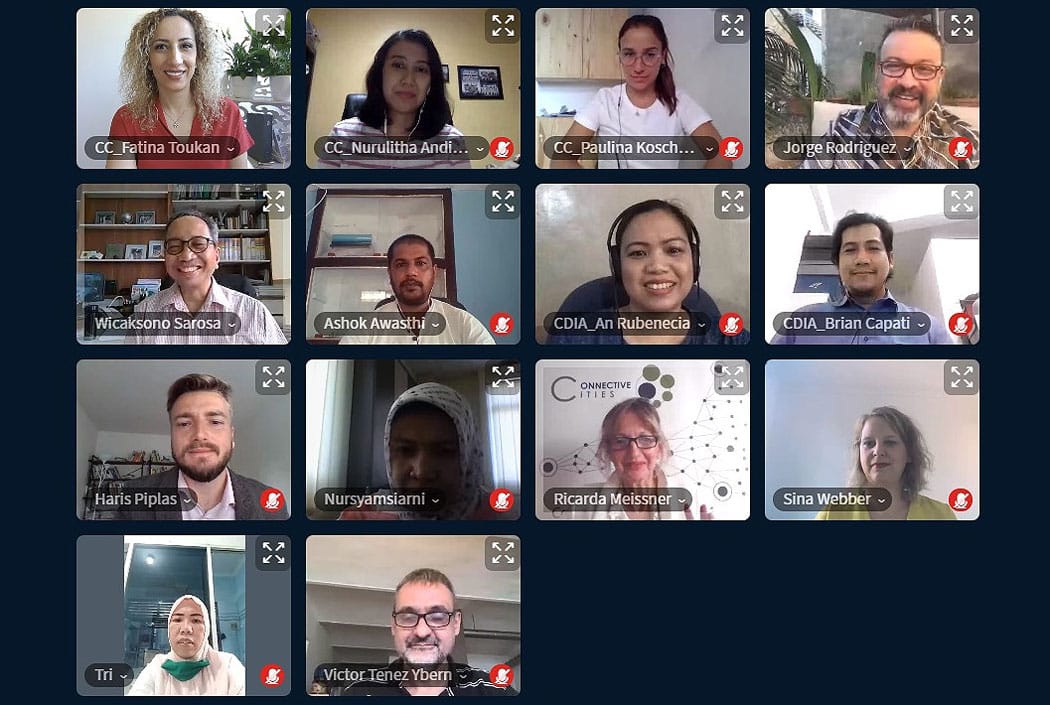
From August 3rd until August 14th, 2020 around 30 urban practitioners from 6 Asian Cities came together virtually to exchange their experiences and expertise in the field of Green Urban Infrastructure. Especially challenges in waste management and water sanitation were discussed intensively, as they represent pressing issues for many Asian cities.
The aim of the workshop was to further develop existing project ideas by discussing arising challenges and trying out new methods to find new perspectives and approaches to urban planning. The event was a follow-up to the dialogue event in Bandung, Indonesia in November 2019.
Due to the restrictions imposed on all of us by the Covid-19-pandemic, the event was conducted virtually by using the Connective Cities Platform. To ensure an enriching learning experience, the event took place over two weeks and included synchronous workdays with various keynote presentations as well as asynchronous days on which the participants could work on their project ideas at their own pace.
Six projects from Indonesia and Nepal were presented and further developed (see presentations).
Pandemic Response in refugee-hosting cities

More than 20 municipal representatives from around 8 cities in MENA participated in the sixth virtual event of the knowledge-exchange series on Municipal Response to the COVID-19 Pandemic. The event aimed at showcasing good practices and special measures tailored to the needs of the vulnerable group of refugees and their host communities. For example, information-sharing through local networks of community volunteers, religious leaders and humanitarian workers became a decisive factor in combatting the spread of the virus. Other effective measures undertaken by refugee-hosting cities have put the Global Compact for Refugees into action with respect to targeting migrant and refugee communities in the context of the pandemic. The virtual event provided the space for an interactive exchange of experiences and all participants have engaged in a lively discussion bringing their local expertise to their peers.
Program
In this virtual session, the experience of the municipal unions of Dreib Al Awsat and Jurd El Qayteh in Lebanon was presented and their good practice of developing and employing an open source tracking application was showcased. In addition, insights from Irbid (Jordan) were shared by the representative of the city’s municipal council who has shed light on the economic impacts on refugees and host communities employed in the agricultural sector.
Moreover, the following set of questions were addressed:
- What have been the core challenges for refugee-hosting municipalities?
- What measures have refugee-hosting municipalities implemented to protect the vulnerable group of refugees?
- Are there any lessons learned with respect to service provision and preparedness against pandemics in refugee-hosting settings such as camps?
Presentations
In Arabic: Pandemic response using the open source application ‘Salamti’ in the municipal unions of Jurd Al Qayta and Dreib Al Awsat in Lebanon.
Mr. Abdul Ilah Zakaria, head of Jurd El Qayteh union, Lebanon
Mr. Abboud Merheb, head of Dreib Al Awsat union, Lebanon
Ms. Souraya Hammoud, SKLI
Measures to alleviate the economic impacts of the lockdown on Syrian refugees and their host communities in Irbid, Jordan.
Arabic version | English version
Ms. Iman Al Zoubi, Representative of municipal council, Irbid-Jordan
Results
Pandemic response in the refugee-hosting municipal unions of Jurd Al Qayta and Dreib Al Awsat in Lebanon was optimized using the open source application ‘Salamti’. The showcasing of this good practice resulted in an opportunity for cooperation between the initiators of Salamti application and greater Absan municipality in Gaza. Connective Cities will facilitate this cooperation as part of the follow-up activities.
Update on follow-up activities: Concrete cooperation on a solid basis
Connective Cities has organized a meeting between the initiators and developers of Salamati application at Balamand university in Lebanon and representatives of Greater Absan municipality in Gaza- Palestine (the mayor Dr.Anwar Abu-Zarifa and Mr. Ahmad Abu-Ismail) to discuss the dissemination of the good practice of Salamati application in Greater Absan municipality. The Representative of GIZ in Gaza has also participated in the meeting.
It has been agreed to sign a Memorandum of Understanding between the municipality and the initiators and developers of the application in order to kick-start the process of good practice dissemination including the provision of the Salamati application in Greater Absan municipality.
Salamati app is an open-source GIS-based application that enables local authorities to rapidly screen potential COVID-19 cases and to classify areas and people at high risk.
The launch of this pilot project is supported by SKL International under the aspect of digitization. As part of the Swedish Association of Local Authorities and Regions (SALAR), SKL International works worldwide to promote and strengthen local and regional self-government and resilience. By supporting active citizenship in Akkar-Lebanon through the promotion of local systems, community capacity building and community participation in local decision-making, Covid-19 can also be better contained and the negative effects of the pandemic reduced.
Civil society initiatives during and after the corona pandemic

More than 15 municipal representatives from Jordan, Palestine, Iraq, Tunis, Libya, Morocco and Algeria participated in the fourth virtual event of the knowledge-exchange series on Municipal Response to the COVID-19 Pandemic. The aim of the event is to showcase good practices that reveals what civil society organizations are doing on the ground, and the added value they bring to municipal response to the pandemic.
The virtual event provided the space for an interactive exchange of experiences and all participants have engaged in a lively discussion bringing their local expertise to their peers.
Program
In this virtual event, three good practices were shared from Beni-Khalled (Tunisia), Greater Amman (Jordan), Zletin (Libya). The moderated plenary session provided an opportunity for discussion between the presenters and the participants. The participants were then encouraged to continue with the exchange on the virtual platform where other resources were shared in addition to the session outputs. Overall, the following set of questions were addressed by the presenters:
- What have been the core challenges for civil society organizations in their role of supporting municipalities during the pandemic?
- What measures have civil society organizations put in place?
- How do the civil society organizations deal with vulnerable groups which were most affected by the pandemic?
- Are civil society organizations cooperating with municipalities to set different development-or service-related priorities in the aftermath of the pandemic?
- What are the lessons learned from the perspective of civil society organizations?
Presentations of good practices in Arabic (for members only)
Civil society initiatives supporting municipal response to the pandemic in Beni- Khalled, Tunisia and the community development sector.
Ms. Leila Ben Gacem, Beni-Khalled municipality
The role of civil society and the community development sector in the Greater Amman Municipality
Ms. Ghaida’a Al Hadidi; Greater Amman Municipality
Civil society and private sector initiatives to alleviate the impacts of the pandemic and the lock-down in Zletin, Libya
Dr. Taha Wali; Zletin Municipality in Libya
Results
The input given and discussion thereafter confirmed the immediate role of civil society in monitoring the pandemic’s impact on municipal service delivery as well as facilitating engagement with affected communities, a critical part of ensuring contextually relevant responses.
In order to follow through with the initiatives in the municipalities, Connective Cities provided a practice-oriented exchange between network members on Connective Cities platform where members could share their challenges and interventions in the provision of their civil society responses.
More: COVID-19-Update
C40 Mayors’ Agenda for a Green and Just Recovery

As the tragedy of the COVID-19 pandemic unfolds, mayors’ immediate priority is to face this unprecedented crisis and protect lives. At the same time, the city leaders who together established the Global Mayors COVID-19 Recovery Task Force are leading in taking the first steps towards recovery. They have committed to providing the swiftest and strongest possible rebound for their citizens and reaffirmed commitment to the principles of the Global Green New Deal — to protect our environment, strengthen economies and build a more equitable future – and reach out to other cities, youth, unions, business and civil society to join in this effort.
[…]
By taking a sustainable path at this critical juncture, by respecting science, fostering unity and embracing a spirit of innovation and purpose, cities will secure the best recovery they can and avoid the worst impacts of the climate crisis. Amid the devastation of this global pandemic, mayoral leadership has never been more important.
Nine principles for a green and just recovery are elaborated that can support cities’ recovery efforts.
More
Climate-proof and Resilient Urban Development

In view of the current situation worldwide, attendance formats for international meetings are neither sensible nor formally possible. Nevertheless, the international community of practice for sustainable urban development Connective Cities continued its offer in Latin America and invited municipal practitioners from Latin America and Germany to participate in the follow-up (LINK NITEROI) virtual workshop on the topic of “Climate-proof and resilient urban development – project planning of municipal adaptation measures”.
This time, 29 participants from eight different countries (Brazil, Ecuador, Argentina, Colombia, Mexico, Germany, Spain, USA) came together virtually to exchange experiences and knowledge. The aim of the event was to further develop the project ideas by revising strategic approaches with peer support and reflecting on examples from municipal practice.
Following project ideas were presented and jointly further developed:
- Project: Improving the resilience of people and environmental communities in areas vulnerable to climate change / Municipality: Portoviejo, Ecuador
- Project: Strengthening the ecosystem-based adaptation measures at the tourist location San Miguel de Allende / Municipality: San Miguel de Allende, México
- Project: Adaptation of existing and new households to the forecast increase in temperatures and precipitation for the Risaralda administrative area / Municipality: Quinchía, Colombia
- Project: Colina Verde – Strengthening of security conditions by limiting the risk of landslides and fires in the community of Boa Vista / Municipality: Niterói, Brazil
- Project: The importance of agroforestry systems as an adaptation measure to climate change and as an economic sector for the community of Tomé-Açu / Municipality: Tomé-Açu, Brazil
Towards the Localization of the SDGs – 4th Report

LOCAL AND REGIONAL GOVERNMENTS’ REPORT TO THE 2020 HLPF 4th REPORT
The fourth report of the local and regional governments (LRGs) to the HLPF: Towards the Localization of the SDGs (2020) has been produced at a difficult time, when the world is suffering the effects of a global pandemic. The impact of this crisis on the social and economic fabric of our communities is, however, still difficult to measure. Within this context, the words “solidarity” and “cooperation” take on an even more relevant meaning. This was the message of the UN Secretary-General in his report to the HLPF and it reflects the feelings of our constituency, based on the experiences of numerous cities and territories.
The transformative framework of the universal development agendas remains essential for a more sustainable future. Local and regional governments from all over the world are reinstating their strong commitment to achieve the transformation that their societies call for after the pandemic through the potential of the SDGs and the universal development agendas.
In this context, the report analyses the evolution of the process of SDG localization in cities and territories throughout the world, particularly focusing on the 47 countries reporting this year. In doing this, it builds upon the information presented in the Voluntary National Reviews (VNRs) and on the views expressed by LRGs through their own reports (more than 40 Voluntary Local Reviews from cities and regions and six reports from LGAs which provide a wider, subnational view of the localization process in the countries reporting this year). It also collects together the answers to the GTF survey, with the visions of LRGs from 75 countries. This report will be presented during the Local and Regional Governments’ Day at the 2020 High-Level Political Forum.
Political Forum.
Cities Policy Responses

This note was developed by the OECD Centre for Entrepreneurship, SMEs, Regions and Cities (CFE) in collaboration with the OECD Working Party for Urban Policy and the OECD Champion Mayors Initiative for Inclusive Growth. It is an update of the earlier versions released on 27 March and 13 May, which expands the examples of measures taken by cities to respond to COVID-19 and recover from the economic and social crisis. The note provides analysis on issues related to the economic, social and environmental impacts, lessons learned in terms of digitalisation, mobility, density, urban design and collaborative governance, and action-oriented guidance to build back better cities, building on previous work on urban resilience. Short and medium term responses provided by cities are clustered around six categories: i) social distancing; ii) workplace and commuting; iii) vulnerable groups; iv) local service delivery; v) support to business; and vi) communication, awareness raising and digital tools. The note also includes updated information on how cities are progressively exiting the lockdown.
German-Turkish Municipal Partnership Conference

In cooperation with the German Association of Cities and Towns (Deutscher Städtetag) together with the Association of Turkish Municipalities (Türkiye Belediyeler Birliği, TBB) and with the support of the city of Istanbul (Istanbul Büyükşehir Belediyesi, IBB), the German representations in Turkey are planning a two-day German-Turkish municipal partnership conference in Istanbul in the second half of 2020. The municipal partnership conference is intended to identify mutual issues and challenges as well as successful approaches for project cooperation.
As a kick-off to the German-Turkish municipal partnership conference, a virtual pre-conference will take place from 15 to 18 June 2020. Topics of the technical workshops are:
- Digital City
- Sustainable urban development
- The role of municipalities in protecting marginalised groups and refugees in the COVID 19 crisis
- Youth exchanges in municipal partnerships
Please refer to the conference announcement (in German) for further information on registration, programme and technical requirements.