


Despite societal and structural challenges that impede women’s participation in the Jordanian labor market, a pioneer program in Jordan has resulted in promoting female employment in the water sector services in refugee-hosting cities.
Category: Local economic development
Climate Proofing Urban Development
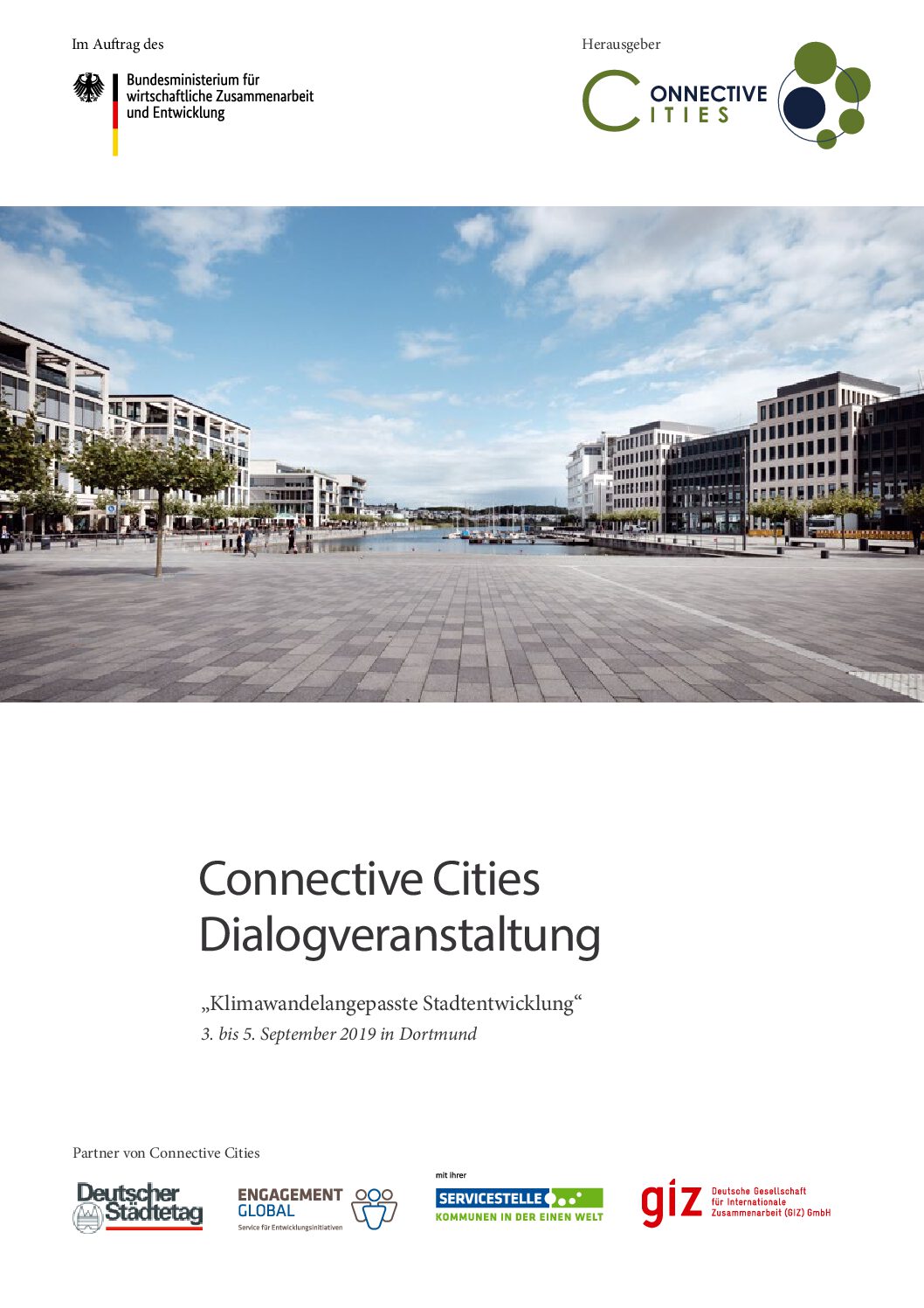
The impacts of climate change include extreme weather events such as heavy rainfalls, severe thunderstorms, prolonged droughts and heat waves. These impacts pose major challenges for cities around the world. Although climate change is a global challenge, adapting to its impacts is largely a local process.
Almost 30 local practitioners from 12 cities, 10 countries and four continents accepted the invitation of Connective Cities and the City of Dortmund to a dialogue event on the topic of ‘Climate proofing urban development’, which took place from 3 to 5 September 2019 in Dortmund, Germany. This report documents the discussed good practices, solution approaches and developed project ideas.
UN-Habitat COVID-19 Response Plan

“The world is living through an unprecedented crisis as COVID-19 continues to spread, with tens of thousands of lives lost and over two hundred countries affected. In just a few months, the pandemic has transformed the way we live, work, travel and socialize. The world’s cities are generally reacting quickly to this urban humanitarian crisis and how they respond is critical to protect their population, halt the pandemic and set the scene for resilience and recovery.”
Tackling coronavirus (COVID‑19) Contributing to a global effort

On its microsite about COVID-19 the OECD is compiling data, analysis and recommendations on a range of topics to address the emerging health, economic and societal crisis, facilitate co-ordination, and contribute to the necessary global action when confronting this enormous collective challenge.
In addition it offers “a country policy tracker”.
What are countries doing to contain the spread of the coronavirus? How are countries helping people, small businesses and the economy to weather the crisis and beyond? This Country Policy Tracker helps you to navigate the global response.
In addition – on city level – a summary can be found in the briefing note on
Cities policy responses
https://read.oecd-ilibrary.org/view/…
Cities may be better equipped than the rest of their country to respond to the COVID19 crisis due to their well-developed health care facilities. However, cities are densely populated places where people live and gather, thus at risk of spreading the virus due to the close proximity among residents and challenges to implement social distancing. The briefing note provides examples of measures taken by cities to respond to the current coronavirus epidemic, clustered around six categories: i) communication and awareness raising, ii) workplace and commuting; iii) social distance; iv) vulnerable groups; v) local service delivery; and vi) support to business.
If you wish to submit examples of how your cities respond to COVID-19, please contact
15 Pathways to localise the Sustainable Development Goals

This publication illustrates how the 15 pathways of the Basque Declaration can be used by towns and cities to localise the Sustainable Development Goals (SDGs).
In this publication, the 15 pathways of the Basque Declaration are illustrated with stories taken from the Transformative Action database of the Sustainable Cities Platform. Each of these stories are former applications to the Transformative Action Award 2017-2019 and have been reviewed by a jury of experts, which includes representatives from the European Committee of the Regions, the European Investment Bank, UNESCO Etxea, the City of Aalborg (Denmark) and ICLEI Europe.
The purpose of these stories is to provide local governments and other local stakeholders with inspiration for action, rather than the formulation of yet another action plan. The examples also give insight into how to implement the goals using an integrated approach across sectors and departments. For each story, the most relevant pathway and SDGs are indicated, based on an independent assessment by ICLEI Europe. They show the diversity of approaches across topics, geographical locations and local cultures.
Understanding Infrastructure Interdependencies in Cities

“Modern urban infrastructure and their systems of operation are highly interdependent. They are formed of multiple connections, feedback and feedforward paths, and intricate branching where services or information are transferred across city sectors. This means that if one system fails, it can have cascading impacts on other systems. Climate change can compound these impacts significantly. Some systems may be directly affected by climate change events – such as roads during flooding. Other systems may be affected indirectly, such as the health sector and the financial sector if there are power outages. The interdependencies of city systems combined with climate impacts can lead to a ripple effect of disruptions. Understanding infrastructure interdependencies and critical failure points is therefore vital to achieving long- term climate resilience across a whole city.”
Integrated Implementation of the 2030 Agenda in Cities and City-Regions

GIZ and the authors in this publication series observe increasing spatial and functional interrelations between cities, settlements and their surrounding rural areas and argue that the city-regional scale is highly relevant and call for paradigm shifts towards urban and regional planning, financing and implementation across sectors, stakeholders, administrative borders and governmental level. The studies and discussion papers in this publication series cover a diverse set of cityregional challenges and solutions gathered around the focus areas “Integrated Implementation of Global Agendas”, “Metropolitan Governance”, “Integrated Territorial Development for Strengthening Urban-Rural Linkages – including City Region Food Systems”, “Urban Resource Management and Climate Change”, “Digitalisation and Urban Development – Smart Cities” and “Regional Economic Development and Innovative Business Regions”. The studies and discussion papers aim at promoting the local implementation of Sustainable Development Goals (SDGs), the Paris Climate Agreement and the New Urban Agenda (NUA) which acknowledge the mutual dependencies between cities and regions as key potentials for inclusive and sustainable development.
The GIZ publication provides an overview of studies, discussion papers and digital sources related to urban and metropolitan issues from the perspective of German development cooperation.
Heatwave Guide for Cities

"Heatwaves are deadly and their impacts are on the rise globally due to climate change. People living in urban areas are amongst the hardest hit when a heatwave occurs because these are hotter than the surrounding countryside. Along with climate change, urbanization is one of the most transformative trends of this century and the last. Over half the world now lives in urban areas and this is projected to increase to two-thirds by 2050. It is crucial that cities incorporate heat-reduction tactics such as green spaces into their plans for growth or retrofit them in built areas. […] This practical guide is designed with, and for, people working in city government to understand, reduce the risk of, and respond to, heatwaves in their cities."
The Silent Revolution of Public Spaces in Afghanistan

"The Silent Revolution of Public Spaces in Afghanistan is the untold story of hope and peace in urban areas. The provision of public spaces in cities across Afghanistan is shaping the lives of the citizens, especially women and the poor, and the relationship with their cities. It is a social and cultural revolution that has empowered women, created jobs for the poor and improved the living standards of the citizens. It is a silent and peaceful revolution that has transformed the people and the city, building trust and confidence in public institutions. The photobook serves to portray the Afghan government’s response to the immediate urban challenges through impactful photos and stories. […]"
The Future of Urban Consumption in a 1.5°C World

New ways of measuring the climate footprint of cities show that urban consumption is a key driver of global GHG emissions. Cities therefore have a responsibility to significantly reduce their GHG emissions. This work has mostly focused on transport, buildings, energy and waste. This report assesses the impact of urban consumption on climate breakdown and explores the type and scale of changes needed to ensure that cities reduce their GHG emissions in line with internationally agreed, climate-safe limits.