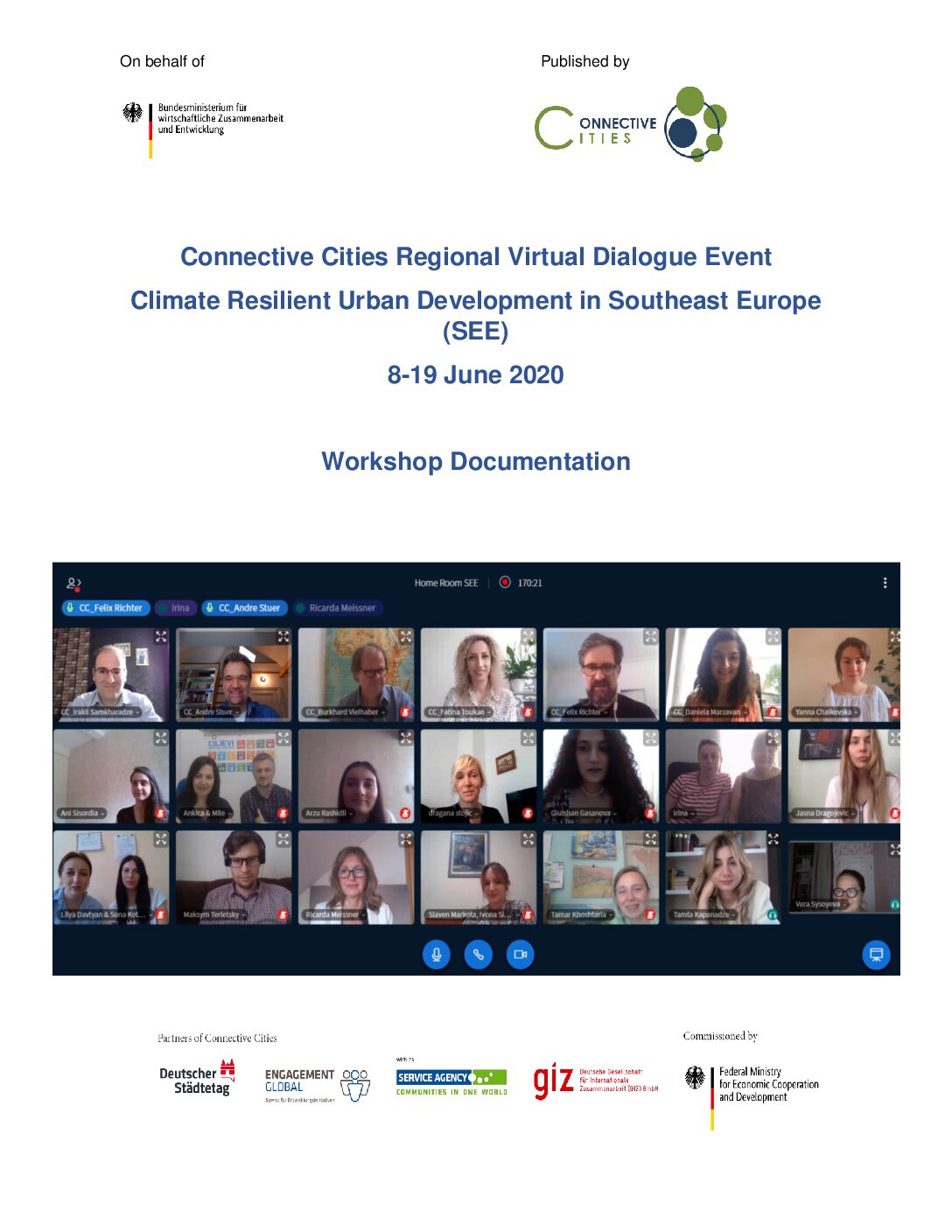
Climate Resilient Urban Development in Southeast Europe

The virtual event was the first component of the learning process conducted by Connective Cities in Southeast Europe. The aim of the virtual event was to support knowledge exchange and networking by increasing the visibility of good practices from municipalities in SEE region on one hand, and on the other hand by facilitating the needed virtual space and tools to create innovative solutions for local challenges through knowledge exchange and peer-to-peer consultations.

The virtual event, thus, supported transforming dialogue and exchange possibilities into a digital and remote format especially during and in the aftermath of the COVID-19 outbreak affecting heavily the lifestyle of urban dwellers and planers. As this will include effects on sustainable urban development, municipal urban practitioners need to develop more innovative and agile processes to improve future crises responses. Here, the interest was mainly in pragmatic solutions and approaches that can be applied or adapted to the different regional/local contexts. Furthermore, the event offered a virtual platform to discuss the challenges around the theme of climate resilient urban development and supported municipalities in developing new project ideas among peers that can be further implemented in the respective home communities or in the framework of existing or new thematic municipal partnerships.

COVID-19 in African cities

“COVID-19, a global pandemic declared by the World Health Organization (WHO), is crippling the global economy and upending people’s lives thereby threatening sustainable development across all its dimensions. Africa is also facing the dire consequences of the crisis, necessitating timely response, recovery and rebuilding policies and strategies. Globally, urban areas are the epicenters of the epidemic accounting for most of the confirmed COVID-19 cases. UN-Habitat in collaboration with UN Economic Commission for Africa (UNECA), UN Capital Development Fund (UNCDF), United Cities and Local Governments of Africa (UCLG), African Development Bank (AfDB), and Shelter Afrique have joined hands to produce this new report: COVID-19 in African Cities: Impacts, Responses and Policies. The report proposes several interventions to promptly and effectively address the challenges of COVID-19 pandemic in Africa at the urban level led by national and local governments supported by international and regional development institutions.”

Call for participants: Municipal Response to the COVID-19 Pandemic

A series of virtual events will be organised with the focus on municipal response to the pandemic. This municipal knowledge-exchange activity aims at analysing and discussing practical examples from municipalities in MENA, Sub Saharan Africa and Germany. The event will thus provide a platform for learning how to plan, manage and evaluate effective measures to curb the impacts of the pandemic. It will also be possible to discuss individual questions with urban practitioners. Municipal representatives from both political and technical levels are invited to participate in the exchange.

Thematic focus of the events

1. Public health and municipal administrative processes:

All countries evoked the public health legal framework and the WHO guidelines to enforce measures to reduce the spread of the virus. Nevertheless, the pandemic has revealed shortcomings in municipal capacities to overcome its implications. Investing in digitalizing municipal administrative processes, IT systems as well as the overall healthcare infrastructure is being prioritized by many localities. Countries have also applied a combination of measures and technologies to monitor and control the situation at both the local and national levels. This session will focus on the possible strategies and measures implemented by public health and administrative municipal actors.

2. Municipal service delivery including water, sanitation and solid waste management:

Maintaining high standards of hygiene requires adequate provision of urban services such as water, sanitation and solid waste management which are key in combatting the spread of the virus. In many regions, the pandemic has heightened the existing shortcomings in the provision of these services. Some municipalities have provided temporal measures in order to improve the service delivery. Urban informal settlements in particular, are struggling with the situation, especially where social distancing rules cannot be effectively enforced. This session will focus on municipal service providers in the water and sanitation sectors.

3. Economic impact:

The pandemic has negatively impacted the economy on all levels. Most countries resolved to partial or complete lock down that resulted in paralyzing many economic sectors. It is in those cities that imposed the strictest lock down measures that the negative economic impacts are most apparent as per initial observations. A significant part of the labour markets in developing countries is informal and is comprised of daily wagers who have suffered immensely from the lockdown measures that impacted their livelihoods and ability to pay for services. These measures have also had a negative impact on the revenue stream for the municipalities. On the flip side, some economic sectors are witnessing growth. For example, many cities are relying on local manufacturing enterprises to produce medical equipment like masks, protective gear and ventilators which they would import in the past. This session will focus on possible measures to cushion the negative economic impacts of the pandemic on the local level.

More information: Call for Participants

Contact

If you wish to participate kindly email Dr. Muna Shalan (muna.shalan@giz.de) for MENA region, Sophia Kamau (sophia.kamau@giz.de) for Sub Saharan Africa and Alex Wagner (Alexander.Wagner@engagement-global.de) or Thiago Garcia (Thiago.Garcia@engagement-global.de) for German cities and counterparts

German-Turkish Municipal Partnership Conference

In cooperation with the German Association of Cities and Towns (Deutscher Städtetag) together with the Association of Turkish Municipalities (Türkiye Belediyeler Birliği, TBB) and with the support of the city of Istanbul (Istanbul Büyükşehir Belediyesi, IBB), the German representations in Turkey are planning a two-day German-Turkish municipal partnership conference in Istanbul in the second half of 2020. The municipal partnership conference is intended to identify mutual issues and challenges as well as successful approaches for project cooperation.

As a kick-off to the German-Turkish municipal partnership conference, a virtual pre-conference will take place from 15 to 18 June 2020. Topics of the technical workshops are:

  1. Digital City
  2. Sustainable urban development
  3. The role of municipalities in protecting marginalised groups and refugees in the COVID 19 crisis
  4. Youth exchanges in municipal partnerships

Please refer to the conference announcement (in German) for further information on registration, programme and technical requirements. 

Towards ecological urban development in Palestine

For the Palestinian town Ajja, transitioning into a sustainable growth path was a result of a comprehensive vision by its municipal council backed up by the local population to build resilient municipal infrastructure that utilizes renewable energy sources and promotes sustainable management of the town’s resources.

Climate Proofing Urban Development

The impacts of climate change include extreme weather events such as heavy rainfalls, severe thunderstorms, prolonged droughts and heat waves. These impacts pose major challenges for cities around the world. Although climate change is a global challenge, adapting to its impacts is largely a local process.

Almost 30 local practitioners from 12 cities, 10 countries and four continents accepted the invitation of Connective Cities and the City of Dortmund to a dialogue event on the topic of ‘Climate proofing urban development’, which took place from 3 to 5 September 2019 in Dortmund, Germany. This report documents the discussed good practices, solution approaches and developed project ideas.

UN-Habitat COVID-19 Response Plan

“The world is living through an unprecedented crisis as COVID-19 continues to spread, with tens of thousands of lives lost and over two hundred countries affected. In just a few months, the pandemic has transformed the way we live, work, travel and socialize. The world’s cities are generally reacting quickly to this urban humanitarian crisis and how they respond is critical to protect their population, halt the pandemic and set the scene for resilience and recovery.”

Tackling coronavirus (COVID‑19) Contributing to a global effort

On its microsite about COVID-19 the OECD is compiling data, analysis and recommendations on a range of topics to address the emerging health, economic and societal crisis, facilitate co-ordination, and contribute to the necessary global action when confronting this enormous collective challenge.

In addition it offers “a country policy tracker”.
What are countries doing to contain the spread of the coronavirus? How are countries helping people, small businesses and the economy to weather the crisis and beyond? This Country Policy Tracker helps you to navigate the global response.

http://oecd.org/coronavirus/en/?fbclid=IwAR2fvsMo0Y86zUxab4nK4lNtK7JGpBMl3KSXTuF2r41ejnpOslxFAt6d6Tc#country-policy-tracker

In addition – on city level – a summary can be found in the briefing note on
Cities policy responses
https://read.oecd-ilibrary.org/view/…
Cities may be better equipped than the rest of their country to respond to the COVID19 crisis due to their well-developed health care facilities. However, cities are densely populated places where people live and gather, thus at risk of spreading the virus due to the close proximity among residents and challenges to implement social distancing. The briefing note provides examples of measures taken by cities to respond to the current coronavirus epidemic, clustered around six categories: i) communication and awareness raising, ii) workplace and commuting; iii) social distance; iv) vulnerable groups; v) local service delivery; and vi) support to business.

If you wish to submit examples of how your cities respond to COVID-19, please contact

CFEcities@oecd.org

15 Pathways to localise the Sustainable Development Goals

This publication illustrates how the 15 pathways of the Basque Declaration can be used by towns and cities to localise the Sustainable Development Goals (SDGs).

In this publication, the 15 pathways of the Basque Declaration are illustrated with stories taken from the Transformative Action database of the Sustainable Cities Platform. Each of these stories are former applications to the Transformative Action Award 2017-2019 and have been reviewed by a jury of experts, which includes representatives from the European Committee of the Regions, the European Investment Bank, UNESCO Etxea, the City of Aalborg (Denmark) and ICLEI Europe.

The purpose of these stories is to provide local governments and other local stakeholders with inspiration for action, rather than the formulation of yet another action plan. The examples also give insight into how to implement the goals using an integrated approach across sectors and departments. For each story, the most relevant pathway and SDGs are indicated, based on an independent assessment by ICLEI Europe. They show the diversity of approaches across topics, geographical locations and local cultures.