Climate Resilient Urban Development in South East Europe

More than 40 local urban practitioners from 24 municipalities and 8 countries, fitting under the EU’s regional dimension of Eastern Partnership and Western Balkans, intensively exchanged their experiences/municipal expertise within 2 weeks of digital experience on the topic of “climate resilient urban development” and jointly developed solutions and project ideas. They followed the invitation of Connective Cities to an unprecedented and unique experience: Virtual Dialogue Event: “Climate Resilient Urban Development” on 8-19 June 2020.

It has been increasingly understood that rapid urbanization and climate risks mean greater vulnerability to urban development. Many cities worldwide face significant challenges arising from natural hazards. The Southeast European region is no exception, whereas the climate resilient urban development becomes a central pillar of local sustainability policies. Most of the countries in the region continue to face environmental and climate change challenges.

This event offered a virtual platform to discuss these challenges and supported municipalities in developing locally adapted solutions for climate challenges; in exchanging cities’ significant experience of developing successful possible options and good practises; in transforming innovative urban project ideas into digital solutions especially in the aftermath of the COVID-19 outbreak, as this latter continues to impact heavily the lifestyle at all levels including the sustainable urban development workers and it’s needed to adapt to more innovative and agile ways of working for future crises responses.

During the 2 weeks asynchronous and synchronous digital experience participants listened to inspiring Keynote presentations from leading European scientists and shared insights with peers in carefully curated Peer2Peer collaboration and exchange formats. They learned how to collaborate digitally and got acquainted with some tools, methods and the overall mindset Design Thinking.

The project has built a Network, an exchange platform of urban players, which provides a systematic access to practice-oriented solutions for sustainable urban development by facilitating change and providing mutual support.

Call for participants: Improvement of urban water supply, sanitation and urban mobility in Sub-Saharan Africa

“Redefining service provision in unprecedented times” – Intermittent sessions between the 7th and 18th September, 2020

The challenge of providing adequate basic services and infrastructure in African cities is central to the economic performance of cities, and their ability to provide a minimum quality of life to their citizens. The major services which cities provide include transport networks, water and sanitation connections, electricity, health, education, and a whole host of other ancillary services such as street cleaning,and the maintenance of public spaces among others.

Connective Cities invites municipal experts from sub-Saharan Africa and Germany to participate in the virtual dialogue series on “Improving efficiency and effectiveness in water supply, sanitation and urban mobility”. The aim is to strengthen the capacity of municipalities to provide sustainable public services through intermunicipal knowledge exchange and mutual learning.

The topic will be addressed by focusing on three specific questions:

  1. Water supply: Approaches and technologies to improve access to clean drinking water
  2. Wastewater management: challenges and technologies for an effective municipal wastewater management
  3. Urban mobility: effective and environmentally friendly transport management

The Covid-19 pandemic also calls for redefining how cities design their projects to safeguard against the negative impacts and also to remain resilient in the face of a pandemic in future.

Please contact us if you have any questions:
Sophia Kamau, Coordinator of the Regional Network Sub-Saharan Africa: sophia.kamau@giz.de
Alice Balbo, Connective Cities Project Manager for the German Association of Cities: Alice.Balbo@staedtetag.de

Call for participants: Municipal Response to the COVID-19 Pandemic

A series of virtual events will be organised with the focus on municipal response to the pandemic. This municipal knowledge-exchange activity aims at analysing and discussing practical examples from municipalities in MENA, Sub Saharan Africa and Germany. The event will thus provide a platform for learning how to plan, manage and evaluate effective measures to curb the impacts of the pandemic. It will also be possible to discuss individual questions with urban practitioners. Municipal representatives from both political and technical levels are invited to participate in the exchange.

Thematic focus of the events

1. Public health and municipal administrative processes:

All countries evoked the public health legal framework and the WHO guidelines to enforce measures to reduce the spread of the virus. Nevertheless, the pandemic has revealed shortcomings in municipal capacities to overcome its implications. Investing in digitalizing municipal administrative processes, IT systems as well as the overall healthcare infrastructure is being prioritized by many localities. Countries have also applied a combination of measures and technologies to monitor and control the situation at both the local and national levels. This session will focus on the possible strategies and measures implemented by public health and administrative municipal actors.

2. Municipal service delivery including water, sanitation and solid waste management:

Maintaining high standards of hygiene requires adequate provision of urban services such as water, sanitation and solid waste management which are key in combatting the spread of the virus. In many regions, the pandemic has heightened the existing shortcomings in the provision of these services. Some municipalities have provided temporal measures in order to improve the service delivery. Urban informal settlements in particular, are struggling with the situation, especially where social distancing rules cannot be effectively enforced. This session will focus on municipal service providers in the water and sanitation sectors.

3. Economic impact:

The pandemic has negatively impacted the economy on all levels. Most countries resolved to partial or complete lock down that resulted in paralyzing many economic sectors. It is in those cities that imposed the strictest lock down measures that the negative economic impacts are most apparent as per initial observations. A significant part of the labour markets in developing countries is informal and is comprised of daily wagers who have suffered immensely from the lockdown measures that impacted their livelihoods and ability to pay for services. These measures have also had a negative impact on the revenue stream for the municipalities. On the flip side, some economic sectors are witnessing growth. For example, many cities are relying on local manufacturing enterprises to produce medical equipment like masks, protective gear and ventilators which they would import in the past. This session will focus on possible measures to cushion the negative economic impacts of the pandemic on the local level.

More information: Call for Participants

Contact

If you wish to participate kindly email Dr. Muna Shalan (muna.shalan@giz.de) for MENA region, Sophia Kamau (sophia.kamau@giz.de) for Sub Saharan Africa and Alex Wagner (Alexander.Wagner@engagement-global.de) or Thiago Garcia (Thiago.Garcia@engagement-global.de) for German cities and counterparts

Towards ecological urban development in Palestine

For the Palestinian town Ajja, transitioning into a sustainable growth path was a result of a comprehensive vision by its municipal council backed up by the local population to build resilient municipal infrastructure that utilizes renewable energy sources and promotes sustainable management of the town’s resources.

Dealing with the Corona Virus

Local utilities all over the world face unprecedented challenges in dealing with the Corona Virus. German utilities have exchanged their respective experiences and the measures they have taken in order to support one another and learn from one another. The German Association of Local Public Utilities has compiled, written down, and translated these experiences into English so that they may benefit utilities worldwide.

Untreated and Unsafe

Cities must ensure universal access to safe, reliable, and affordable sanitation so that all urban residents can lead productive, healthy, and thriving lives. New analysis of 15 cities in the global South shows that on average, 62 percent of sewage and fecal sludge is unsafely managed somewhere along the sanitation service chain.

Global monitoring efforts have resulted in an underestimation of the urban sanitation crisis and the risks to public health, the economy, and the environment. New data and analysis at the city and sub-city level is needed to galvanize action.

Sewers are convenient, safe, sanitary, and work well in dense urban environments and in multistory buildings. From the perspective of the household, sewer connections and services are often less expensive than on-site sanitation options.

In the absence of universal access to sewers, cities need to find an optimal combination of off-site and on-site sanitation options. On-site sanitation systems place enormous responsibility on households and private providers, and thus require strong government capacity to regulate and enforce sanitation standards to ensure public health and safety.

Citywide upgrading of informal settlements can improve low-income households’ access to urban sanitation. City governments should work with community organizations, nongovernmental organizations, and federations to improve and extend sanitation to informal settlements and address affordability.

Improving public service delivery at local level – solutions for participatory and accountable management

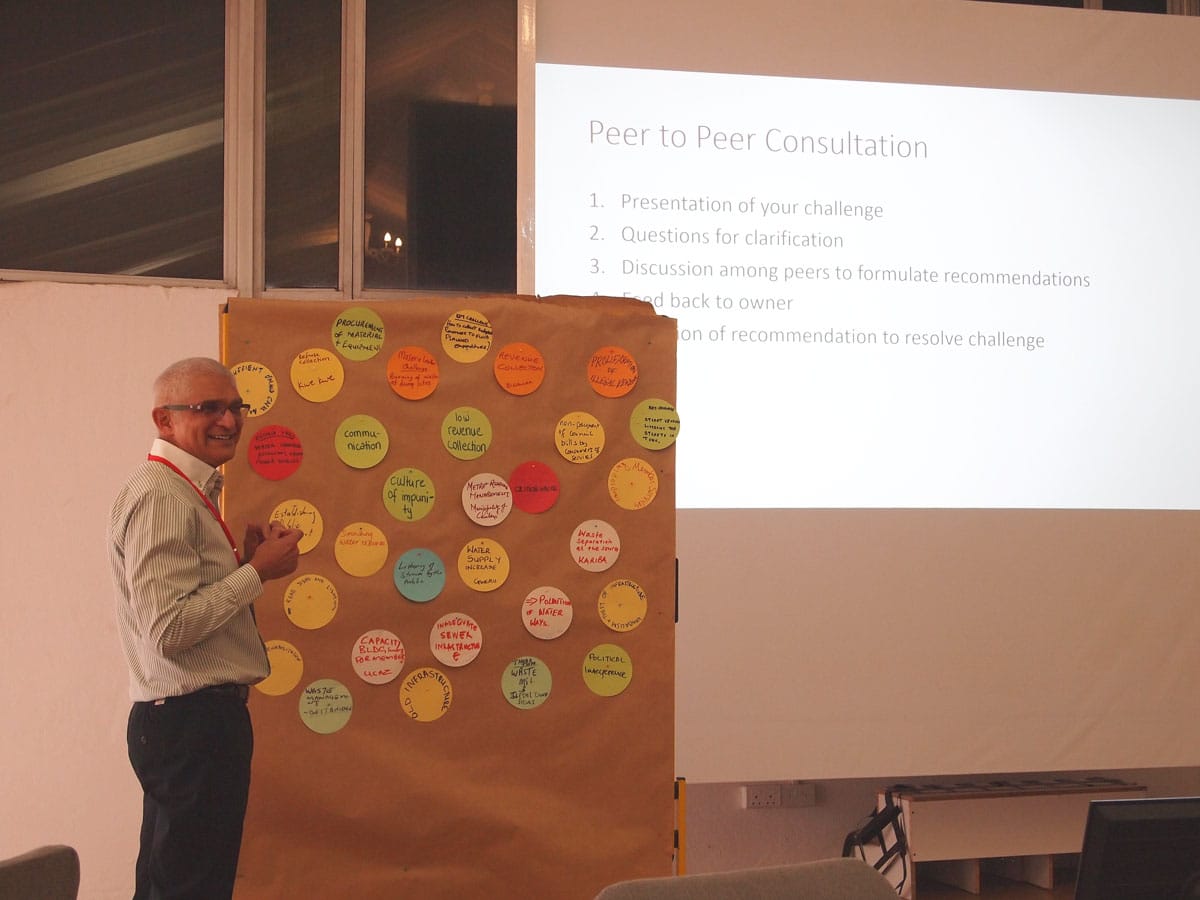
Connective Cities brought together urban practitioners from Sub-Sahara Africa and Germany to meet at the dialogue event “Improving public service delivery at local level – solutions for participatory and accountable management” in Harare, Zimbabwe from 20th to 22nd of August 2019.

Especially in Sub-Saharan Africa, dynamic urbanization and significant environmental and demographic changes are stating new challenges with regard to basic service delivery. Therefore, the focus was on developing approaches to improve public service delivery through public participation in order to achieve social accountability in the sectors of water, sanitation, waste management and transport.

Twenty-one representatives from Zimbabwean municipalities as well as a number of municipal practitioners from South Africa, Lesotho, Zambia, Kenya and municipal experts from Germany exchanged their experiences based on examples of Good Practices on public service delivery and defined possible solutions for the improvement of public service management.

The dialogue event was organized in cooperation with the GIZ project in Zimbabwe, “Strengthening the Urban Councils Association of Zimbabwe (UCAZ) to promote inter-regional and municipal knowledge transfer and capacity development”.

Resilient Cities, Resilient Lives

“The world is more densely populated and more interconnected than ever before. From extreme weather to refugee crises, from disease pandemics to cyberattacks, today’s state of play requires new models of governance to mitigate risk and respond to challenges. Business-as-usual models of reactive planning and siloed decision-making will not generate the fundamental strength and flexibility essential for us to thrive in the face of the shocks and stresses of the 21st century. […] The launch of 100 Resilient Cities program (100RC) by the Rockefeller Foundation acknowledged that the escalating trends of urbanization, globaliza- tion, and climate change pose tremendous risks, but also offer a tremendous opportunity. This report shares 100RC’s knowledge about what it takes to catalyze an urban resilience movement.”

Lifelines

From serving our most basic needs to enabling our most ambitious ventures in trade and technology, infrastructure services are essential for raising and maintaining people’s quality of life. Yet millions of people, especially in low- and middle-income countries, are facing the consequences of unreliable electricity grids, inadequate water and sanitation systems, and overstrained transport networks. Natural hazards magnify the challenges faced by these fragile systems. Building on a wide range of case studies, global empirical analyses, and modeling exercises, Lifelines lays out a framework for understanding infrastructure resilience — the ability of infrastructure systems to function and meet users’ needs during and after a natural shock — and it makes an economic case for building more resilient infrastructure.
It examines four essential infrastructure systems: power, water and sanitation, transport, and telecommunications. The focus is on spending better. Investing in regulations and planning, in the early stages of project design, and in maintenance can significantly outweigh the costs of repairs or reconstruction.

Lifelines concludes by identifying five obstacles to resilient infrastructure and offering concrete recommendations and specific actions that can be taken by governments, stakeholders, and the international community to improve the quality and resilience of these essential services, and thereby contribute to more resilient and prosperous societies.