C40 Mayors’ Agenda for a Green and Just Recovery

As the tragedy of the COVID-19 pandemic unfolds, mayors’ immediate priority is to face this unprecedented crisis and protect lives. At the same time, the city leaders who together established the Global Mayors COVID-19 Recovery Task Force are leading in taking the first steps towards recovery. They have committed to providing the swiftest and strongest possible rebound for their citizens and reaffirmed commitment to the principles of the Global Green New Deal — to protect our environment, strengthen economies and build a more equitable future – and reach out to other cities, youth, unions, business and civil society to join in this effort.
[…]
By taking a sustainable path at this critical juncture, by respecting science, fostering unity and embracing a spirit of innovation and purpose, cities will secure the best recovery they can and avoid the worst impacts of the climate crisis. Amid the devastation of this global pandemic, mayoral leadership has never been more important.

Nine principles for a green and just recovery are elaborated that can support cities’ recovery efforts.
More

Water and Climate Change

Climate change affects – and is affected by – global water resources. It reduces the predictability of water availability and affects water quality. Climate change also increases the occurrence of extreme weather events, threatening sustainable social-economic development and biodiversity worldwide. This, in turn, has profound implications for water resources. As such, climate change exacerbates the ever-growing challenges associated with the sustainable management of water. Conversely, the way water is managed influences the drivers of climate change.

The 2020 edition of the UN World Water Development Report addresses the critical linkages between water and climate change in the context of sustainable development. It also serves as a guide for concrete actions to address these challenges. It outlines actions, supported by examples from across the world, in three areas: first, enabling people to adapt to the impacts of climate change; second, improving the resilience of livelihoods; and, third, reducing the drivers of climate change.

Municipal Response to Covid-19 Pandemic II

More than 30 municipal representatives from around 20 cities in MENA and Sub-Sharan Africa participated in the second virtual event of the knowledge-exchange series on Municipal Response to the COVID-19 Pandemic.

Municipal representatives from both political and technical levels were invited and they engaged in knowledge-exchange to analyse and discuss practical examples of municipal response related to provision of urban basic services such as water and solid waste management.

Climate Resilient Urban Development in South East Europe

More than 40 local urban practitioners from 24 municipalities and 8 countries, fitting under the EU’s regional dimension of Eastern Partnership and Western Balkans, intensively exchanged their experiences/municipal expertise within 2 weeks of digital experience on the topic of “climate resilient urban development” and jointly developed solutions and project ideas. They followed the invitation of Connective Cities to an unprecedented and unique experience: Virtual Dialogue Event: “Climate Resilient Urban Development” on 8-19 June 2020.

It has been increasingly understood that rapid urbanization and climate risks mean greater vulnerability to urban development. Many cities worldwide face significant challenges arising from natural hazards. The Southeast European region is no exception, whereas the climate resilient urban development becomes a central pillar of local sustainability policies. Most of the countries in the region continue to face environmental and climate change challenges.

This event offered a virtual platform to discuss these challenges and supported municipalities in developing locally adapted solutions for climate challenges; in exchanging cities’ significant experience of developing successful possible options and good practises; in transforming innovative urban project ideas into digital solutions especially in the aftermath of the COVID-19 outbreak, as this latter continues to impact heavily the lifestyle at all levels including the sustainable urban development workers and it’s needed to adapt to more innovative and agile ways of working for future crises responses.

During the 2 weeks asynchronous and synchronous digital experience participants listened to inspiring Keynote presentations from leading European scientists and shared insights with peers in carefully curated Peer2Peer collaboration and exchange formats. They learned how to collaborate digitally and got acquainted with some tools, methods and the overall mindset Design Thinking.

The project has built a Network, an exchange platform of urban players, which provides a systematic access to practice-oriented solutions for sustainable urban development by facilitating change and providing mutual support.

Municipal Response to the COVID-19 Pandemic

More than 40 municipal representatives from around 30 cities in MENA, Sub-Saharan Africa and Germany participated in the first virtual event of the knowledge-exchange series on Municipal Response to the COVID-19 Pandemic.

Municipal representatives from both political and technical levels were invited and they engaged in knowledge-exchange to analyse and discuss practical examples of municipal response to the pandemic in the field of public health and municipal administrative processes. The webinar provided the space for an exchange of experience on how to plan, manage and evaluate effective measures to curb the impacts of the pandemic.

Call for participants: International exchange of experiences: lessons learned in the Covid-19 crisis

August – December 2020

Cities worldwide are still experiencing the impacts of the Covid-19 pandemic throughout all their municipal departments. In addition to public health care, municipal services must be maintained during the crisis. Local governments must also ensure their own ability to function properly. Some consequences of the pandemic, such as halting economic development, hit local authorities first. Municipalities are currently having to learn to cope with new situations very fast. But the crisis has also shown how important the resilience of municipalities is: this directly applies to local crisis management and disaster preparedness as well as the need for continually adaptive urban planning and development towards increasing the resilience of cities. The current crisis has shown and proven once again that resilience is an essential capacity of municipalities.

Many cities and municipalities have found solutions to the new challenges and developed new strategies. In order to better address the issues related to the pandemic, it is now necessary to share and possibly develop these solutions and strategies together.  
From August to December 2020, the international community of practice for sustainable urban development Connective Cities is organising a series of virtual exchange formats on measures, challenges, and solutions to overcome the corona crisis in cooperation with engaged urban practitioners (municipal experts as well as local experts from academia, civil society and business).

The series of virtual exchange events targets German and international urban practitioners working on various aspects of municipal strategies to cope with the COVID-19 crisis. Presentations of good practice examples will encourage the participating stakeholders to exchange ideas. Developing customized and practical solutions for relevant affected cities can also be an additional and beneficial outcome of the series in the context of a follow-up cooperation.

More information: Detailed and regular updated schedule of events

Towards the Localization of the SDGs – 4th Report

LOCAL AND REGIONAL GOVERNMENTS’ REPORT TO THE 2020 HLPF 4th REPORT

The fourth report of the local and regional governments (LRGs) to the HLPF: Towards the Localization of the SDGs (2020) has been produced at a difficult time, when the world is suffering the effects of a global pandemic. The impact of this crisis on the social and economic fabric of our communities is, however, still difficult to measure. Within this context, the words “solidarity” and “cooperation” take on an even more relevant meaning. This was the message of the UN Secretary-General in his report to the HLPF and it reflects the feelings of our constituency, based on the experiences of numerous cities and territories.

The transformative framework of the universal development agendas remains essential for a more sustainable future. Local and regional governments from all over the world are reinstating their strong commitment to achieve the transformation that their societies call for after the pandemic through the potential of the SDGs and the universal development agendas.

In this context, the report analyses the evolution of the process of SDG localization in cities and territories throughout the world, particularly focusing on the 47 countries reporting this year. In doing this, it builds upon the information presented in the Voluntary National Reviews (VNRs) and on the views expressed by LRGs through their own reports (more than 40 Voluntary Local Reviews from cities and regions and six reports from LGAs which provide a wider, subnational view of the localization process in the countries reporting this year). It also collects together the answers to the GTF survey, with the visions of LRGs from 75 countries. This report will be presented during the Local and Regional Governments’ Day at the 2020 High-Level Political Forum.
Political Forum.

Cities Policy Responses

This note was developed by the OECD Centre for Entrepreneurship, SMEs, Regions and Cities (CFE) in collaboration with the OECD Working Party for Urban Policy and the OECD Champion Mayors Initiative for Inclusive Growth. It is an update of the earlier versions released on 27 March and 13 May, which expands the examples of measures taken by cities to respond to COVID-19 and recover from the economic and social crisis. The note provides analysis on issues related to the economic, social and environmental impacts, lessons learned in terms of digitalisation, mobility, density, urban design and collaborative governance, and action-oriented guidance to build back better cities, building on previous work on urban resilience. Short and medium term responses provided by cities are clustered around six categories: i) social distancing; ii) workplace and commuting; iii) vulnerable groups; iv) local service delivery; v) support to business; and vi) communication, awareness raising and digital tools. The note also includes updated information on how cities are progressively exiting the lockdown.

Call for participants: Improvement of urban water supply, sanitation and urban mobility in Sub-Saharan Africa

“Redefining service provision in unprecedented times” – Intermittent sessions between the 7th and 18th September, 2020

The challenge of providing adequate basic services and infrastructure in African cities is central to the economic performance of cities, and their ability to provide a minimum quality of life to their citizens. The major services which cities provide include transport networks, water and sanitation connections, electricity, health, education, and a whole host of other ancillary services such as street cleaning,and the maintenance of public spaces among others.

Connective Cities invites municipal experts from sub-Saharan Africa and Germany to participate in the virtual dialogue series on “Improving efficiency and effectiveness in water supply, sanitation and urban mobility”. The aim is to strengthen the capacity of municipalities to provide sustainable public services through intermunicipal knowledge exchange and mutual learning.

The topic will be addressed by focusing on three specific questions:

  1. Water supply: Approaches and technologies to improve access to clean drinking water
  2. Wastewater management: challenges and technologies for an effective municipal wastewater management
  3. Urban mobility: effective and environmentally friendly transport management

The Covid-19 pandemic also calls for redefining how cities design their projects to safeguard against the negative impacts and also to remain resilient in the face of a pandemic in future.

Please contact us if you have any questions:
Sophia Kamau, Coordinator of the Regional Network Sub-Saharan Africa: sophia.kamau@giz.de
Alice Balbo, Connective Cities Project Manager for the German Association of Cities: Alice.Balbo@staedtetag.de

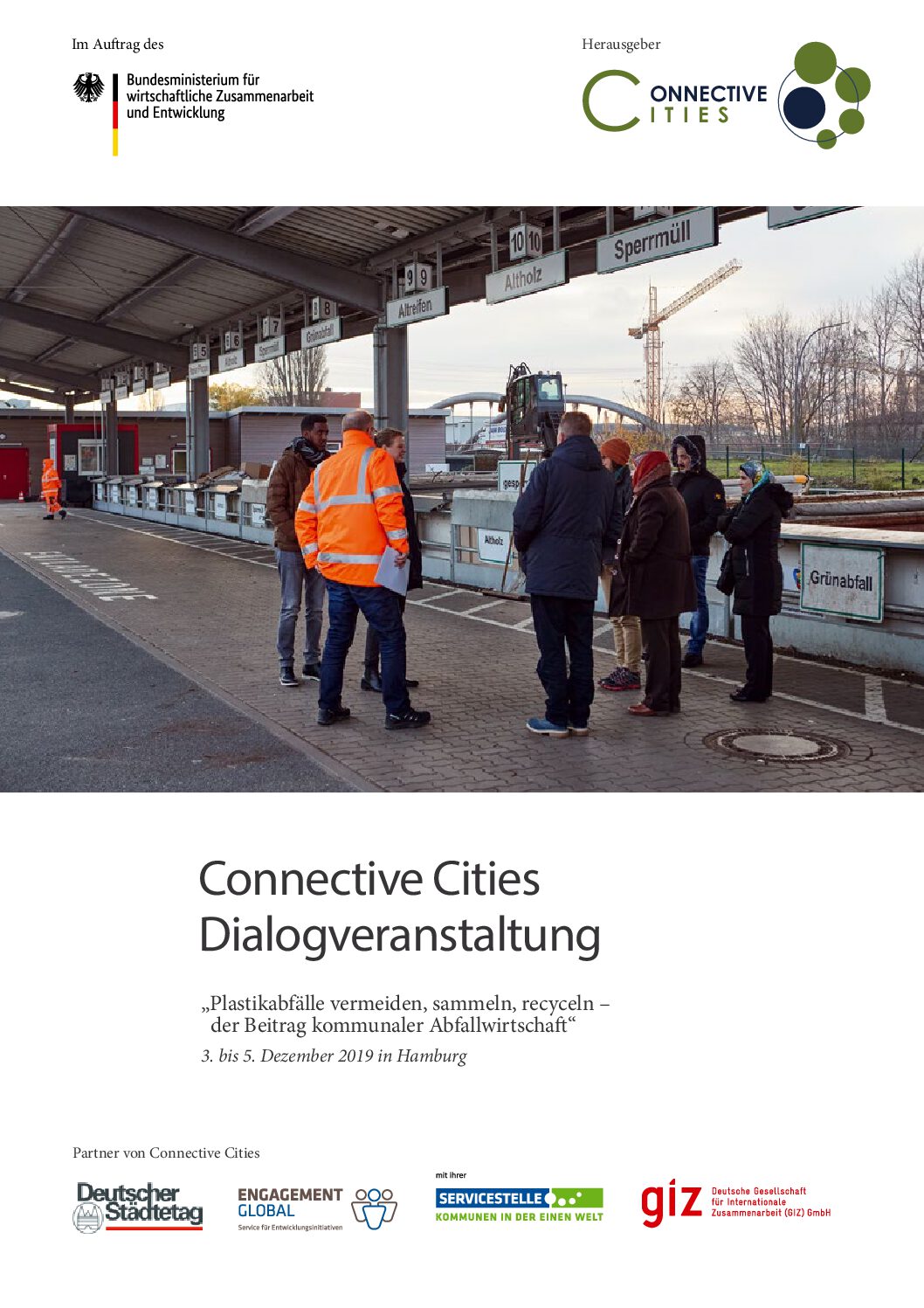
Avoiding, Collecting and Recycling Plastic Waste – The Contribution of Municipal Waste Management Systems

Almost 40 local practitioners from 13 cities, 9 countries and 4 continents intensively exchanged their experiences on the topic of ‘plastic waste’ and jointly developed solutions and project ideas. They followed the invitation of Connective Cities and the City of Hamburg to a dialogue event on ‘Avoiding, Collecting and Recycling Plastic Waste – The Contribution of Municipal Waste Management Systems’, which took place from 3 to 5 December 2019 in Hamburg.

At the end of the conference, eight concrete project ideas were developed which have great potential for implementation. The spectrum ranged from the establishment of an umbrella organisation for waste collectors in Mitrovica, the establishment of a recycling centre in Himara, the economically sustainable organisation of the collection of recyclable waste in Vushtrri, the automation of the recycling plant in Kandy, the development of a communication strategy for the recycling project in Quito, the establishment of waste separation at household level in Hawassa, the certification of sustainable shops in La Unión, to action planning for greater quality and competition in waste collection in Mogadishu.

The documentation describes in detail the format of the dialogue event, the good practices and results of the working groups as well as the planned further steps to implement the developed project ideas.