Call for participants: Municipal Response to COVID-19 in the Business Sector

Together with Policy and Management Consulting Group (PMCG), Connective Cities hereby invites municipal experts to the international exchange event – Connective Cities virtual exchange in direction of business.
What does post COVID -19 era hold for business? What potential does this have for municipalities, and how can they leverage the change?

The event is designed for the region of Southeast Europe and for international actors from municipalities and local business experts to talk about the effectiveness of business recovery plans on municipal level during the COVID-19 pandemic.

This Connective Cities event will set out to facilitate an international dialogue that compares regional and municipal approaches, solutions  and good practices of quick business recovery.

Key Parts of the conference

To facilitate discussion of the broad field on a practical level, the Connective Cities dialogue event will be broken down to three specific parts:

  • Presenting methodology and results of the study on COVID-19 business responses within the Connective Cities network
  • Practitioners’ exchange – presentations of good practices in direction of business
  • Interactive panel on the effectiveness of business recovery plans on municipal level during the COVID-19 pandemic

Language of the event is English.

Further Information: Agenda [pdf]

How to take part in the conference, and who to contact

If you would like to actively participate in the event, you are cordially invited to apply for a place.

Please send us an email indicating your position and organisation. We welcome participation by up to two experts per municipality who are actively working on business recovery measures.

If you have any questions concerning the event or the process of taking part, please get in touch with us:

Elene Samukashvili, Elene.samukashvili@giz.de

Stari Grad – how vaccination campaigns can reach groups at risk

As in many other countries, people in Serbia who want to be vaccinated have to book an appointment online and then get their jabs at a vaccination centre. But what about the elderly and people without internet access, or those unable to operate digital devices? And what do people do who can’t travel to the vaccination centres on their own? Stari Grad, in Serbia, shows how municipalities can reach this important target group in their vaccination campaigns.

Communicate and coordinate – the key to successful vaccination campaigns

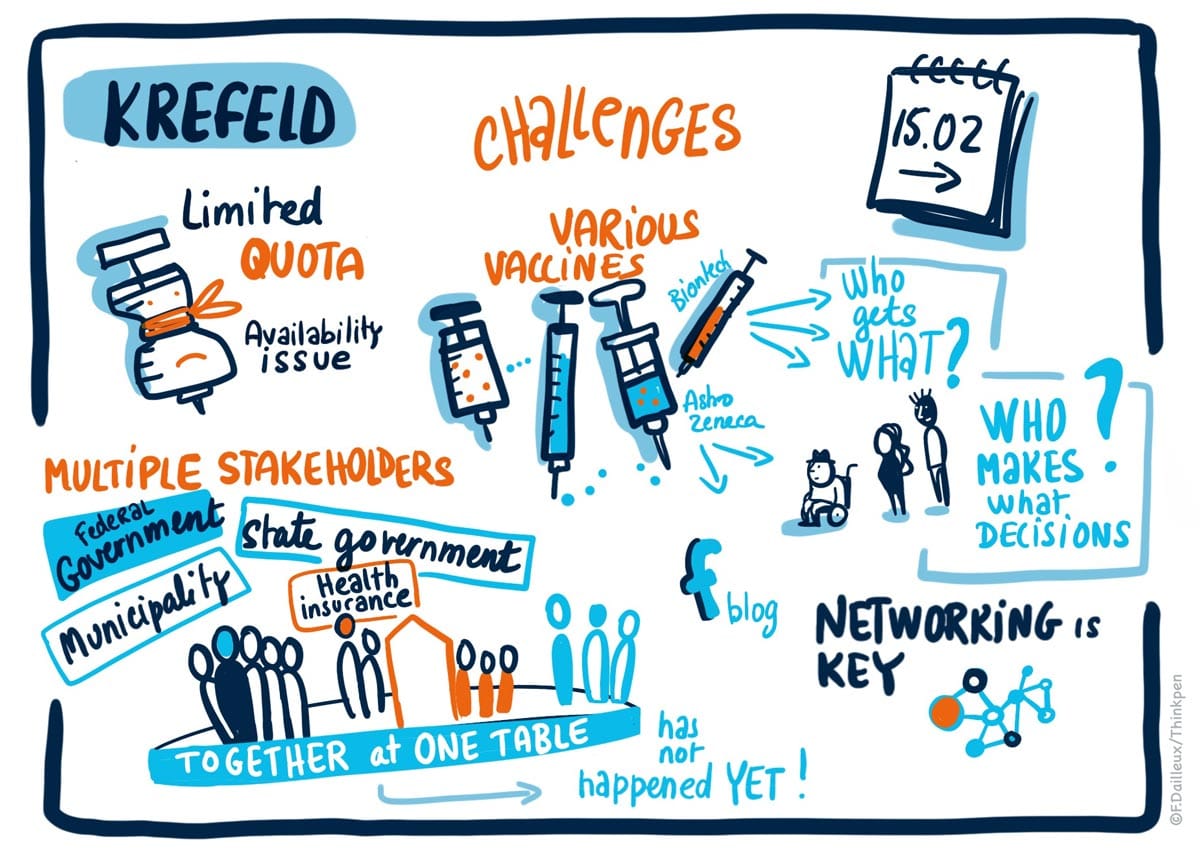
Impatient and sceptical citizens, the ongoing shortage of vaccines, constantly changing regulations that have to be rapidly implemented – these are some of the considerable challenges facing German municipalities in their vaccination campaigns. In its campaign, the City of Krefeld relies on communication and coordination. The concept has proven successful.

Urban Gardening

The concept of Urban Gardening, which emerged in the seventies in New York, Manhattan, describes a communal garden use of urban green spaces. It therefore differs from the so-called “gardens for the poor” that emerged in Germany as early as the beginning of the 19th century and from which the allotment garden (“Kleingarten”) movement later grew from. Private allotment gardens and community gardens should be seen as complementary to each other and not as competition. In modern practice, there are increasingly mixed forms of private and community gardens. They range from cooperatively managed urban agricultural plots, to community gardens within allotments, botanical gardens or parks, to urban gardening with primarily social goals such as inclusion and environmental education.

Municipal practitioners from 9 countries and 16 cities discussed this new diversity of approaches and experiences in depth and jointly developed solutions and project ideas. They had accepted the invitation of Connective Cities and the Berlin districts of Berlin-Mitte, Pankow, Lichtenberg, Tempelhof-Schönfeld and Charlottenburg-Wilmersdorf to join the virtual dialogue event that took place from 20.04. – 22.04.2021.

‘Digital Shop Window’, Darmstadt

The Covid-19 pandemic posed significant challenges for retailers and restaurants. During the lockdown, also small local shops in Germany had to close temporarily. In the south of Hesse, the City Darmstadt responded successfully with the “Digital Shop Window” project. Retailers and restaurateurs can offer their goods and services on the city’s central shopping platform. 

The project was already launched in 2019 with around 25 participating shops and restaurants. After the pandemic began, the German city intensified its efforts to expand the platform because interest increased significantly. Currently, over 500 local restaurants and shops are represented, and the platform registers around 700 hits per day. Interested citizens have access to the businesses’ contact details, opening hours, social media channels, and the online shop on the platform.

What led to the success of the “Digital Shop Window”? A key component was the networking of other city projects with the platform. For example, the so-called “Darmstadt City Voucher” has been integrated online. Moreover, Darmstadt offers free delivery of products.  Local events, such as an art market or the city’s wine festival, are also advertised on the website. Since the traders themselves are responsible for their contributions and data, the “Digital Shop Window” always remains up to date.  

Another success factor was that Darmstadt photographed the traders free of charge to personalise online shopping. The pictures make the “Digital Shop Window” much more personal than other online shopping sites, such as Amazon. The personalisation also increased solidarity with the traders within the population. “Digital Shop Window” will certainly have its raison d’être even after the pandemic and make local shopping attractive. 

Further Information:

Good Practice “Digitales Schaufenster” Digitised shopping windows (pdf)

Event Recording (Presentation on Darmstadt starts min. 83): The role of digitalised public services as reactions to the COVID 19-pandemic (Only for those registered on the Connective Cities Platform)

Digital Shop Window: https://www.darmstadt-citymarketing.de/digitales-schaufenster/

Contact:

Agnes Allig, City and tourism marketing
Wissenschaftsstadt Darmstadt Marketing GmbH
Elisabethenstraße 20-22
64283 Darmstadt
Germany
+49-(0)6151-134510
touristikmarketing@darmstadt.de

Strengthening the local implementation of SDGs through local reviews and monitoring

Local and regional governments are essential partners for monitoring and reporting on progress in localising the Sustainable Development Goals (SDGs). Since 2018, more and more cities and regions have started to develop Voluntary Local Reviews (VLRs) based on local data and localised indicators. They aim to shed light on their local efforts to implement the SDGs in order to contribute to and complement the information and data provided by their national governments to the United Nations High-Level Political Forum on Sustainable Development (HLPF).

The Connective Cities virtual dialogue event on 26, 27 and 29 April 2021 facilitated the exchange of experience on this topic, with almost 60 participants from 19 countries from Europe, Asia, Africa and Latin America.

The event’s three main topics dealt with

  1. data availability and data collection systems for SDG monitoring,
  2. data-driven policy development and contribution to different levels of governance and
  3. quality citizen dialogue and stakeholder engagement.

The dialogue event was held in partnership with United Cities and Local Governments (UCLG) and PLATFORMA and co-hosted by the City of Bonn.

Streets for all – Glasgow’s new avenues

The pandemic has fundamentally changed all our daily lives. Instead of meeting indoors, we meet outside and instead of taking the bus or train, we use the bicycle or sometimes the car. Cities need to respond to this change in population behavior. Glasgow, Scotland’s largest city, whose central streets have long been reserved for car traffic, has met this challenge by taking extensive measures to create more space for cyclists and pedestrians and new central green spaces.

During the pandemic, space for cyclists and pedestrians in Glasgow was provisionally separated from the streets with plastic elements, giving them more space. By doing so, the city successfully responded to the new needs of its residents.

But in the long term the streetscapes suffer from the unsightly plastic elements. However, for the quality of life in a city and the well-being of its residents not only the functionality but also the beauty of the city is important. That’s why the long-term avenue strategy in Glasgow’s city center calls for the creation of 21 streets with continuous bicycle and pedestrian paths in combination with extensive greening by 2027. The new avenues will link central locations and better connect adjacent neighborhoods. The greening will beautify the streets, which were often completely concreted before, and more space for pedestrians and cyclists will significantly reduce motorized traffic.

Thus, not only does the functionality of the street adapt to the new needs of the population, but the new avenues are also visually much more attractive. This increases the attractiveness of the location for retailers and the quality of stay in the public space. Combined with new technologies, such as individually controllable LED lighting, the center of Glasgow is thus made fit for the future.

More Information

Glasgows Avenue Strategy & the Role of Beauty in Public Spaces (PDF)

Event Recording (Presentation on Glasgow starts min. 78): COVID-19 – A chance for urban green recovery? (Only for those registered on the Connective Cities Platform)

Contact:

Jamie Shields, Development and Regeneration Services, Glasgow City Council, UK  jamie.shields@glasgow.gov.uk

Paola Pasino, Development and Regeneration Services, Glasgow City Council, UK paola.pasino@glasgow.gov.uk

Hazmieh in Lebanon: A lighthouse in good urban governance

Hazmieh municipality has set a comprehensive and effective strategy for local economic development, in which the public and the private sector’s participation in planning and decision-making are the cornerstones. The municipality has partnered with representatives of the local community and private sector to ensure the formulation of municipal development plans that prioritize the prosperity and common good of the local community and ensure gender equality and youth participation.

The municipality has attracted investments by diversifying local economy in the city. By employing the business model “Everything under one roof”, Hazmieh has succeeded in proving that one doesn’t need to leave the city boundaries to secure supplies, resulting in making the city an essential hub for investment in Lebanon.

Sustainable urban energy planning in Southeast Europe – Infographics

These infographics illustrate the current context and importance of sustainable energy in SEE:

  • Final Energy Consumption rates of Southeast Europe (SEE) Region
  • Greenhouse gas emission rates in Southeast Europe (SEE) Region
  • Signatories of Covenant of mayors from Southeast Europe (SEE) Region
  • General Challenges of SEE Region in Energy Efficiency and Renewable Energy

Municipal Response to COVID-19: Driving Smart City Development

On 29th of April a virtual workshop on Smart City Development took place as part of the ongoing applied research project “Research of good practices and moderation of virtual events on the subject of health, business and governance at municipal level in times of COVID-19”. 

Workshop centered on overviewing the EU Green Deal Agenda, smart cities models and concepts, as well as advantages of accelerating digitalization processes and financial attraction possibilities in the period of a pandemic.

Approximately 15 participants from Albania, Armenia, Bulgaria, Colombia, Kyrgyzstan, Moldova, Philippines, Poland, Ukraine, Georgia took part in the workshop.

The event focused on

  • Presenting the concept of European Green Deal
  • Introducing Smart cities development models and concepts
  • Providing digitalization solutions for municipalities in the pandemic period
  • Highlighting possible sources of financing
  • Providing conclusions and possible next step suggestions

After the event all attendees were given certificates of completion of the workshop.

Program

This virtual event was opened by welcoming remarks made by Dr. Piotr Żuber, Project Team Leader, PMCG. Dr. Żuber provided background information of the workshop and briefly overviewed the agenda. Following the introduction, Ms. Daiva Matonienė, International Consultant, advanced into the core sessions.

Two main topics of the sessions were:

  • Smart city development: innovations and key drivers
  • Acceleration of digitalization processes in the pandemic period

After each session, active discussions were held on relevant topics, where participants were given floor to present their practices and share challenges in the Smart City Development processes from their municipalities.

Presentations

European Green Deal and Smart City Development
Ms. Daiva Matonienė, International Consultant

Improvement of local actors, project management in Lithuania
Mr. Arunas Grazulis, Expert of Public Policy and European Union programmes

Smart cities development models and concepts
Ms. Daiva Matonienė, International Consultant

Digitalization- the future is today
Ms. Daiva Matonienė, International Consultant

“ALL-IN-ONE” solution suite for smart municipalities
Mr. Edgaras Engelmanas, Head of Export, IRTC

International practices of the deposit refund system
Ms. Daiva Matonienė, International Consultant

Financial attraction possibilities
Ms. Daiva Matonienė, International Consultant

Results

During this online workshop representatives from multitudes of municipalities exchanged their experiences and insights in the field of smart city development.

Participants were introduced to topics such as: development of green recovery plan, innovative tools for digitalization and public-private partnership. At the same time attendees were given some recommendations on atracting potential donors and funds as well as tips on steps forward. Contact information of field experts, as well as companies experienced in the field of smart development were given to municipal representatives to support further collaboration opportunities.