C40 Mayors’ Agenda for a Green and Just Recovery

As the tragedy of the COVID-19 pandemic unfolds, mayors’ immediate priority is to face this unprecedented crisis and protect lives. At the same time, the city leaders who together established the Global Mayors COVID-19 Recovery Task Force are leading in taking the first steps towards recovery. They have committed to providing the swiftest and strongest possible rebound for their citizens and reaffirmed commitment to the principles of the Global Green New Deal — to protect our environment, strengthen economies and build a more equitable future – and reach out to other cities, youth, unions, business and civil society to join in this effort.
[…]
By taking a sustainable path at this critical juncture, by respecting science, fostering unity and embracing a spirit of innovation and purpose, cities will secure the best recovery they can and avoid the worst impacts of the climate crisis. Amid the devastation of this global pandemic, mayoral leadership has never been more important.

Nine principles for a green and just recovery are elaborated that can support cities’ recovery efforts.
More

Climate-proof and Resilient Urban Development

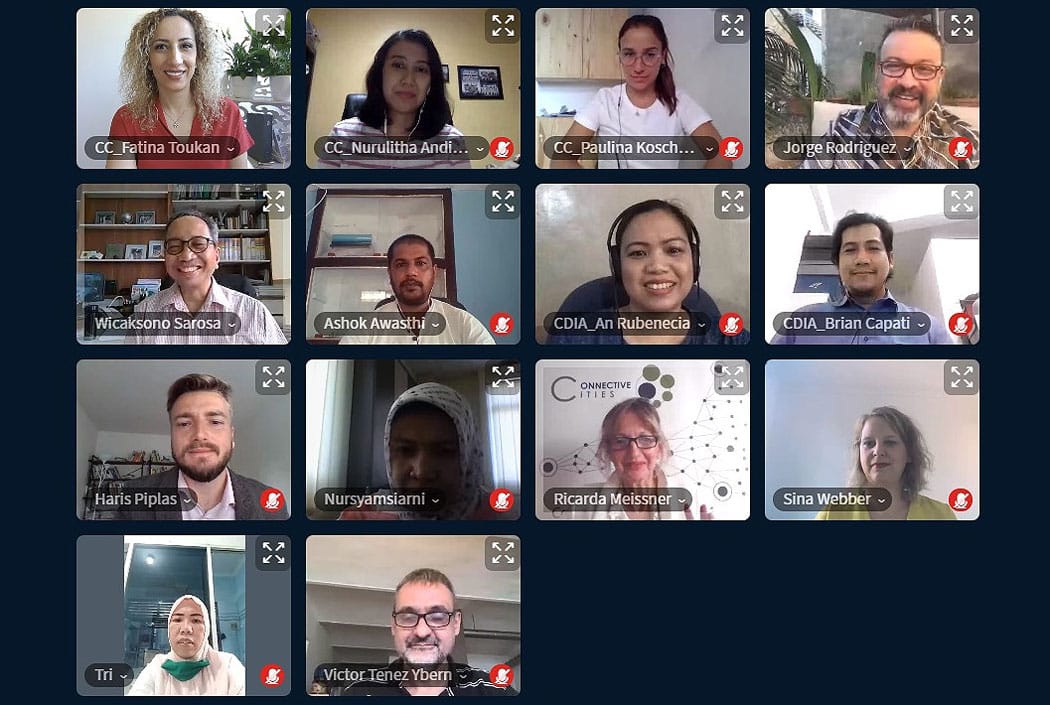
In view of the current situation worldwide, attendance formats for international meetings are neither sensible nor formally possible. Nevertheless, the international community of practice for sustainable urban development Connective Cities continued its offer in Latin America and invited municipal practitioners from Latin America and Germany to participate in the follow-up (LINK NITEROI) virtual workshop on the topic of “Climate-proof and resilient urban development – project planning of municipal adaptation measures”.

This time, 29 participants from eight different countries (Brazil, Ecuador, Argentina, Colombia, Mexico, Germany, Spain, USA) came together virtually to exchange experiences and knowledge. The aim of the event was to further develop the project ideas by revising strategic approaches with peer support and reflecting on examples from municipal practice.

Following project ideas were presented and jointly further developed:

  1. Project: Improving the resilience of people and environmental communities in areas vulnerable to climate change / Municipality: Portoviejo, Ecuador
  2. Project: Strengthening the ecosystem-based adaptation measures at the tourist location San Miguel de Allende / Municipality: San Miguel de Allende, México
  3. Project: Adaptation of existing and new households to the forecast increase in temperatures and precipitation for the Risaralda administrative area / Municipality: Quinchía, Colombia
  4. Project: Colina Verde – Strengthening of security conditions by limiting the risk of landslides and fires in the community of Boa Vista / Municipality: Niterói, Brazil
  5. Project: The importance of agroforestry systems as an adaptation measure to climate change and as an economic sector for the community of Tomé-Açu / Municipality: Tomé-Açu, Brazil

Water and Climate Change

Climate change affects – and is affected by – global water resources. It reduces the predictability of water availability and affects water quality. Climate change also increases the occurrence of extreme weather events, threatening sustainable social-economic development and biodiversity worldwide. This, in turn, has profound implications for water resources. As such, climate change exacerbates the ever-growing challenges associated with the sustainable management of water. Conversely, the way water is managed influences the drivers of climate change.

The 2020 edition of the UN World Water Development Report addresses the critical linkages between water and climate change in the context of sustainable development. It also serves as a guide for concrete actions to address these challenges. It outlines actions, supported by examples from across the world, in three areas: first, enabling people to adapt to the impacts of climate change; second, improving the resilience of livelihoods; and, third, reducing the drivers of climate change.

Climate Resilient Urban Development in South East Europe

More than 40 local urban practitioners from 24 municipalities and 8 countries, fitting under the EU’s regional dimension of Eastern Partnership and Western Balkans, intensively exchanged their experiences/municipal expertise within 2 weeks of digital experience on the topic of “climate resilient urban development” and jointly developed solutions and project ideas. They followed the invitation of Connective Cities to an unprecedented and unique experience: Virtual Dialogue Event: “Climate Resilient Urban Development” on 8-19 June 2020.

It has been increasingly understood that rapid urbanization and climate risks mean greater vulnerability to urban development. Many cities worldwide face significant challenges arising from natural hazards. The Southeast European region is no exception, whereas the climate resilient urban development becomes a central pillar of local sustainability policies. Most of the countries in the region continue to face environmental and climate change challenges.

This event offered a virtual platform to discuss these challenges and supported municipalities in developing locally adapted solutions for climate challenges; in exchanging cities’ significant experience of developing successful possible options and good practises; in transforming innovative urban project ideas into digital solutions especially in the aftermath of the COVID-19 outbreak, as this latter continues to impact heavily the lifestyle at all levels including the sustainable urban development workers and it’s needed to adapt to more innovative and agile ways of working for future crises responses.

During the 2 weeks asynchronous and synchronous digital experience participants listened to inspiring Keynote presentations from leading European scientists and shared insights with peers in carefully curated Peer2Peer collaboration and exchange formats. They learned how to collaborate digitally and got acquainted with some tools, methods and the overall mindset Design Thinking.

The project has built a Network, an exchange platform of urban players, which provides a systematic access to practice-oriented solutions for sustainable urban development by facilitating change and providing mutual support.

Call for participants: Local Economic Development and Job Creation in MENA

Beyond the Immediate Response to the Economic Impacts of the Pandemic

The international cities platform, Connective Cities and its initiators, the Deutsche Gesellschaft fuer Internationale Zusammenarbeit (GIZ) GmbH, the German Association of Cities (Deutscher Städtetag) and Engagement Global GmbH with its Service Agency Communities in One World (SKEW), invite urban practitioners from the Middle East and North Africa region (MENA) and Germany to take part in the virtual dialogue event “Local Economic Development and Job Creation” from 29th September to 07th October 2020.

Thematic focus of the virtual dialogue event:

The Connective Cities virtual dialogue event on will focus on the following subtopics:

  1. Strategic planning for LED: guiding a participatory LED process that encourages partnership arrangements and inclusive representation; mobilizing strategic partnerships with the private sector and investors to access alternative financing mechanisms; enabling the joint design and implementation of a common development strategy; using local resources and competitive advantages to create a resilient locality.
  2. Promoting sustainable livelihood opportunities and social enterprise: implementing livelihood programs to enhance entrepreneurship skills and support the establishment of microbusinesses; contributing to social cohesiveness and conflict prevention through decent job creation for local communities.
  3. Public investments in green infrastructure and circular economies: creating decent jobs and revenues for localities through the investment in green infrastructure and circular economy; transformation towards green economy.

Objectives and Methodology

This virtual dialogue event is the first component of the Connective Cities learning process on LED and job creation and it aims at promoting the exchange of expertise on good practices for planning and implementing LED and job creation programs in cities in MENA. It thus facilitates practice-oriented exchange and peer-to-peer consultations among municipal actors on effective solutions to address challenges related to LED and job creation in their local realities. Through its virtual format, the dialogue event enables sharing of a broad variety of information synchronously as well as asynchronously, while ensuring the ease of communication between the participants. Interaction will take place using a variety of tools and the discussions will be recorded for future reference.
The objectives of the dialogue event include:

  • Facilitating exchange of know-how and experience on good practices through peer-to-peer consultation among urban practitioners from MENA and Germany;
  • Developing the capacity of participants to analyse and overcome challenges of implementing LED and job creation programs;
  • Determining future support needed for projects, which includes support from the Connective Cities International Community of Practice for Sustainable Urban Development.

Participation and Contact

Prospective participants are expected to provide a good practice example from a project they implemented or are currently implementing fitting the thematic focus of the event. We particularly encourage showcasing of good practices that incorporate gender- and/or climate-sensitive solutions.
The deadline for application is 11st September 2020.

For further details see: Call for participants [pdf 4 pages]

For applications and queries from interested experts from the MENA region, please contact: Dr. Muna Shalan, GIZ Regional Network Coordinator Connective Cities – MENA region (muna.shalan@giz.de).
Interested German experts should contact Ms. Alice Balbo, Connective Cities Project Manager at the German Association of Cities (alice.balbo@staedtetag.de).

Towards the Localization of the SDGs – 4th Report

LOCAL AND REGIONAL GOVERNMENTS’ REPORT TO THE 2020 HLPF 4th REPORT

The fourth report of the local and regional governments (LRGs) to the HLPF: Towards the Localization of the SDGs (2020) has been produced at a difficult time, when the world is suffering the effects of a global pandemic. The impact of this crisis on the social and economic fabric of our communities is, however, still difficult to measure. Within this context, the words “solidarity” and “cooperation” take on an even more relevant meaning. This was the message of the UN Secretary-General in his report to the HLPF and it reflects the feelings of our constituency, based on the experiences of numerous cities and territories.

The transformative framework of the universal development agendas remains essential for a more sustainable future. Local and regional governments from all over the world are reinstating their strong commitment to achieve the transformation that their societies call for after the pandemic through the potential of the SDGs and the universal development agendas.

In this context, the report analyses the evolution of the process of SDG localization in cities and territories throughout the world, particularly focusing on the 47 countries reporting this year. In doing this, it builds upon the information presented in the Voluntary National Reviews (VNRs) and on the views expressed by LRGs through their own reports (more than 40 Voluntary Local Reviews from cities and regions and six reports from LGAs which provide a wider, subnational view of the localization process in the countries reporting this year). It also collects together the answers to the GTF survey, with the visions of LRGs from 75 countries. This report will be presented during the Local and Regional Governments’ Day at the 2020 High-Level Political Forum.
Political Forum.

Niteroi Resilience Plan

Niteroi is a Brazilian coastal city surrounded by hills just outside Rio de Janeiro. With its approximately 500,000 inhabitants, Niteroi’s economy focuses mainly on commerce and services. In 2010, the city had the highest Human Development Index in the state of Rio de Janeiro and the seventh largest among Brazilian municipalities. Also, it is the first of the state concerning sanitation performance.

As a coastal city, Niteroi has at the same time, many tourism possibilities with extraordinary beaches, but also, problems related to sea level rising and eventual rough seas. Climate change has also contributed to an increase in droughts and wildfires.

The city is located between the sea and the hills and in the past decades, with the increasing of the city combined with a non-structured urbanistic plan, most of the hillsides were irregularly occupied by low-income families in a massive way. As the result of this situation, Niteroi has areas occupied by vulnerable people where there are significant risks of land sliding.

In April 2010, more than 240 people died in landslides, most of which occurred on the hills surrounding the city. After that, many preventive actions were made, aiming to reduce the number of accidents and deaths, what generated excellent results.

Finally, the municipal government has developed a Resilience Plan aiming to strengthen the direct and indirect actions of the Niteroi Civil Defense. It has had a great importance and a strong impact in the city. The plan was finalized and launched in December 2019 and its implementation has already started.

Series of virtual events on local climate leadership in times of COVID-19

The GIZ project “Climate Policy Meets Urban Development” is organizing a series of three online-seminars on local climate action in times of #COVID19. The series will kick off with its first online-seminar on 7 July 2020, 3-4 pm (CEST/UTC+2). The session will introduce Germany’s multi-level governance framework with a focus on the German National Climate Initiative (NCI) and its mechanisms to foster local climate projects.

Session 2 on maintstreaming climate projects into city governance frameworks and session 3 on steering local climate leadership trough collaborative action will take place on 1 September and 5 October. 

More Info

Climate Resilient Urban Development in Southeast Europe

The virtual event was the first component of the learning process conducted by Connective Cities in Southeast Europe. The aim of the virtual event was to support knowledge exchange and networking by increasing the visibility of good practices from municipalities in SEE region on one hand, and on the other hand by facilitating the needed virtual space and tools to create innovative solutions for local challenges through knowledge exchange and peer-to-peer consultations.

The virtual event, thus, supported transforming dialogue and exchange possibilities into a digital and remote format especially during and in the aftermath of the COVID-19 outbreak affecting heavily the lifestyle of urban dwellers and planers. As this will include effects on sustainable urban development, municipal urban practitioners need to develop more innovative and agile processes to improve future crises responses. Here, the interest was mainly in pragmatic solutions and approaches that can be applied or adapted to the different regional/local contexts. Furthermore, the event offered a virtual platform to discuss the challenges around the theme of climate resilient urban development and supported municipalities in developing new project ideas among peers that can be further implemented in the respective home communities or in the framework of existing or new thematic municipal partnerships.

Call for participants: Climate Resilient Urban Development in South East Europe and the Caucasus region

Responding to climate change plays a crucial role today in sustainable urban development policies worldwide. The Southeast European region is no way exception being heavily impacted by growing trend of urbanisation. This is now coupled with the sudden outbreak of COVID-19 affecting the lifestyles of cities and municipalities, which need to adapt to more innovative and agile ways of working for future crises responses. Against this background, the international cities platform – Connective Cities cordially invites municipalities & urban practitioners to take part in the unprecedented and unique experience: Connective Cities Virtual Event: “Climate Resilient Urban Development” on 8-19 June 2020.

Bring your initial urban project idea and we will incubate it within 2 weeks of digital experience where you can expect to listen to inspiring keynote presentations from leading European scientists and share insights with your peers in carefully curated Peer2Peer collaboration and exchange formats. During asynchronous and synchronous workshops, you will learn how to collaborate digitally and get acquainted with tools, methods and the overall mindset Design Thinking that helps you to be more innovative and successful.

Check out our Call for Participants for more details and apply by 17 May 2020. The invite is predominantly open for the countries fitting under the EU’s reginal dimension of Eastern Partnership and Western Balkans

More information in the Call for Participants [pdf, 1,89mb].

Concerning the questions from international applicants on the event and the participation process, please contact: Mr. Irakli Samkharadze, GIZ Regional Network Coordinator Connective Cities – Southeast Europe. Tbilisi, Georgia (irakli.samkharadze@giz.de)

Interested German experts should contact Ms. Alice Balbo, Connective Cities Project Manager at the German Association of Cities (Alice.Balbo@staedtetag.de)