Space-blind strategies don’t work for COVID-19

The Organisation for Economic Cooperation and Development (OECD) recently analysed how cities have responded to the COVID-19 pandemic. Soo-Jin Kim, Head of the OECD’s Urban Policies and Reviews Unit, calls for locally-adapted solutions now and for the post-COVID era.

Since March 2020, local health authorities have often dominated the headlines. Citizens’ trust in local politicians has significantly increased. Which role have municipalities played so far in responding to the COVID 19 crisis?

Soo-Jin Kim: Since the very beginning of the pandemic, municipalities have not waited for national governments to tell them what to do – they started to act immediately. They have deployed a range of measures to inform the public about necessary measures, ensure that people comply with social distancing and lockdown rules, support the shift to tele-working and take care of the most vulnerable such as the elderly and the poor. They have also worked to keep basic public services running, including the health system, and help the local economy survive the crisis. So I would describe municipalities as ‘essential workers’.

In addition, regardless of the crisis, we should not forget that municipalities are always key public actors. Subnational governments are responsible for an average of 40 per cent of all public spending across OECD countries. In federal states such as Germany or Switzerland, it’s even 50 to 60 per cent!

New working groups in the MENA network: Municipal recovery from the pandemic

Following the intensive knowledge-exchange program on municipal response to the pandemic that was conducted in 2020 to support the Connective Cities network in MENA, several working groups are being established to sustain the results of the peer learning activities. The working groups consist of municipal representatives and partners from the business sector, civil society, and academia. From a thematic standpoint, the topics under focus are:

  • Waste management and circular economy
  • Digitalisation for resilient cities
  • Biodiversity and environmental protection (kick-off event: August 9, 2021)
  • Crisis management in Palestinian municipalities
  • Social entrepreneurship and local economic development (kick-off event: August 12,2021)

Several meetings and preparatory activities have been conducted to formulate the road map of each working group. The core working group on ‘biodiversity and environmental protection’ has developed and submitted a concept note to the EU Call for Proposals on Biodiversity and Ecosystems Protection in Lebanon. In order to be eligible for this call, an effective consortium was established under the umbrella of Connective Cities network. The consortium members included Saint Joseph University (represented by Dr. Jocelyne Gerard and Dr. Zaarour), Green Line environmental NGO (represented by Dr. Ali Darwish), and Menjez municipality (represented by its Mayor Dr. Georges Yousef). Other potential local authorities’ beneficiaries include Beit Meri, Jezzine, Al Buhayra Union of municipalities, which will join at a later stage of the project.  

We are looking forward to include new members to these working groups. If you would like to be an active member of these working groups, please contact us at: muna.shalan@giz.de

Successful pandemic response in the slums of Lusaka, Zambia

Lusaka, the capital of Zambia, is growing rapidly. Within the last 20 years the number of inhabitants has risen from one million to over three million in 2020. The city’s formal housing could not be expanded fast enough, which is why especially the slums experience fast growth. Today around 70 percent of the city’s population is living in slums. 

In Zambia, COVID-19 primarily affects densely populated areas and especially the capital city of Lusaka, where more than half of the country’s recorded corona infections have been counted.

Lusaka’s slum dwellers are particularly vulnerable to the effects of the pandemic due to a high population density and an often insecure employment situation. In particular, the unemployment caused by Corona measures and the subsequent inability to pay has multiple broader consequences for slum dwellers, including: 

  • Food insecurity
  • Threats of eviction and forced evictions by landlords
  • Inability to pay for water supply and land rent to the city council. 

The Lusaka City Council took broad measures to address this. For example, land rents owed to the city council were reduced by 50 percent and fees for legalizing land ownership were sharply reduced. This relieved the burden on landowners and landlords, who were thus able to partially forgo rental income and refrain from evicting residents.  

Also, water access was no longer cut due to lack of payment, as water is particularly crucial for hygiene and thus for pandemic control.

In addition, food was distributed, and digital aid was disbursed to combat the acute effects of the pandemic. Decentralization helped to avoid crowded distribution points. High-traffic locations such as markets are regularly being disinfected so that the population can work and shop there with minimized risk. 

It became apparent that a multi-sectoral approach and the involvement of various stakeholders and local community leaders was necessary to pool resources and avoid duplication of effort

Further information

Urbanisation and proliferation of informal settlements in Lusaka, Zambia (PDF)

Recording of Event (Presentation on Lusaka starts min. 18): Urban Poverty and Living Conditions: Limiting COVID-19 Impacts in Densely Populated Backyard Rental Areas (only for those registered on the Connective Cities Platform) 

Contact

Danny Chibinda
Director of Housing and Social Services
Lusaka City Council, Zambia
info@lcc.gov.zm

Fangcang Shelter Hospitals in Wuhan, China

Like many other cities, the city of Wuhan, China, often referred to as the epicenter of the pandemic, faced severe challenges when being confronted with the outbreak of the virus at the end of 2019 and early 2020. A lack of medical supplies, doctors and nurses, and available beds made it impossible to contain the pandemic in its early stages by the means of traditional hospitals. To isolate COVID-19 cases from the rest of the population quickly and on a large scale, the city of Wuhan developed a novel concept in public health: Fangcang Shelter Hospitals.

During the outbreak of the pandemic in Wuhan, public facilities such as gymnasiums or stadiums were rapidly transformed into health facilities. Within ten days, these new medical shelter hospitals provided the basic functions of isolation, primary health care, disease surveillance and rapid referral, as well as food and shelter. Especially mild and moderate COVID-19 cases were treated and isolated quickly in these shelter hospitals, while severe cases were transported to traditional hospitals. This triage led to an enormous relief of the traditional hospitals and enabled the treatment and isolation of large numbers of patients.

Further, within the new health facilities, medical teams of different disciplines constantly generated new knowledge about the diagnostic and treatment options for COVID-19. These were permanently updated with the help of multidisciplinary collaborations and helped to inform other practitioners in the health sector on the city, national and international level. Through an innovative cloud-based medical service solution, hospitals were further able to provide online health advice.

A total of 16 such shelter hospitals enabled the isolation of thousands of patients within a very short time during the COVID-19 outbreak in Wuhan. They provided medical treatment and care and fulfilled an important function to relieve the burden on traditional hospitals and to efficiently avoid the spread of the disease. For the future post-epidemic era, psychological counselling of medical staff now plays an equally important role as follow-up research, evaluation and adjustment of processes in the shelter hospitals, so that Wuhan will be even better prepared for challenges to its health system in the future.

Further Information

How do we challenge the Covid-19? – Jun Wang [pdf 2,24 mb]

Event Recording in English and Chinese (Presentation on Wuhan starts min. 6): https://conference.meet-modular.com/playback/presentation/2.0/playback.html?meetingId=ffacab8b40bcf33de7da48374038a61adb2d30df-1606200349228

Contact

Dr. Wang Jun,
Tongji Medical College of Huazhong University of Science and Technology in Wuhan,
Huabei Province, P.R. of China
brendawj2006@163.com

Pandemic response in Aracaju, Brazil

Brazil is one of the countries most affected by the pandemic worldwide. Aracaju, the capital of the state of Sergipe in north-eastern Brazil, responded quickly and comprehensively to Covid-19.

In March 2020, a response plan was developed, and a crisis team was established. This meant that even before the first cases appeared in the region, people with symptoms could be isolated, tested and followed up. Random testing of citizens, for example, in public places, markets and train stations, was also very successful. Through this strategy, around 3,600 PCR tests and 1,200 rapid tests were conducted weekly in all 44 neighbourhoods of Aracaju. Testing allowed a-symptomatic cases to be detected and isolated. In addition, the protection of at-risk groups was vital for the Brazilian city. Therefore, they were tested especially frequently and at home. The prevention measures also included registering travellers at the airport.

In March 2020, the Aracaju city government set up eight medical centres, of which around 130,000 patients were cared for by October 2020. Furthermore, hospitals were equipped with respirators and beds were increased. The field hospital opened in May 2020 treated more than 450 patients. Thanks to these measures, the city’s health system was relieved.

Crisis communication was another key component in the strategic management of the pandemic in Aracaju. The citizens were informed about infection numbers in a daily briefing. Another concern of the city was to support the citizens emotionally. Therefore, Aracaju offered psychological counselling by telephone, an offer that was taken up more than 4000 times. Thanks to these comprehensive measures, Aracaju has recorded one of the lowest mortality rates in Brazil concerning Covid-19.

Further Information

Gestão Estratégica e medidas inovadoras no enfrentamento à pandemia em Aracaju/SE  –  Präsentation in Portugiesisch [PDF, 1,96 mb]

Event Recording in German, Spanish, and Portugiese (Presentation on Aracaju starts min. 73): Strategisches management zur Bekämpfung der Pandemie in Aracaju (Only for those registered on the Connective Cities Platform)

Contact

Frau Waneskade Souza Barboza,
Representative of the National Front of Mayors (FNP)
Secretary of Health of Aracaju Prefeitura Municipal de Aracaju, Aracaju, Brazil
waneska.barboza@aracaju.se.gov.br

Municipal response to COVID-19 in the MENA region

Sharing of good practices and lessons learned and providing peer to peer consultation on seven topics in a series of events with over 150 participants from 54 cities across nine countries in the region.

Mehr: https://youtu.be/uzxS9j3Lfug

Weitere Videos und demnächst auch Interviews und Podcasts auf unserer COVID-19-Themenseite.

Waste Management in Vushtrri, Kosovo

The strategy and implementation of waste management in the city of Vushtrri before and during the pandemic

The city of Vushtrri in north-eastern Kosovo, with around 70.000 inhabitants and an area of 345km2, has significantly improved its waste management, waste separation and recycling in the last three years. While about three years ago, only 40 percent of the territory had access to waste disposal, today it is 100 percent. In addition, illegal waste dumpsite has been reduced thanks to the government from 100 to 11.

How could this outstanding achievement be made? In Kosovo, the municipalities are responsible for waste disposal according to the law. Vushtrri cooperates with the company “RWC Uniteti” for this purpose and has provided each house with a waste bin free of charge. Moreover, citizens in remote parts of Vushtrri also pay the same prices for the service as within the city, although the logistics costs are higher. In this way, the city succeeds in protecting vulnerable groups. Another vital component of Vuhsstri’s success is education. Environmental protection and waste management are addressed in all schools, for example, in so-called “Green Clubs” where pupils carry out projects on recycling.

The Covid-19 pandemic posed many challenges to the implementation of waste management in the city of Vushtrri. One challenge was the loss of revenue last year. Shops and businesses that had to close for several months due to the pandemic and families living in difficult socio-economic conditions could not always afford the cost of the waste management service. In addition, the already unstable price for the sale of recycled waste has been erratic and falling.

How did the city respond to this challenging situation? Vushtrri waived the cost of waste management for all families living in difficult socio-economic conditions from March to December 2020. In addition, an online payment system was introduced. Furthermore, the new waste management action plan 2021-2025 will take into account the lessons learned from the pandemic.

Further Information:

Current Situation of the Waste Management System in Vushtrri (pdf, 980 kb)

Recording of the event (Presentation on Vushtrri starts min. 40): Managing solid waste during the pandemic (Only for those registered on the Connective Cities Platform)  https://community.connective-cities.net/node/468

Contact:

Xhafer Tahiri
Mayor
Vushtrri municipality
Republic of Kosovo
xhafer.sh.tahiri@rks-gov.net

COVID-19 – The local implementation of vaccination strategies and vaccine communication in municipalities

Since December 2020, municipalities worldwide have been organising the vaccination of their citizens against COVID-19. Not only do they have to ensure that vaccinations run smoothly; they also have to gain people’s trust through innovative communication strategies, and reach vulnerable groups such as the elderly and refugees with important information on vaccination.

The virtual dialogue on vaccination strategies and vaccine communication on 22 and 25 March 2021 was attended by eight municipalities and two local government associations from Germany, Israel, Colombia, Serbia and Togo. It was one of a series of events on COVID-19 held by Connective Cities – the international community of practice for sustainable urban development. Since the summer of 2020, this series of online events has been giving municipalities around the world an opportunity to share their experiences, advise each other on how to control the COVID-19 pandemic, and jointly identify pandemic management solutions.

Stari Grad – how vaccination campaigns can reach groups at risk

As in many other countries, people in Serbia who want to be vaccinated have to book an appointment online and then get their jabs at a vaccination centre. But what about the elderly and people without internet access, or those unable to operate digital devices? And what do people do who can’t travel to the vaccination centres on their own? Stari Grad, in Serbia, shows how municipalities can reach this important target group in their vaccination campaigns.

Communicate and coordinate – the key to successful vaccination campaigns

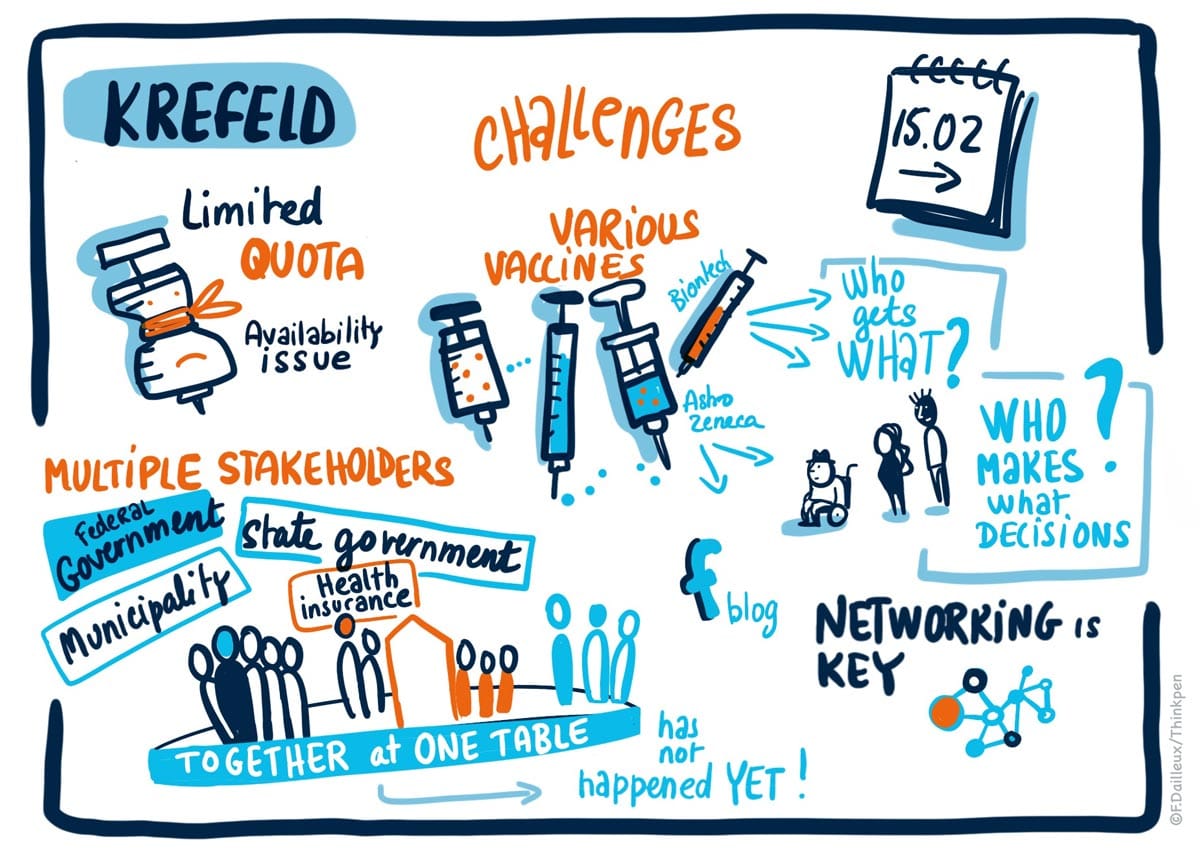
Impatient and sceptical citizens, the ongoing shortage of vaccines, constantly changing regulations that have to be rapidly implemented – these are some of the considerable challenges facing German municipalities in their vaccination campaigns. In its campaign, the City of Krefeld relies on communication and coordination. The concept has proven successful.